The Shoreham Channel UFO
Fishermen observed a submerging object in the English Channel.
The English Channel has long served as a boundary between nations, but for the fishermen who work its grey and restless waters, it is something else entirely. It is a place of routine and rhythm, of tides understood in the bones, of horizons scanned so often that every variation in light and weather becomes as familiar as the lines on one’s own hands. These are not people given to flights of fancy. Their livelihoods depend on reading the sea and sky with unflinching accuracy, distinguishing a distant trawler from a tanker, a cormorant from a gull, a squall line from harmless cloud. So when the crew of a fishing vessel operating out of Shoreham-by-Sea reported that they had watched a glowing, disc-shaped object descend from the sky and slip beneath the surface of the Channel on a cold morning in March 1995, the claim carried a weight that similar reports from less experienced observers might not. These men knew what belonged in their sky and in their water. What they saw that morning belonged in neither.
The Harbour at the Edge of the Downs
Shoreham-by-Sea sits at the mouth of the River Adur, where the gentle green humps of the South Downs give way to the flat coastal plain and the Channel stretches out toward France. It is an ancient settlement, its harbour in use since Roman times, its importance as a port waxing and waning with the centuries but never entirely disappearing. By the late twentieth century, Shoreham was a modest working harbour, home to a small commercial fishing fleet, a few cargo operations, and a growing number of leisure craft. The town itself had the quiet, slightly weathered character of many English coastal communities—prosperous enough, but shaped by the sea in ways that inland places could never quite understand.
The fishing fleet that operated from Shoreham Harbour in the mid-1990s was a tight-knit community. The crews knew each other, shared information about conditions and catches, and maintained the unspoken code of mutual assistance that has governed fishing communities for centuries. They were practical men who worked punishing hours in difficult conditions, heading out before dawn and often not returning until well after dark. The Channel off the Sussex coast could be treacherous—strong tidal currents, unpredictable weather systems sweeping in from the Atlantic, and the constant hazard of heavy commercial shipping traffic through one of the world’s busiest waterways. Survival depended on vigilance, experience, and a clear-eyed assessment of one’s surroundings.
It was this very pragmatism that made what happened in March 1995 so difficult to dismiss.
The Morning Watch
The precise date has been variously reported, but the events took place during the second or third week of March 1995. The fishing vessel—whose name has been withheld at the crew’s request in most accounts—had departed Shoreham Harbour in the early hours of the morning, heading south-southeast into the Channel to reach grounds where sole and plaice were running. The crew numbered four: the skipper, an experienced hand with decades on the water, and three crew members ranging from seasoned fishermen to a younger man on his first season aboard.
The weather that morning was cold but clear, with good visibility and a light breeze from the northwest. The sea state was calm, with a gentle swell running—comfortable conditions by Channel standards. The sky was still dark when they left harbour, but the first grey hints of dawn were beginning to show along the eastern horizon as they reached their fishing grounds, roughly five to seven miles offshore.
It was the younger crew member who noticed it first. He was on deck preparing gear when something caught his attention to the northeast—a light that did not behave like anything he recognized. At first he assumed it was an aircraft, perhaps one of the commercial flights descending toward Gatwick Airport, which lay some twenty miles inland. But the light was wrong. It was too bright, too concentrated, and it was not following any flight path he had ever observed from the water. He called out to the skipper, who came on deck and studied the object through binoculars.
What the skipper saw through the lenses convinced him that this was no ordinary aircraft. The light was a brilliant orange-white, steady rather than blinking, and it appeared to be descending at an angle that would bring it toward the water rather than toward any airport. More troubling still, it was moving in a manner unlike any aircraft he had ever seen—smoothly, without the characteristic engine noise that even distant planes produce over open water, and with a trajectory that seemed to shift subtly as if the object were correcting its course.
Within moments, all four crew members were on deck, watching the light approach.
The Descent
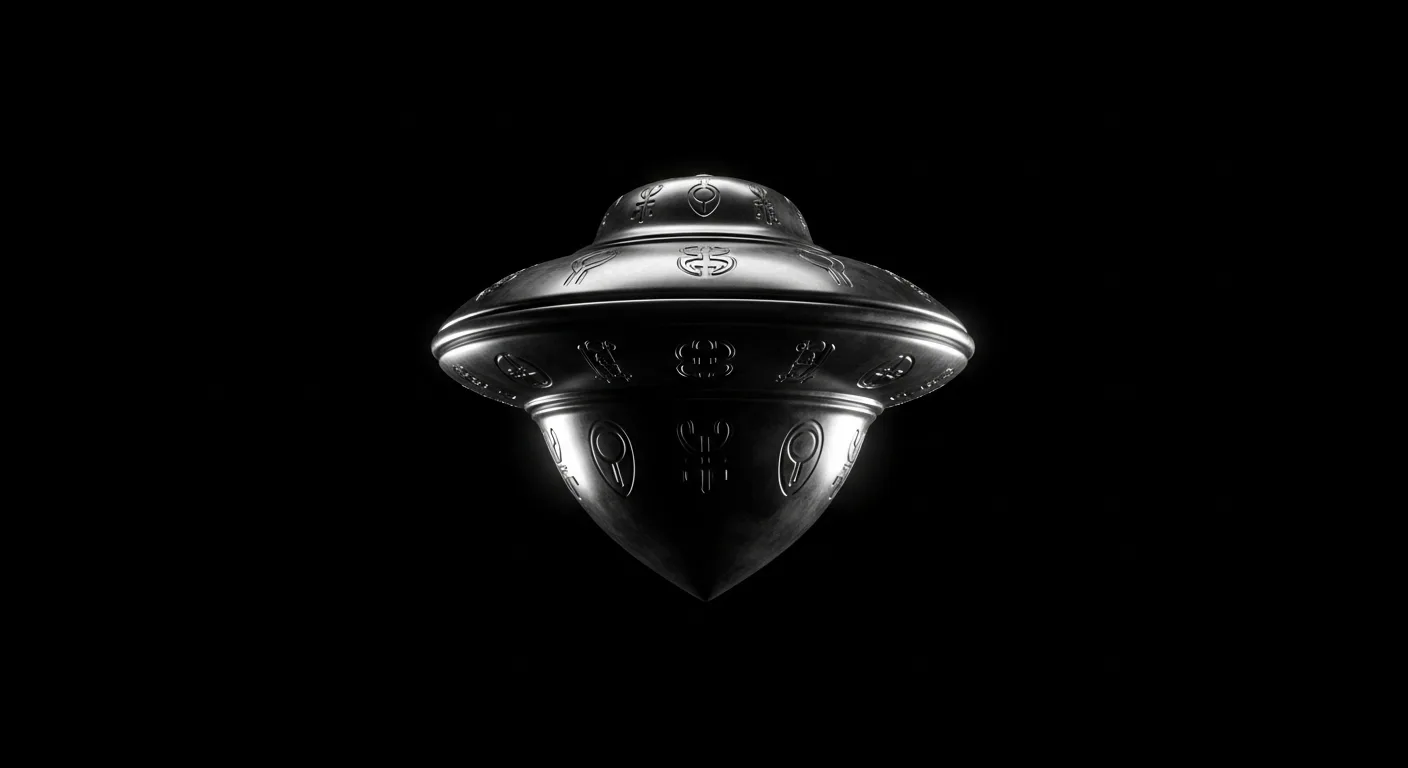
As the object drew closer, the crew were able to make out more detail, though what they saw only deepened their confusion. The light resolved itself into a disc-shaped form, its underside glowing with the same orange-white luminescence they had first observed. The object appeared solid and substantial, not a trick of atmospheric light or a distant flare. Its diameter was difficult to estimate over open water with no nearby reference points, but the crew judged it to be roughly thirty to forty feet across—larger than their own vessel.
The disc moved with a fluidity that struck every witness as profoundly unnatural. There was no sound whatsoever—no engine roar, no whoosh of displaced air, nothing. Over the open Channel, where sound carries with startling clarity, this silence was itself deeply unsettling. The fishermen were accustomed to hearing aircraft from miles away, the drone of engines arriving long before the machines themselves became visible. This object made its approach in absolute silence, as if it existed outside the normal rules that governed moving objects.
As the disc neared the surface of the water, its behaviour changed. The steady descent slowed, and the object appeared to hover at a height the crew estimated at between fifty and a hundred feet above the waves. It remained stationary for what witnesses described as perhaps thirty seconds to a minute, though all acknowledged that their sense of time had become unreliable in the grip of what they were witnessing. During this pause, the glow intensified slightly, shifting from orange-white to a brighter, more purely white illumination that cast faint reflections on the surface of the Channel below.
Then the object resumed its descent, moving toward the water with what several crew members described as a deliberate, controlled motion—not falling, not plunging, but lowering itself with evident purpose. The skipper later stated that the object’s behaviour reminded him of nothing so much as a submarine surfacing in reverse: a large, solid craft entering the water with full operational control.
The disc made contact with the Channel surface and continued downward. There was no splash. There was no impact. The water did not erupt or froth or behave in any way that the crew would have expected when a large solid object entered it at speed. Instead, the disc seemed to merge with the water, slipping beneath the surface as smoothly as a seal sliding off a rock. The orange-white glow persisted beneath the waves for several seconds, visible as a diffuse luminescence that faded gradually as the object descended into the depths. Within perhaps ten seconds of entering the water, the glow had vanished entirely, and the Channel was dark and featureless once more.
The entire sighting, from the first observation of the approaching light to the disappearance of the glow beneath the surface, lasted between three and five minutes.
Aftermath on the Water
For several moments after the object vanished, the crew stood in silence on deck, staring at the patch of water where the glow had last been visible. The skipper was the first to act, starting the engine and bringing the vessel toward the spot where the object had entered the Channel. It took them only a few minutes to reach the approximate location—they had been close enough to have a reasonable fix on the position.
What they found, or rather what they did not find, was as baffling as the sighting itself. The surface of the water was undisturbed. There was no debris, no oil slick, no floating material of any kind. There were no bubbles rising from below, no disturbance to the current, no evidence whatsoever that anything had entered the water at that location. The sea was as calm and featureless as it had been before the object appeared. The crew circled the area for some time, searching with spotlights and watching for any sign of the object, but the Channel offered nothing. Whatever had gone down had left no trace.
The fishermen also checked their instruments. The depth sounder showed normal readings for that area of the Channel—perhaps twenty to thirty metres of water over a sandy bottom. There was no anomalous return, no contact on the seabed that might have indicated a crashed object. The radio was functioning normally, and there had been no interference or static during the sighting, a detail that would later interest UFO researchers, as electromagnetic disturbance is commonly reported in association with close encounters.
The crew discussed what they had seen in low, serious voices. There was no disagreement about the basic facts: all four had watched the object descend and enter the water. There was no suggestion among them that what they had witnessed was any kind of conventional aircraft, satellite re-entry, or meteorological phenomenon. These were men who had spent years watching the sky over the Channel, and they were unanimous in their conviction that the object was unlike anything in their experience.
The skipper made the decision to continue fishing. There was nothing more to be learned from circling empty water, and the crew had livelihoods to maintain. But the morning’s work was conducted in a subdued atmosphere, each man turning over in his mind what he had witnessed and what, if anything, he should do about it.
Reporting and Response
Upon returning to Shoreham Harbour, the skipper contacted the coastguard to report the sighting. He described what the crew had observed in straightforward terms, without embellishment or speculation. The coastguard logged the report but had no additional information to offer—no other vessels or shore observers had reported anything unusual in the area that morning, and no aircraft were listed as missing or in distress.
The crew also made inquiries at the harbour, asking other fishermen and harbour workers whether anyone else had seen anything strange that morning. No one had, though several noted that they had been inside or facing away from the relevant direction at the time. The absence of corroborating witnesses was frustrating but not surprising—the sighting had occurred well offshore in the pre-dawn darkness, and the number of people likely to have been looking in the right direction at the right time was small.
Word of the sighting eventually reached UFO researchers, who contacted the crew and conducted interviews over the following weeks and months. The investigators found the witnesses credible and consistent. Each crew member’s account matched the others in essential details, with only the minor variations in estimated distances, durations, and precise descriptions that one would expect from honest, independent recollections of an unexpected event. There was no evidence of collusion or embellishment, and the fishermen appeared neither to seek publicity nor to profit from their account. Several expressed reluctance to discuss the matter publicly, concerned about ridicule from fellow fishermen and the broader community.
The investigators also checked with military and aviation authorities. No military exercises had been conducted in the area that morning, and no aircraft—military or civilian—had been reported missing. The Royal Navy confirmed that no submarine operations had taken place in that section of the Channel on the date in question. Gatwick Airport had no record of any unusual radar returns or pilot reports from the relevant time period.
The USO Phenomenon
The Shoreham Channel sighting belongs to a category of reports that UFO researchers designate as USO encounters—Unidentified Submerged Objects—involving craft that are observed entering or exiting bodies of water. While less widely known than their airborne counterparts, USO reports have a long and surprisingly detailed history, particularly in and around the world’s oceans and major waterways.
The English Channel has generated a disproportionate number of such reports over the decades, a fact that may owe something to the sheer volume of maritime traffic passing through these waters and the consequent number of potential witnesses. But the pattern extends well beyond simple statistical probability. Reports from the Channel describe objects entering the water, emerging from beneath the surface, or traveling at speed just below the waves with a consistency that suggests either a genuine phenomenon or a remarkably persistent maritime folklore.
The characteristics described by the Shoreham crew—the silent approach, the disc shape, the controlled descent, the absence of splash or disturbance upon entry, and the fading glow beneath the surface—recur with striking regularity across USO reports from around the world. Accounts from the coast of Norway, the Caribbean, the waters off South America, and the deep Pacific describe objects behaving in almost identical fashion. The implication, for those who take these reports at face value, is either that a single type of technology is responsible for all such sightings or that the witnesses are drawing on a shared cultural template that shapes their perceptions.
Skeptics offer several possible explanations for USO reports generally and for the Shoreham sighting in particular. Bolides—large meteors entering the atmosphere—can produce brilliant, sustained light and have been known to strike water, though they typically produce significant splash and sound upon impact. Satellite re-entries can create slow-moving, bright objects in the sky, though their trajectory is generally predictable and well-documented. Military flares, bioluminescent phenomena, and even unusual atmospheric conditions have all been proposed as explanations for various USO reports.
None of these explanations fully accounts for what the Shoreham crew described. A bolide would not hover before entering the water. A satellite re-entry would not produce a disc-shaped form visible at close range. Flares do not descend beneath the surface and continue glowing. And atmospheric phenomena do not typically present as solid, structured objects to multiple experienced observers at relatively close range.
The Witnesses and Their Credibility
The question of witness credibility lies at the heart of any UFO report, and in the case of the Shoreham Channel sighting, the credibility of the witnesses is perhaps the strongest element of the case. Commercial fishermen are, by the nature of their profession, among the most experienced observers of sky and sea conditions to be found anywhere. Their ability to identify aircraft, vessels, weather phenomena, and marine life is not an academic skill but a practical necessity—misidentifying a squall line or failing to spot a cargo ship on a collision course can be fatal.
The four crew members who witnessed the Shoreham object had a combined experience of several decades on the water. They were familiar with every type of aircraft that commonly overflew the Channel, with the appearance of helicopters, military jets, and commercial airliners at various altitudes and in various lighting conditions. They knew what flares looked like, what weather balloons looked like, what the lights of distant ships and oil platforms looked like. They had seen shooting stars, satellites, and the International Space Station tracking across the pre-dawn sky. And they were unanimous in stating that what they observed that March morning was none of these things.
The fishermen gained nothing from their report. They did not seek media attention, did not write books, did not appear on television programs. Several actively avoided discussion of the incident, uncomfortable with the attention it brought and wary of being labelled as cranks or fantasists. This reticence itself speaks to the genuineness of their experience—people who fabricate stories typically want those stories to be heard.
An Unsolved Case
More than three decades have passed since the Shoreham Channel sighting, and no definitive explanation has emerged. The object was never recovered, no wreckage was ever found, and no government or military authority has ever claimed responsibility for whatever the crew observed that morning. The case remains in the files of UFO research organizations as one of many well-witnessed but ultimately unresolved encounters.
The English Channel continues to generate reports of unusual objects and lights, though none from the immediate Shoreham area have matched the detail and clarity of the 1995 sighting. The fishermen who witnessed the event have largely retired from the sea, but the account they provided remains one of the more compelling USO cases in British ufological records—a straightforward report from credible observers of something that, by all conventional understanding, should not have been there.
Whatever descended into the Channel that cold March morning left no physical trace, but it left an indelible mark on the four men who watched it happen. The sea keeps its secrets well, and the waters off Shoreham-by-Sea have offered no further clues about what lies beneath the grey surface of one of the world’s most traveled waterways. The object, whatever it was, remains where it went—somewhere in the dark and silent deep, beyond the reach of explanation.
Sources
- CIA UFO/UAP Reading Room — Declassified CIA documents on UAP
- UK National Archives — UFO Files — MoD UFO investigation records
- British Newspaper Archive — UK press archive