Paranormal Glossary
Understanding the terminology of the supernatural. From apparitions to wraiths, explore the vocabulary of paranormal investigation and folklore.
Alien Species 23 terms
Andromedans
Andromedans, beings allegedly originating from the Andromeda galaxy (approximately 2.5 million light-years distant), entered UFO literature through various contactee accounts and channeled communications. The most prominent source is Alex Collier (a pseudonym), who claims extensive contact with Andromedans beginning in childhood. Collier describes receiving information about galactic history, Andromedan civilisation, and Earth's role in cosmic affairs through lectures, interviews, and publications since the 1990s. Andromedans are typically described as humanoid, often with blue skin tones, though accounts vary. Some descriptions portray them as tall and slender with somewhat larger eyes than humans, while others describe them as nearly indistinguishable from Earth humans. According to Collier, Andromedans are highly evolved spiritually and technologically, possessing the ability to travel between dimensions with lifespans of approximately 2,000 years. They allegedly oppose the influence of Reptilian and Grey factions. The concept of 'Andromedan Starseeds' has developed alongside similar concepts for other star systems. The Andromeda galaxy's cultural resonance in science fiction—from H.G. Wells to 'Star Trek' to 'Mass Effect'—provides a familiar framework for these claims.
Anunnaki
The Anunnaki are authentic deities from ancient Mesopotamian religion, appearing in Sumerian texts dating back to approximately 2500 BCE. Their reinterpretation as ancient astronauts began with Zecharia Sitchin's 1976 book 'The 12th Planet.' Sitchin claimed to have translated cuneiform texts revealing the Anunnaki were extraterrestrial beings from a planet called Nibiru, which allegedly has a 3,600-year elliptical orbit around our sun. According to Sitchin, the Anunnaki arrived on Earth approximately 450,000 years ago seeking gold to repair their planet's atmosphere, and genetically engineered Homo sapiens from Homo erectus to serve as a slave labour force. In Sitchin's interpretation, the Anunnaki were tall, giant-like beings depicted in Mesopotamian art with wings and horned caps, often connected to the Biblical Nephilim and the 'sons of God' mentioned in Genesis 6:4. David Icke incorporated Sitchin's ideas into broader Reptilian theories. The ancient astronaut interpretation suggests the Anunnaki were responsible for the pyramids, Nazca Lines, and various megalithic structures. The History Channel's 'Ancient Aliens' has devoted numerous episodes to Anunnaki theories. Academic criticism of Sitchin's translations has been extensive, with Assyriologists noting fundamental errors in his linguistic interpretations.
Arcturians
Arcturians first came to prominence through the teachings of American psychic Edgar Cayce (1877-1945), often called 'The Sleeping Prophet.' By 1928, Arcturus had become part of Cayce's readings, where he mentioned the star in more than 30 psychic sessions, describing it as 'the highest civilisation in our galaxy' and a 'gateway' to higher realms of spiritual consciousness. Earlier references include David Lindsay's 1920 science fiction novel 'A Voyage to Arcturus.' Arcturians are described as humanoid beings of average or shorter stature with blue, greenish, or white skin and larger almond-shaped eyes. According to New Age author Norma J. Milanovich ('We The Arcturians'), they have lifespans of 350-400 years and sustain themselves on an 'effervescent' liquid. They possess three fingers and exist primarily in higher dimensions (fifth dimension or above). Unlike many alien species in abduction literature, Arcturians are almost universally portrayed as entirely benevolent, serving as guardians, healers, and spiritual teachers. They communicate telepathically and possess advanced mental abilities including telekinesis. Their civilisation allegedly operates through a collective consciousness. The concept of 'Arcturian Starseeds'—individuals believing their souls originated in the Arcturus system—has gained popularity in spiritual communities.
Ashtar Command / Ashtar Sheran
Ashtar first appeared through channeler George Van Tassel in 1952, who claimed to receive messages from 'Ashtar, commandant of station Schare.' The concept developed through various channelers to describe a fleet commander of benevolent space forces monitoring Earth. The 1977 broadcast interruption in southern England—when a voice claiming to represent the 'Ashtar Galactic Command' broke into television programming—added notoriety to the concept, though the incident was likely a sophisticated hoax. Ashtar is typically described as a tall, blonde, Nordic-type being leading an alliance of positive extraterrestrials committed to Earth's spiritual evolution and protection from negative forces. The Ashtar Command is portrayed as a vast space fleet comprising millions of craft from various star systems, all working under spiritual hierarchy. Different channelers have produced varying details about Ashtar's appearance, mission, and messages, leading to multiple sometimes-contradictory traditions. The concept has influenced numerous UFO religions and New Age groups, representing organised benevolent intervention in human affairs. Ashtar communications typically emphasise messages of love, spiritual awakening, and warnings about nuclear weapons and environmental destruction.
Blue Avians (Sphere Beings)
The Blue Avians emerged primarily through Corey Goode, a self-described 'Secret Space Program' whistleblower who began sharing experiences publicly around 2015. Goode claims recruitment through a MILAB programme at age six and service in secret space programmes for twenty years, after which he was 'age-regressed' and returned to civilian life. His first Blue Avian encounter allegedly occurred in late 2014 when an 8-foot-tall Blue Avian called 'Raw-Tear-Eir' appeared in his living room. Blue Avians are described as approximately 8 feet tall with bodies covered in indigo-blue and violet feathers, bird-like features including flexible beaks, and large expressive eyes. They communicate through telepathy and elaborate sign language. According to Goode, they exist in the sixth density and identify as 'Ra,' connecting them to the channeled 'Law of One' material from the 1980s. Their message centres on spiritual development: practising forgiveness, raising vibrational frequency, and becoming more loving. His testimony was amplified through Gaia's 'Cosmic Disclosure' series hosted by David Wilcock. Proponents point to bird-headed deities in ancient cultures—Egyptian Thoth, Hindu Garuda, Hopi Eagle Kachina—as evidence of historical Blue Avian contact. Critics have analysed Goode's claims as blending New Age philosophy, science fiction tropes, and unverifiable assertions.
Draconians (Draco Reptilians)
Distinguished from standard Reptilians, Draconians are described as a royal or warrior caste allegedly originating from the Draco constellation. They are portrayed as larger than common Reptilians (7-12 feet), more powerful, and sometimes winged, representing the elite of reptilian hierarchy. The concept emerges from the broader Reptilian mythology developed by David Icke and others, with Draconians representing ancient ruling bloodlines. In Secret Space Program narratives popularised by figures like Corey Goode, they are described as leading a 'Draco Empire' opposed to benevolent species including Pleiadians and Arcturians. The term draws on the mythological significance of dragons across human cultures. Some accounts describe Draconians as the original genetic manipulators who created the Grey aliens as a worker or servant race. They are typically portrayed as aggressive, conquest-oriented, and viewing humanity as a resource to be exploited. The white 'Royal Draco' is described in some accounts as the supreme leader, standing up to 14 feet tall. The Draconian concept has become influential in conspiracy culture, representing the pinnacle of alleged malevolent extraterrestrial influence on Earth.
Ebens
The Ebens emerged through the controversial 'Serpo' legend of the 2000s, which claimed to document a secret exchange programme between the U.S. government and aliens from Serpo, a planet in the Zeta Reticuli system, allegedly running from 1965-1978. According to the anonymous postings that first appeared in 2005 on UFO forums, twelve military personnel were sent to the Eben homeworld aboard an alien spacecraft following the Roswell crash, living there for 13 years before most returned to Earth. Ebens are described as short beings similar to Grey aliens but with a more peaceful, benevolent nature. They allegedly operate under a single government with no concept of crime, have a binary star system, and possess technology far in advance of Earth's. The Serpo material created detailed mythology about their society, diet (they are vegetarians), lifespan (approximately 350-400 years), and reproductive practices. Despite being widely considered a hoax or disinformation, the Serpo story attracted significant attention in UFO circles and was investigated by researchers including Bill Ryan. The detailed nature of the claims—covering everything from Eben music to their calendar system—makes it one of the most elaborate alien civilization narratives in modern ufology.
Feline Aliens (Lyrans / Urmah)
Feline aliens emerged primarily through New Age channeling and metaphysical literature of the late 20th and early 21st centuries. Stewart Swerdlow, in 'Montauk: The Alien Connection,' described feline races including the 'Ari' (winged lions) and the 'Koroti,' a hybrid species allegedly engineered by Sirius A beings to serve as starship pilots. Contactee Erick Romero describes them as over two meters tall with a civilisation called 'Kaujamut.' Feline aliens are described as tall, muscular humanoid beings covered in fur with distinctly cat-like features: tails, whiskers, slit pupils, and pointed ears. Their faces range from human with subtle feline traits to entirely cat-like. Reported fur colours include white, black, gold, blue, and silver, with some resembling lions, tigers, leopards, or panthers. They typically stand 9 to 12 feet tall. Ray Kosulandich described them as gentle, telepathic beings from 'the 5th dimension.' Ancient Egyptian cat worship, particularly of Bastet, and lion-headed deities like Sekhmet are frequently cited as evidence of historical contact. In science fiction, the Kilrathi from 'Wing Commander' and the Kzinti from Larry Niven's 'Known Space' represent feline alien archetypes.
Flatwoods Monster (Braxton County Monster)
The Flatwoods Monster was first reported on September 12, 1952, in Flatwoods, Braxton County, West Virginia. At 7:15 PM, brothers Edward (13) and Fred May (12) observed a bright object that appeared to land on a nearby hill. They gathered a group including their mother Kathleen May and 17-year-old National Guardsman Eugene Lemon to investigate. Witnesses described a 10-foot-tall creature with a blood-red, spade-shaped face or head and glowing eyes. The entity had a dark, metallic body resembling a dress or robe, with small claw-like hands. Glennie Lankford described it as 'like a five-gallon gasoline can with a head on top.' The group reported a pungent mist causing burning eyes and noses, and Lemon's dog fled in terror. The creature allegedly emitted a shrill hissing noise before gliding toward witnesses, then changing direction toward a large pulsating red light. The national press rated the story 'No. 11 for the year' in 1952. Skeptical investigators have proposed the 'monster' was likely a barn owl perched on a tree branch. Today, Flatwoods has embraced its monster heritage with the Flatwoods Monster Museum and giant monster-shaped chairs as tourist attractions. The creature appears in 'Fallout 76' and the History Channel's 'Project Blue Book.'
Grey Aliens (Zeta Reticulans)
The Grey alien archetype emerged primarily from the Betty and Barney Hill abduction case of September 1961 in New Hampshire, USA—the first well-documented alien abduction in American history. The Hills described beings with grey skin, large heads, and enormous dark eyes during hypnotic regression sessions with Dr. Benjamin Simon in 1963-1964, published in John G. Fuller's 1966 book 'The Interrupted Journey.' Greys are typically 3 to 5 feet tall (though 'Tall Greys' up to 7 feet have been reported), with pale grey, smooth, hairless skin, oversized bulbous heads, enormous black almond-shaped eyes lacking visible pupils, small slit-like mouths, vestigial nostrils, and either absent or very small ears. Their bodies are frail and spindly with long thin limbs and typically three or four fingers. Communication is almost universally reported as telepathic. The species allegedly originates from the Zeta Reticuli star system, a connection made by amateur astronomer Marjorie Fish who interpreted a star map Betty Hill claimed to have been shown. Greys are consistently associated with medical examinations, genetic experiments, and hybrid creation programmes. The Grey has become the dominant alien archetype in popular culture, featured in 'Close Encounters of the Third Kind' (1977), 'The X-Files,' Whitley Strieber's 'Communion' (1987), and countless other productions.
Human-Alien Hybrids
The concept of human-alien hybrids emerged prominently through alien abduction research in the 1980s. Budd Hopkins' 1987 book 'Intruders' documented cases where abductees reported involvement in alien breeding programmes. David Jacobs further developed hybrid theories in 'The Threat' (1998), describing an alleged systematic programme to create beings that could integrate into human society. The earlier 1954 Antônio Vilas-Boas case included claims of sexual contact with a female alien. Hybrids are described with varying characteristics depending on the proportion of human versus alien genetics. Early-generation hybrids reportedly appear more alien: pale translucent skin, larger-than-human eyes, sparse white or blonde hair, and thin fragile bodies. Later-generation hybrids allegedly appear increasingly human, eventually becoming indistinguishable from ordinary people. Abductees frequently report being introduced to hybrid children and experiencing intense emotional connections. Barbara Lamb's 'Meet the Hybrids' (2015) features individuals claiming hybrid ancestry who report enhanced psychic abilities and memories of off-world experiences. Critics attribute these narratives to false memories and psychological factors, noting the biological impossibility of cross-species reproduction. The hybridisation narrative touches on anxieties about bodily autonomy, forced reproduction, and human identity.
Kelly-Hopkinsville Goblins
The Kelly-Hopkinsville encounter occurred on the night of August 21, 1955, at a farmhouse near Hopkinsville, Kentucky, involving the Sutton and Taylor families—eight adults and three children. Around 7 PM, Billy Ray Taylor saw a silvery object streak across the sky before landing. What followed became one of the best-documented close encounter cases: small humanoids, approximately 2 to 4 feet tall, with spindly legs, large round heads, huge glowing yellow eyes, pointed ears, and silvery-grey metallic skin appeared at the property. They had long arms ending in claw-like hands and moved in an unusual gliding manner. Witnesses reported shooting at the creatures repeatedly, but bullets seemed to have no effect—when hit, the beings would flip or float away before returning. One creature allegedly touched Billy Ray Taylor's hair from the roof. The siege continued approximately four hours. Police found bullet holes throughout the property but no blood, bodies, or other physical evidence. The encounter is widely credited with popularising the term 'little green men' for aliens, though ironically the creatures were described as silvery rather than green. Steven Spielberg drew direct inspiration from the encounter when developing 'E.T.' and 'Close Encounters of the Third Kind.' Kelly holds an annual 'Little Green Men' Days Festival.
Mantis Beings (Insectoids / Mantids)
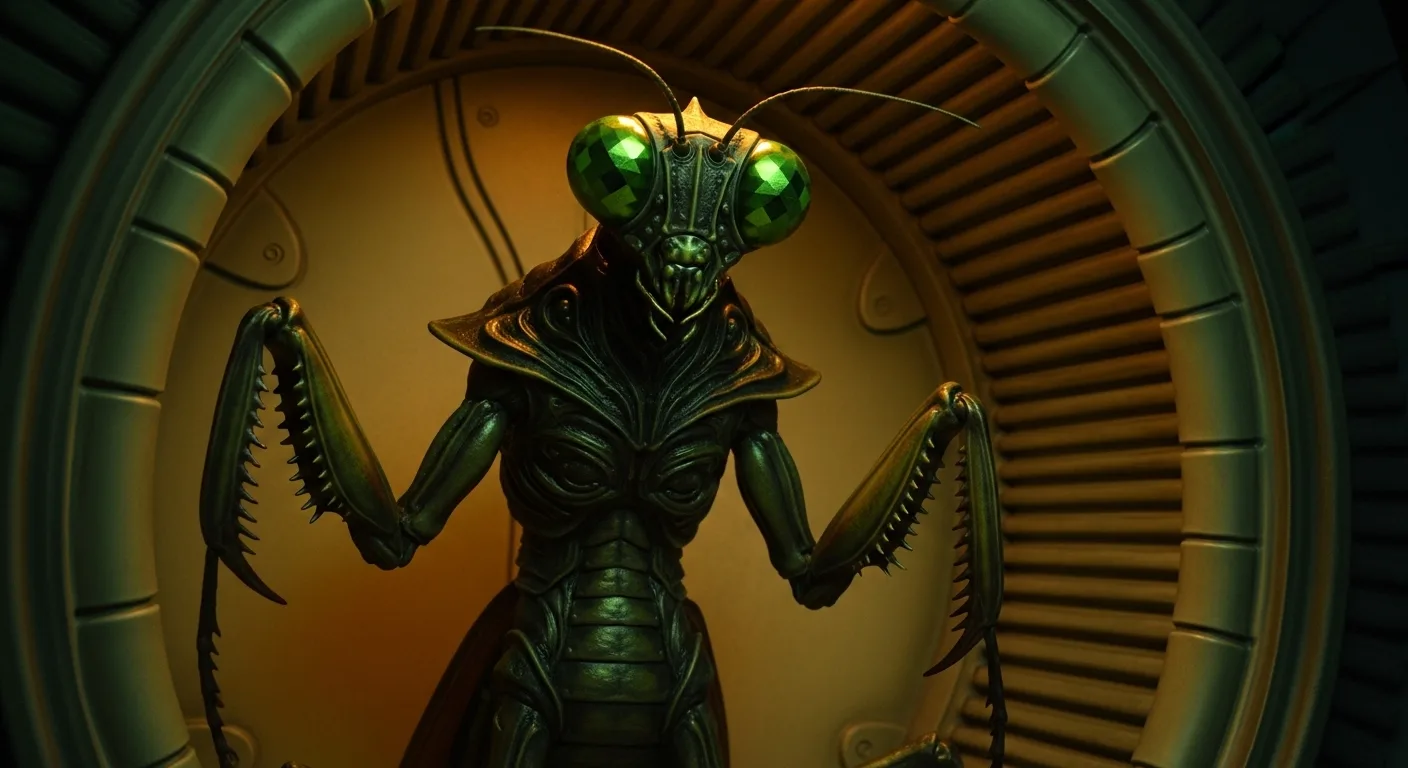
Reports of praying mantis-like aliens emerged in abduction literature beginning in the late 20th century. Brian Thompson documented an early account in 1992 of a 1957 Cincinnati encounter. The beings gained significant attention through psychiatrist Dr. John Mack at Harvard, who documented numerous abductee reports of insectoid entities. Mantis beings are described as tall entities, typically 7 to 9 feet in height, with distinctly insectoid features resembling a praying mantis: triangular heads, large multifaceted or black eyes, thin elongated bodies with exoskeletons, and long spindly limbs with multiple joints ending in claw-like appendages. Skin colour is reported as green, brown, or grey. A distinctive feature is their apparent position of authority—Mantis beings frequently appear as overseers or supervisors during abduction scenarios, directing smaller Grey aliens in performing medical procedures. As researcher John Carpenter noted, 'Why would anyone imagine a large bug directing an abduction experience?' Communication is consistently reported as telepathic, with some experiencers describing clicking or trilling sounds when Mantis beings communicate among themselves. Despite their frightening appearance, many abductees report they project feelings of calm, wisdom, or even benevolence.
Men in Black (MIB)
Men in Black are mysterious figures who allegedly visit UFO witnesses and researchers to intimidate them into silence. First appearing in 1950s UFO literature through researcher Albert K. Bender—who claimed intimidation that caused him to abandon UFO research—and popularised by Gray Barker's 1956 book 'They Knew Too Much About Flying Saucers.' MIB typically appear as strange men in black suits and hats, driving black cars, who seem unfamiliar with ordinary human behaviour—using antiquated speech patterns, not understanding common objects, or having waxy, artificial-looking features. They may claim government affiliation or offer no identification. Visits often involve veiled threats to stop discussing UFO experiences. John Keel expanded the mythology, suggesting MIB were not government agents but ultraterrestrial entities. Proposals range from government disinformation agents to hoaxes to actual non-human entities to psychological phenomena. The Men in Black concept entered mainstream culture through the comedy film franchise (1997-2019) starring Will Smith and Tommy Lee Jones, which portrayed MIB as a secret agency monitoring alien activity—ironically making the original, much stranger accounts seem like fiction.
Nommo (Dogon Fish Beings)
The Nommo are figures from the mythology of the Dogon people of Mali, West Africa, who entered ancient astronaut literature primarily through Robert K.G. Temple's 1976 book 'The Sirius Mystery.' Temple examined anthropological research documenting the tribe's detailed knowledge of the Sirius star system, including Sirius B (a white dwarf invisible to the naked eye) and its 50-year orbital period. Temple proposed this knowledge could only have come from contact with beings from Sirius whom the Dogon called Nommo. In Dogon tradition, the Nommo are ancestral spirits described as amphibious, fish-like beings who descended from the sky in an 'ark' accompanied by fire and thunder. They are sometimes depicted with fish-like lower bodies and humanoid upper bodies, resembling merfolk. The Nommo are credited with bringing wisdom, agriculture, and civilisation to the Dogon ancestors. Temple drew parallels to similar amphibious culture-bringers like Oannes of Babylonian mythology. Skeptics have proposed the Dogon acquired their Sirius knowledge from European visitors before anthropological research, or that researchers led informants toward confirming preconceptions. Despite criticism, the Nommo concept has influenced fiction and Sirian alien mythology.
Nordic Aliens (Space Brothers / Pleiadians)
Nordic aliens first entered UFO literature through the contactee movement of the 1950s, most notably through George Adamski's November 20, 1952 claimed encounter with 'Orthon' from Venus in the California desert. Adamski described Orthon as a beautiful, human-looking man with long blond hair who communicated through telepathy. His 1953 book 'Flying Saucers Have Landed' and 1955 'Inside the Space Ships' detailed these alleged encounters. Other contactees including Howard Menger, Truman Bethurum, and George Van Tassel reported similar encounters with benevolent 'Space Brothers.' Nordics are described as tall (6 to 7 feet), strikingly attractive humanoids resembling idealised Scandinavian humans, with long straight blonde or golden hair, blue or green eyes, and fair skin sometimes with a slightly luminous quality. They are most commonly associated with the Pleiades star cluster (hence 'Pleiadians'), though some accounts place their origin on Venus or the Lyra constellation. Swiss contactee Billy Meier, beginning in 1975, claimed extensive contact with a Pleiadian woman named Semjase. Nordics are typically portrayed as spiritual guides concerned with humanity's moral development and environmental stewardship. Their influence extends to New Age spirituality, including Barbara Marciniak's channeled works beginning with 'Bringers of the Dawn' (1992).
Orb Beings / Light Beings
Described as pure consciousness manifesting as spheres of light or luminous humanoid forms, Orb Beings appear across spiritual traditions and UFO accounts. They are often associated with higher-dimensional existence where physical form becomes optional. Corey Goode's 'Sphere Being Alliance' includes such entities, with Blue Spheres reportedly capable of transporting individuals across vast distances. Many experiencers describe positive encounters with light beings during near-death experiences, meditation, or spontaneous contact. Descriptions vary from small luminous orbs a few inches in diameter to large spheres of brilliant light and fully humanoid figures composed entirely of radiant energy. Colours reported include white, blue, gold, and multicoloured emanations. Light beings are typically described as projecting feelings of unconditional love, peace, and wisdom. In some accounts, they serve as guides, teachers, or protectors. Photography anomalies interpreted as 'orbs' have become common in paranormal investigation, though skeptics attribute these to dust, moisture, or lens effects. Light beings represent the most incorporeal end of the alien spectrum, with some researchers suggesting they may represent beings who have transcended physical form entirely.
Reptilian Aliens (Reptoids / Lizard People)
The modern Reptilian conspiracy theory was primarily popularised by British author David Icke in his 1994 book 'The Robots' Rebellion' and expanded significantly in his 1999 work 'The Biggest Secret.' However, precedents exist: Maurice Doreal wrote of a 'serpent race' in the 1940s, and Robert E. Howard's 1929 story 'The Shadow Kingdom' featured serpent men assuming human guise. Reptilians are described as large, bipedal humanoids standing 6 to 8 feet tall, with scaly green, brown, or grey skin, clawed hands, pronounced reptilian faces with slitted vertical pupils, sharp teeth, and sometimes tails. According to Icke, they originate from the Alpha Draconis star system and possess the ability to shapeshift into human form, allegedly infiltrating positions of power. A key claim is that many world leaders are Reptilians or Reptilian-human hybrids. Abduction accounts describing Reptilians typically portray them as aggressive and intimidating, associated with underground bases. The Reptilian trope appears in the 1983 TV miniseries 'V,' John Carpenter's 'They Live' (1988), and video games like 'XCOM' and 'Mass Effect.' Critics have noted troubling parallels between Reptilian theories and antisemitic tropes.
Shadow People (Paranormal)
Shadow people gained widespread attention through the Coast to Coast AM radio show when host Art Bell interviewed 'Thunder Strikes' on April 12, 2001. However, the concept has far older roots: ancient Egyptians described shadow beings called 'khailbut,' Romans believed such entities came from the Underworld, and various folklore traditions include similar shadowy humanoids. Shadow people are described as dark, humanoid silhouettes lacking discernible features except for their form. They typically appear in peripheral vision or in dark areas of rooms, doorways, or hallways, possessing depth and three-dimensionality rather than being flat shadows. Some witnesses report glowing red eyes. The 'Hat Man' variant—a shadow figure wearing a distinctive fedora or wide-brimmed hat—began appearing in descriptions by the late 2000s and gained significant traction on social media. Encounters frequently occur during sleep paralysis, a well-documented phenomenon where the body remains paralysed while the brain awakens. Witnesses consistently report feelings of overwhelming dread, menace, or being watched. Psychic medium Natalia Kuna has described shadow people as 'conscious, intelligent, interdimensional beings.' The Hat Man phenomenon has been associated with diphenhydramine (Benadryl) abuse, where users report seeing him during high-dose hallucinatory states.
Sirians
Beings from the Sirius star system entered modern ufology through various channeled communications and contactee accounts. A notable event occurred in 1977 when a message was broadcast across parts of Southern England on television, allegedly from an entity called 'Ashtar,' rumoured to be associated with Sirian beings. The Dogon people of Mali have traditions about beings from Sirius explored in Robert Temple's 'The Sirius Mystery' (1976), suggesting ancient contact. Multiple types of Sirian beings are described in ufology literature. The primary type from Sirius A is humanoid with coppery or dark tanned skin. A second type possesses human-like appearance but with vertical pupils similar to cats and elongated noses—Stewart Swerdlow calls these 'Kothory,' genetically created as UFO technicians. A fourth type, documented by Pavel Khailov, includes beings from 'Dzingia' with pale greenish skin, standing about 1.5 meters tall. Sirians are generally described as technologically advanced and aligned with benevolent factions. The star Sirius—the brightest in Earth's night sky—held enormous significance in ancient Egyptian religion, personified as the goddess Sopdet, suggesting to some researchers that Egyptian knowledge of Sirius reflects ancient alien contact.
Tall Blacks
A less common type in abduction literature, Tall Blacks are described as extremely tall humanoids with black or dark skin, distinct from Shadow People. Some accounts describe them as related to or hybrids of Mantis beings, with glowing red eyes, incredibly long limbs, and extra joints on their appendages resembling insectoid anatomy. They typically stand 7 to 9 feet tall or more. Tall Blacks are usually encountered in medical or examination scenarios during abductions, often working alongside Grey aliens in roles that appear supervisory or technical. Reports describe them as wearing dark robes or cloaks in some cases, while others appear unclothed with smooth, dark skin that may have a slightly reflective quality. Their demeanour is typically described as cold, clinical, and emotionless. The name distinguishes them from the more commonly reported 'Tall Whites' and 'Tall Greys.' Reports of Tall Blacks are scattered throughout abduction literature but less documented than major species categories. Some researchers have noted similarities between Tall Black descriptions and traditional folklore about dark entities, suggesting possible cultural influences on these reports.
Tall Whites
The Tall Whites concept emerged primarily through Charles Hall, a former U.S. Air Force weather observer who claimed extensive contact with these beings during his assignment at Nellis Air Force Base in Nevada from 1965 to 1967. Hall's self-published book series 'Millennial Hospitality' describes his alleged experiences in detail. Tall Whites are described as humanoid beings ranging from 6 to 10 feet in height with chalk-white or extremely pale skin that appears to glow, thin elongated bodies, and large blue eyes. They have fine white or platinum blonde hair and an ethereal, almost angelic appearance. According to Hall, their lifespan is approximately ten times that of humans (around 800 years), and they take ten times longer to heal from injuries. He describes a growth phase around age 400 where they can grow to 8 feet or taller. Hall claims they speak English with a peculiar accent but prefer telepathic communication. According to his accounts, the Tall Whites have an agreement with the U.S. Air Force, providing technological assistance in exchange for a safe haven and resources. Researcher Paola Harris has conducted extensive investigation of Hall's claims, including taking him back to Indian Springs to identify specific locations.
Venusians
Venusians were among the first alleged alien species described by contactees, primarily through George Adamski's accounts beginning in 1952. His first contact, 'Orthon,' was claimed to be from Venus, detailed in 'Flying Saucers Have Landed' (1953) and 'Inside the Space Ships' (1955). Other 1950s contactees made similar claims: Howard Menger described contact with Venusian women, Orfeo Angelucci detailed spiritual experiences with Venusian beings, and British contactee Cynthia Appleton claimed her son's father was a Venusian extraterrestrial. Venusians in contactee accounts are typically indistinguishable from attractive Northern European humans—blonde, fair-skinned, and beautiful—leading to significant overlap with the later 'Nordic' alien category. Their message consistently emphasised peace, spiritual development, and warnings about nuclear weapons. The Venusian contactee wave peaked in the 1950s-60s but declined as space probes revealed Venus's hostile surface conditions—temperatures of 464°C, atmospheric pressure 92 times Earth's, and clouds of sulfuric acid. Some later interpreters suggest Venusians exist in higher dimensions or on an 'etheric' Venus overlapping the physical planet. The UFO religion Aetherius Society, founded by George King in 1955, incorporates Venusian theology and continues to operate internationally.
Cryptids 24 terms
Beast of Gevaudan
The Beast of Gevaudan was a real and terrifying animal, or possibly multiple animals, responsible for a series of deadly attacks in the former province of Gevaudan in south-central France between 1764 and 1767. The beast killed an estimated 100 to 300 people, primarily women and children tending livestock in remote areas. Survivors and witnesses described a creature the size of a cow or horse, with reddish fur, a broad chest, an enormous mouth with prominent fangs, and a long tail with a lion-like tuft. The attacks caused nationwide panic, and King Louis XV dispatched professional wolf hunters and eventually his personal gun-bearer, Francois Antoine, to kill the beast. Antoine killed a large wolf in September 1765 and declared the crisis over, but attacks resumed within months. A local hunter named Jean Chastel finally killed an unusually large canid in June 1767, after which the attacks permanently ceased. The identity of the beast remains debated: theories include an exceptionally large wolf, a wolf-dog hybrid, a striped hyena escaped from a menagerie, a young lion, or even a serial killer using a trained animal. The case is extensively documented in French archives and represents one of the best-documented cases of an anomalous predator in European history.
Bigfoot/Sasquatch
The most famous cryptid in North America, Bigfoot (also known as Sasquatch from the Salish word 'sasq'ets') is described as a massive, bipedal ape-like creature standing seven to ten feet tall, covered in dark brown or reddish hair, with a strong, unpleasant odor. Sightings span the Pacific Northwest, the Rocky Mountains, and virtually every other region of North America. Evidence includes footprint casts some showing dermal ridges, the controversial 1967 Patterson-Gimlin film, and thousands of eyewitness reports. The creature is described as shy, primarily nocturnal, and omnivorous. Indigenous peoples across North America have traditions of large, hairy wild men predating European contact. Scientists remain skeptical, citing the absence of physical remains, the ecological improbability of sustaining a breeding population undetected, and the prevalence of hoaxes. Believers counter that the Pacific Northwest contains vast wilderness capable of concealing rare animals and point to the discovery of previously unknown great apes as evidence that large primates can evade detection.
Bunyip
The bunyip is a legendary creature from Australian Aboriginal mythology, said to inhabit swamps, billabongs, creeks, riverbeds, and waterholes throughout Australia. Descriptions vary widely between Aboriginal nations and regions, but common features include a dark, shaggy coat, flippers, tusks or horns, a horse-like tail, and a terrifying bellowing cry that echoes across waterways at night. Some accounts describe it as more dog-like, others as more seal-like, and still others as resembling a giant starfish. The bunyip's primary characteristic across all traditions is its association with water and its role as a dangerous predator that devours anyone who ventures too close to its domain, particularly women and children. European settlers adopted the term in the early 19th century after encountering Aboriginal warnings about water-dwelling creatures, and several colonial-era reports describe encounters with unidentified animals in Australian waterways. Some researchers have suggested the bunyip legend may preserve cultural memory of megafauna such as the diprotodon or the marsupial lion that went extinct roughly 46,000 years ago when Aboriginal Australians were already present on the continent. Others propose that bunyip sightings may involve known animals like seals, cassowaries, or large eels encountered in unusual circumstances.
Champ (Lake Champlain Monster)
Champ is the name given to a lake monster reportedly inhabiting Lake Champlain, a large freshwater lake on the border of New York, Vermont, and Quebec. The creature has been described as a serpentine or plesiosaur-like animal, dark in color, with a long neck, humped back, and a body estimated between 15 and 40 feet long. Reports of unusual creatures in the lake date back to Abenaki and Iroquois traditions of a large horned serpent dwelling in the waters. Over 300 modern sightings have been documented since the early 19th century. The most famous evidence is the 1977 'Mansi photograph,' taken by Sandra Mansi, which appears to show a long-necked creature rising from the lake. The photo has been analyzed repeatedly, with experts unable to conclusively identify a hoax but also unable to confirm what the object is. In 1981, the Vermont state legislature passed a resolution protecting Champ from harm. Sonar contacts and underwater recordings of unusual clicking sounds have added to the mystery. Proposed explanations include surviving plesiosaurs, giant sturgeons, large snapping turtles, schools of fish, floating logs, and boat wakes.
Chupacabra
The chupacabra (Spanish for 'goat-sucker') emerged in Puerto Rico in 1995 when livestock were found dead with puncture wounds and apparently drained of blood. The original creature was described as a bipedal reptilian being about four feet tall, with large eyes, spines along its back, and a taste for animal blood. Later sightings, particularly in Texas and Mexico, described a very different creature: a hairless, dog-like animal often identified as coyotes or dogs suffering from mange. The two descriptions may represent entirely different phenomena. The original Puerto Rican chupacabra may have been influenced by the creature in the film 'Species,' released shortly before the first sightings. The later canine version appears to be a case of sick animals being given a supernatural explanation. Regardless of its reality, the chupacabra has become a significant figure in Latin American folklore and a popular subject in cryptozoology.
Crawfordsville Monster
The Crawfordsville Monster was a mysterious aerial creature reportedly seen by hundreds of residents in Crawfordsville, Indiana on September 5, 1891. Witnesses described a 'horrible apparition' roughly 18 feet long and 8 feet wide, hovering at about 300 feet altitude. It was described as a shapeless, undulating white mass with no visible head or limbs, moving through the air with a 'wheezing, plaintive sound.' Two ice delivery men, Marshall McIntyre and Bill Gray, reported the first sighting around 2 AM. The creature returned the following night, witnessed by a Methodist pastor and his wife among others. The Indianapolis Journal published accounts under the headline 'A Horrible Monster.' Skeptics have proposed flocks of killdeer plovers illuminated by electric lights (Crawfordsville had recently installed electric streetlights), or atmospheric phenomena. The incident is notable as one of the earliest mass-witnessed aerial anomaly reports in American history, predating the 1896 Mystery Airship wave by five years.
Cryptid
A cryptid is an animal whose existence is claimed but not recognized by mainstream science due to lack of sufficient evidence. The term was coined by cryptozoologist John Wall in 1983. Cryptids range from creatures with some scientific plausibility (such as surviving populations of supposedly extinct animals) to beings that would require rewriting biology if proven real (such as dragons or werewolves). Famous cryptids include Bigfoot, the Loch Ness Monster, the Chupacabra, and the Mokele-mbembe. The study of cryptids is cryptozoology. While mainstream science is skeptical of most cryptid claims, history has shown that some 'impossible' animals proved real: the mountain gorilla, giant squid, and okapi were all once considered myths. Cryptid claims are evaluated based on witness testimony, physical evidence (tracks, hair, droppings), photographs and videos, and ecological plausibility.
Cryptozoology
Cryptozoology is the study and search for animals whose existence is unproven, including creatures from folklore, reported but unverified animals, and supposedly extinct species that may survive. The term was coined by Belgian zoologist Bernard Heuvelmans in the 1950s. Cryptozoology occupies a controversial position between mainstream science and pseudoscience. Practitioners point to their successes: several animals once dismissed as cryptids were later scientifically described, including the coelacanth (a fish thought extinct for 65 million years), the giant panda, and the Komodo dragon. Critics note that cryptozoology lacks rigorous methodology, often accepts anecdotal evidence uncritically, and has failed to produce physical evidence for its most famous subjects despite decades of searching. Modern cryptozoology increasingly uses technology such as camera traps, environmental DNA sampling, and acoustic monitoring. The field attracts both serious researchers seeking unknown species and enthusiasts more interested in monsters than science.
Dogman
The Dogman is a bipedal canine cryptid reported primarily in the United States, most famously the Michigan Dogman first described in 1887 near Wexford County. Witnesses describe a creature standing six to seven feet tall with the body of a muscular man and the head of a dog or wolf, often with glowing eyes and a menacing howl. The Beast of Bray Road in Wisconsin, investigated by journalist Linda Godfrey since 1991, is the most documented case, with dozens of independent witnesses reporting a large, wolf-like creature walking upright. Reports share common elements: bipedal locomotion, canine head on humanoid body, extreme aggression or menacing behavior, and sightings often near rural roads at night. Skeptics propose misidentified bears standing upright, mange-afflicted wolves, or hysteria. Some researchers connect Dogman reports to Native American legends of shapeshifters and skinwalkers. The phenomenon has spawned dedicated research organizations and a popular TV series, 'These Woods Are Haunted.'
Dover Demon
The Dover Demon is a cryptid sighted on three separate occasions over a 25-hour period in April 1977 in and around Dover, Massachusetts. On the evening of April 21, seventeen-year-old Bill Bartlett was driving with friends when his headlights illuminated a bizarre creature perched on a stone wall. He described it as approximately three to four feet tall, with a disproportionately large watermelon-shaped head, glowing orange eyes, long thin fingers, and a hairless, peach-colored body with rough-textured skin. It had no visible nose, mouth, or ears. Later that night, fifteen-year-old John Baxter encountered what appeared to be the same creature while walking home. The following night, another teenager, Abby Brabham, reported seeing a similar creature from a car. All three witnesses were interviewed separately and produced remarkably consistent descriptions. Cryptozoologist Loren Coleman investigated the case and coined the name 'Dover Demon.' The witnesses were described by teachers and parents as reliable and not prone to fabrication. No conventional explanation has been widely accepted, with proposals ranging from a baby moose to an alien being.
Fresno Nightcrawler
The Fresno Nightcrawler is one of the most unusual and distinctive cryptids to emerge in the 21st century, known primarily from surveillance camera footage captured in Fresno, California in 2007 and subsequently in Yosemite National Park around 2011. The creatures appear as tall, pale, almost entirely leg-based entities, roughly three to four feet tall, with extremely long legs, minimal or no visible arms, and a very small head or body perched atop the legs, giving them the appearance of walking pants or stilts draped in white fabric. Their gait is smooth and fluid, almost graceful, as they stride across the camera's field of view. The original Fresno footage was submitted to a local television station by a homeowner whose security camera captured two of the beings walking across his lawn at night. The Yosemite footage, reportedly from a park security camera, shows similar figures in a wooded setting. Some Native American communities in central California have noted similarities between the Nightcrawlers and traditional figures depicted in local woodcarvings and petroglyphs. Skeptics have proposed puppets, CGI, or humans in costumes as explanations, though no definitive debunking has been produced.
Jersey Devil
The Jersey Devil is a legendary creature said to inhabit the Pine Barrens, a heavily forested region of southern New Jersey. Descriptions typically include a kangaroo-like body, bat wings, hooves, a forked tail, horns, and a piercing scream. The legend dates to colonial times and centers on 'Mother Leeds,' who allegedly cursed her thirteenth child in 1735, whereupon it transformed into a devil and flew away. Sightings have continued for centuries, with a notable wave in January 1909 when hundreds of people across New Jersey, Pennsylvania, and Delaware reported encounters over several days. Schools closed, workers stayed home, and armed posses formed to hunt the creature. Explanations range from mass hysteria to misidentified animals (sandhill cranes are a popular candidate) to deliberate hoaxes. The Jersey Devil has become embedded in New Jersey culture and identity, serving as the mascot for the state's NHL hockey team and appearing in countless works of fiction.
Kraken
The Kraken is a legendary sea monster of enormous proportions from Scandinavian maritime folklore, described as a creature so vast it could be mistaken for an island, capable of dragging entire ships beneath the waves with its massive tentacles. The earliest written accounts appear in the 13th-century Old Norse saga 'Orvar-Odds saga' and the Icelandic text 'Konungs skuggsja.' Swedish naturalist Carl Linnaeus initially included the Kraken in his 1735 'Systema Naturae' as a real cephalopod before removing it from later editions. Bishop Erik Pontoppidan's 1752 'Natural History of Norway' provided detailed descriptions of the Kraken as a creature one and a half miles in circumference. The Kraken is now widely believed to have been inspired by sightings of giant squid (Architeuthis dux) and colossal squid (Mesonychoteuthis hamiltoni), which can reach lengths of 43 feet or more. Giant squid were considered myths themselves until the first complete specimen was scientifically described in 1857, and a living giant squid was not filmed in its natural deep-sea habitat until 2004 by Japanese researchers. The Kraken demonstrates how cryptid legends can have a basis in real but poorly understood animals.
Loch Ness Monster
The Loch Ness Monster, affectionately known as 'Nessie,' is a large aquatic cryptid reportedly inhabiting Loch Ness in the Scottish Highlands. The modern legend began in 1933 when a couple reported seeing 'an enormous animal rolling and plunging' in the loch, though references to a water beast in the River Ness appear as early as the 7th century in the Life of Saint Columba. The most famous evidence is the 1934 'Surgeon's Photograph,' long considered the most compelling image, which was revealed in 1994 as a hoax involving a toy submarine with a sculpted head. Despite this, sightings continue with over 1,000 reported. Scientific expeditions using sonar (1987 Operation Deepscan), underwater cameras, and environmental DNA sampling (2019 eDNA study by Professor Neil Gemmell) have produced no conclusive evidence. The eDNA study found significant amounts of eel DNA, suggesting the monster could be an unusually large European eel. Theories have proposed surviving plesiosaurs, giant eels, floating logs, boat wakes, and optical illusions caused by the loch's dark, peat-stained waters. Nessie remains the world's most famous cryptid and a massive driver of Scottish tourism.
Mokele-mbembe
Mokele-mbembe, meaning 'one who stops the flow of rivers' in the Lingala language, is a legendary creature reportedly inhabiting the rivers, lakes, and swamps of the Congo Basin in Central Africa. Descriptions consistently portray a large, long-necked animal resembling a sauropod dinosaur, with a body roughly the size of an elephant, brownish-grey skin, a long flexible neck, a small head, and a muscular tail. Local tribes in the Republic of Congo, Cameroon, and Gabon have traditions of the creature dating back generations, and some claim it is herbivorous but extremely dangerous, capable of killing hippopotami and overturning canoes. Western interest began with reports from French missionaries in the 18th century and intensified during the 20th century, with numerous expeditions mounted to find the creature. Notable expeditions include those led by James Powell and Roy Mackal in the 1980s, who collected extensive witness testimony. Cryptozoologists point to the vast, largely unexplored swamp forests of the Congo Basin as an environment capable of concealing large animals. Skeptics suggest that reports may stem from misidentified rhinoceroses, elephants swimming with trunks raised, or cultural traditions that have taken on a life of their own.
Mongolian Death Worm
The Mongolian Death Worm, known locally as 'olgoi-khorkhoi' meaning 'large intestine worm' due to its resemblance to a cow's intestine, is a cryptid reportedly inhabiting the Gobi Desert of Mongolia. The creature is described as a bright red or dark red worm-like animal, two to five feet long, with no visible head, eyes, or legs, and roughly as thick as a man's arm. According to Mongolian tradition, the death worm possesses two extraordinary abilities: it can kill at a distance by spitting a lethal yellow corrosive venom, and it can discharge an electrical shock powerful enough to kill a camel. It is said to hibernate underground for most of the year, emerging during the hottest months of June and July, particularly after rain. The creature was first described to Western audiences by paleontologist Roy Chapman Andrews in his 1926 book 'On the Trail of Ancient Man,' based on stories he heard during expeditions to the Gobi. Several expeditions have searched for the death worm, including those led by Czech explorer Ivan Mackerle in the 1990s and 2000s, and British researcher Richard Freeman in 2005, but none have produced physical evidence. Proposed explanations include the worm lizard, the death adder, or an unknown species adapted to desert conditions.
Mothman
Mothman is a winged humanoid creature reported in and around Point Pleasant, West Virginia between November 1966 and December 1967. Witnesses described a gray figure, six to seven feet tall, with large wings folded against its back and enormous, glowing red eyes. The creature was often seen near the abandoned TNT plant, a World War II munitions facility. The Mothman sightings culminated with the collapse of the Silver Bridge on December 15, 1967, which killed 46 people. This timing led to associations between Mothman and disaster, casting it as either a harbinger of doom or its cause. John Keel's book 'The Mothman Prophecies' (1975) connected the sightings to UFOs and other paranormal phenomena, suggesting an interdimensional origin. Skeptics have proposed that witnesses saw large owls, herons, or sandhill cranes, with fear and poor lighting conditions transforming ordinary birds into monsters. Point Pleasant has embraced its monster, erecting a Mothman statue and hosting an annual Mothman Festival.
Ogopogo
Ogopogo is a lake monster reportedly inhabiting Okanagan Lake in British Columbia, Canada. The creature has been described by witnesses as a serpentine animal ranging from 20 to 50 feet long, with dark green or black skin, a horse-like or goat-like head, and multiple humps visible when it surfaces. Indigenous Syilx (Okanagan) people have traditions of a dangerous water spirit called N'ha-a-itk or Naitaka that dwelt in the lake long before European settlement, and early settlers were warned to carry small animals as offerings when crossing the water. The modern name 'Ogopogo' dates to 1926, derived from a popular English music-hall song. Sightings number in the hundreds, with some witnesses including respected community figures, and several photographs and video recordings have been produced, though none are conclusive. Unlike Loch Ness, Okanagan Lake is a much warmer and more productive body of water, theoretically capable of supporting a population of large animals. Proposed explanations include surviving prehistoric marine reptiles, giant sturgeons, large otters, floating logs, and wave patterns. Ogopogo remains Canada's most famous lake monster and a significant cultural icon for the Okanagan region.
Skinwalker
In Navajo (Diné) tradition, a skinwalker (yee naaldlooshii, 'by means of it, it goes on all fours') is a type of harmful witch who has gained the power to transform into, possess, or disguise themselves as an animal. Becoming a skinwalker requires violating a fundamental cultural taboo, typically killing a close family member. Once transformed, skinwalkers can travel at superhuman speeds, become impossible to catch, and cause illness or death. The Navajo consider skinwalkers extremely dangerous and generally avoid discussing them, as speaking of them may attract their attention. The term has entered broader paranormal discourse through its association with Skinwalker Ranch in Utah, where a wide range of anomalous phenomena have been reported. Non-Navajo use of the term is controversial, as it removes the concept from its cultural context and may trivialize genuine religious beliefs. Authentic skinwalker beliefs are deeply integrated into Navajo witchcraft traditions and should be understood within that framework.
Skunk Ape
The Skunk Ape is a Bigfoot-like cryptid reported primarily in the swamps and forests of Florida, the Gulf Coast states, and the southeastern United States. The creature derives its name from the overwhelmingly foul odor witnesses consistently associate with it, often described as a combination of rotten eggs, skunk spray, and decomposing garbage. Descriptions portray a large, bipedal, ape-like creature standing six to seven feet tall, covered in dark reddish-brown or black hair, with glowing red or green eyes visible at night. Unlike the Pacific Northwest Sasquatch, the Skunk Ape is associated with subtropical environments, particularly the Everglades and surrounding wetlands. The most famous evidence is the 'Myakka photographs,' two images mailed anonymously to the Sarasota County Sheriff's Office in 2000 by a woman who claimed a large ape-like creature had been raiding her garden. Dave Shealy, who operates the Skunk Ape Research Headquarters in Ochopee, Florida, has dedicated decades to investigating the creature. Skeptics suggest that Skunk Ape sightings involve misidentified black bears, escaped primates, or hoaxes. The Skunk Ape has become an important part of Florida folklore and a driver of ecotourism in the Everglades region.
Tatzelwurm
The Tatzelwurm is a legendary creature reported in the Alps of Austria, Bavaria, Switzerland, and northern Italy. Described as a stubby, lizard-like or snake-like creature two to six feet long, with a cat-like face, two short front legs (sometimes four), and a thick cylindrical body covered in scales. The name translates roughly to 'claw worm' in German. Reports date back centuries, with sightings continuing into the 20th century. A famous 1934 photograph from a Swiss photographer allegedly shows a Tatzelwurm, though it was never authenticated. Proposed explanations include misidentified European legless lizards, large salamanders, or an unknown species of skink. Some cryptozoologists have compared it to surviving prehistoric amphisbaenians. The creature appears in Alpine folklore as dangerous—capable of leaping at people and emitting poisonous breath. The Tatzelwurm remains one of Europe's most enduring cryptid mysteries, supported by the relative isolation of high Alpine valleys where an unknown reptile species could theoretically survive undetected.
Thunderbird
The Thunderbird is a creature from Native American mythology, described as an enormous bird whose wingbeats create thunder and whose eyes flash lightning. Different nations have distinct thunderbird traditions, but the beings are generally depicted as powerful spirits associated with storms and the sky. In cryptozoology, 'thunderbird' refers to reported sightings of gigantic birds with wingspans of fifteen to twenty feet or more—far larger than any known living bird. Sightings have been reported across North America for centuries, including a widely discussed 1977 incident in Lawndale, Illinois, where a large bird allegedly attempted to carry off a young boy. Some researchers have suggested that thunderbirds might be surviving teratorns, giant birds that lived in North America until about 10,000 years ago. Others propose misidentification of known species such as condors or wandering albatrosses. A persistent legend involves a 'missing' photograph showing nineteenth-century men standing with an enormous dead bird, though no original image has ever been found despite many claiming to remember seeing it.
Wendigo
The wendigo (also windigo, wiindigo) is a malevolent supernatural entity from the folklore of Algonquian-speaking peoples of the northern forests of the United States and Canada. Associated with winter, cold, famine, and starvation, the wendigo is typically described as a gaunt, emaciated giant with ash-gray skin stretched tight over bones, burning eyes, and an insatiable hunger for human flesh. In traditional belief, humans could become wendigos through cannibalism, even if undertaken to survive starvation—the more a wendigo ate, the larger it grew, so its hunger could never be satisfied. Wendigo psychosis, a culture-bound syndrome, was a condition recognized in some communities where individuals believed they were becoming wendigos and developed cravings for human flesh. The wendigo has become a popular figure in horror fiction, though modern depictions often differ significantly from traditional accounts. The creature serves as a powerful symbol of the dangers of wilderness, the consequences of violating taboos, and the thin line between humanity and monstrosity that extreme conditions can expose.
Yeti
The Yeti, or Abominable Snowman, is an ape-like cryptid said to inhabit the Himalayan mountain regions of Nepal, Tibet, and Bhutan. Reports describe a large, bipedal creature covered in dark or reddish-brown fur, standing six to ten feet tall, leaving enormous footprints in the snow. The name 'Yeti' comes from Tibetan words meaning 'rock bear.' Western interest surged after Eric Shipton photographed large footprints on Everest in 1951. Sir Edmund Hillary's 1960 expedition found a supposed Yeti scalp at Khumjung monastery, later identified as made from serow (goat-antelope) hide. DNA analysis of alleged Yeti samples (2014 study by Bryan Sykes, 2017 study in Proceedings of the Royal Society B) consistently identified them as belonging to bears—Himalayan brown bears and Asian black bears. Tibetan and Sherpa traditions include the Yeti in their folklore, viewing it as both a real animal and a spiritual being. The Yeti holds similar cultural significance in the Himalayas as Bigfoot does in North America, representing the persistent human belief in undiscovered primates inhabiting remote wilderness.
Entities 29 terms
Apparition
A supernatural appearance of a person or thing, most commonly a ghost or spirit visible to the living. Apparitions range from full-bodied manifestations that appear completely solid and lifelike to partial figures showing only a face, torso, or limbs. Some manifest as translucent or transparent forms, while others appear as mists, shadows, or glowing orbs of light. Researchers distinguish between crisis apparitions (appearing at moments of death or danger), post-mortem apparitions (appearing after death to convey messages), and haunting apparitions (repeatedly appearing at specific locations). The most compelling cases involve apparitions seen by multiple independent witnesses who provide consistent descriptions without prior communication.
Banshee
In Irish and Scottish folklore, the banshee is a female spirit whose mournful wailing heralds an impending death in certain families. The name derives from the Irish 'bean sídhe' meaning 'woman of the fairy mound,' connecting her to the aos sí, the supernatural race of Irish mythology. Traditionally, banshees were attached to ancient Gaelic families, particularly those with names beginning with 'O' or 'Mac.' She is variously described as a young woman with long flowing hair, an old crone in grey, or a pale figure in white. Her cry, called keening, resembles the traditional Irish lament for the dead. Multiple banshees may keen together when a great person dies. Reports of banshee encounters continue into the modern era, with Irish diaspora communities in America and Australia reporting her wail before family deaths.
Changeling
A changeling is a creature left in place of a human child stolen by fairies, according to European folklore particularly prevalent in Ireland, Scotland, Scandinavia, and Germany. The fairy child left behind was said to be sickly, demanding, and developmentally different from the stolen human child. Signs of a changeling included failure to thrive, unusual appearance, insatiable appetite, constant crying, or sudden display of wisdom beyond the child's age. Traditional remedies were often cruel—exposing the changeling to fire, leaving it on a hillside overnight, or dunking it in water—in the belief that the fairies would return the real child. Modern scholars interpret changeling beliefs as folk explanations for children with undiagnosed conditions including autism, failure to thrive syndrome, developmental disabilities, and genetic conditions. The changeling tradition reveals the intersection of supernatural belief with the harsh realities of child mortality and developmental variation in pre-modern societies. The story of Bridget Cleary (1895), burned to death by her husband who believed she was a changeling, demonstrates how these beliefs persisted into the modern era.
Demon
A malevolent supernatural entity distinct from human spirits, believed across cultures to represent forces of evil, chaos, or spiritual corruption. In Christian demonology, demons are fallen angels who rebelled against God and now seek to corrupt or possess human souls. Paranormal investigators distinguish demons from ghosts by their origin (never human), their typically hostile nature, and their association with religious phenomena such as aversion to holy objects and sacred names. Demonic encounters are characterized by oppression (external harassment), obsession (mental influence), or possession (complete control of a human body). Signs traditionally associated with demonic presence include foul odors, extreme cold, physical attacks, and the ability to speak in unknown languages. Exorcism rituals across various religious traditions aim to drive out demonic entities through prayer, holy water, and invocation of divine authority.
Djinn
Djinn (also jinn, genies) are supernatural beings in Islamic theology and pre-Islamic Arabian mythology, created from 'smokeless fire' by God alongside humans (from clay) and angels (from light). Unlike Western demons, djinn are not inherently evil—they possess free will, can be Muslim or non-Muslim, and exist in a moral spectrum from benevolent to malevolent. They inhabit a parallel dimension, living in communities with hierarchies, families, and governance. Djinn can see humans but are normally invisible to us, though they can choose to manifest in human or animal form. In paranormal contexts, djinn encounters overlap significantly with ghost and demonic phenomena: unexplained sounds, object movement, shadowy figures, sleep paralysis attacks, and possession. Some paranormal researchers argue that many Western 'haunting' and 'demonic' cases could be explained by djinn activity, which has a richer theological framework in Islamic tradition. The concept of djinn may also intersect with UFO phenomena—some Islamic scholars have proposed that UAP could be djinn manifestations.
Doppelgänger
The doppelgänger (German: 'double-goer') is a supernatural double of a living person, distinct from a ghost of the dead. The concept appears across cultures: the Egyptian ka (spirit double), the Norse vardøger (a double who precedes the person), the Irish fetch, and the Scottish wraith. Francis Grose's Provincial Glossary (1787) used 'fetch' to describe 'the apparition of a person living', while Catherine Crowe's 'The Night-Side of Nature' (1848) popularised the German term. Traditionally, seeing one's doppelgänger was considered an omen of death. Abraham Lincoln reportedly saw his double in a mirror after his 1860 election—one face normal, one pale—which his wife interpreted as meaning he would not survive his second term. The German poet Goethe described encountering his double on horseback. Neurology has identified heautoscopy—hallucinating one's own image at a distance—associated with temporal lobe abnormalities. From a physics perspective, there is no known mechanism by which a person's exact likeness could manifest independently.
Dullahan
The Dullahan is a fearsome headless horseman from Irish folklore who rides a black horse through the countryside at night, carrying his own severed head under one arm like a lantern. The head is said to have a hideous grin that stretches from ear to ear, small dark eyes that dart about with supernatural perception, and skin the color and texture of moldy cheese. The Dullahan uses a human spine as a whip and drives a coach drawn by six black horses, known as the 'Coiste Bodhar' or death coach, whose passage is accompanied by the sound of thunder and the smell of decay. When the Dullahan stops riding, someone dies, and no gate or lock can bar his passage, as all doors and gates fly open at his approach. The only thing said to repel a Dullahan is gold, as even a small gold pin thrown in his path will force him to retreat. The Dullahan is thought to derive from the Celtic god Crom Dubh, to whom human sacrifices by decapitation were allegedly made. Unlike many Irish supernatural beings who may be benign or helpful, the Dullahan is invariably associated with death and is considered among the most dangerous entities in Irish folklore. Washington Irving's Headless Horseman in 'The Legend of Sleepy Hollow' draws heavily from the Dullahan tradition.
Egregore
An egregore is a collective thought-form or psychic entity created by the sustained mental energy, beliefs, and rituals of a group of people. The term derives from the Greek 'egregoros' meaning 'watcher' and appears in the Book of Enoch referring to angelic beings. In occult philosophy, an egregore develops when a group focuses intensely on a shared concept, symbol, or purpose over time, eventually generating an autonomous entity that feeds on and amplifies the group's collective emotional energy. Unlike a tulpa, which is created by an individual, an egregore emerges from collective consciousness and can persist as long as the group maintains its focus and cohesion. Occultist Eliphas Levi described egregores as 'terrible beings' formed by the passions and desires of groups. Modern magical practitioners recognize egregores in religious institutions, political movements, corporations, and even sports teams, where the collective devotion of followers creates a palpable psychic presence. Some paranormal researchers theorize that haunted locations may harbor egregores formed from centuries of fear, trauma, and belief rather than actual spirits of the dead. The concept has gained renewed interest in chaos magic circles, where practitioners deliberately create and work with group thought-forms for specific magical purposes.
Elemental
Supernatural beings associated with one of the four classical elements—earth, water, fire, and air—elementals are considered among the oldest and most primitive spirit forms. The concept derives from the work of Renaissance philosopher Paracelsus, who named them gnomes (earth), undines (water), salamanders (fire), and sylphs (air). In paranormal investigation, 'elemental' has evolved to describe any non-human entity attached to a natural location such as forests, caves, or bodies of water. These entities are distinguished from ghosts by never having been human and from demons by not being inherently malevolent, though they may be territorial and hostile toward intruders. Elemental encounters are often reported at ancient sites, wilderness areas, and locations with long histories of human absence. They are said to be particularly difficult to remove because their attachment is to the land itself rather than to human events.
Fetch
In Irish and Scottish folklore, a fetch is a supernatural double of a living person—essentially the Celtic equivalent of a doppelgänger. Seeing one's own fetch is traditionally considered an omen: if seen in the morning, it portends a long and healthy life; if seen in the evening, it foretells imminent death. Unlike ghostly apparitions of the dead, fetches appear as exact duplicates of living people, sometimes carrying out routine activities in places the real person has not visited. The most famous historical account involves Lord Castlereagh, who reportedly encountered his fetch in an Irish castle before a significant political event. The fetch concept connects to broader Celtic beliefs about the soul's ability to project itself independently of the body, and to the Irish concept of the 'co-walker,' a spirit double that accompanies each person through life. Some researchers link fetch encounters to the modern phenomenon of crisis apparitions, where people appear to others at the moment of their death despite being physically distant.
Ghost
The soul, spirit, or consciousness of a deceased person that manifests in the physical world, making it perceptible to the living through sight, sound, touch, or other senses. Ghosts are the most commonly reported paranormal phenomena worldwide and appear in the folklore, religion, and literature of virtually every culture. Paranormal researchers classify ghosts into two primary categories: residual ghosts, which appear to replay past events like a recording without awareness of current observers, and intelligent ghosts, which demonstrate awareness, react to the living, and may communicate. Theories about ghost origins range from the religious (souls unable to move on) to the scientific (imprints of consciousness on the environment) to the psychological (projections of grief or expectation). Common triggers for ghost manifestations include violent death, unfinished business, strong emotional attachment to a location, and the presence of sensitive individuals who may perceive what others cannot.
Grim Reaper
The Grim Reaper is the Western personification of death, depicted as a skeletal figure cloaked in black robes and carrying a scythe, who appears to collect the souls of the dying. The modern image crystallized during the 14th and 15th centuries, heavily influenced by the Black Death pandemic that killed roughly one-third of Europe's population. The figure draws from multiple traditions: the Greek god Thanatos, the Roman figure of Mors, the Norse goddess Hel, and the Christian angel of death. The scythe symbolizes death's role as a harvester of souls, drawing from agricultural imagery of reaping grain. During the medieval 'Danse Macabre' or 'Dance of Death' artistic tradition, skeletal death figures were shown leading people of all social stations in a final dance, emphasizing death's universality. In paranormal contexts, witnesses sometimes report seeing dark, robed figures at deathbeds or in hospitals, interpreted either as the literal Grim Reaper, death omens, or shadow people. Some near-death experiencers describe encountering a hooded figure during their experience. Cross-cultural equivalents include the Hindu god Yama, the Aztec god Mictlantecuhtli, the Slavic figure of Morana, and the Mexican Santa Muerte, suggesting that the personification of death as a distinct entity is a near-universal human impulse.
Hellhound
Hellhounds are spectral or demonic dogs appearing in folklore worldwide, typically associated with death, the underworld, and guarding supernatural boundaries. The most famous British examples include Black Shuck of East Anglia (reported since 1127), the Barghest of Yorkshire, and the Grim of churchyards. These phantom dogs are usually described as enormous—the size of a calf or larger—with blazing red or green eyes, dark or black fur, and often accompanied by sulfurous smells. Encountering one is generally considered an omen of death. The most dramatic historical account is the 1577 Bungay, Suffolk incident, where a black dog reportedly burst into a church during a thunderstorm, killing two worshippers and leaving scorch marks on the church door (still visible today). Greek mythology features Cerberus, the three-headed dog guarding the entrance to Hades. Norse mythology has Garmr, who guards the gates of Hel. The consistency of spectral dog reports across unrelated cultures suggests either a deeply embedded archetype or a genuine category of paranormal encounter.
Imp
An imp is a small, mischievous supernatural creature found in European folklore and demonology, often depicted as a lesser demon or familiar spirit. Imps are typically portrayed as diminutive beings, rarely more than a foot or two tall, with pointed ears, small horns, batlike wings, and forked tails, though descriptions vary considerably across traditions. In medieval demonology, imps were considered minor demons who served witches and sorcerers as familiars, performing tasks, gathering information, and causing small-scale mischief in exchange for the witch's devotion or drops of blood. The Lincoln Imp, a stone carving in Lincoln Cathedral dating to the 14th century, is one of the most famous depictions, said to represent a real imp turned to stone by an angel. Unlike full demons, imps are characterized more by their annoying, prankish behavior than by genuine malevolence, though they could be dangerous if provoked. They are blamed for causing minor household disturbances, hiding objects, souring milk, and creating general disorder. Some paranormal researchers have noted that certain poltergeist cases, particularly those involving small-scale mischief like hiding keys or moving small objects, align more closely with imp folklore than with traditional ghost behavior.
Incubus/Succubus
Demons that take male (incubus) or female (succubus) form to engage in sexual activity with sleeping humans, these entities appear in the demonology of numerous cultures from ancient Mesopotamia to medieval Europe. Victims report being paralyzed while a presence sits on their chest, often accompanied by feelings of suffocation, dread, and sexual assault. Modern researchers frequently attribute incubus/succubus experiences to sleep paralysis combined with hypnagogic hallucinations—a state between sleep and waking where the body is paralyzed but the mind produces vivid, often terrifying imagery. However, the cross-cultural consistency of these reports, appearing in societies that had no contact with each other, has led some researchers to suggest a genuine phenomenon underlying the folklore. In traditional belief, repeated visits from these entities were said to cause physical deterioration, mental illness, and eventually death. Religious remedies included prayer, holy objects, and sleeping with protective symbols.
La Llorona
La Llorona, the 'Weeping Woman,' is one of the most enduring and widespread supernatural figures in Latin American folklore, with roots stretching back to pre-Columbian Aztec mythology. The legend tells of a beautiful woman who, in a fit of rage or madness after being abandoned by her lover, drowns her children in a river. Overwhelmed by grief and horror at her actions, she drowns herself or is condemned to wander the earth for eternity, searching for her lost children near bodies of water while weeping inconsolably. Those who hear her cries are said to be marked for death or terrible misfortune. The legend varies across regions: in some versions she is an indigenous woman betrayed by a Spanish conquistador; in others she is a wealthy woman who married above or below her station. Some scholars connect La Llorona to the Aztec goddess Cihuacoatl, who was said to wander at night crying for her lost children. Sightings of La Llorona are reported to this day along rivers, lakes, and canals throughout Mexico, the American Southwest, and Central America. Witnesses describe a tall woman in white with long dark hair, sometimes faceless or with a skull-like visage, heard wailing near water at night.
Mare (Nightmare Spirit)
The mare is a malevolent entity from Germanic and Scandinavian folklore that visits sleepers at night, sitting on their chests to produce terrifying dreams and a sensation of suffocation. The word 'nightmare' literally derives from this creature, combining 'night' with the Old English 'mara' or Old Norse 'mara' meaning an evil spirit or goblin that torments people during sleep. In Scandinavian traditions, the mare was often believed to be the projected spirit of a living person, typically a woman, whose soul wandered while her body slept, driven by jealousy, unrequited love, or malice. The victim would awaken gasping, paralyzed, and terrified, often reporting a heavy weight on their chest and the presence of a dark figure in the room. Similar entities appear across cultures: the German 'Alp,' the Polish 'zmora,' the Turkish 'karabasan,' the Japanese 'kanashibari,' and the Newfoundland 'Old Hag.' Modern sleep researchers recognize these descriptions as consistent with sleep paralysis, a condition where the body remains in REM-induced muscular atonia while the mind becomes partially conscious, often accompanied by hypnagogic hallucinations of intruders or pressure on the chest. The remarkable cross-cultural consistency of mare-like encounters suggests either a universal neurological phenomenon or a genuinely recurring paranormal experience.
Phantom
A general term for any ghostly or spectral figure that appears to exist but lacks physical substance, phantoms encompass a wide range of supernatural manifestations. The word derives from the Greek 'phantasma' meaning 'image' or 'apparition.' Unlike more specific terms, 'phantom' can refer to ghosts of the dead, projections of the living, or entirely non-human entities. Famous phantom types include phantom hitchhikers (spectral travelers who vanish from vehicles), phantom ships (ghost vessels that appear before storms or disasters), phantom animals (spectral beasts including black dogs and ghostly horses), and phantom armies (spectral battles replaying ancient conflicts). The term's flexibility makes it useful when the exact nature of an apparition is uncertain. Phantom appearances are often associated with liminal times (dusk, midnight) and liminal places (crossroads, boundaries, thresholds) where the barrier between worlds is believed to be thinner.
Poltergeist
The term 'poltergeist' entered English from German in 1838, combining 'poltern' ('to make noise' or 'to rumble') and 'Geist' ('ghost' or 'spirit'), literally meaning 'noisy ghost'. The phenomenon has been reported for centuries across cultures, with the earliest well-documented case dating to 856 CE in Germany. Historically attributed to demons, witches, or malevolent spirits. A crucial 20th-century observation emerged: poltergeist activity often centres on a specific individual termed the 'agent' or 'focus', typically an adolescent experiencing emotional stress. This led parapsychologist Nandor Fodor to propose in the 1930s-40s that poltergeists represent 'projected repressions'—unconscious psychokinetic activity rather than external spirits. William G. Roll developed this into 'Recurrent Spontaneous Psychokinesis' (RSPK). Famous cases include the Enfield Poltergeist (1977-78), Rosenheim case (1967), and the Bell Witch (early 19th century). Sceptical investigator Joe Nickell has identified fraud as the most common explanation, noting 'in the typical poltergeist outbreak... usually just what could be accomplished by a juvenile trickster.' Nevertheless, some cases—like the 1967 Miami warehouse case with 224 documented incidents witnessed by police and a professional magician—resist simple debunking.
Preta (Hungry Ghost)
Preta, commonly translated as 'hungry ghosts,' are supernatural beings in Hindu and Buddhist cosmology condemned to a realm of perpetual, insatiable craving as karmic punishment for greed, jealousy, or selfishness in previous lives. They are depicted with enormous, bloated bellies representing their endless hunger, but with mouths as small as the eye of a needle and throats so narrow that they cannot swallow food or water. In some traditions, any food or drink they attempt to consume turns to fire, ash, or filth before reaching their lips. The preta realm is one of the six realms of existence in Buddhist cosmology, and beings can be reborn there through accumulated negative karma related to avarice, envy, and attachment to material possessions. In Chinese and Japanese Buddhist traditions, an entire month, the Ghost Month or Obon festival, is dedicated to honoring and feeding hungry ghosts through ritual offerings, paper money burning, and elaborate ceremonies. Paranormal researchers have noted that preta-like entities appear in ghost traditions worldwide. Reports of insatiable, desperate spirits that drain energy from the living and haunt locations associated with famine or starvation share characteristics with the preta archetype.
Revenant
A revenant is a visible ghost or reanimated corpse that returns from the grave, typically to terrorize the living, seek vengeance, or complete unfinished business. The term comes from the French 'revenir' meaning 'to return.' Unlike incorporeal ghosts, revenants in folklore were believed to be physical, capable of walking, eating, and inflicting bodily harm. Medieval European chronicles contain numerous accounts of revenants attacking villages, spreading plague, and killing livestock. The means of stopping a revenant—staking, decapitation, burning, or reburial—would later influence vampire legends. Revenants were believed to rise from the graves of those who died violent deaths, committed suicide, were improperly buried, or had unfinished earthly business. The belief in literal physical return has diminished in modern times, but the revenant concept persists in stories of corporeal ghosts and the undead. Some researchers connect revenant beliefs to premature burial and corpse decomposition gases that could cause bodies to move or make sounds.
Shadow Person
Shadow people are dark, humanoid silhouettes perceived as separate entities rather than ordinary shadows. Typically described as pitch-black masses in human form, they are usually seen in peripheral vision and often vanish when looked at directly. Witnesses commonly report feeling watched, experiencing intense dread, and sensing malevolent intent. Some shadow people appear to wear hats or cloaks; a frequently reported type is 'The Hat Man,' a tall shadow figure in a wide-brimmed hat seen worldwide. Shadow people are distinct from other apparitions by their complete darkness—they absorb rather than emit light—and their tendency to flee rather than interact. Explanations range from the paranormal (interdimensional beings, demons, spirits of the dead) to the psychological (hypnagogic hallucinations, pareidolia, the brain misinterpreting visual data). The phenomenon has gained prominence since the 1990s, possibly due to increased internet sharing of experiences. Some researchers associate shadow people with sleep paralysis, though many sightings occur during full waking consciousness.
Spirit
The non-physical essence of a living being, believed to survive physical death and potentially interact with the material world. While often used interchangeably with 'ghost,' spirit is a broader term encompassing all non-physical consciousness, including beings that were never human. The concept appears in virtually all world religions and philosophical traditions, from the Hebrew 'ruach' and Greek 'pneuma' to the Hindu 'atman' and the Chinese 'shen.' In paranormal contexts, spirits are understood as conscious entities existing in a non-physical realm who may communicate with the living through mediums, dreams, or direct manifestation. Spiritualism, a religious movement beginning in the 1840s, is founded on the belief that communication with spirits of the dead is possible and beneficial. Modern paranormal investigators use various tools—EVP recorders, spirit boxes, EMF detectors—attempting to capture evidence of spirit presence. The question of whether spirits represent surviving personalities, residual energy, or something else entirely remains central to paranormal research.
Strigoi
Strigoi are troubled spirits in Romanian folklore, considered the origin of modern vampire legends. There are two types: strigoi vii (living strigoi—people born with certain signs such as a caul, extra nipple, or tail who are destined to become undead) and strigoi mort (dead strigoi—corpses that rise from the grave to torment the living). Strigoi mort are created when a person dies violently, commits suicide, is improperly buried, or was a strigoi vii in life. They return from the grave to drain the life force of family members, cause illness, and create chaos. Prevention includes placing garlic in the mouth of the deceased, driving a nail through the forehead, or placing a sickle across the body. Documented 'strigoi panics' in Romanian villages persisted into the 21st century—in 2004, relatives in Marotinu de Sus exhumed a body, removed the heart, burned it, and drank the ashes mixed with water. Strigoi are distinct from the literary vampire popularized by Bram Stoker, being more feral, less aristocratic, and rooted in genuine folk belief about death and the afterlife.
Tulpa
A tulpa is a being or object created through focused thought, meditation, and spiritual practice, believed to take on an independent existence separate from its creator. The concept originates in Tibetan Buddhism, where advanced practitioners reportedly create thought-forms through intense concentration and visualization over weeks or months. The term entered Western occultism primarily through explorer Alexandra David-Neel, who described in her 1929 book 'Magic and Mystery in Tibet' how she created a tulpa in the form of a jovial monk during her travels. According to her account, the figure gradually became more solid and visible to others, eventually developing an independent personality that grew increasingly sinister, forcing her to spend months dissolving it through counter-meditations. The tulpa concept has experienced a modern revival through online communities since 2012, where practitioners claim to create sentient companions through directed thought and emotional investment. In paranormal research, tulpa theory is sometimes invoked to explain poltergeist activity, collective apparitions, and entities that seem to gain strength from the attention and belief of witnesses. The Philip Experiment in Toronto during the 1970s, where a group deliberately created a fictional ghost named Philip who then apparently manifested physical phenomena, is frequently cited as evidence supporting tulpa-like creation.
Vardoger
A vardoger (also vardogr) is a supernatural phenomenon from Scandinavian folklore in which a person's spirit double arrives at a destination before the actual person, performing the same actions the real person will later carry out. Unlike the doppelganger, which is typically an omen of death, the vardoger is considered a relatively benign phenomenon, essentially a precognitive projection of a person's imminent arrival. Witnesses report hearing footsteps, doors opening and closing, voices calling out, and seeing a figure they recognize, only to find the location empty. Minutes or hours later, the real person arrives and unknowingly performs the exact actions their vardoger had already carried out. The phenomenon is deeply embedded in Norwegian culture, where it has been discussed seriously in folklore collections since at least the 17th century. The vardoger concept challenges conventional understanding of time and consciousness, suggesting that some aspect of identity can precede the physical body. Parapsychologists have drawn connections between vardoger experiences and crisis apparitions, astral projection, and precognition, suggesting they may represent different manifestations of a single underlying phenomenon related to consciousness existing independently of the physical body.
Wraith
A wraith is an apparition or spectral image of a person, particularly one seen shortly before or after their death, traditionally interpreted as an omen of impending doom. The term originates from Scottish dialect and carries connotations of both ghostliness and prophecy. Unlike ghosts that linger, wraiths are typically seen only once, at the moment of crisis or transition. Historical accounts include people seeing wraiths of loved ones at the exact moment of their distant deaths, a phenomenon documented extensively by the Society for Psychical Research in the late 19th century. Wraiths are often distinguishable from ordinary apparitions by their timing and their association with specific individuals rather than locations. In fiction and gaming, the term has evolved to describe particularly fearsome or incorporeal spirits, but its traditional meaning emphasizes the prophetic rather than the frightening. The experience of seeing a wraith—often of someone later confirmed to have died at that moment—represents one of the most compelling categories of anecdotal evidence for consciousness surviving physical death.
Yokai
Yokai is a broad Japanese term encompassing a vast array of supernatural beings, spirits, monsters, and phenomena that populate Japanese folklore, mythology, and contemporary culture. The word combines 'yo' (bewitching, attractive, calamity) with 'kai' (mystery, wonder), roughly translating to 'strange apparition.' Yokai range from terrifying demons to mischievous tricksters to benign nature spirits. Major categories include oni (ogre-like demons), tengu (bird-like mountain spirits), kitsune (fox spirits capable of shapeshifting), tanuki (raccoon dogs with supernatural powers), kappa (water creatures that inhabit rivers and ponds), and numerous others numbering in the hundreds. The great yokai encyclopedist Toriyama Sekien catalogued hundreds of yokai in his illustrated volumes during the 18th century, establishing visual traditions that persist today. Unlike the Western tendency to classify supernatural beings as either good or evil, yokai occupy a moral spectrum and often embody the unpredictable, amoral forces of nature itself. Many yokai are tied to specific locations, weather phenomena, or times of day. Yokai have experienced a massive cultural revival through anime, manga, video games, and films, making them perhaps the most culturally influential category of supernatural beings in modern global pop culture.
Yurei
Japanese ghosts bound to the physical world by powerful emotions experienced at death, yūrei are among the most distinctive and influential ghost types in world folklore. The term combines 'yū' (faint, dim) and 'rei' (soul, spirit). Unlike Western ghosts who may appear as they did in life, yūrei have a characteristic appearance: white burial kimono, long disheveled black hair, and hands hanging limply with wrists bent. They often lack feet, floating above the ground. Yūrei are created when a person dies with intense emotions—grief, jealousy, rage, or love—that prevent their spirit from passing on. They typically haunt specific locations or people connected to their unfinished business. Categories include onryō (vengeful ghosts seeking retribution), ubume (mothers who died in childbirth), and funayūrei (ghosts of those drowned at sea). Japanese ghost stories, kaidan, feature yūrei prominently and have influenced horror cinema worldwide. Rituals to appease or release yūrei include Buddhist prayers, proper burial, and resolving the circumstances that created their attachment to the living world.
General 26 terms
Anomaly
Something that deviates from what is standard, normal, or expected. In paranormal research, an unexplained occurrence or object.
Bermuda Triangle
The Bermuda Triangle, also known as the Devil's Triangle, is a loosely defined region of the western North Atlantic Ocean roughly bounded by Miami, Bermuda, and Puerto Rico, where numerous aircraft and ships are said to have disappeared under mysterious circumstances. The concept was popularized by Charles Berlitz's 1974 bestseller 'The Bermuda Triangle,' though reports of unusual disappearances in the area date back decades earlier. Famous incidents include the disappearance of Flight 19, a group of five US Navy torpedo bombers that vanished during a training exercise in December 1945, along with a rescue plane sent to find them. The USS Cyclops, a Navy cargo ship with 309 crew, disappeared without a trace in 1918. Proposed explanations range from the mundane to the exotic: heavy maritime traffic and weather patterns that naturally produce more incidents, methane hydrate eruptions from the ocean floor that could reduce water density and sink ships, compass anomalies caused by the area's location near the agonic line where true north and magnetic north align, rogue waves, human error, and poor weather reporting. More speculative theories invoke time warps, alien abduction, or remnants of Atlantean technology. The US Coast Guard and Lloyd's of London do not recognize the Bermuda Triangle as particularly dangerous, noting that the number of incidents is not statistically unusual for such a heavily traveled region.
CE5 (Close Encounter of the Fifth Kind)
CE5, or Close Encounter of the Fifth Kind, refers to human-initiated contact with extraterrestrial or non-human intelligence through conscious, voluntary effort. The concept was developed primarily by Dr. Steven Greer, founder of the Center for the Study of Extraterrestrial Intelligence (CSETI) and the Disclosure Project. CE5 extends J. Allen Hynek's original classification system (CE1 through CE3, later expanded to CE4 for abductions) by adding a category for deliberate human outreach to UAP. CE5 protocols typically involve groups gathering at outdoor locations to meditate collectively, using coherent thought sequences to 'vector' or attract UAP to their location. Participants may use lasers, tones, or recorded electromagnetic signals as additional signaling methods. Greer claims that thousands of people worldwide have successfully initiated UAP sightings and encounters using CE5 protocols. Critics within the UFO research community argue that CE5 methodology lacks scientific rigor, that reported results may involve misidentified satellites, aircraft, or natural phenomena, and that the spiritual framework surrounding CE5 practice undermines its credibility. Supporters counter that the reproducibility of CE5 results across independent groups constitutes evidence worthy of serious investigation.
Contactee vs Abductee
In ufology, the terms 'contactee' and 'abductee' describe fundamentally different types of alleged human-alien interaction. Contactees claim voluntary, often positive communication with extraterrestrial beings, typically receiving spiritual messages, warnings about nuclear weapons, or cosmic wisdom. The contactee movement flourished in the 1950s with figures like George Adamski, Howard Menger, and George Van Tassel, who described friendly encounters with benevolent 'Space Brothers' resembling idealized Nordic humans. Contactees often developed quasi-religious followings and conveyed utopian messages. Abductees, by contrast, report being taken against their will, typically by Grey aliens, subjected to medical examinations, reproductive procedures, and psychological trauma. The abduction phenomenon emerged in the 1960s with the Betty and Barney Hill case and was extensively documented by Budd Hopkins, David Jacobs, and John Mack. The two experiences differ markedly in emotional tone: contactees describe wonder and enlightenment, while abductees report terror and violation. Some researchers suggest the distinction reflects cultural shifts, with the optimistic contactee era of the 1950s giving way to the more anxious abduction phenomenon of the Cold War and beyond. Others propose that both experiences involve the same intelligence presenting different aspects to different individuals.
Cryptid
A cryptid is an animal whose existence is claimed by witnesses and folklore but not yet recognized by mainstream science due to lack of conclusive physical evidence. The term was coined by cryptozoologist John Wall in 1983, derived from the Greek 'kryptos' meaning hidden. Cryptids range from creatures with scientific plausibility—such as surviving populations of supposedly extinct animals like the thylacine—to beings that would require rewriting biology if proven real. Famous cryptids include Bigfoot, the Loch Ness Monster, the Chupacabra, the Mothman, and the Yeti. History has vindicated some 'impossible' animal claims: the mountain gorilla, giant squid, okapi, coelacanth, and Komodo dragon were all once considered myths or legends before being scientifically described. Modern cryptid research increasingly employs technology such as camera traps, environmental DNA sampling, acoustic monitoring, and satellite imagery. Cryptid claims are evaluated based on witness testimony, physical evidence, photographs and videos, and ecological plausibility.
Curse
A curse is an expressed wish or invocation of supernatural power to inflict harm, misfortune, or punishment upon a person, place, object, or lineage. Curses appear in virtually every human culture and represent one of the oldest and most widespread supernatural beliefs. Famous curses include the Curse of the Pharaohs, associated with the opening of Tutankhamun's tomb in 1922 after which several people connected to the excavation died, and the Hope Diamond curse, which allegedly brings misfortune to its owners. The 'Curse of the Billy Goat' was blamed for the Chicago Cubs' 108-year World Series drought. In folk magic traditions, curses are cast through spoken words, written inscriptions, ritual actions, or enchanted objects. Roman curse tablets (defixiones) and medieval witch bottles represent physical manifestations of cursing practice. The psychological power of curses is well-documented: the 'nocebo effect,' the opposite of the placebo effect, demonstrates that belief in a curse can produce genuine physical symptoms and even death, as documented in cases of 'voodoo death' studied by Walter Cannon in 1942. Whether curses operate through supernatural means or purely through psychological mechanisms, their effects on believers can be devastating and measurable.
Demonology
Demonology is the systematic study of demons, their nature, hierarchies, methods of influence, and the means by which they can be summoned, controlled, or expelled. While the term is sometimes used loosely to describe any study of evil spirits, formal demonology has a rich scholarly tradition spanning centuries. In Christian demonology, demons are understood as fallen angels who followed Lucifer in rebellion against God. Medieval scholars created elaborate taxonomies of demonic hierarchies: the Pseudomonarchia Daemonum of Johann Weyer (1577) and the Ars Goetia section of the Lesser Key of Solomon catalogue 72 demons with specific names, ranks, appearances, and abilities. Islamic demonology centers on the jinn and Iblis (Satan), while Hindu traditions describe asuras and rakshasas as demonic beings. In paranormal investigation, demonology informs the understanding and classification of non-human hostile entities, the recognition of signs of demonic activity versus ordinary haunting, and the protocols for exorcism and spiritual warfare. Modern demonologists like the late Ed and Lorraine Warren combined religious tradition with field investigation, claiming to identify and combat demonic entities in hundreds of cases. Academic demonology studies these belief systems as cultural and historical phenomena without affirming supernatural claims.
Flap
In ufology and paranormal research, a flap is a concentrated burst of sightings or encounters in a specific geographic area over a relatively short period. UFO flaps can last from days to months and often involve dozens or hundreds of independent witnesses. Historical flaps include the 1947 wave following Kenneth Arnold's sighting, the 1952 Washington D.C. mass sightings, the 1965 Midwest flap, the 1973 humanoid wave, the Belgian UFO wave (1989-1990), and the 2024-2025 drone/UAP wave over the US Northeast. Flaps may be triggered by media attention creating heightened awareness (the 'social contagion' theory), genuine increased activity in a region, or a combination of both. Researchers study flaps for patterns—preferred terrain, time of day, witness demographics, and object descriptions—that might reveal the nature of the underlying phenomenon. Some window areas experience recurring flaps over decades or centuries.
Fortean
Relating to paranormal phenomena, named after Charles Fort who catalogued unexplained events. Covers UFOs, cryptids, anomalies.
High Strangeness
High strangeness is a term coined by astronomer J. Allen Hynek to describe UFO and paranormal cases that are particularly bizarre, illogical, or absurd—featuring elements that go beyond a simple sighting into deeply weird territory. Examples include encounters where witnesses experience impossible physical sensations, time distortions, telepathic communication, reality distortions, or multiple types of paranormal phenomena simultaneously. A UFO encounter that also involves Bigfoot sightings, poltergeist activity, and telepathic contact would be considered 'high strangeness.' The concept suggests that some paranormal phenomena operate outside normal logical frameworks and may involve dimensions of reality that human cognition struggles to process. Researcher Jacques Vallée expanded on Hynek's concept, arguing that the absurdity of many encounters might be intentional—a form of 'psychic conditioning' by whatever intelligence lies behind the phenomena. The term has become widely used in paranormal research to flag cases that are particularly challenging to conventional analysis.
Ley Lines
Alleged alignments of ancient sites and natural features believed to have spiritual significance or paranormal energy.
Liminal Space
A transitional space between two states or places. Often associated with heightened paranormal activity.
Mandela Effect
The Mandela Effect is a phenomenon where large groups of people share false memories of events, names, or details that differ from recorded history. Named by paranormal researcher Fiona Broome in 2010, who discovered many people shared her false memory that Nelson Mandela died in prison in the 1980s (he was released in 1990 and died in 2013). Popular examples include memories of 'Berenstain Bears' being spelled 'Berenstein,' Darth Vader saying 'Luke, I am your father' (the actual line is 'No, I am your father'), and the Monopoly Man having a monocle (he doesn't). Proposed explanations range from the psychological (confabulation, source monitoring errors, schema-driven memory distortion) to the speculative (parallel universe theory, timeline shifts, simulation glitches). Cognitive psychologists point to well-documented memory fallibility and the power of suggestion in creating shared false memories. The phenomenon has generated significant online communities documenting alleged 'reality changes' and connects to broader philosophical questions about the reliability of collective memory.
Mothership
In ufology, a mothership refers to an extremely large UFO believed to serve as a carrier or base for smaller craft, analogous to an aircraft carrier in naval operations. The concept emerged during the contactee era of the 1950s, when George Adamski and others described enormous cigar-shaped or cylindrical craft from which smaller disc-shaped UFOs would emerge and return. Witnesses have reported seeing small objects entering or exiting larger craft in numerous cases across decades. The 1996 Yukon Territory sighting involved a massive object estimated at over a mile in length, witnessed by dozens of people across multiple communities, with smaller lights seen separating from and returning to the main craft. Military radar data has occasionally tracked large objects accompanied by smaller fast-moving objects. The mothership concept has been reinvigorated by recent government interest in UAP, with some researchers noting that the variety of UFO shapes and sizes reported could be explained by different craft serving different functions while operating from a common base. Harvard astrophysicist Avi Loeb has speculated that interstellar objects like Oumuamua could potentially be motherships releasing smaller probes. The concept bridges science fiction imagery with recurring patterns in UFO witness testimony.
NUFORC (National UFO Reporting Center)
The National UFO Reporting Center is a private organization in the United States that receives, records, and archives reports of unidentified flying objects from the public. Founded in 1974 by Robert Gribble, NUFORC has been directed by Peter Davenport since 1994 and operates a telephone hotline and online reporting system. The center's database contains over 170,000 sighting reports spanning decades, making it one of the largest UFO databases in the world. Reports are screened for obvious hoaxes, misidentifications, and insufficient detail, with Davenport often following up with witnesses by telephone. NUFORC data has been used by researchers to identify patterns in UFO sightings, including geographic clusters, temporal patterns, and recurring object descriptions. The database has been analyzed in academic studies and data visualization projects, revealing concentrations of sightings near military installations, population centers, and along certain geographic corridors. NUFORC provides its data freely to researchers and the public, serving as a crucial resource for both serious UFO investigation and statistical analysis of the phenomenon. The organization operates with minimal funding and relies on public contributions.
Panspermia
Panspermia is the hypothesis that life exists throughout the universe and can be distributed between planets, stars, and even galaxies by meteoroids, asteroids, comets, and interstellar dust. The concept has ancient roots in the writings of the Greek philosopher Anaxagoras, but was revived in the modern era by Swedish chemist Svante Arrhenius in 1903, who proposed that bacterial spores could survive the vacuum and radiation of space to seed life on new worlds. Nobel laureate Francis Crick and Leslie Orgel proposed 'directed panspermia' in 1973, suggesting that advanced civilizations might intentionally seed the galaxy with life. The hypothesis gained scientific credibility through discoveries that extremophile organisms can survive conditions previously thought incompatible with life, including the vacuum of space, extreme radiation, and temperatures near absolute zero. Experiments aboard the International Space Station have demonstrated that certain bacteria and tardigrades can survive extended exposure to space conditions. The discovery of Martian meteorites on Earth proves that material is naturally exchanged between planets, and amino acids have been found in meteorites and interstellar space. Panspermia does not explain the ultimate origin of life but proposes that once life arises somewhere, it can spread throughout the cosmos. The hypothesis has implications for astrobiology, SETI, and the interpretation of potential biosignatures on other worlds.
Paranormal
Events or phenomena beyond the scope of normal scientific understanding. Includes ghosts, cryptids, UFOs, and psychic phenomena.
Parapsychology
The study of mental phenomena excluded from mainstream psychology, including telepathy, precognition, and psychokinesis.
Portal
A doorway or gateway to another dimension or realm, through which entities may pass.
SETI (Search for Extraterrestrial Intelligence)
SETI is the collective name for scientific efforts to detect signals or evidence of intelligent extraterrestrial life, primarily by monitoring electromagnetic radiation for patterns that suggest artificial origin. The modern SETI era began in 1960 when astronomer Frank Drake conducted Project Ozma, using a radio telescope at Green Bank, West Virginia to listen for signals from two nearby stars. In 1977, the 'Wow! signal,' a strong narrowband radio signal detected by Jerry Ehman at Ohio State University's Big Ear telescope, remains the most intriguing candidate signal ever received, though it was never detected again. NASA funded SETI research until Congress cut funding in 1993, after which the SETI Institute, founded by Jill Tarter and others, continued work through private funding. The Breakthrough Listen initiative, funded by Yuri Milner with $100 million in 2015, represents the most comprehensive SETI program to date. SETI methodology has expanded beyond radio to include optical SETI searching for laser pulses, analysis of exoplanet atmospheres for biosignatures and technosignatures, and searches for megastructures like Dyson spheres. The relationship between SETI and ufology is complex: SETI scientists generally distance themselves from UFO claims, while some UFO researchers argue that SETI's focus on distant signals ignores evidence of intelligence already present in Earth's vicinity.
Skinwalker
In Navajo tradition, a skinwalker (yee naaldlooshii, meaning 'by means of it, it goes on all fours') is a type of harmful witch who has gained the supernatural ability to shapeshift into any animal by wearing its skin. Skinwalkers are considered deeply taboo in Navajo culture—most traditional Navajo people are reluctant to discuss them, believing that speaking about skinwalkers attracts their attention. They are said to be practitioners who have perverted traditional healing knowledge for malicious purposes, gaining their power through transgressive acts including murder of a close family member. Skinwalkers are associated with Skinwalker Ranch in Utah, though the ranch's phenomena encompass far more than the Navajo tradition. The term has entered broader paranormal vocabulary to describe shapeshifting entities and is often misused outside its specific cultural context. Researchers and visitors to the Navajo Nation are advised to approach the topic with cultural sensitivity, as casual discussion of skinwalkers is considered disrespectful and potentially dangerous by traditional practitioners.
Supernatural
Attributed to some force beyond scientific understanding or the laws of nature.
Thin Place
A location where the barrier between the physical and spiritual worlds is believed to be thinner, allowing easier communication or manifestation.
Ultraterrestrial
The ultraterrestrial hypothesis proposes that UAP and related phenomena originate not from distant planets but from entities that coexist with humanity on Earth, occupying dimensions, frequencies, or aspects of reality that we normally cannot perceive. Proposed by researcher John Keel in the 1970s and developed by Jacques Vallée, the theory attempts to explain why UFO entities seem intimately familiar with human culture, why encounters often have dream-like or absurd qualities, and why the phenomenon adapts its appearance to match contemporary expectations (fairies in medieval times, airships in the 1890s, flying saucers in the 1950s, black triangles today). The ultraterrestrial hypothesis challenges the dominant extraterrestrial hypothesis by arguing that the intelligence behind UAP is too intimately connected to human consciousness and culture to be visiting from another star system. The theory has gained renewed attention in the disclosure era, as government insiders like Lue Elizondo have hinted that UAP may involve 'interdimensional' rather than purely extraterrestrial origins.
Veil (The)
The metaphorical barrier between the world of the living and the spirit realm. Said to be thinner at certain times (Halloween) or places.
Zoo Hypothesis
The Zoo Hypothesis is a proposed solution to the Fermi Paradox suggesting that advanced extraterrestrial civilizations intentionally avoid contact with Earth to allow for natural evolution and development, much as humans observe animals in wildlife reserves without interfering. The hypothesis was formally proposed by MIT radio astronomer John Ball in 1973 in the journal Icarus. Ball argued that if extraterrestrial civilizations are as advanced as the age of the universe suggests they could be, they would have the capability to observe Earth without detection and the ethical motivation to avoid disrupting a developing civilization. The Zoo Hypothesis implies that Earth may be situated within a kind of cosmic nature preserve, monitored but not contacted until humanity reaches a certain level of development or demonstrates readiness for interstellar communication. Variations include the 'laboratory hypothesis,' where Earth is an experiment being observed, and the 'planetarium hypothesis,' where our perceived reality is actually a simulation. The hypothesis has gained renewed relevance in the context of UAP disclosure, as some researchers have noted that the observed behavior of UAP, which appears to involve monitoring without overt contact, is consistent with Zoo Hypothesis predictions. Critics argue the hypothesis is unfalsifiable and relies on assumptions about alien psychology and ethics that may not apply.
Government & Disclosure 17 terms
AARO (All-domain Anomaly Resolution Office)
AARO is the Pentagon's official office for investigating UAP, established in July 2022 under the Department of Defense. It replaced the earlier Airborne Object Identification and Management Synchronization Group (AOIMSG) and the UAP Task Force. Led by Dr. Jon Kosloski since August 2024, AARO investigates reports from military personnel and government agencies across all domains: air, sea, land, space, and trans-medium. As of February 2026, AARO's caseload exceeds 2,000 reports. The office has been controversial: its March 2024 Historical Record Report found 'no empirical evidence' of alien technology, contradicting sworn Congressional testimony from whistleblowers. Critics including Rep. Anna Paulina Luna have called for AARO to be disbanded, arguing it serves as a cover for continued secrecy rather than genuine investigation. AARO director Kosloski testified in November 2024 that some cases represent 'true anomalies' he cannot explain with his physics background.
AATIP (Advanced Aerospace Threat Identification Program)
AATIP was a secret Pentagon program that investigated UAP from 2007 to 2012, funded with $22 million in black budget money secured by Senator Harry Reid of Nevada. The program was run by Luis Elizondo from the Office of the Under Secretary of Defense for Intelligence. AATIP investigated military encounters with anomalous objects, commissioned 38 research papers on advanced propulsion and physics, and maintained a database of UAP incidents. Its existence was revealed by the New York Times in December 2017, marking the beginning of the modern disclosure era. Elizondo resigned from the Pentagon in protest over excessive secrecy and government inaction, later testifying before Congress in November 2024 that 'the U.S. is in possession of UAP technologies.' The program's connection to Robert Bigelow's Bigelow Aerospace Advanced Space Studies (BAASS) and the investigation of Skinwalker Ranch added layers of controversy.
Aliens.gov
Aliens.gov and alien.gov are two US government domains registered on March 17, 2026 by the Cybersecurity and Infrastructure Security Agency (CISA), part of the Department of Homeland Security. The registration came less than a month after President Trump directed federal agencies to release files related to aliens, UAP, and UFOs. As of registration, neither site was live. White House Principal Deputy Press Secretary Anna Kelly responded to questions with 'Stay tuned!' and an alien emoji. The domains sparked a betting frenzy on prediction markets and intense public speculation about potential government disclosure of extraterrestrial evidence.
Disclosure
In UFO/UAP context, disclosure refers to the hypothetical moment when governments officially acknowledge the existence of non-human intelligence and release evidence they have allegedly concealed. The disclosure movement has evolved from fringe conspiracy theory to mainstream political discourse, with Congressional hearings, sworn testimony from intelligence officials, and presidential directives all advancing toward greater transparency. Key milestones include the 2017 AATIP revelation, David Grusch's 2023 whistleblower testimony, the 2024 Immaculate Constellation allegations, and Trump's 2026 directive to release UFO files. Retired Army Colonel Karl Nell has presented a structured 'Campaign Plan' for disclosure, identifying 2026 as the critical tipping point year. Whether full disclosure will be a single dramatic event or a gradual process of normalization remains debated.
Drake Equation
The Drake Equation is a mathematical formula devised by astronomer Frank Drake in 1961 to estimate the number of active, communicative extraterrestrial civilizations in the Milky Way galaxy. The equation multiplies factors including the rate of star formation, the fraction of stars with planets, the fraction of those that could support life, the fraction where life actually develops, the fraction that develop intelligence, the fraction that develop detectable technology, and the length of time such civilizations release detectable signals. While the equation cannot produce a definitive answer due to uncertain variables, it provides a framework for scientific discussion about extraterrestrial life. Modern exoplanet discoveries by Kepler and TESS have refined some variables — we now know most stars have planets — while others remain speculative. The Drake Equation is foundational to SETI and provides context for understanding why UAP investigation is scientifically worthwhile.
Fermi Paradox
The Fermi Paradox is the apparent contradiction between the high probability of extraterrestrial civilizations existing in the universe and the lack of evidence for, or contact with, such civilizations. Named after physicist Enrico Fermi, who posed the question 'Where is everybody?' during a 1950 lunch conversation at Los Alamos. Given the age and size of the universe, the number of potentially habitable planets, and the time available for intelligent life to evolve and spread, the galaxy should be teeming with advanced civilizations — yet we see no obvious evidence. Proposed solutions include the Great Filter (civilizations destroy themselves), the Zoo Hypothesis (aliens are watching but not interfering), the Dark Forest theory (civilizations hide from each other), and increasingly, the possibility that evidence exists but has been concealed by governments — a solution that UAP disclosure advocates take seriously.
Five Observables
The Five Observables are the defining characteristics of UAP technology as identified by AATIP and military witnesses. They are: (1) Anti-gravity lift — hovering without visible propulsion or aerodynamic surfaces; (2) Sudden and instantaneous acceleration — moving from stationary to hypersonic speeds with no visible acceleration phase; (3) Hypersonic velocities without signatures — moving faster than sound without sonic booms, heat signatures, or contrails; (4) Low observability or cloaking — evading radar or visual detection despite being physically present; (5) Trans-medium travel — moving seamlessly between air, water, and potentially space without apparent change in performance. These characteristics, consistently reported across military encounters from the Nimitz Tic Tac to modern incidents, represent capabilities far beyond known human technology and form the basis for claims that UAP may involve non-human engineering.
Galileo Project
The Galileo Project is a scientific research initiative at Harvard University, founded in 2021 by astrophysicist Avi Loeb. Its mission is to bring the search for extraterrestrial technology from anecdotal observations to the mainstream of transparent, validated, and systematic scientific research. The project deploys a network of detectors designed to capture high-resolution images and data of UAP. In 2023, the project conducted an expedition to recover fragments from the ocean floor near Papua New Guinea, where an interstellar object (IM1) had crashed in 2014. Loeb reported recovering spherules with unusual isotopic compositions, though this finding has been debated by other scientists. The Galileo Project represents the most prominent effort to apply rigorous scientific methodology to UAP investigation.
Immaculate Constellation
Immaculate Constellation is an alleged unacknowledged Special Access Program (uSAP) reportedly created in 2017 to collect and quarantine UAP imagery, video, and documentation from across the US government. The program's existence was alleged by journalist Michael Shellenberger on October 9, 2024, based on information from a government whistleblower who reportedly encountered the material accidentally. Pentagon spokesperson Sue Gough denied any program by that name exists. However, a FOIA response document (DF-2025-00021) from the Director of National Intelligence later referenced 'Immaculate Constellation' by name, contradicting the blanket denial. The allegations were discussed at the November 13, 2024 Congressional hearing. If true, the program would represent systematic concealment of UAP evidence from Congressional oversight.
Non-Human Biologics
Non-human biologics is a term used by UAP whistleblower David Grusch during his July 2023 Congressional testimony, referring to biological material allegedly recovered from UAP crash sites. Grusch testified that 'biologics' were recovered from some crash retrieval operations and that these materials were assessed to be 'non-human.' The statement does not necessarily imply intelligent alien beings — biologics could theoretically include anything from microbial life to tissue samples of unknown origin. However, in context, Grusch's testimony implied the recovery of remains associated with the operators of crashed craft. The claim has not been independently verified and remains one of the most extraordinary assertions in the disclosure timeline.
PURSUE (Presidential Unsealing and Reporting System for UAP Encounters)
PURSUE is the Department of War program created under President Trump's February 2026 disclosure directive to find, review, declassify, and publicly release the federal government's UAP records. It published its first tranche of 158 records on May 8, 2026 (FBI vault holdings, USAAF incident files, AARO documents), a second of 64 records on May 22 (military sensor videos, NASA mission audio, CIA, ODNI and Department of Energy files), and a third of 72 records on June 12 (the FBI's modern case files, CIA historical documents including the Robertson Panel report, and NASA Gemini debriefings) — 294 records in total, released on a rolling Friday cadence. AARO designates the released cases unresolved by default: the program publishes the records without concluding the events were anomalous or conventional. PURSUE is the largest declassification of U.S. government UFO material in history, and the releases are the primary-source foundation for the modern documented record. Spooky Valley indexes every PURSUE record in its disclosure archive.
Record Group 615
Record Group 615 is the National Archives and Records Administration's (NARA) designation for the UAP Records Collection, established under the 2024 National Defense Authorization Act. Modeled after the JFK Assassination Records Collection Act, Record Group 615 creates a centralized repository for all government UAP-related records. The establishment of a dedicated NARA record group for UAP documents represents a significant institutional step toward permanent preservation and eventual public access to government UFO records, applying the same archival standards used for other matters of national historical significance.
SCIF (Sensitive Compartmented Information Facility)
A SCIF is a secure room or building used by the US government to handle classified information. In the UAP disclosure context, SCIFs have become central to the process, as Congressional members receive classified UAP briefings in these facilities. The push for SCIF briefings rather than public hearings signals that some UAP evidence is too sensitive for open discussion. David Grusch initially provided classified testimony in a SCIF before his public Congressional hearing. In 2026, Congress sought SCIF briefings with a new whistleblower rather than public testimony first, suggesting the information involved may be of even higher classification than previous disclosures.
Sol Foundation
The Sol Foundation is an academic organization based at Stanford University, founded by immunologist Garry Nolan and policy researcher Peter Skafish, dedicated to studying the philosophical, policy, and scientific implications of UAP. The foundation hosts annual symposia bringing together scientists, military officials, intelligence professionals, and policymakers. Notable participants include retired Army Colonel Karl Nell, former Deputy Assistant Secretary of Defense Christopher Mellon, and Harvard astrophysicist Avi Loeb. The Sol Foundation publishes white papers on UAP policy implications and has become the premier venue for serious academic engagement with the UAP topic.
Trans-medium
Trans-medium refers to the ability of an object to travel seamlessly between different physical mediums — typically air and water — without any apparent change in performance, structural adaptation, or propulsion method. This is one of the Five Observables identified by AATIP as a defining characteristic of UAP. The USS Omaha incident (2019) captured footage of a spherical object descending into the ocean without deceleration or splash. The USS Nimitz Tic Tac encounter (2004) involved an object that appeared to be interacting with something beneath the ocean surface. No known human technology can transition between air and water without significant engineering compromises. Trans-medium capability is considered one of the strongest indicators that some UAP may involve non-human technology.
uSAP (Unacknowledged Special Access Program)
A uSAP is the most restricted category of classified program in the US government — so secret that its very existence is denied. Unlike acknowledged SAPs, which are classified but whose existence is known to appropriate oversight committees, uSAPs operate in complete secrecy. UAP whistleblowers, including David Grusch, have alleged that crash retrieval and reverse-engineering programs exist as uSAPs, hidden from Congressional oversight. The alleged Immaculate Constellation program is described as a uSAP. The existence of uSAPs related to UAP is central to disclosure debates: if such programs exist outside normal oversight, they represent a constitutional crisis regarding the separation of powers and Congressional authority over classified activities.
Whistleblower (UAP)
In the UAP context, whistleblowers are current or former government and military personnel who come forward with classified or sensitive information about UAP programs. The most prominent is David Grusch, a former intelligence official who testified before Congress in July 2023 about alleged crash retrieval and reverse-engineering programs. Luis Elizondo, former AATIP director, testified in November 2024 about US possession of UAP technology. The Intelligence Authorization Act of 2023 includes specific protections for UAP whistleblowers, allowing them to share classified information with Congress without fear of prosecution. By early 2026, Congress had identified a new whistleblower and sought classified SCIF briefings. The growing number of insiders willing to come forward has been a primary driver of the modern disclosure movement.
Historical Phenomena 18 terms
Amityville Horror
The Amityville Horror refers to alleged paranormal events experienced by the Lutz family at 112 Ocean Avenue in Amityville, Long Island, New York, beginning in December 1975. The house had been the site of the DeFeo family murders on November 13, 1974, when Ronald DeFeo Jr. shot and killed six family members. George and Kathy Lutz purchased the house at a reduced price and moved in with their three children. They reported 28 days of escalating terror: green slime oozing from walls, swarms of flies in winter, demonic faces, levitation, personality changes, cold spots, foul odors, a red-eyed pig-like creature, and physical attacks. They fled on January 14, 1976. Jay Anson's book 'The Amityville Horror' (1977) became a massive bestseller, spawning numerous films. However, subsequent investigation raised serious doubts. Lawyer William Weber, who represented Ronald DeFeo, stated that he and the Lutzes had conceived the horror story 'over many bottles of wine.' Later residents reported no paranormal activity. Paranormal investigators including Ed and Lorraine Warren supported the Lutzes' claims, while others found no evidence. The case remains one of the most commercially successful and most disputed paranormal claims in history, raising questions about the line between genuine experience, embellishment, and deliberate fabrication.
Bell Witch
The Bell Witch haunting of Adams, Tennessee (1817-1821) is considered one of the most documented and celebrated supernatural cases in American history. The Bell family—patriarch John Bell, his wife Lucy, and their children—experienced phenomena beginning with strange animal sightings and escalating to knockings, scratching sounds, bedclothes being pulled off, physical assaults (particularly on daughter Betsy), and eventually a disembodied voice that identified itself as 'Kate,' the witch of a neighbor named Kate Batts. The entity demonstrated intelligence, engaging in theological discussions, singing hymns, and predicting future events. It expressed particular hatred for John Bell, declaring its intention to kill him, and affection for Lucy Bell. John Bell's health deteriorated progressively, and he died on December 20, 1820. A vial of mysterious liquid was found near his body; when tested on the family cat, the cat died instantly. General Andrew Jackson reportedly visited the Bell farm and experienced the entity firsthand, later stating he would 'rather fight the entire British Army than deal with the Bell Witch.' The case is unique in American folklore for its duration, the number of witnesses (the entire community was involved), and the alleged lethal outcome.
Black Dog
Spectral hounds appearing in the folklore of Britain, the Americas, and other regions, typically enormous black dogs with glowing red or green eyes. Famous examples include Black Shuck of East Anglia, the Barghest of northern England, and the Gwyllgi of Wales. Black dogs are often considered omens of death—seeing one may presage the witness's demise or that of a family member. They frequently appear on lonely roads, at crossroads, near churchyards, and at locations associated with executions or violence. Some black dogs are protective, guiding travelers safely through dangerous areas. Arthur Conan Doyle drew on black dog legends for 'The Hound of the Baskervilles.' Attempts to explain black dogs as misidentified ordinary animals struggle with their consistently reported supernatural characteristics—their size, their eyes, and their tendency to appear and disappear impossibly. The phenomenon remains actively reported in the present day.
Cottingley Fairies
In 1917, two young cousins—Elsie Wright (16) and Frances Griffiths (10)—produced a series of photographs in Cottingley, Yorkshire, appearing to show them playing with fairies in their garden. The images came to the attention of Theosophist Edward Gardner and, most notably, Sir Arthur Conan Doyle, creator of the hyper-rational Sherlock Holmes, who championed them as genuine evidence of elemental beings. Doyle published the photographs in The Strand Magazine in 1920 and devoted an entire book, 'The Coming of the Fairies' (1922), to defending their authenticity. Photography experts at Kodak were divided—some detected no signs of manipulation while others were suspicious. The photographs became one of the most famous cases in paranormal history, debated for decades. In 1983, Elsie and Frances finally admitted the fairies were cardboard cutouts held in place with hatpins, copied from illustrations in Princess Mary's Gift Book (1914). However, Frances maintained until her death that the fifth and final photograph was genuine. The case demonstrates how the authority of prominent figures (Doyle), the desire to believe, and the limitations of photographic analysis can sustain a hoax for over sixty years. It also illustrates how even brilliant minds can be deceived when investigating claims that align with their existing beliefs.
Death Omens
Signs, events, or phenomena believed to presage or announce death, appearing across all human cultures. Common death omens include seeing apparitions of the soon-to-die, unusual animal behavior (owls hooting, dogs howling, birds striking windows), clocks stopping at the moment of death, mirrors cracking, and photographic anomalies appearing in images of those who will soon die. The banshee of Irish folklore, the fetch of British tradition, and crisis apparitions documented by the Society for Psychical Research all represent culturally specific death omens. Psychologists explain death omens through confirmation bias (remembering hits, forgetting misses) and the human tendency to find meaningful patterns. However, some cases—particularly crisis apparitions where percipients learn of a death at the moment they see an apparition of the dying person—resist purely psychological explanation.
Dyatlov Pass Incident
On February 2, 1959, nine experienced hikers died under mysterious circumstances while crossing the northern Ural Mountains in Russia. The group, led by Igor Dyatlov, had set up camp on the slopes of Kholat Syakhl (a Mansi name meaning 'Dead Mountain'). Their tent was found slashed open from the inside, and the hikers had fled into subzero temperatures (-30 degrees Celsius) without adequate clothing or footwear. Bodies were found scattered over a wide area. While some died of hypothermia, others showed unexplained injuries: two had major chest fractures comparable to those caused by a car crash, one was missing her tongue and eyes, and several had traces of radioactive contamination. The Soviet investigation concluded with the vague determination that the group died from a 'compelling natural force.' Theories about the cause include avalanche (supported by a 2021 modeling study), military testing (Soviet missile tests were conducted in the region), infrasound-induced panic from wind patterns (Karman vortex street), paradoxical undressing (a known hypothermia symptom), and—in paranormal circles—UFO encounters (strange lights were reported in the area), yeti attacks, or involvement by the indigenous Mansi people. The case was officially reopened by Russian authorities in 2019, who concluded avalanche was the cause, though many researchers remain unsatisfied with this explanation.
Ectoplasm
A substance allegedly produced by physical mediums during séances, supposedly representing the material manifestation of spiritual energy. Ectoplasm was typically described as a whitish, gauze-like substance that emerged from the medium's body (often from orifices including the mouth, nose, and ears) and could form into shapes including faces, hands, and complete spirit figures. The phenomenon was particularly associated with mediums of the late 19th and early 20th centuries, including Eva Carrière, Marthe Béraud, and the controversial medium Helen Duncan. Photographs of ectoplasm were produced as evidence, though many were later exposed as fraud—the substance revealed to be muslin, paper, or regurgitated materials. Despite exposures, some researchers maintained that genuine ectoplasm occurred in certain cases. The term was coined by Nobel laureate Charles Richet in 1894. Modern paranormal research rarely references ectoplasm, which has become associated with the debunked excesses of physical mediumship.
Enfield Poltergeist
The Enfield Poltergeist case occurred between August 1977 and September 1978 at a council house in Enfield, north London, occupied by the Hodgson family—single mother Peggy and her four children. Activity centered on 11-year-old Janet Hodgson and included furniture moving, objects flying across rooms, knocking sounds, electrical disturbances, and most dramatically, Janet speaking in a deep, gruff male voice claiming to be 'Bill,' later identified as Bill Wilkins, a man who had died in a chair in the house years earlier. The case was investigated extensively by members of the Society for Psychical Research, particularly Maurice Grosse and Guy Lyon Playfair, who documented over 2,000 incidents. Police officer WPC Carolyn Heeps witnessed a chair sliding across the floor. Photographer Graham Morris captured objects in mid-flight. However, Janet and her sister Margaret were caught bending spoons and attempting to bend an iron bar, and Janet admitted to faking 'some' of the phenomena, estimating about 2% was fabricated. Skeptic Anita Gregory argued the entire case was fraudulent. The Enfield case remains deeply divisive—believers point to the sheer volume and variety of witnessed phenomena that resist explanation through trickery, while skeptics emphasize the proven deception and the unreliability of testimony in charged emotional situations. The case inspired the 2016 film 'The Conjuring 2.'
Fox Sisters
Margaret and Kate Fox of Hydesville, New York, sparked the Spiritualist movement in 1848 when they claimed to communicate with a spirit in their home through a system of rapping sounds. The girls (aged 14 and 11) demonstrated that they could ask questions and receive intelligent responses through coded knocks, attracting enormous public attention. Their older sister Leah became their manager, arranging public demonstrations that drew large crowds and launched Spiritualism as a religious movement. The Fox sisters became celebrities, performing before distinguished audiences including newspaper editor Horace Greeley. However, their story took a dramatic turn in 1888 when Margaret publicly confessed that the rapping sounds had been produced by cracking her toe joints—a skill she demonstrated on stage. She recanted the confession a year later, but the damage to her credibility was done. Both sisters died in poverty in the 1890s. Despite the confession, the movement they launched continued to grow. The Fox sisters' case illustrates the complex interplay between genuine belief, performance, public desire for evidence of afterlife, and the social pressures that can transform youthful mischief into a global religious phenomenon. Their home in Hydesville became a pilgrimage site, and their legacy remains central to the history of Spiritualism.
Ghost Photography
The practice of capturing images of ghosts, spirits, or other paranormal entities on film or digital media. The first alleged ghost photograph was created by William Mumler in 1861, who claimed to capture spirit extras appearing beside living sitters. Ghost photography flourished during the Spiritualist era, with photographers producing images of ectoplasm, spirit forms, and deceased relatives. Most historical ghost photographs have been explained as double exposures, film defects, or deliberate fraud. Modern ghost photography focuses on capturing orbs (typically dust or moisture), mists, shadow figures, and apparent apparitions that were not visible when the photograph was taken. Digital photography has both enabled new forms of alleged evidence and created new opportunities for manipulation. The debate over photographic evidence of the paranormal continues, with skeptics arguing that photographic anomalies have mundane explanations while believers point to images that resist conventional interpretation.
Mary Celeste
The Mary Celeste is the most famous ghost ship in maritime history. On December 4, 1872, the British brigantine Dei Gratia discovered the American merchant vessel Mary Celeste adrift in the Atlantic Ocean between the Azores and Portugal. The ship was in seaworthy condition, under partial sail, with provisions, cargo (1,701 barrels of industrial alcohol), and personal belongings intact—but the entire crew of ten (Captain Benjamin Briggs, his wife, their two-year-old daughter, and seven crew members) had vanished. The lifeboat was missing, and the ship's chronometer and sextant were not found, suggesting a deliberate (if hasty) abandonment. The last log entry was dated November 25, nine days before discovery. A salvage hearing in Gibraltar raised more questions than it answered, with the investigating attorney bizarrely pursuing a theory of foul play by the Dei Gratia crew. Proposed explanations include alcohol vapor explosion (feared but not actual), waterspout or seaquake causing panic, piracy, mutiny, and ergot poisoning causing hallucinations. Arthur Conan Doyle's fictionalized account (1884) popularized embellished details that persist in popular culture. The most accepted modern theory suggests that fumes from the alcohol cargo caused the crew to temporarily abandon ship in the lifeboat, after which they were unable to reboard when the ship drifted away. The Mary Celeste remains the archetypal maritime mystery.
Phantom Hitchhiker
A recurring motif in ghostlore worldwide involving a spectral figure who appears to be an ordinary hitchhiker, accepts a ride, and then vanishes from the moving vehicle. The classic narrative involves a driver picking up a young woman in white who gives an address, then disappears before arrival. The driver discovers that the address belongs to the home of a young woman who died years earlier, often on the same stretch of road. Variations include hitchhikers who warn of danger, predict the future, or leave behind physical evidence (a coat or scarf that proves connected to the deceased). The phantom hitchhiker legend exists in virtually every culture with automobiles, suggesting either a fundamental human archetype or genuine repeated phenomena. Famous examples include Resurrection Mary of Chicago, the Uniondale hitchhiker in South Africa, and the vanishing hitchhiker of Blue Bell Hill in Kent, England.
Philadelphia Experiment
The Philadelphia Experiment is an alleged United States Navy experiment conducted at the Philadelphia Naval Shipyard in October 1943, in which the destroyer escort USS Eldridge was supposedly rendered invisible and teleported from Philadelphia, Pennsylvania to Norfolk, Virginia, and back. The story originated with Carl M. Allen (also known as Carlos Allende), who wrote letters to author Morris K. Jessup in 1955-1956 claiming to have witnessed the experiment from a nearby ship. According to Allen, the Navy used powerful electromagnetic generators based on Einstein's unified field theory to bend light around the ship, rendering it invisible. The experiment allegedly went horribly wrong: crewmen were said to have been fused with the ship's metal structure, gone insane, or become permanently invisible. Some were reportedly 'frozen'—stuck between visible and invisible states. The Navy has consistently denied the experiment occurred, and USS Eldridge crew logs show the ship was nowhere near Philadelphia at the time. Nevertheless, the story has become deeply embedded in conspiracy and paranormal culture, connecting to broader theories about government suppression of advanced technology, time travel, and the Montauk Project (an alleged continuation of the Philadelphia Experiment involving time manipulation). The case represents how a single unverified claim can generate a self-sustaining mythology.
Spring-Heeled Jack
Spring-Heeled Jack was a mysterious entity reported across England primarily between 1837 and 1904, described as a tall, thin figure capable of making extraordinary leaps over walls and onto rooftops. Witnesses described a man-like figure with clawed hands, glowing eyes (often described as 'balls of blue and white fire'), the ability to breathe blue and white flames, and wearing a dark cloak or tight-fitting oilskin garment. The first widely publicized attacks occurred in 1837-1838 in suburban London, where several women reported being assaulted by a tall, cloaked figure who breathed fire in their faces. The Lord Mayor of London held a public hearing on the matter in January 1838 after receiving numerous complaints. Sightings continued sporadically across England for decades, with notable appearances in the Midlands (1877) and Liverpool (1904), where the figure was reportedly seen leaping between rooftops. Proposed explanations include the Marquess of Waterford (a notorious prankster), mass hysteria, and misidentification of various individuals. No conclusive identification was ever made. Spring-Heeled Jack became a folk legend and a popular figure in penny dreadful literature, representing one of the earliest modern urban legends and a precursor to later mysterious entity reports.
Table-Turning (Table-Tipping)
A technique popular in 19th-century séances whereby participants place their hands on a table and wait for it to move, rock, or tilt, supposedly through spirit intervention. Tables reportedly rose completely off the floor, moved across rooms, and tapped out messages in response to questions. The phenomenon was investigated by scientists including Michael Faraday, who demonstrated in 1853 that the movement could be explained by unconscious muscular action (the ideomotor effect)—participants were moving the table themselves without realizing it. Despite this explanation, table-turning remained popular for decades and continues in some séance traditions today. Believers argue that genuine spirit-powered table movement occurs even if some cases involve unconscious muscle action. The practice demonstrates how group expectation and subtle physical cues can produce apparently supernatural effects.
Tunguska Event
On June 30, 1908, a massive explosion occurred near the Podkamennaya Tunguska River in Siberia, flattening approximately 80 million trees across 830 square miles (2,150 square kilometers) of remote forest. The blast, estimated at 10-15 megatons of TNT (roughly 1,000 times the Hiroshima bomb), was detected by seismic stations worldwide and produced atmospheric effects visible across Europe, including bright night skies and unusual noctilucent clouds. No impact crater was found, leading to decades of speculation about the cause. The mainstream scientific explanation is that an asteroid or comet fragment approximately 50-60 meters in diameter exploded in mid-air at an altitude of 5-10 kilometers, producing an airburst that devastated the region below. However, the absence of a crater and the remote location (the first scientific expedition did not reach the site until 1927) spawned alternative theories: an antimatter collision, a mini black hole passing through Earth, a Tesla death ray experiment, and—most persistently in paranormal circles—the crash of an extraterrestrial spacecraft. Russian researcher Alexander Kazantsev first proposed the UFO hypothesis in 1946, noting similarities between the blast pattern and nuclear explosions. While the airburst hypothesis is now well-supported by evidence, the Tunguska Event remains a touchstone for those who see unexplained natural events as evidence of non-human intervention.
Victorian Spiritualism
A religious movement that began in 1848 when the Fox sisters of Hydesville, New York, claimed to communicate with spirits through rappings and knockings. Spiritualism spread rapidly through America and Britain, attracting millions who sought evidence of life after death. Séances became fashionable in parlors across the Western world, with professional mediums demonstrating table-tilting, spirit writing, ectoplasm production, and full-form materializations. The movement attracted both genuine believers and fraudulent practitioners, prompting the formation of investigative bodies including the Society for Psychical Research. While exposed hoaxes damaged the movement's reputation, Spiritualism influenced attitudes toward death, grief, and the afterlife that persist today. Modern Spiritualist churches continue to practice mediumship and heal the bereaved through messages from the dead.
Wild Hunt
A folklore motif appearing across European cultures describing a ghostly procession of supernatural beings riding through the sky or along specific routes on the ground. The Hunt typically appears on stormy nights or during specific seasons (particularly autumn and winter), led by figures including Odin (Norse), Herne the Hunter (English), or the Devil (Christian interpretations). Those who see the Wild Hunt may be swept up and taken away, struck dead, or pursued by ghostly hounds. The phenomenon may originate in pre-Christian mythology, with the Hunt representing the souls of the dead processing between worlds. Some researchers connect modern reports of phantom processions and spectral coaches to this ancient tradition. In modern paranormal research, sightings of ghostly hunting parties, mysterious hounds, and inexplicable mounted figures are sometimes interpreted as contemporary manifestations of the Wild Hunt archetype.
Investigation 13 terms
Debunking
The process of finding natural explanations for alleged paranormal phenomena. Essential to credible investigation.
EMF (Electromagnetic Field)
A field of energy produced by electrically charged objects. Paranormal investigators use EMF detectors to identify unusual activity.
EVP (Electronic Voice Phenomena)
Electronic Voice Phenomena refers to unexplained voices or sounds discovered on electronic recordings. The phenomenon emerged with Friedrich Jürgenson, a Swedish artist who in 1959 was recording birdsong when he discovered voices on the tape not present during recording. He announced his discovery to the Swedish press in 1963 and published 'Voices from Space' (1964). His work caught the attention of Konstantīns Raudive, a Latvian psychologist and former student of Carl Jung, who documented over 100,000 recorded voices through three methods: the microphone method (recording in silence), the radio method (recording white noise between stations), and the diode method. In 1971, Pye Records invited Raudive to their soundproof London studio, where he allegedly captured over 200 voices. Scientists classify EVP as auditory pareidolia—the brain perceiving meaningful patterns (particularly speech) in random noise. The phenomenon is particularly susceptible to priming effects: when listeners are told what to hear, they typically hear it. Nevertheless, EVP remains popular in ghost hunting, with organisations maintaining databases of purported spirit communications.
FLIR (Forward Looking Infrared)
Thermal imaging technology used in paranormal investigation and UFO tracking. Captures heat signatures invisible to the naked eye.
Full Spectrum Camera
A camera modified to capture light beyond the visible spectrum (infrared and ultraviolet), used in ghost hunting.
K-II Meter
An electromagnetic field detector popular in ghost hunting. Originally designed for detecting EMF from household sources.
Ouija Board
A board marked with letters and symbols, used with a planchette to allegedly communicate with spirits.
Provocation
A controversial technique where investigators attempt to anger or challenge entities to elicit a response.
REM Pod
A device that creates an electromagnetic field and alerts when the field is disturbed, used to detect spirit presence.
SLS Camera
Structured Light Sensor camera that maps 3D environments and can detect humanoid shapes invisible to the naked eye.
Spirit Box
A device that rapidly scans radio frequencies, believed to allow spirits to communicate through audio snippets.
Thermal Imaging
Technology that detects heat signatures, used to identify cold spots and anomalous temperature variations.
Trigger Object
An item placed in a location to encourage spirit interaction, often something connected to the location's history.
Investigation Equipment 15 terms
Audio Recorder (Digital)
Digital audio recorders are fundamental tools in paranormal investigation, used primarily to capture Electronic Voice Phenomena (EVP)—unexplained voices or sounds that appear on recordings but were not heard by investigators at the time of recording. Modern digital recorders offer advantages over older analog tape recorders, including higher sampling rates, less background noise, and no mechanical parts that could produce artifacts. Investigators typically use recorders with sampling rates of at least 44.1 kHz and 16-bit depth to ensure sufficient audio quality for analysis. Standard EVP methodology involves placing recorders in allegedly active areas, asking questions with pauses for responses, and later analyzing the recordings with audio software that allows waveform visualization, spectral analysis, and careful amplification of quiet segments. Professional investigators use multiple recorders positioned at different locations to cross-reference any captured anomalies—a sound appearing on recorders in separate rooms simultaneously would be significant, while one appearing on only a single device might indicate equipment artifact. Best practices include tagging all investigator-generated sounds during recording, using external microphones rather than built-in ones to reduce handling noise, and conducting blind reviews where listeners analyze recordings without knowing what questions were asked.
Dowsing Rods
Dowsing rods are among the oldest tools used to detect hidden things, traditionally used to find water or minerals, but applied in paranormal investigation to locate spirits, energy fields, or graves. The typical setup involves two L-shaped metal rods held loosely in the hands; when crossing an area of interest, the rods are said to cross, separate, or point in a direction. Some investigators use a single Y-shaped rod or a pendulum. The ideomotor effect—unconscious muscle movements—provides a scientific explanation for rod movement. However, practitioners report results that seem to exceed chance, particularly in locating unmarked graves or boundaries of active areas. Dowsing requires no electronic equipment and costs essentially nothing, making it accessible to beginning investigators. Results are typically used to direct attention to areas for further investigation rather than as standalone evidence.
EMF Detector
Electromagnetic Field detectors are among the most common tools in paranormal investigation, based on the theory that spirit manifestations disrupt or generate electromagnetic fields. These devices measure fluctuations in the electromagnetic spectrum, typically in the 30-300 Hz range. Popular models include the K-II meter, Mel Meter, and TriField meter. Investigators look for sudden spikes in EMF readings that cannot be attributed to conventional sources like electrical wiring, appliances, or mobile phones. Critics note that EMF fields are ubiquitous in modern environments and that the connection between ghosts and electromagnetic disturbance has no scientific basis. Nevertheless, correlations between EMF spikes and other phenomena (cold spots, witness experiences) are frequently reported. Some researchers suggest that high EMF exposure can cause hallucinations and feelings of presence in sensitive individuals, potentially explaining some 'haunting' experiences.
EVP (Electronic Voice Phenomena)
Electronic Voice Phenomena are unexplained sounds or voices found on electronic recordings that were not audible during the recording process. The phenomenon was first documented by Friedrich Jürgenson in 1959 when he found mysterious voices on recordings of birdsong. Konstantin Raudive expanded the research, publishing 'Breakthrough' in 1971 after recording over 100,000 voice samples. EVP is categorized by clarity: Class A (clear, understandable by all listeners), Class B (fairly clear, most listeners agree on content), and Class C (unclear, requiring interpretation). Recording methods include leaving devices running in allegedly haunted locations, asking questions and leaving pauses for responses, and using white noise generators to provide raw audio for manipulation. Skeptics attribute EVP to radio interference, auditory pareidolia, equipment artifacts, or unconscious manipulation. The Association for the Scientific Study of Anomalous Phenomena has established protocols for EVP research, emphasizing blind analysis and multiple listener verification.
Faraday Cage
A Faraday cage is an enclosure made of conductive material (typically copper or aluminum mesh) that blocks external electromagnetic fields from entering and internal fields from escaping. Named after Michael Faraday, who built the first one in 1836, the cage works because the conductive material distributes electric charges around its exterior, canceling the field's effect inside. In paranormal investigation, Faraday cages serve multiple purposes. Some researchers place electronic equipment (EVP recorders, EMF detectors) inside Faraday cages to eliminate external electromagnetic interference, ensuring that any anomalous readings are generated within the cage itself rather than picked up from radio transmissions, power lines, or mobile phones. This controlled environment helps distinguish genuine anomalies from mundane electromagnetic contamination. Other investigators use Faraday cages to test claims of psychic sensitivity—if a subject can still detect a 'presence' or receive impressions while shielded from all electromagnetic radiation, it suggests the phenomenon operates through non-electromagnetic means. The cage has become an important tool for researchers attempting to bring scientific rigor to paranormal investigation, providing a controlled variable in otherwise uncontrollable environments.
Full Spectrum Camera
Standard digital cameras are filtered to capture only visible light, but full spectrum cameras have this filter removed, allowing them to record ultraviolet and infrared light invisible to human eyes. The theory suggests that spirits may manifest in frequencies outside the visible spectrum, appearing on full spectrum photographs when invisible to direct observation. Investigators often use external UV or IR light sources to illuminate scenes in wavelengths their cameras can detect. Full spectrum photography has captured unexplained figures, mists, and light anomalies in some investigations. Skeptics note that the UV and IR spectrums contain their own artifacts and that many 'anomalies' result from dust, moisture, camera straps, or reflection. Proper technique requires understanding how light behaves in these wavelengths and controlling for environmental factors.
Geophone
Geophones are seismic sensors originally designed to detect ground vibrations for geological surveys or security systems. In paranormal investigation, they are used to detect vibrations that might indicate footsteps, knocking, or other physical activity in the absence of visible causes. The devices can detect extremely subtle movements, including vibrations too faint for human perception. Multiple geophones placed throughout a location can potentially triangulate the source of disturbances. Investigators use them particularly when witnesses report footsteps, knocking, or other vibration-producing phenomena. While geophones provide objective data about physical disturbances, distinguishing paranormal activity from environmental sources (settling structures, external traffic, animals) requires careful analysis and environmental controls.
Infrared Thermometer
An infrared thermometer (also called a non-contact thermometer or temperature gun) measures surface temperature by detecting infrared radiation emitted by objects. In paranormal investigation, these devices are used to detect cold spots—localized areas of unexplained temperature decrease that some researchers associate with spirit manifestation. The theory suggests that entities draw thermal energy from the environment in order to manifest, creating measurable temperature drops. Investigators sweep rooms with infrared thermometers, noting sudden temperature changes that cannot be explained by drafts, HVAC systems, or structural features. The advantage over traditional thermometers is the ability to take instant readings at a distance, allowing rapid mapping of temperature variations across a space. Professional investigators use infrared thermometers alongside baseline temperature readings to establish what is normal for a location before identifying anomalies. Limitations include the fact that these devices measure surface temperatures rather than ambient air temperature, and they can be affected by the emissivity of different materials, humidity, and distance from the target surface. Despite these caveats, infrared thermometers remain standard equipment because they provide objective, quantifiable data.
Laser Grid
A laser grid projects a pattern of green or red laser dots across a room or area, creating a visible reference grid that allows investigators to detect movement or disturbances that would be invisible to the naked eye. When something passes through the grid, it interrupts the laser dots, creating visible displacement that can be captured on video. The grid pen or projector is typically positioned to cover a doorway, hallway, or area of reported activity, with a camera recording the grid pattern continuously. Any shadow, figure, or disturbance passing through the beams displaces the dots, providing visual documentation of movement. Laser grids are particularly useful during lockdown investigations when all team members are accounted for in other locations—any disturbance captured on the grid in an unoccupied area becomes significant evidence. The technology is relatively inexpensive and easy to deploy, making it accessible to both professional and amateur investigators. Limitations include sensitivity to air currents (which can cause subtle dot movement), insects triggering false positives, and the fact that the grid only covers a two-dimensional plane rather than a full three-dimensional space. Despite these limitations, laser grids provide compelling visual evidence when anomalies are captured.
Motion Sensors and Trigger Objects
Paranormal investigators use various devices to detect physical movement that might indicate spirit presence. Motion sensors detect infrared radiation changes when something moves through a monitored area. Trigger objects are items placed in controlled positions to see if spirits will move them—often toys in locations where child spirits are suspected, or personal objects connected to deceased individuals. Modern setups may include laser grids that create visible patterns; any disturbance to the pattern indicates movement. REM pods (Radiating Electromagnetism Pod) generate their own electromagnetic field and alarm when that field is disturbed. The principle underlying these tools is that spirits capable of physical interaction should be detectable through their effects on the environment. Documentation typically involves photography or video showing the undisturbed state, the moment of disturbance, and the changed position.
Ovilus
The Ovilus is a device that converts environmental readings (EMF, temperature, etc.) into words from a pre-programmed dictionary of thousands of terms. The theory holds that spirits can manipulate environmental conditions to select specific words to communicate. Different models offer various modes: dictionary mode speaks words, phonetic mode creates speech-like sounds, and picture mode displays relevant images. Some investigators consider the Ovilus valuable for interactive sessions, reporting contextually appropriate word selections that seem responsive to questions or locations. Critics argue the device operates essentially randomly and that any apparent meaning results from human interpretation. The Ovilus represents the intersection of technology and spirit communication, updating the medium's séance for the digital age. Results are typically used alongside other evidence rather than standing alone.
SLS Camera (Structured Light Sensor)
Structured Light Sensor cameras, adapted from Microsoft Kinect technology, project thousands of infrared dots onto an environment and measure their distortion to create a 3D map of the space. The device's software identifies human-shaped figures and overlays stick-figure representations on the display. Paranormal investigators use SLS cameras on the theory that they may detect humanoid forms invisible to the naked eye or conventional cameras. SLS cameras have captured apparent figures in reportedly haunted locations—sometimes moving, sometimes static, sometimes in positions that would be impossible for human bodies. Critics note that the software is designed to find human forms and may identify false positives in environmental features, pareidolia essentially built into the algorithm. The technology is relatively recent in paranormal investigation, and best practices are still being developed.
Spirit Box (Ghost Box)
A spirit box is a modified radio receiver that rapidly scans through AM or FM frequencies, creating white noise and fragments of broadcast audio through which spirits are said to communicate. The theory holds that entities can manipulate the random audio fragments to form words and responses to questions. Popular models include the P-SB7 and P-SB11. During sessions, investigators ask questions and listen for relevant responses emerging from the scanning noise. Critics argue that the responses are examples of pareidolia—the human tendency to perceive meaningful patterns in random stimuli—or confirmation bias where investigators hear what they expect. Proponents counter that specific, contextually appropriate responses that answer direct questions are difficult to explain as coincidence. The spirit box remains controversial even within paranormal research, with some investigators considering it unreliable while others report remarkable results.
Tesla Coil (Paranormal Use)
Tesla coils, originally invented by Nikola Tesla in 1891 to experiment with high-voltage, low-current, high-frequency alternating current electricity, have been adopted by some paranormal investigators as experimental tools for spirit communication and energy manipulation. In paranormal applications, small Tesla coils generate high-frequency electromagnetic fields and visible electrical discharges (arcs of plasma) that some researchers believe may provide energy for spirits to manifest or interact with the physical environment. The theory proposes that entities can draw from or manipulate the electromagnetic energy produced by the coil, potentially enabling more detectable manifestations or communication. Some investigators report increased paranormal activity when Tesla coils are operating, including more frequent EVP captures, enhanced spirit box responses, and visual anomalies near the discharge area. The visible electrical arcs also serve as a potential interaction point—any unusual behavior of the discharge could indicate manipulation by an unseen force. However, Tesla coil use in investigation is controversial and far from standard practice. The devices generate significant electromagnetic interference that can produce false readings on EMF detectors and other sensitive equipment, contaminating data from other instruments. Safety concerns also apply, as even small Tesla coils produce high voltages that can cause burns or interfere with electronic medical devices.
Thermal Camera (FLIR)
Forward-Looking Infrared cameras detect thermal radiation, displaying temperature variations as visual images. In paranormal investigation, thermal cameras are used to detect cold spots (areas of unexplained temperature decrease) or heat signatures that might indicate invisible presences. The theory suggests that spirits draw energy from the environment to manifest, creating localized temperature drops, or that their presence generates heat signatures. High-quality thermal imaging cameras are expensive, leading to widespread use of less accurate thermal scanners. While temperature anomalies are genuinely measurable phenomena, their interpretation as paranormal remains contested. Environmental factors including drafts, humidity variations, and structural features can create apparent cold spots. Nevertheless, thermal imaging provides objective data that can be analyzed and compared across investigations, making it valuable for documentation regardless of interpretation.
Investigation Techniques 10 terms
Baseline Reading
Before investigating a location, researchers establish baseline readings—normal measurements against which anomalies can be identified. This includes documenting EMF levels throughout the location, temperature variations, ambient sound levels, and sources of potential contamination (electrical wiring, HVAC systems, outside noise). Without baseline data, it is impossible to determine whether readings during investigation are unusual. Professional investigators spend significant time establishing baselines, sometimes visiting locations multiple times before formal investigation. Baseline readings may reveal mundane explanations for reported phenomena—high EMF from faulty wiring, drafts creating cold spots, or infrasound from machinery. This scientific approach distinguishes serious investigation from casual ghost hunting.
Estes Method
The Estes Method (also called the SB7 Spirit Box Experiment) is an investigation technique developed by Karl Pfeiffer, Connor Randall, and Michelle Tate at the Stanley Hotel in Estes Park, Colorado around 2016. The method involves one investigator (the 'receiver') wearing noise-isolating headphones connected to a spirit box while blindfolded, completely cutting them off from the external environment. The receiver calls out any words or phrases they hear through the spirit box without context or prompting. Meanwhile, other team members ask questions aloud that the receiver cannot hear. The goal is to determine whether the words reported by the receiver correspond meaningfully to the questions being asked—a correlation that would be difficult to explain by chance if the receiver is genuinely isolated from the questioners. The method addresses a major criticism of standard spirit box sessions: that investigators hear what they expect to hear (auditory pareidolia amplified by confirmation bias). By separating the receiver from the questioning, the Estes Method creates a form of blind experiment. When the receiver's responses directly and specifically answer questions they cannot hear, the results can be striking. The method has gained widespread popularity through its use on paranormal television programs and YouTube channels, becoming one of the most commonly employed spirit communication techniques in modern investigation.
Ganzfeld Experiment
The Ganzfeld experiment (German for 'whole field') is a technique used in parapsychology to test for extrasensory perception by placing a subject in a state of sensory deprivation. The standard protocol involves the receiver sitting in a comfortable chair with halved ping-pong balls taped over their eyes, red light illuminating the translucent shells to create a uniform visual field, and white noise or pink noise played through headphones. This sensory homogenization induces a mild altered state of consciousness that theoretically enhances psychic receptivity by reducing sensory noise. Meanwhile, a 'sender' in another room concentrates on a randomly selected target image or video clip, attempting to transmit it telepathically. The receiver verbally reports any mental impressions during the session. Afterward, the receiver is shown four images (including the target) and asked to identify which matches their impressions. Chance performance would yield 25% accuracy. The autoganzfeld experiments conducted by Charles Honorton and later replicated by Daryl Bem reported hit rates of approximately 32-34%, a small but statistically significant deviation from chance. Meta-analyses of Ganzfeld studies have produced some of the most debated evidence in parapsychology, with proponents citing consistent above-chance results and critics identifying methodological concerns including sensory leakage and selective reporting.
ITC (Instrumental Trans-Communication)
Instrumental Trans-Communication (ITC) is the use of electronic devices to facilitate communication with discarnate entities, encompassing a broader range of methods than EVP alone. The term was coined by Ernst Senkowski in the 1970s to describe all forms of spirit communication through technology. ITC methods include EVP (voices on audio recordings), video ITC (faces or figures appearing on television screens tuned to static or in video feedback loops), telephone ITC (calls allegedly received from deceased persons), computer ITC (messages appearing in text files or through automated writing programs), and radio ITC (voices emerging from modified radio receivers). Pioneers include Friedrich Jurgenson, Konstantin Raudive (audio), Klaus Schreiber (video), and the Harsch-Fischbach couple in Luxembourg, who claimed sustained two-way communication with a group of spirits through modified electronics. The Luxembourg experiments reportedly produced extended dialogues, images of deceased persons on computer screens, and historically verifiable information. ITC research operates on the theory that consciousness survives death and can interact with electromagnetic and electronic systems. Critics note the role of pareidolia, equipment artifacts, and radio interference in producing apparent communications. The field continues to develop as new technologies provide additional potential channels for anomalous communication.
Lock-Down Investigation
A lock-down investigation involves securing a location so that no one can enter or exit during the investigation period, typically overnight. This controls for contamination from outside sources and ensures that any activity documented cannot be attributed to undetected living persons. Television programs like 'Ghost Adventures' popularized this format. Lock-down protocols typically include securing all entrances, documenting which investigators are in which areas, and establishing communication systems. The extended duration allows for phenomena that may take time to develop and enables investigators to become familiar with the location's normal sounds and patterns. Critics note that fatigue, expectation, and the unusual experience of spending a night in unfamiliar locations can produce psychological effects mistaken for paranormal activity.
Provocation
Provocation involves deliberately attempting to provoke a response from spirits through challenging, insulting, or emotionally charged statements. The theory holds that dormant or shy spirits may be roused to activity by being challenged. This technique is controversial within the paranormal community. Proponents argue it produces results when gentler methods fail. Critics counter that it is disrespectful to potentially suffering spirits, may attract negative entities, and can produce psychological effects on investigators that are misinterpreted as paranormal. Some investigators distinguish between 'harsh' provocation (insults, threats) and 'emotional' provocation (referencing known traumas or conflicts associated with the location). If provocation is used, investigators should be prepared for intense responses and have protocols for de-escalation.
Séance
A séance is a structured attempt to communicate with spirits, typically conducted by a group seated in a circle, often with hands joined. Traditional elements include dim lighting, candles, a designated medium or leader, and verbal invitations for spirits to communicate. Modern séances may incorporate technological tools like spirit boxes or EVP recorders. The practice emerged from 19th-century Spiritualism and carries associations with Victorian parlor games, table-tipping, and mediumship. Scientific investigation of séances has found fraud in many historical cases but has also documented phenomena that resist easy explanation. Contemporary paranormal investigators may use séance-like sessions to focus group intention, though the theatrical trappings are often simplified. The séance represents the intersection of religious belief, social ritual, and paranormal investigation.
Spirit Board Protocol
Spirit board protocol refers to the structured methodology used when conducting sessions with Ouija boards, talking boards, or similar letter-and-number communication devices in a paranormal investigation context. While Ouija boards are often dismissed as toys or criticized as dangerous, some investigators employ them with rigorous protocols designed to minimize suggestion and maximize evidential value. Standard protocol includes establishing a controlled environment, designating a note-taker who does not touch the planchette, blindfolding participants to reduce conscious or unconscious manipulation, and positioning the board so letters are not visible to participants (to test whether meaningful messages still emerge). Questions should be structured to elicit verifiable information rather than subjective responses. Before and after sessions, protection rituals or prayers may be performed depending on the investigators' orientation. Scientific critics point to the ideomotor effect—unconscious muscle movements—as the mechanism behind planchette movement, a phenomenon well demonstrated in controlled studies. However, some investigators report sessions producing accurate historical information unknown to any participant, spelling out names or details later verified through research. The controversy over spirit boards continues to divide the paranormal community between those who consider them valuable tools and those who regard them as unreliable or spiritually dangerous.
Trigger Object Method
The trigger object method involves placing specific items in controlled positions within an allegedly haunted location and monitoring them for movement or interaction. The objects are chosen based on their potential relevance to the spirits believed to inhabit the location—children's toys for locations associated with child ghosts, period-appropriate items for historical hauntings, or personal effects connected to specific deceased individuals. Objects are placed on surfaces marked with their exact position (often outlined in flour, powder, or on marked paper), photographed, and then monitored via camera or periodic visual checks. Any change in position constitutes potential evidence of paranormal interaction. Some investigators enhance the method by placing trigger objects on vibration-sensitive surfaces or alongside motion sensors to document the moment of movement. The method's strength lies in its simplicity and the difficulty of explaining genuine object displacement in a controlled, monitored environment. Weaknesses include the possibility of subtle environmental causes (vibration from traffic, settling buildings, air currents) and the challenge of maintaining truly continuous observation. The best results come from combining trigger objects with multiple forms of monitoring—video, motion sensors, and environmental controls—to create a comprehensive record.
Vigil
A vigil is an extended observation period, typically conducted in darkness, during which investigators remain alert for paranormal activity while minimizing their own movement and noise. Vigils may last from an hour to an entire night. Participants typically remain in assigned positions, documenting any observations through notes, recordings, or team communication. The vigil approach recognizes that paranormal phenomena often occur sporadically and unpredictably, requiring patience. Traditional vigils emphasize passive observation, while modified approaches may include periodic EVP sessions or use of interactive devices. The challenges of vigils include fatigue-induced misperception, the psychological effects of darkness and expectation, and the difficulty of remaining alert for extended periods. Well-designed vigils include rotation of personnel and verification of observations across multiple witnesses.
Occult 34 terms
Alchemy
An ancient philosophical and proto-scientific tradition practiced across Egypt, the Islamic world, China, India, and medieval Europe, alchemy sought the transmutation of base metals into gold, the creation of the philosopher's stone (a substance enabling transmutation and granting immortality), and the development of an elixir of life. However, these material goals were understood by serious alchemists as metaphors for spiritual transformation—the transmutation of the practitioner's own consciousness from its 'leaden' base state to spiritual 'gold.' Key alchemical processes include calcination (burning), dissolution (dissolving), separation (filtering), conjunction (combining), fermentation (introducing life), distillation (purifying), and coagulation (solidifying)—stages mirrored in psychological and spiritual development. Famous alchemists include Jabir ibn Hayyan (Geber), who established foundational chemical techniques; Paracelsus, who revolutionized medicine through alchemical principles; Nicolas Flamel, around whom legends of successful transmutation grew; and Isaac Newton, who devoted more writing to alchemy than to physics. Carl Jung extensively analyzed alchemical symbolism as a projection of the individuation process—the unconscious mind's journey toward wholeness. While alchemy's material claims are rejected by modern chemistry, its symbolic framework continues to influence Western esotericism, depth psychology, and spiritual practice.
Astral Projection
The experience of consciousness separating from the physical body and traveling in an 'astral body' or 'body of light' to other locations, dimensions, or planes of existence. Traditions worldwide describe similar experiences: shamanic journeys, witches' flights, soul travel. Western occultism formalized astral projection as a trainable skill. The Golden Dawn taught 'rising on the planes' as a standard technique. Robert Monroe's 'Journeys Out of the Body' (1971) brought astral projection to mainstream attention, spawning the Monroe Institute and hemisphere-synchronization technology. Common induction methods include trance, visualization, sleep paralysis, and lucid dreaming transitions. Experiences range from near-physical out-of-body states to journeys through symbolic realms and encounters with entities. Skeptics attribute these experiences to imagination, dream states, or neurological phenomena. Practitioners often describe obtaining verifiable information during projections, though controlled experiments have produced mixed results. Astral projection remains a valued practice for magical exploration and spirit contact.
Aura
An alleged energy field surrounding living beings, often described as visible to psychic perception as colored light. The concept appears in many traditions: the halo in Christian art, the light around enlightened beings in Eastern iconography, and the electromagnetic field studied by some researchers. Theosophists like C.W. Leadbeater systematized aura reading, describing layers corresponding to physical, emotional, mental, and spiritual states. Colors are interpreted symbolically: red for passion or anger, blue for calm or spirituality, and so forth. Kirlian photography, developed in 1939, captures electrical corona discharges around objects and was initially claimed to photograph the aura, though mainstream science explains the effect without reference to psychic energy. Modern psychics and healers claim to see or sense auras diagnostically, detecting illness, emotional states, or spiritual conditions. While mainstream science does not recognize auras as objective phenomena, the concept remains central to energy healing, chakra work, and psychic practice.
Banishing
Magical practices designed to clear unwanted energies, entities, or influences from a space, person, or object. The Lesser Banishing Ritual of the Pentagram (LBRP) is the foundational banishing practice in Golden Dawn-derived ceremonial magic, using pentagrams and divine names to purify and protect. This ritual is often performed before and after other magical operations. Banishing may also involve physical techniques like smudging with sage, sprinkling salt or water, ringing bells, or burning specific incenses. Some practitioners distinguish banishing (driving something away) from exorcism (forcing a possessing entity to depart from a person). Regular banishing practice is considered essential magical hygiene, preventing the accumulation of psychic debris and maintaining clear working space. The counterpart to banishing is invoking—calling energies in. A balanced magical practice includes both clearing and filling operations.
Book of Shadows
A witch's personal grimoire containing spells, rituals, correspondences, and magical records. The term was popularized by Gerald Gardner for the ritual text of Wiccan covens, though it now describes any witch's working magical journal. Traditional Books of Shadows were handwritten, often copied by initiates from their teaching coven's master copy. Modern practitioners may use printed, digital, or hand-crafted versions. Contents typically include seasonal rituals, moon ceremonies, spell recipes, herb correspondences, deity invocations, divination methods, and personal magical experiences. Some traditions require Books of Shadows be destroyed at the owner's death; others pass them down as magical inheritances. The personal Book of Shadows serves as both instruction manual and magical diary, documenting developing practice and preserving techniques that prove effective. The combination of received tradition and personal experimentation makes each Book of Shadows unique to its creator.
Ceremonial Magic
A tradition of elaborate ritual magic involving precise ceremonies, consecrated tools, specific timings, lengthy invocations, and formal procedure. Also called 'high magic' in contrast to 'low magic' or folk practice. Ceremonial magic draws on Renaissance syntheses of Kabbalah, astrology, and grimoire traditions, formalized by the Hermetic Order of the Golden Dawn and subsequent orders. Key elements include the magic circle (protective boundary), the altar, elemental weapons (wand, cup, sword, pentacle), robes, and a temple space oriented to the cardinal directions. Operations follow planetary hours and astrological timing. Training typically involves foundational practices like the Lesser Ritual of the Pentagram and the Middle Pillar exercise before advancing to more complex workings. Critics dismiss ceremonial magic as unnecessarily complicated; practitioners argue that the elaborate structure trains attention and creates powerful psychological containers for magical work. The tradition emphasizes systematic development of magical capability through graduated practices.
Chakra
Energy centers in the subtle body, derived from Hindu and Buddhist tantric traditions and widely adopted in Western occultism and New Age spirituality. The classical system describes seven major chakras along the spine: Muladhara (root, base of spine, survival and grounding), Svadhisthana (sacral, sexuality and creativity), Manipura (solar plexus, will and power), Anahata (heart, love and compassion), Vishuddha (throat, communication and expression), Ajna (third eye, intuition and perception), and Sahasrara (crown, spiritual connection). Each chakra corresponds to specific colors, elements, sounds, and psychological functions. Practices for chakra work include meditation, visualization, yoga, and energy healing. Blockages or imbalances in chakras are said to manifest as physical or psychological problems. While Western science does not recognize chakras as physical structures, the system provides a useful map for somatic and psychological self-exploration. The Theosophist C.W. Leadbeater's 'The Chakras' (1927) significantly shaped Western understanding of this system.
Chaos Magic
A contemporary magical paradigm emerging in late 1970s England through Peter Carroll and Ray Sherwin, emphasizing belief as a tool and pragmatic results over traditional doctrine. Chaos magic's foundational principle is that belief itself is a technique—practitioners adopt belief systems temporarily as 'paradigm shifts,' using whatever mythology or symbol system serves the immediate working, then discarding it afterward. This approach synthesizes techniques from diverse traditions while refusing allegiance to any single system. Austin Osman Spare's sigil techniques became central to chaos magic practice. Carroll's 'Liber Null & Psychonaut' (1987) provided systematic instruction. The movement embraced pop culture entities, Lovecraftian mythology, and self-created systems alongside traditional magical material. Chaos magic influenced Grant Morrison's comic book work and Phil Hine's 'Condensed Chaos.' Critics argue the approach is spiritually shallow; proponents counter that focusing on practical efficacy rather than metaphysical dogma produces genuine magical capability.
Curse / Hex
A curse (or hex) is a deliberate supernatural act intended to bring harm, misfortune, illness, or death upon a target. Cursing practices appear in virtually every human culture from ancient Mesopotamian incantation bowls and Greek curse tablets (defixiones) to Irish fairy curses and African American hoodoo works. Methods of cursing include spoken words of power, written incantations buried or hidden near the target, effigy magic (harming a representation of the victim, such as the 'voodoo doll' or poppet), ritual actions performed at specific times and places, and the deployment of cursed objects. Many traditions distinguish between justified cursing (punishing wrongdoers, protecting the innocent) and malicious cursing (harming the innocent for personal gain). Protective countermeasures against curses include amulets, counter-spells, ritual cleansing, and religious intervention. The psychological effects of believing oneself cursed are well documented—the 'nocebo effect' can produce genuine physical symptoms and deterioration. Anthropologist Walter Cannon documented cases of 'voodoo death' where individuals died after believing they were cursed, apparently from extreme sympathetic nervous system activation. Whether curses operate through supernatural mechanisms, psychological manipulation, or both remains debated.
Demonology
The study of demons, their nature, hierarchy, and methods of contact or control. Christian demonology developed extensively in the medieval and early modern periods, systematizing beliefs about fallen angels, their ranks, and their influence on human affairs. Grimoires like the Goetia catalog 72 demons allegedly commanded by Solomon, describing their appearances, powers, and the methods for summoning and binding them. The church produced demonological treatises like the Malleus Maleficarum, which guided witch trials. Modern ceremonial magicians work with Goetic and other demonic entities as sources of power and information, typically using protective rituals to ensure safety. Theologically, demons represent fallen spiritual beings opposed to divine order. Psychologically, they may represent shadow aspects of consciousness. The Satanic Temple and similar organizations reinterpret Satan and demons as liberating symbols rather than literal entities. Academic demonology studies these beliefs historically and culturally without affirming supernatural claims.
Divination
The practice of seeking knowledge of the future or the unknown through supernatural means. Divination methods include tarot and oracle cards, astrology, runes, I Ching, pendulum dowsing, scrying (gazing into reflective surfaces), tea leaf reading, palmistry, numerology, and countless other systems. Some diviners claim to contact spirits for information; others interpret symbolic systems believed to reflect universal patterns; still others tap intuition or higher consciousness. Divination appears in virtually all human cultures and throughout recorded history. Scientific testing of divination has generally not supported claims of predictive accuracy beyond chance. Practitioners counter that divination works through synchronicity (meaningful coincidence) rather than causality, or that the value lies in stimulating intuition rather than literal prediction. Psychological perspectives suggest divination may access unconscious knowledge or provide structure for decision-making. Whatever the mechanism, divination remains widely practiced for guidance in personal and spiritual matters.
Enochian Magic
A system of ceremonial magic based on the claimed angelic communications received by Elizabethan scholar John Dee and his scryer Edward Kelley between 1582 and 1589. Through extended scrying sessions using a crystal ball, Kelley reported receiving an angelic language, a series of complex tables, and invocations for contacting hierarchies of angels governing different quadrants of the universe. The Enochian system includes its own alphabet of 21 characters, a grammar, and an extensive vocabulary. The angels dictated the material in reverse, claiming it was too dangerous to transmit forward. The system lay largely dormant until the Hermetic Order of the Golden Dawn incorporated Enochian magic into their higher-grade teachings in the 1890s, creating Enochian chess and elaborate ritual workings. Aleister Crowley further developed Enochian practice, using the system's 'Aethyrs'—thirty successive spiritual dimensions—as a framework for visionary exploration documented in 'The Vision and the Voice' (1911). Modern practitioners debate whether the system represents genuine angelic communication, an elaborate construction by Kelley to maintain Dee's patronage, or an unconscious production of remarkable linguistic and symbolic complexity. The system remains one of the most sophisticated magical frameworks in Western esotericism.
Esbat
A Wiccan or witchcraft gathering held during the full moon (or sometimes the new moon), distinct from the eight seasonal Sabbats. The term appears in Margaret Murray's discredited but influential 'The Witch-Cult in Western Europe' (1921). Esbats provide regular opportunities for magical work, as the full moon is considered optimal for spell casting, manifestation, and communion with the Goddess in her full aspect. Typical Esbat activities include casting a circle, Drawing Down the Moon (invoking the Goddess into a priestess), magical workings appropriate to current needs, and sharing cakes and wine. Some traditions observe 13 full moons annually, corresponding to a lunar year. The lunar emphasis connects witchcraft to cycles of nature, feminine mysteries, and the ebb and flow of magical energy through the month. Solitary witches may observe Esbats alone; covens gather their members for collective practice.
Evil Eye
The evil eye is a belief that certain individuals can cause harm, illness, or misfortune through their gaze, whether intentionally or involuntarily. This belief is among the most widespread in human culture, documented in ancient Mesopotamia, Egypt, Greece, Rome, the Islamic world, South Asia, Latin America, and many other regions. The evil eye is frequently associated with envy—someone admiring a child, a possession, or good fortune may inadvertently cast the evil eye upon it. In many Mediterranean and Middle Eastern cultures, the evil eye is considered a genuine daily threat, and extensive protective measures have developed. The nazar (blue glass eye amulet) is ubiquitous in Turkey and Greece. The hamsa (hand-shaped amulet) protects against the evil eye in Jewish and Islamic traditions. Italian culture uses the cornicello (horn-shaped charm) and various hand gestures. Protective practices include spitting three times after receiving a compliment, wearing red thread, reciting specific prayers, and rituals involving oil dropped into water to diagnose and cure the affliction. The evil eye belief has persisted across millennia and continues actively in modern societies, suggesting it addresses a fundamental human anxiety about the destructive power of envy and the vulnerability of good fortune.
Evocation
The magical practice of calling forth a spirit or entity to visible or perceptible appearance outside the magician—contrasted with invocation, where the force enters the practitioner. Classical grimoire evocation involves elaborate ritual preparation, protective circles, consecrated tools, and specific conjurations. The entity is typically summoned into a triangle of manifestation while the magician remains protected within a magic circle. Famous evocatory texts include the Goetia (listing 72 demons of Solomon), the Heptameron (for conjuring planetary spirits), and the Arbatel (working with Olympic spirits). Modern magicians debate whether evoked spirits are objectively real entities, psychological projections given temporary autonomy, or something between these poles. Israel Regardie suggested that evocation externalizes contents of the unconscious mind. Regardless of metaphysical interpretation, practitioners report that evocation produces genuine encounters with apparently autonomous intelligences capable of providing information and performing tasks.
Familiar Spirit
A supernatural entity or animal companion believed to assist witches and magicians in their work. Medieval witch-trial records frequently accused witches of keeping familiars—often cats, toads, hares, or other animals—that performed magical errands and served as vessels for demonic spirits. Confessions (often obtained under torture) described familiars being suckled on witch's marks. Modern witches and magicians understand familiars differently. Some work with physical animal companions believed to have psychic sensitivity or magical aptitude. Others cultivate relationships with non-physical entities—spirits, thoughtforms, or astral beings—that assist in magical operations. Ceremonial magicians may create artificial spirits (servitors) to perform specific tasks. The familiar relationship involves mutual benefit: the magician provides energy and attention; the familiar provides assistance, information, and magical capability. Whether understood as literal spirits or psychological projections, familiar work remains common in contemporary magical practice.
Goetia
The Goetia, formally 'Ars Goetia,' is the first section of 'The Lesser Key of Solomon' (Lemegeton), a 17th-century grimoire cataloguing 72 demons allegedly bound by King Solomon using a magical brass vessel and divine authority. Each demon is described with a specific rank (king, duke, prince, marquis, earl, knight, president), a number of legions commanded, a unique sigil for summoning, a physical appearance (often bizarre combinations of animal and human features), and specific powers or knowledge they can bestow. Traditional Goetic practice involves elaborate preparation: constructing a magic circle for the operator's protection, a triangle of manifestation where the spirit appears, consecrated tools, and lengthy conjurations invoking divine names to compel the demon's obedience. The Golden Dawn integrated Goetic work into their curriculum, and Aleister Crowley published an influential edition in 1904 with illustrations by his associate. Modern practitioners range from traditionalists who follow historical procedures precisely to chaos magicians who adapt the system freely. Some interpret the demons psychologically as aspects of the unconscious mind; others treat them as objectively real entities requiring genuine caution and respect.
Grimoire
A textbook of magic, typically containing instructions for creating magical objects, performing spells, invoking spirits, and divination. The term derives from the French 'grammaire' (grammar), suggesting a foundational text for learning magical language and practice. Famous grimoires include 'The Key of Solomon' (medieval ritual magic), 'The Lemegeton' (containing the Goetia of demon evocation), 'The Book of Abramelin' (angel magic and demon binding), and 'The Grimoire of Armadel' (invoking angels through seals). Medieval grimoires often presented themselves as derived from Biblical figures like Solomon or Moses. Renaissance magicians including Agrippa and Trithemius drew on grimoire traditions while attempting philosophical systematization. Modern magicians continue to work with traditional grimoires while also creating new ones. The grimoire tradition demonstrates the historical continuity of magical practice in Western culture, preserved through centuries despite religious persecution.
Hermetic Order of the Golden Dawn
An influential magical order founded in 1888 by William Wynn Westcott, S.L. MacGregor Mathers, and William Robert Woodman. The Golden Dawn synthesized Kabbalah, astrology, tarot, Enochian magic, and ceremonial practice into a graded curriculum of magical training. Members included W.B. Yeats, Aleister Crowley, Arthur Machen, Algernon Blackwood, and possibly Bram Stoker. The Order's degree system guided initiates through progressive ritual experiences and practical instruction. Despite fragmentation after internal conflicts in the 1900s, Golden Dawn teachings became the foundation of modern Western ceremonial magic. Israel Regardie's publication of the complete rituals in 'The Golden Dawn' (1937-1940) made this material widely available. Derivative orders continue operating today. The Golden Dawn's systematic approach to magical education, its integration of diverse esoteric traditions, and its emphasis on practical work rather than theory alone transformed Western occultism.
Hoodoo
Hoodoo, also called rootwork or conjure, is an African American folk magical tradition that developed in the Southern United States from a blend of West and Central African spiritual practices, Native American herbalism, and European folk magic. Unlike Vodou, which is a religion with clergy and congregations, hoodoo is a practical system of magic accessible to individuals without formal initiation. Hoodoo practitioners (rootworkers, conjure doctors, or two-headed doctors) work with herbs, roots, minerals, animal parts, candles, oils, and curios to achieve practical goals: protection, love, money, health, justice, and cursing enemies. Signature practices include mojo bags (flannel pouches containing magical ingredients carried on the person), foot track magic (working with the dirt from someone's footprint), crossroads rituals (performing magic at intersections, sacred to the spirit of the crossroads), and spiritual baths using herb-infused water. The tradition was transmitted orally through generations and documented by researchers including Harry Middleton Hyatt, whose five-volume 'Hoodoo-Conjuration-Witchcraft-Rootwork' (1970-1978) recorded thousands of practices from African American informants. Hoodoo has experienced a significant revival in the 21st century through practitioners like Cat Yronwode and online communities.
Invocation
A magical practice of calling upon or bringing a spiritual force, deity, or entity into oneself—contrasted with evocation, which calls entities outside the practitioner. During invocation, the magician draws divine or archetypal energy into their consciousness, temporarily taking on the characteristics and powers of the invoked being. In Thelemic magick, 'Liber Astarte' provides systematic methods for invoking deities through devotion. The Lesser Ritual of the Pentagram invokes the archangels of the four quarters. Wiccan 'Drawing Down the Moon' invokes the Goddess into a priestess. Invocation produces altered states of consciousness where the practitioner experiences identification with the invoked force. This can range from subtle influence on perception and capability to full possession-like states. The technique is central to ceremonial magic, witchcraft, and religious traditions worldwide. Successful invocation requires preparation, appropriate ritual context, and the ability to both open to the invoked energy and maintain sufficient ego-integrity for practical work.
Kabbalah
A system of Jewish mysticism that has profoundly influenced Western ceremonial magic. The magical Kabbalah—sometimes spelled 'Qabalah' or 'Cabala' to distinguish it from Jewish religious tradition—centers on the Tree of Life (Otz Chiim), a diagram of ten spheres (Sephiroth) connected by twenty-two paths corresponding to the Hebrew letters. The Sephiroth represent stages of divine emanation from Kether (Crown, the highest) to Malkuth (Kingdom, physical reality). Magicians use the Tree as a map of consciousness, a filing system for magical correspondences, and a structure for organizing pathworking—visionary journeys through the spheres. The Golden Dawn integrated Kabbalah with tarot, astrology, and ceremonial practice. Aleister Crowley's '777' systematized Kabbalistic correspondences. While Jewish Kabbalah focuses on Torah interpretation and divine names, magical Kabbalah applies these principles to practical spiritual development and consciousness transformation.
Left-Hand Path / Right-Hand Path
Terms distinguishing two broad approaches to spiritual development. The Right-Hand Path emphasizes union with the divine, submission to cosmic order, and eventual dissolution of individual ego into universal consciousness. The Left-Hand Path emphasizes individual apotheosis, becoming a god oneself rather than merging with the divine, and maintaining individual consciousness eternally. The distinction derives from Tantra, where left-hand practices involved transgressive rituals. Aleister Crowley embraced both paths as necessary for complete attainment. Modern Left-Hand Path traditions include the Temple of Set (founded 1975 by Michael Aquino), which emphasizes the isolation and immortality of individual consciousness. The Left-Hand Path often works with antinomian figures—Satan, Set, the adversarial principle. The Right-Hand Path corresponds more to mystical traditions seeking ego-transcendence. Both paths can involve magical practice; the distinction lies in ultimate goals rather than techniques.
Magick
A deliberate spelling used by Aleister Crowley and subsequent occultists to distinguish esoteric practice from stage magic and illusion. Crowley defined magick as 'the Science and Art of causing Change to occur in conformity with Will.' The spelling emphasizes that this is a spiritual discipline involving the manipulation of consciousness, energy, and reality through ritual, symbol, and intention. Crowley added the 'k' partly because the word 'magic' had six letters—adding 'k' made it eleven, a sacred number in Thelema. Magick encompasses ceremonial magic, planetary work, invocation, evocation, talismanic work, and practical spellcraft. The term has been adopted by Thelemites, chaos magicians, and many modern witches to distinguish their practices from entertainment magic. Central to magickal practice is the development of will—the focused intention that directs energy toward manifestation. Critics dismiss magick as superstition, while practitioners describe it as a technology of consciousness with practical psychological and spiritual applications.
Occultism
The study and practice of hidden or esoteric knowledge, particularly traditions involving magic, mysticism, alchemy, astrology, and related subjects. The term derives from the Latin 'occultus' (hidden, secret). Occultism encompasses diverse traditions: Western ceremonial magic, Hermeticism, Kabbalah, alchemy, Rosicrucianism, Theosophy, and various magical orders. The 19th-century occult revival, led by figures like Eliphas Lévi and the founders of the Theosophical Society, brought Eastern philosophy into dialogue with Western esotericism. Subsequent developments include the Golden Dawn, Thelema, Wicca, and chaos magic. Occultism often claims access to hidden truths about reality, human nature, and spiritual development—knowledge concealed from the uninitiated or mainstream culture. Academic study of occultism as a historical and cultural phenomenon has developed since the 1990s, treating these traditions as worthy of scholarly attention without requiring belief in their metaphysical claims. Modern occultism ranges from serious spiritual practice to aesthetic interest in dark aesthetics.
Sabbat
In Wicca and modern paganism, one of eight seasonal festivals marking the turning of the year—collectively called the Wheel of the Year. The Greater Sabbats are Samhain (October 31, honoring the dead and beginning the dark half of the year), Imbolc (February 1-2, celebrating returning light), Beltane (May 1, fertility and the beginning of summer), and Lughnasadh/Lammas (August 1, first harvest). The Lesser Sabbats mark the solstices (Yule and Midsummer) and equinoxes (Ostara and Mabon). Each Sabbat has associated mythology, often involving the relationship between Goddess and God through the agricultural year. Historically, 'Sabbat' referred to alleged witch gatherings described in early modern witch trials—fantastic accounts of nocturnal meetings, feasting with demons, and obscene rituals. Modern Wiccans reclaimed the term for their legitimate religious observances. Sabbat celebrations typically involve ritual, feasting, and magical work appropriate to the season.
Santeria
Santeria (more properly Regla de Ocha or Lukumi) is an Afro-Caribbean religion that developed in Cuba through the syncretism of Yoruba spiritual traditions with Spanish Catholicism. Enslaved Yoruba people preserved their religious practices by outwardly identifying their orishas (deities) with Catholic saints—hence 'Santeria' (way of the saints). The religion centers on building relationships with orishas through initiation, divination, prayer, music, dance, and animal sacrifice. Major orishas include Obatala (creation, purity), Yemaya (ocean, motherhood), Shango (thunder, justice), Oshun (rivers, love), and Elegua (crossroads, fate). Religious authority is maintained through a lineage system of godparents (padrinos/madrinas) who initiate practitioners through increasingly complex ceremonies culminating in 'making ocha' (full priesthood initiation, also called 'crowning'). Divination through systems including the diloggun (cowrie shells) and Ifa (the sacred oracle) guides practitioners in daily life and ritual decisions. Santeria gained legal protection in the United States through the 1993 Supreme Court case Church of Lukumi Babalu Aye v. City of Hialeah, which upheld the right to practice animal sacrifice as religious expression. The religion has spread throughout the Americas and Europe, with an estimated 100 million practitioners worldwide.
Sigil
A symbol created for a specific magical purpose, typically to represent an entity, encode an intention, or serve as a focus for magical will. Traditional grimoires contain sigils of angels and demons—unique signatures by which these beings can be contacted and commanded. Austin Osman Spare revolutionized sigil magic by developing techniques for creating personal sigils from statements of intent. His method involves writing a desire, removing duplicate letters, combining remaining letters into an abstract symbol, and charging the sigil through gnosis (altered states achieved through exhaustion, ecstasy, or focused concentration). The charged sigil is then forgotten, allowing the intention to work through the unconscious. This technique became foundational to chaos magic. Modern practitioners use sigils for everything from mundane goals to spiritual transformation. Digital sigil work has emerged where symbols are created and charged through computer-based methods.
Tarot
A system of 78 cards used for divination, meditation, magical work, and psychological exploration. The deck divides into the Major Arcana (22 trump cards depicting archetypal figures from The Fool to The World) and Minor Arcana (56 cards in four suits). Tarot originated as an Italian card game in the 15th century; occult associations developed later through figures like Court de Gébelin and Eliphas Lévi, who connected tarot to Kabbalah and Egyptian mysteries. The Golden Dawn systematized tarot/Kabbalah correspondences, assigning Major Arcana to Hebrew letters and paths on the Tree of Life. Aleister Crowley's Thoth deck (painted by Lady Frieda Harris) and Arthur Edward Waite's Rider-Waite deck (illustrated by Pamela Colman Smith) became influential 20th-century designs. Modern tarot use ranges from fortune-telling to Jungian self-exploration to magical ritual. Thousands of deck designs now exist, adapting tarot symbolism to diverse cultural and aesthetic traditions.
Thelema
A spiritual philosophy and religious system developed by Aleister Crowley beginning in 1904 with 'The Book of the Law,' received through communication with the praeterhuman intelligence Aiwass in Cairo. The central tenet is 'Do what thou wilt shall be the whole of the Law,' emphasizing the discovery and fulfillment of one's True Will—the deepest authentic purpose of one's existence. This is complemented by 'Love is the law, love under will.' Thelema proclaims the dawning of the Aeon of Horus, a new spiritual era superseding the Aeon of Osiris (characterized by dying-and-rising god religions). Thelemites practice ceremonial magick within organizations including A∴A∴ (a magical order for individual advancement) and Ordo Templi Orientis (OTO, a fraternal organization). The Gnostic Mass is Thelema's central religious ceremony. Thelema emphasizes individual spiritual liberation, the sanctity of authentic self-expression, and the magical transformation of consciousness.
Theurgy
Theurgy (from Greek 'theos' meaning god and 'ergon' meaning work, literally 'divine work') is a form of ritual practice aimed at invoking the presence of divine beings to elevate the practitioner's soul toward union with the divine. Distinguished from 'goetia' (working with lower spirits for practical ends), theurgy seeks spiritual ascent rather than material results. The concept was systematized by Iamblichus of Chalcis (c. 245-325 CE), a Neoplatonic philosopher who argued that intellectual contemplation alone could not achieve union with the One—ritual action involving material sympathies, divine names, and sacred objects was necessary. Theurgic rites included the animation of divine statues (telestiké), the invocation of divine light, and the use of sacred symbols (synthemata) that corresponded to different levels of divine reality. The Chaldean Oracles, a collection of hexameter verses attributed to divine revelation, provided much of theurgy's theological framework. The practice influenced Christian liturgy, Islamic mysticism, and Renaissance magic. The Golden Dawn's system of ceremonial magic is essentially theurgic in orientation, seeking to elevate the practitioner through progressive identification with divine forces. Modern practitioners of theurgy work within Neoplatonic, Hermetic, and Thelemic frameworks, understanding ritual as a technology for aligning human consciousness with cosmic principles.
Thoughtform
A mental creation given sufficient energy and attention to develop apparent independent existence—also called an egregore (collective thoughtform) or tulpa (Tibetan Buddhist terminology adopted by Western occultists). Alexandra David-Néel described creating a tulpa of a monk during her Tibetan travels, which eventually gained enough independence that she had to dissolve it. Occultists create thoughtforms for specific purposes: protection, information gathering, manifesting intentions. The process involves sustained visualization, emotional investment, and sometimes ritual 'feeding.' Thoughtforms may be designed to dissipate after completing their purpose or to persist as ongoing servants. Group thoughtforms—egregores—develop when many people focus on the same image or concept, as with corporate logos, national symbols, or religious figures. The thoughtform concept intersects with chaos magic's paradigm of belief as a tool and with Jungian ideas about autonomous complexes. Whether these entities are 'real' spirits or purely psychological constructs, practitioners report that they function as if independent.
Voodoo / Vodou
Vodou (also spelled Voodoo, Vodoun) is a syncretic religion originating in West Africa and developing in Haiti through the fusion of Fon, Ewe, and Kongo spiritual traditions with Catholicism imposed during slavery. Haitian Vodou centers on service to the lwa (spirits or intermediaries between God and humanity), who are organized into families or 'nations' (nanchons) reflecting their African origins. Practitioners serve the lwa through elaborate ceremonies involving drumming, singing, prayer, animal sacrifice, and possession—lwa 'ride' devotees as a horse is ridden, speaking and acting through them. Key lwa include Papa Legba (guardian of crossroads and communication), Erzulie Freda (love and beauty), Baron Samedi (death and the cemetery), and Ogou (iron, war, and politics). Vodou has been profoundly misrepresented in Western popular culture, which reduces it to 'voodoo dolls,' zombies, and black magic. In reality, Vodou is a complex theological system emphasizing community, healing, ancestor veneration, and maintaining proper relationships with the spirit world. It served as a unifying force during the Haitian Revolution (1791-1804), the only successful slave revolution in history, and continues as a living religion practiced by millions.
Wicca
A modern pagan religion emphasizing worship of the Goddess and God, observation of seasonal festivals (Sabbats), lunar cycles (Esbats), and magical practice. Gerald Gardner publicly introduced Wicca in the 1950s, claiming initiation into a surviving coven of traditional witches. Whether historical witchcraft covens existed or Gardner synthesized Wicca from ceremonial magic, folklore, and other sources remains debated. Doreen Valiente refined Wiccan liturgy, creating 'The Charge of the Goddess' and other foundational texts. Wiccan traditions include Gardnerian (emphasizing lineaged initiation), Alexandrian (founded by Alex Sanders), and many others. Solitary practice became common following Scott Cunningham's books in the 1980s. The Wiccan Rede ('An it harm none, do what ye will') provides ethical guidance. While influenced by Margaret Murray's discredited 'witch-cult' hypothesis, Wicca has evolved into a vibrant religious movement with millions of practitioners worldwide, emphasizing nature spirituality, gender polarity, and magical self-development.
Phenomena 32 terms
Ball Lightning
Ball lightning is a rare and poorly understood atmospheric phenomenon involving luminous, spherical objects that typically appear during thunderstorms. Witnesses describe glowing orbs ranging from golf-ball to beach-ball sized, lasting from seconds to over a minute, floating through the air, passing through solid objects like walls and windows, and sometimes exploding. Reports date back centuries—a famous 1638 account describes a 'great ball of fire' entering a church in Widecombe-in-the-Moor, Devon, killing four and injuring sixty. Despite thousands of reports from credible observers including pilots, scientists, and military personnel, ball lightning has been difficult to reproduce in laboratory settings. A 2012 Chinese study captured ball lightning on spectrographic camera during a thunderstorm, detecting silicon, iron, and calcium—consistent with the theory that lightning striking soil vaporizes minerals into a glowing sphere. Ball lightning is frequently cited as a possible explanation for some UFO and ghost light sightings, though its own mechanism remains debated.
Bilocation
Bilocation is the reported phenomenon of a person being present in two physically separate locations simultaneously. The concept appears across multiple religious and mystical traditions, with numerous Catholic saints reportedly manifesting bilocation, including Saint Anthony of Padua, Saint Alphonsus Liguori, and Padre Pio. In one of the most famous accounts, Saint Alphonsus Liguori claimed in 1774 to have attended the deathbed of Pope Clement XIV in Rome while his physical body remained in a cell in Arienzo, four days' journey away. Multiple witnesses at both locations confirmed his presence. Bilocation reports also appear in Hindu and Buddhist traditions, where advanced practitioners are said to project their physical or subtle body to distant locations. The phenomenon differs from astral projection in that the bilocated individual reportedly appears fully physical and corporeal at both locations, capable of speaking and interacting with others. Parapsychological research has documented cases where individuals seem to appear to others at distant locations, though distinguishing these from crisis apparitions or hallucinations remains challenging. No scientific mechanism for genuine bilocation has been proposed, and the phenomenon violates fundamental principles of physics regarding the conservation of matter.
Cattle Mutilation
Cattle mutilation refers to the unexplained killing and mutilation of livestock, primarily cattle, found with surgical-precision removal of specific organs—typically eyes, tongue, genitalia, and rectum—often with complete blood drainage and no tracks or signs of predators nearby. The phenomenon gained widespread attention in the 1970s, with thousands of cases reported across the American West. Notable features include cauterized incision edges (suggesting heat-based cutting), complete absence of blood at the scene and in the carcass, avoidance of the carcass by predators and scavengers, and sometimes unexplained aerial lights reported in the area beforehand. The FBI investigated the phenomenon in the late 1970s under Senator Harrison Schmitt's request, concluding most cases were natural predation misidentified by concerned ranchers. However, investigators like former Deputy Sheriff Chuck Zukowski, who documented cases across a '37th parallel' band, found features inconsistent with natural explanations. Proposed causes range from predators and decomposition to government testing, cult activity, and extraterrestrial experimentation.
Cold Spot
A localized area where the temperature is noticeably lower than the surrounding environment, often associated with paranormal activity.
Crop Circles
Crop circles are geometric patterns created by the flattening of crops—primarily wheat, barley, and rapeseed—appearing overnight in fields. While many are acknowledged hoaxes (Doug Bower and Dave Chorley claimed to have started the modern phenomenon in 1978 using planks and rope), some researchers argue certain formations exhibit characteristics inconsistent with mechanical flattening: bent but unbroken stalks, expanded plant nodes, altered soil composition, and electromagnetic anomalies. The phenomenon is concentrated in southern England, particularly Wiltshire near ancient sites like Stonehenge and Avebury, though formations appear worldwide. Designs have evolved from simple circles to extraordinarily complex mathematical and fractal patterns, some appearing in fields over impossibly short periods. Biophysicist W.C. Levengood published peer-reviewed research documenting cellular changes in affected crops, suggesting microwave-frequency energy involvement. Whether all crop circles are human-made or some involve unknown processes remains debated. The phenomenon has generated its own subculture of 'croppies' who view formations as communications from non-human intelligence.
Ectoplasm
A supernatural viscous substance supposedly exuded by a medium during a spiritual trance. Popularized during the spiritualist movement.
Haunting
A manifestation of a ghostly presence attached to a specific location. Can be residual (replay) or intelligent (interactive).
Hitchhiker Effect
Paranormal phenomena that follow investigators home from a haunted location. Reported at Skinwalker Ranch and other sites.
Infrasound
Sound waves below human hearing range (below 20 Hz) that can cause feelings of unease, fear, and visual anomalies. Proposed explanation for some hauntings.
Intelligent Haunting
A haunting where the entity is aware of its surroundings and can interact with the living, responding to questions or actions.
Levitation
Levitation is the reported phenomenon of a person or object rising into the air and hovering without any physical support or known means of propulsion. Claims of human levitation appear across religious traditions and paranormal literature. In Christian hagiography, over 200 saints are said to have levitated, most famously Saint Joseph of Cupertino, a 17th-century Franciscan friar who reportedly levitated so frequently during prayer that he was banned from public worship. His levitations were said to have been witnessed by multiple credible observers including Pope Urban VIII. In Eastern traditions, yogic flying and levitation are associated with advanced meditative attainment, described in Patanjali's Yoga Sutras as one of the siddhis or supernatural powers. During the heyday of physical mediumship, Daniel Dunglas Home reportedly levitated on numerous occasions, including an alleged 1868 incident where he floated out of one third-story window and in through another in the presence of three witnesses. Skeptics attribute levitation claims to illusion, exaggeration, misperception, and fraud. Stage magicians regularly perform convincing levitation illusions. The Transcendental Meditation movement's 'Yogic Flying' program has been extensively criticized as mere hopping rather than genuine levitation. No scientifically documented case of genuine levitation exists.
Manifestation
The appearance or materialization of a spirit or supernatural entity in a perceptible form.
Materialization
The alleged appearance of solid objects or beings from nothing, particularly during séances.
Miracle
A miracle is an extraordinary event attributed to divine or supernatural intervention that transcends the known laws of nature. The concept is central to virtually all world religions, where miracles serve as evidence of divine power, reward for faith, or validation of a prophet or holy person. In Catholicism, verified miracles are required for canonization of saints, and the Vatican maintains rigorous investigation procedures involving medical experts who examine whether a healing defies scientific explanation. The Lourdes Medical Bureau has documented 70 officially recognized miraculous cures since 1858, from an initial pool of over 7,000 claimed healings. Common categories of miracles include spontaneous healings of terminal illness, weeping or bleeding religious statues and icons, Eucharistic miracles where communion bread allegedly transforms into biological tissue, and stigmata. The Miracle of the Sun at Fatima, Portugal in 1917, witnessed by an estimated 70,000 people who reported the sun dancing, spinning, and plunging toward Earth, remains one of the most mass-witnessed alleged miracles. Skeptics explain miracles through misdiagnosis, spontaneous remission, placebo effect, mass hysteria, and the law of large numbers. The philosophical debate over miracles dates to David Hume's argument that no testimony could establish a miracle because natural explanations are always more probable.
Near-Death Experience (NDE)
A near-death experience is a profound psychological event reported by individuals who come close to death or are clinically dead before being resuscitated. NDEs share remarkably consistent features across cultures, ages, and belief systems. Common elements include a sensation of leaving the physical body and observing it from above, traveling through a dark tunnel toward an intensely bright light, encountering deceased relatives or spiritual beings, experiencing a panoramic life review, entering a realm of extraordinary beauty and peace, and reaching a boundary or point of no return before being sent or choosing to return to the body. The term was popularized by Raymond Moody's 1975 book 'Life After Life.' Cardiologist Pim van Lommel's prospective study of 344 cardiac arrest survivors, published in The Lancet in 2001, found that 18 percent reported NDEs with consistent features. The AWARE study led by Sam Parnia attempted to verify out-of-body perceptions during cardiac arrest using hidden visual targets. Neurological explanations include oxygen deprivation, endorphin release, temporal lobe activity, and the dissociative effects of ketamine-like compounds produced by the brain under stress. The question of whether NDEs represent genuine glimpses of an afterlife or neurochemical artifacts of a dying brain remains one of the most debated topics at the intersection of science, philosophy, and spirituality.
Orb
Spherical anomalies in photographs attributed to spirits. Most are dust or moisture, but some remain unexplained.
Out-of-Body Experience (OBE)
An out-of-body experience is a sensation of consciousness separating from the physical body, often including the perception of viewing one's own body from an external vantage point. OBEs can occur spontaneously during sleep, meditation, extreme stress, near-death situations, or under the influence of certain substances, and some practitioners claim to induce them deliberately through specific techniques. Surveys suggest that approximately 10 to 20 percent of the general population reports having had at least one OBE during their lifetime. The experience typically begins with a sensation of floating upward, followed by a clear view of the physical body below and the surrounding environment. Some experiencers report traveling to distant locations or encountering other beings. Robert Monroe's 1971 book 'Journeys Out of the Body' brought OBEs to widespread public attention and led to the founding of the Monroe Institute, which develops audio technology designed to facilitate OBEs. Neuroscientist Olaf Blanke induced OBE-like experiences by electrically stimulating the temporo-parietal junction of the brain, suggesting a neurological basis. The question of whether OBEs involve genuine separation of consciousness from the body or are vivid neurological experiences remains unresolved, though attempts to verify OBE perceptions through hidden targets have produced inconclusive results.
Phantom Sounds
Phantom sounds are unexplained auditory phenomena reported at haunted locations and during paranormal encounters. They include disembodied voices, footsteps in empty corridors, phantom music, knocking or rapping, crying, screaming, and sounds of battle at former conflict sites. Residual phantom sounds appear to replay at fixed times—the sound of a piano playing in an empty room at midnight, footsteps on stairs at the same hour, or cannon fire at a former battlefield on its anniversary. Interactive phantom sounds respond to the living—knocking patterns that answer questions, voices calling names, or laughter that follows observers. The phenomenon is among the most commonly reported in haunted locations and has been captured on audio recording equipment (EVP). Explanations range from infrasound generated by building acoustics, electrical interference, auditory pareidolia (the brain interpreting random noise as meaningful sounds), to genuine paranormal activity. The Stone Tape theory proposes that building materials can 'record' and 'replay' sounds from emotionally charged events.
Possession
The belief that a person's body can be inhabited and controlled by a spirit or supernatural entity.
Precognition
Precognition is the purported psychic ability to perceive or know future events before they occur, through means that cannot be explained by inference, deduction, or currently understood sensory processes. The term derives from the Latin 'praecognitio' meaning 'foreknowledge.' Reports of precognitive experiences appear throughout human history, from the Delphic Oracle of ancient Greece to modern accounts of premonitory dreams and gut feelings that prove accurate. The most extensively studied form is precognitive dreaming, where individuals report dreaming of events that subsequently occur. J.W. Dunne's influential 1927 book 'An Experiment with Time' documented his own precognitive dreams and proposed a theory of serial time to explain them. Parapsychological research has attempted to test precognition under controlled conditions, with Daryl Bem's controversial 2011 paper 'Feeling the Future' claiming evidence for retroactive influence on cognition, published in the Journal of Personality and Social Psychology. The paper sparked intense debate about replication and statistical methods in psychology. The Rhine Research Center has conducted decades of forced-choice precognition experiments with mixed results. Skeptics attribute apparent precognition to coincidence, selective memory, subconscious inference, and the base rate of dreams and thoughts that happen to match future events among billions of human experiences.
Psychokinesis (Telekinesis)
Psychokinesis (PK), also commonly called telekinesis, is the hypothetical ability to influence physical matter, energy, or processes through mental intention alone, without any known physical mechanism. The term was coined by American parapsychologist J.B. Rhine in 1934, combining the Greek 'psyche' (mind) and 'kinesis' (motion). Research into PK has been conducted since the early days of psychical research, with the Society for Psychical Research investigating claims of physical mediums who allegedly moved objects during seances. Rhine conducted extensive dice-throwing experiments at Duke University, claiming statistically significant results suggesting mental influence on falling dice. More recent research by the Princeton Engineering Anomalies Research (PEAR) laboratory, which operated from 1979 to 2007, studied the effects of human intention on random event generators, reporting small but consistent deviations from chance. Macro-PK refers to large-scale observable effects like levitating objects, while micro-PK involves subtle statistical influences on random systems. The poltergeist phenomenon is sometimes interpreted as spontaneous, unconscious psychokinesis (RSPK). Famous alleged PK practitioners include Uri Geller, who claimed to bend metal with his mind, though skeptics like James Randi demonstrated that such feats could be replicated through stage magic. Mainstream science does not accept psychokinesis as a real phenomenon, citing a lack of repeatable experimental evidence and the absence of any known mechanism by which thought could exert physical force.
Residual Haunting
A haunting where past events replay like a recording. The entities are not aware of the living.
Sleep Paralysis
A state of temporary paralysis upon waking or falling asleep, often accompanied by hallucinations. May explain some supernatural encounters.
Spontaneous Human Combustion
Spontaneous human combustion (SHC) is the alleged phenomenon of a human body catching fire without an external ignition source. Cases typically share common features: the victim is found with the torso largely reduced to ash while extremities remain intact, surrounding furniture and room show minimal fire damage, a greasy residue coats nearby surfaces, and there is an absence of any obvious accelerant or external fire source. Notable cases include Mary Reeser (St. Petersburg, Florida, 1951), whose body was reduced to ash and a shrunken skull within a largely undamaged apartment, and Dr. John Irving Bentley (Coudersport, Pennsylvania, 1966), found as a pile of ash with only the lower portion of one leg remaining. The 'wick effect' theory proposes that an initial small ignition (such as a dropped cigarette) melts body fat, which is absorbed by clothing acting as a wick, creating a slow-burning, localized fire. This has been experimentally demonstrated but doesn't explain all case features. Over 200 cases have been reported in the last 300 years.
Stigmata
Stigmata are the spontaneous appearance of bodily wounds or marks corresponding to the crucifixion wounds of Jesus Christ, typically manifesting on the hands, feet, side, and forehead. The phenomenon has been reported by over 300 individuals throughout Christian history, the majority of whom are Roman Catholic, with a significant preponderance of women. Saint Francis of Assisi is traditionally considered the first stigmatic, receiving the wounds in 1224 during an ecstatic vision on Mount La Verna. The wounds reportedly appeared suddenly, bled profusely, resisted normal healing, and sometimes emitted a sweet fragrance rather than the smell of infection. Some stigmatics have been extensively studied: Padre Pio of Pietrelcina bore visible stigmata for fifty years until his death in 1968, and his wounds were examined by multiple physicians who could not explain their persistence or their resistance to infection. Therese Neumann of Bavaria reportedly displayed stigmata every Friday from 1926 until her death in 1962. The Catholic Church approaches stigmata cautiously, neither automatically accepting them as miraculous nor dismissing them. Medical explanations include psychosomatic illness, self-inflicted wounds, and dermatological conditions, though some cases resist these explanations due to the spontaneous onset observed by credible witnesses.
Stone Tape Theory
The hypothesis that emotional events can be 'recorded' in stone or building materials and 'played back' later as hauntings.
Telepathy
Telepathy is the hypothetical transmission of thoughts, feelings, or information directly from one mind to another without the use of known sensory channels or physical interaction. The term was coined in 1882 by Frederic W.H. Myers, a founder of the Society for Psychical Research, from the Greek 'tele' (distant) and 'patheia' (feeling). Telepathy is arguably the most commonly reported psychic experience, with surveys consistently finding that a significant percentage of the population reports telepathic experiences, particularly between emotionally close individuals such as twins, parents and children, or romantic partners. The SPR conducted some of the earliest systematic research, including experiments with the Creery sisters and extensive documentation of spontaneous cases. J.B. Rhine's card-guessing experiments at Duke University using Zener cards (featuring star, circle, cross, square, and wavy lines) became the standard methodology for decades. The Ganzfeld experiment, developed in the 1970s, uses sensory deprivation to enhance telepathic reception, with meta-analyses of hundreds of sessions producing results slightly above chance. Rupert Sheldrake's research on the 'sense of being stared at' and telephone telepathy has been controversial. Mainstream science remains skeptical, noting that no consistent, repeatable demonstration of telepathy has been produced under rigorously controlled conditions.
Time Slip
A time slip is a reported phenomenon where a person or group appears to travel through time, finding themselves briefly in a different historical period before returning to the present. The most famous case is the Moberly-Jourdain incident of 1901, where two Oxford academics visiting the Palace of Versailles claimed to have temporarily entered the 18th century, encountering people in period dress and seeing buildings in their historical state. Other notable cases include the Bold Street time slips in Liverpool, where multiple independent witnesses over decades reported stepping from modern Bold Street into its 1950s or 1960s version—complete with vintage cars, old shop signs, and period-dressed people—before snapping back to the present. Time slips differ from ghost sightings in that the experiencer physically enters the past environment rather than merely observing spectral figures. Proposed explanations include localized space-time anomalies, psychic impressions, dissociative episodes, and the 'place memory' hypothesis. The phenomenon connects to broader questions about the nature of time and whether past events leave accessible imprints on specific locations.
Trans-medium
The ability of an object to transition between different mediums (air, water, space) without apparent change in performance. Associated with UAP.
Vanishing Hitchhiker
The vanishing hitchhiker is one of the most widespread and enduring paranormal legends worldwide. The basic narrative involves a driver picking up a hitchhiker—often a young woman—who gives an address, rides silently, and vanishes from the moving vehicle before arrival. Upon reaching the address, the driver learns the hitchhiker died years ago, often in an accident on the road where she was picked up. Variations appear across cultures: Resurrection Mary in Chicago (reportedly seen since the 1930s near Resurrection Cemetery), the ghost of Route 365 in Texas, and similar figures on roads in South Africa, Japan, Korea, Malaysia, and throughout Europe. Folklorist Jan Harold Brunvand documented hundreds of variants in his research on urban legends. While most scholars classify the vanishing hitchhiker as folklore, specific cases have generated multiple independent witness accounts that resist easy dismissal. The legend may serve psychological functions—processing grief, warning about road dangers, and expressing cultural anxieties about the permeability of the boundary between life and death.
Window Area
A window area (also called a window zone or portal area) is a geographic location with a persistent, unusually high concentration of paranormal activity spanning multiple phenomenon types—UFO sightings, cryptid encounters, ghost reports, poltergeist activity, electromagnetic anomalies, and time distortions. The concept was developed by researcher John Keel, who observed that certain regions seemed to act as 'windows' through which various paranormal phenomena entered our reality. Famous window areas include Skinwalker Ranch in Utah, the Bridgewater Triangle in Massachusetts, Point Pleasant (West Virginia, associated with the Mothman), the Pennine Triangle in England, and the San Luis Valley in Colorado. These areas often share features: proximity to geological fault lines, presence of water, strong geomagnetic anomalies, and long histories of indigenous spiritual significance. The window area concept challenges the assumption that different paranormal phenomena are unrelated, suggesting instead that they may share a common underlying mechanism tied to specific geographic or geological features.
Xenoglossy
Xenoglossy is the purported phenomenon of a person speaking or writing in a language they have never learned through normal means. The term was coined by French parapsychologist Charles Richet from the Greek 'xenos' (stranger) and 'glossa' (tongue). Two types are distinguished: recitative xenoglossy, where the subject speaks words or phrases in an unlearned language without understanding their meaning, and responsive xenoglossy, where the subject can carry on a meaningful conversation in the language. The latter is considered far more evidentially significant and far rarer. Ian Stevenson of the University of Virginia documented several cases he considered compelling, including a woman under hypnosis who allegedly conversed in fluent Swedish despite having no known exposure to the language. Cases are also reported in the context of possession, past-life regression, and religious ecstasy. The phenomenon of glossolalia, or 'speaking in tongues,' practiced in Pentecostal and charismatic Christian traditions, is distinct from xenoglossy as linguistic analysis has consistently shown glossolalia to lack the structural features of natural language. Skeptics argue that apparent xenoglossy can be explained by cryptomnesia, where forgotten exposure to a language resurfaces under altered states of consciousness.
Practices 11 terms
Automatic Writing
Writing produced without conscious thought, believed to be guided by spirits or the subconscious mind.
Channeling
The practice of allowing a spirit or entity to speak through a living person. Similar to mediumship.
Cleansing
Rituals performed to remove negative energy or spirits from a location. May involve sage, salt, prayers, or holy water.
Exorcism
A religious practice of evicting demons or evil spirits from a person, place, or object.
Medium
A person claimed to have the ability to communicate with spirits of the dead.
Necromancy
The practice of communicating with the dead, especially to predict the future. Considered dark magic in many traditions.
Psychometry
The claimed ability to read information about a person or event by touching an associated object.
Remote Viewing
The practice of seeking impressions about a distant target using extrasensory perception. Studied by US military (Project Stargate).
Sage Smudging
Burning sage to cleanse a space of negative energy or spirits. Originated in Native American traditions.
Scrying
Gazing into a reflective surface (mirror, crystal ball, water) to receive visions or communicate with spirits.
Séance
A meeting at which people attempt to make contact with the dead, typically conducted by a medium.
Theories 19 terms
Akashic Records
The Akashic Records are described in Theosophical and New Age traditions as a cosmic library or universal filing system containing every thought, word, action, and experience that has ever occurred throughout all of existence. The concept derives from the Sanskrit word 'akasha' meaning sky, space, or ether—the fifth element in Hindu philosophy that pervades all things. Theosophy's Helena Blavatsky introduced the concept to Western audiences in the 1870s, describing an 'imperishable record' written on the 'astral light.' Rudolf Steiner developed the idea further, claiming to access the Akashic Records through clairvoyant meditation and using information obtained there to describe Atlantean civilizations and humanity's spiritual evolution. Edgar Cayce, the 'sleeping prophet,' attributed his medical readings and past-life information to the Akashic Records accessed during trance states. In paranormal research, the Akashic Records concept potentially explains psychic readings, past-life memories, and the acquisition of information through non-ordinary means. If an information field containing all events exists and can be accessed by consciousness under certain conditions, phenomena like remote viewing, precognition, and mediumistic communication become theoretically possible. The concept parallels modern ideas including the holographic universe theory and the zero-point field, though it remains outside scientific verification.
Collective Unconscious
A concept developed by psychiatrist Carl Gustav Jung describing a level of the unconscious mind shared by all members of the human species, containing inherited patterns of thought, imagery, and instinct called archetypes. Unlike the personal unconscious (individual repressed memories and experiences), the collective unconscious is universal, containing primordial images that manifest across all cultures in myths, dreams, and religious symbols. Key archetypes include the Shadow (the dark, repressed aspect of personality), the Anima/Animus (the inner feminine/masculine), the Self (the totality of the psyche), and the Wise Old Man/Great Mother. In paranormal research, the collective unconscious provides explanatory frameworks for several phenomena. Apparitions might represent archetypal projections from the collective unconscious rather than spirits of the dead. The cross-cultural consistency of paranormal experiences—shadow people, old hag attacks, UFO encounters—could reflect shared archetypal patterns rather than objective phenomena. Jung himself took paranormal phenomena seriously, investigating a medium for his doctoral thesis and developing the concept of synchronicity (meaningful coincidence) as a bridge between psychological and physical events. His 1958 book 'Flying Saucers: A Modern Myth of Things Seen in the Skies' interpreted UFO sightings as projections of the archetype of wholeness (the mandala) onto the external world.
Crisis Apparition Theory
A crisis apparition is a visual or sensory experience of a person occurring at or near the moment of that person's death or life-threatening crisis, perceived by someone at a distant location. Edmund Gurney, Frederic W.H. Myers, and Frank Podmore published 'Phantasms of the Living' (1886), analyzing over 700 such cases. They proposed that at moments of extreme crisis, individuals might unconsciously transmit telepathic signals manifesting as apparitions to emotionally connected percipients. The SPR's 1894 Census of Hallucinations found that hallucinations of living or recently deceased persons occurred far more frequently around the time of death than chance would predict. Irish folklore speaks of the 'fetch' appearing at death, while Scottish tradition describes the 'wraith'. Crisis apparitions remain intriguing because they potentially involve verifiable information—the percipient reports seeing someone later confirmed to have died at that moment.
EMF Theory of Hauntings
The connection between electromagnetic fields and paranormal experiences gained scientific attention through Michael Persinger at Laurentian University. Beginning in the 1980s, Persinger demonstrated that weak, pulsed magnetic fields applied to the temporal lobes could induce experiences resembling paranormal phenomena: sense of presence, out-of-body sensations, and apparitional encounters. His 'God Helmet' experiments suggested that fluctuations in the Earth's magnetic field or localised EMF anomalies might explain some ghostly experiences. Paranormal investigators adopted EMF meters as standard ghost-hunting equipment. The theory developed in two directions: some proposed that ghosts generate electromagnetic fields (hence spikes indicating presence), while others suggested environmental EMF causes hallucinations. Attempts to replicate Persinger's findings have produced mixed results, and the fundamental problem is that his effects required prolonged exposure to carefully calibrated laboratory fields.
Holographic Universe Theory
The holographic universe theory proposes that the three-dimensional reality we experience is actually a projection from information encoded on a distant, two-dimensional surface—much as a hologram creates a three-dimensional image from a flat surface. The idea emerged from theoretical physics, particularly the work of Gerard 't Hooft and Leonard Susskind in the 1990s, building on black hole thermodynamics research by Jacob Bekenstein and Stephen Hawking showing that the information content of a region of space is proportional to its surface area, not its volume. Physicist David Bohm extended holographic principles to consciousness, proposing that the universe is an 'undivided wholeness' where every part contains information about the whole—explaining how psychics might access distant information, as all points in a hologram contain the complete image. Michael Talbot popularized these ideas in 'The Holographic Universe' (1991), arguing that paranormal phenomena including telepathy, psychokinesis, and apparitions become explicable if reality is fundamentally holographic. If consciousness is distributed throughout the holographic field rather than localized in the brain, survival after death, remote viewing, and non-local communication become theoretically possible. While the physical holographic principle is mathematically supported, its extension to paranormal phenomena remains speculative.
Infrasound Hypothesis
The connection between infrasound (sound below 20 Hz, beneath human hearing) and ghostly experiences was established by Vic Tandy, an engineer at Coventry University, in 1998. Working late in a laboratory reputed to be haunted, Tandy experienced cold sweats, fear, and peripheral visual disturbances. Discovering his fencing foil vibrating, he found a 19 Hz standing wave generated by an extractor fan. With Dr. Tony Lawrence, Tandy published 'The Ghost in the Machine' in the Journal of the Society for Psychical Research. He proposed that infrasound at approximately 19 Hz could cause symptoms associated with hauntings: fear, unease, and visual anomalies (possibly from eyeball resonance). NASA research noted that 18 Hz was near the resonant frequency of the human eyeball. While offering a testable physical mechanism, attempts to replicate the effect under controlled conditions have produced inconsistent results.
Intelligent Haunting Theory
An intelligent haunting involves a conscious entity capable of interacting with the living, representing the traditional understanding of ghostly phenomena—the idea that some aspect of a deceased person's consciousness persists after death. The Society for Psychical Research, founded in 1882, was established largely to investigate such claims scientifically. G.N.M. Tyrrell, SPR president in 1945, devoted forty years to classifying apparitions, identifying intelligent hauntings by their responsiveness: these spirits acknowledge observers, respond to questions, move objects deliberately, and may attempt to convey specific messages. Modern investigators use EVP recorders, spirit boxes, and EMF meters to detect responsive entities. From a scientific standpoint, intelligent hauntings require not merely a recording mechanism but a conscious entity operating outside a physical brain—a challenge mainstream psychology explains through hallucination, suggestion, and grief responses.
Morphic Resonance
A hypothesis developed by biologist Rupert Sheldrake proposing that 'memory' is inherent in nature through non-material fields called morphic fields. According to Sheldrake, when a member of a species learns a new behavior or a crystal forms a new structure, it becomes easier for other members of the species or other crystals to adopt the same pattern through a process of 'morphic resonance'—a kind of cumulative collective memory transmitted across space and time without any known physical mechanism. Sheldrake first published the theory in 'A New Science of Life' (1981), which the journal Nature famously called 'the best candidate for burning there has been for many years.' In paranormal contexts, morphic resonance offers explanations for several phenomena: residual hauntings could be morphic fields preserving emotional events at specific locations; collective unconscious archetypes could be morphic patterns accumulated over millennia; and the increasing ease of psychological experiments over time could reflect morphic learning. Telepathy, in Sheldrake's framework, operates through morphic fields connecting members of social groups. His experimental work on the 'sense of being stared at' and telepathy in animals has been published in peer-reviewed journals but remains highly controversial among mainstream scientists.
Multiverse Theory
The multiverse hypothesis proposes that our universe is one of many—potentially infinite—universes existing simultaneously, each with its own physical laws, histories, and possibilities. In physics, multiverse concepts arise from several theoretical frameworks: the Many-Worlds Interpretation of quantum mechanics (Hugh Everett III, 1957), which proposes that every quantum measurement causes the universe to split into branches representing all possible outcomes; eternal inflation theory, which suggests our Big Bang was one of countless universe-generating events; and string theory's landscape of possible vacuum states. In paranormal contexts, the multiverse offers intriguing explanatory possibilities. Ghosts and apparitions might be bleed-through from parallel universes where different events occurred—the deceased person is alive in another branch. The Mandela Effect (shared false memories of events that apparently never happened) could represent memory from an alternative timeline. Time slips—experiences of briefly entering a different historical period—might involve momentary crossover between parallel worlds. UFOs could originate from parallel universes rather than distant stars. Interdimensional travel would explain their ability to appear and disappear instantaneously. While multiverse theories have legitimate standing in theoretical physics, their application to paranormal phenomena remains speculative and unfalsifiable with current technology.
Observer Effect (Paranormal)
In paranormal research, the observer effect refers to the apparent influence that the act of observation or the presence of observers has on paranormal phenomena. This concept borrows from quantum physics, where the act of measurement demonstrably affects the outcome of quantum experiments, but extends it to argue that consciousness itself plays a role in whether paranormal events manifest. The observer effect is frequently cited to explain why paranormal phenomena are notoriously difficult to capture under controlled scientific conditions—the very act of rigorous observation may inhibit the phenomena. Laboratory studies of psychokinesis and ESP have reported a 'decline effect,' where initial promising results diminish with repeated testing, potentially reflecting the observer effect at work. Skeptics argue this simply reflects regression to the mean and publication bias. Some paranormal researchers have designed experiments attempting to work with rather than against the observer effect, using passive monitoring equipment in unobserved rooms, automated recording systems, or protocols that minimize the emotional and intentional impact of observation. The concept raises profound questions about the relationship between consciousness and physical reality, connecting paranormal research to fundamental issues in quantum mechanics and the philosophy of mind.
Place Memory Hypothesis
Place memory refers to the hypothesis that locations can somehow retain impressions of past events, particularly those involving strong emotions. The concept emerged in the early days of the Society for Psychical Research as investigators sought explanations for location-based hauntings. Edmund Gurney and Eleanor Sidgwick proposed that buildings or materials might store 'records' of past events, which could be 'played back' by sensitive individuals. This provided a naturalistic alternative to location-bound spirits. The concept intersects with psychometry—the claimed ability to obtain information about an object's history through physical contact. No mechanism is known by which physical locations could store or transmit emotional information. Sceptics argue that 'place memory' experiences reflect the percipient's imagination informed by knowledge of a location's history, combined with environmental factors creating suggestive atmospheres.
Psychic Ether Hypothesis
The concept of a 'psychic ether' was proposed by H.H. Price, professor of logic at Oxford and SPR president, around 1940. Price sought a theoretical framework accommodating both physical and mental aspects of apparitional phenomena. He postulated a substance—neither purely material nor purely spiritual—in which mental images could exist independently. This 'ether' could carry 'telepathic charges' and might become localised in specific places, explaining location-based hauntings. Price's theory attempted to solve several problems: if apparitions were purely mental, how could multiple witnesses see the same thing? If purely physical, why did they often pass through walls? The psychic ether provided an intermediate realm where images could persist. The concept has no support in physics—the physical ether was abandoned after Einstein's special relativity. It remains primarily of historical interest, illustrating the challenge of bridging subjective experience and physical reality.
Quantum Consciousness (Orch-OR)
Orchestrated Objective Reduction (Orch-OR) is a theory of consciousness proposed by mathematical physicist Sir Roger Penrose and anesthesiologist Stuart Hameroff, suggesting that consciousness arises from quantum computations occurring within microtubules—protein structures inside neurons. Penrose argued that consciousness involves non-computable processes that cannot be replicated by classical computers, requiring quantum mechanics. Hameroff identified microtubules as potential sites for quantum coherence within biological systems. Together, they proposed that quantum superpositions within microtubules undergo 'objective reduction'—a form of quantum state collapse connected to the fundamental structure of spacetime. In paranormal contexts, Orch-OR provides a theoretical mechanism for consciousness existing independently of the brain's classical neural activity, potentially surviving physical death. If consciousness is rooted in quantum processes connected to spacetime geometry, it might persist after biological death as a pattern in the quantum fabric of reality—offering a physics-based framework for ghosts, near-death experiences, and mediumistic communication. The theory also potentially explains psychic phenomena through quantum entanglement and non-locality. Orch-OR remains controversial in mainstream neuroscience, with critics arguing that the brain is too warm and wet for quantum coherence, though recent experiments have detected quantum effects in biological systems.
Recurrent Spontaneous Psychokinesis (RSPK)
RSPK is a parapsychological term coined by William G. Roll to describe poltergeist phenomena without presupposing a spirit origin. Working at the Psychical Research Foundation from the 1960s, Roll observed that poltergeist activity typically centred on one individual—usually an adolescent experiencing emotional stress. He proposed that this 'agent' unconsciously caused the physical disturbances through psychokinetic ability. The theory built on Nandor Fodor's 1930s-40s characterization of poltergeists as 'bundles of projected repressions'. RSPK offers testable predictions: activity should correlate with the agent's presence and emotional state; it should diminish when the agent receives psychological support; it should be more common in adolescents. Roll investigated numerous cases, including the 1967 Miami warehouse case with 224 documented incidents. RSPK shifts the explanatory burden from spirits to unconscious human agency, but replaces one unexplained phenomenon (ghosts) with another (psychokinesis).
Residual Haunting Theory
A residual haunting is defined as a paranormal event where energy from a previous occurrence becomes embedded in a location and replays itself repeatedly, like a video stuck in an endless loop. The concept emerged from 19th-century SPR investigations into 'place memory.' Frederic W.H. Myers coined the term 'vertical afterimage' to describe these phenomena. The key distinction is their non-interactive nature—unlike intelligent hauntings, residual phenomena show no awareness of observers. Common examples include spectral footsteps heard at the same time each night, battlefield apparitions replaying combat scenes, and figures walking through walls where doorways once existed. Proposed mechanisms include buildings with high quartz content acting as piezoelectric storage media, or water retaining and transmitting emotional impressions. None of these hypotheses has experimental support.
Simulation Theory
The hypothesis that reality as we perceive it is actually a computer-generated simulation, potentially run by an advanced civilization. Philosopher Nick Bostrom formalized the argument in 2003, proposing that at least one of three propositions must be true: civilizations go extinct before developing simulation technology, advanced civilizations choose not to run simulations, or we are almost certainly living in a simulation. In paranormal contexts, simulation theory offers explanations for phenomena that defy conventional physics—glitches in the matrix could account for Mandela Effects (shared false memories), time slips, deja vu, and reality shifts. UFO phenomena, including objects that appear to defy physics with instantaneous acceleration and trans-medium travel, could represent features or errors in the simulation's programming. Ghosts might be residual data from deleted or archived consciousness programs. The theory has gained mainstream attention through figures like Elon Musk, who has publicly stated the probability of living in 'base reality' is 'one in billions.' While unfalsifiable in its strongest form, simulation theory represents a modern cosmological framework that parallels ancient philosophical traditions questioning the nature of perceived reality, from Plato's cave allegory to Hindu concepts of maya (cosmic illusion).
Stone Tape Theory
The Stone Tape Theory proposes that certain materials—particularly stone, quartz, and other geological formations—can absorb and later 'replay' intense emotional events, much like a magnetic tape recording. The intellectual foundations stretch back to 1838, when Charles Babbage speculated that spoken words leave permanent impressions through particle motion. H.H. Price, Oxford professor and SPR president, later postulated a 'psychic ether' enabling objects to carry memory traces. However, the theory received its fullest articulation from Thomas Charles Lethbridge in his 1961 book 'Ghost and Ghoul'. The term itself derives from Nigel Kneale's 1972 BBC television drama 'The Stone Tape'. From a physics perspective, the theory lacks any known mechanism—as critics note, 'chunks of stone just do not have the same properties as reels of tape.' Nevertheless, it remains influential for explaining residual hauntings where apparitions repeat identical actions without responding to observers.
Super-Psi Hypothesis
The super-psi hypothesis proposes that all phenomena attributed to spirits of the dead—mediumistic communications, apparitions, deathbed visions, and after-death contacts—can be explained by extraordinarily powerful psychic abilities (psi) of living persons rather than by the survival of consciousness after death. Under this framework, mediums who appear to communicate with the dead are actually using telepathy to read the minds of sitters (clients), clairvoyance to access information about deceased persons from the environment, and psychokinesis to produce physical phenomena attributed to spirits. The hypothesis was developed as a counter-argument to the survival hypothesis by researchers including Hornell Hart and later elaborated by Stephen Braude. The super-psi hypothesis creates a fundamental dilemma in parapsychology: if psi abilities of the living are powerful enough to account for all survival-type evidence, it becomes impossible to distinguish between genuine spirit communication and living-agent psi. Critics argue that super-psi is unfalsifiable—any evidence for survival can be reinterpreted as psi—and that it requires positing abilities far beyond anything demonstrated in laboratory ESP research. Supporters counter that it is the more parsimonious explanation, not requiring the additional assumption of post-mortem consciousness.
Survival Hypothesis
The survival hypothesis asserts that some aspect of human consciousness, personality, or identity persists after physical death and can, under certain circumstances, communicate with or manifest to the living. This is the oldest and most intuitive explanation for ghostly phenomena, supported by virtually all world religions and forming the foundation of Spiritualism. Scientific investigation of survival began with the Society for Psychical Research (founded 1882), whose founders sought empirical evidence for or against post-mortem existence. Evidence cited in favor of survival includes mediumistic communications containing information unknown to the medium or sitters (later verified), drop-in communicators (spirits appearing at seances who are unknown to all participants but later identified as real deceased persons), cross-correspondences (fragmentary messages received independently by multiple mediums that only make sense when combined), near-death experiences with veridical perceptions (accurate observations made while clinically dead), and the content and character of apparitional encounters. The survival hypothesis competes with the super-psi hypothesis, which attributes all survival-type evidence to psychic abilities of the living. Key researchers include Frederic Myers, whose posthumous 'Human Personality and Its Survival of Bodily Death' (1903) remains foundational, and more recently Gary Schwartz, whose laboratory mediumship studies have generated both interest and criticism.
UFO/UAP 31 terms
Abduction
Alien abduction refers to the reported experience of being taken against one's will by apparently non-human entities, typically associated with UFO encounters. The phenomenon gained public attention with the 1961 Betty and Barney Hill case and has since become a major theme in UFO research. Common elements include paralysis, being transported to a craft, medical examination by grey-skinned beings with large eyes, and missing time upon return. Abductees often have fragmented memories that emerge through hypnosis, a practice that raises concerns about false memory creation. The psychological impact on experiencers is real regardless of the phenomenon's objective nature—many report PTSD-like symptoms. Skeptics attribute abductions to sleep paralysis, false memories, and cultural conditioning from media. Believers point to the consistency of reports across cultures and independent witnesses who recall similar experiences. The late Harvard psychiatrist John Mack took abduction reports seriously, interviewing hundreds of experiencers and finding them psychologically normal.
Adamski-Type
Adamski-type UFOs are named after George Adamski, one of the first and most famous 'contactees' of the 1950s. Adamski claimed to have met human-like aliens and photographed their spacecraft. His images showed a distinctive bell-shaped or domed disc with portholes around the rim and a spherical landing gear arrangement underneath. Whether Adamski's photos were genuine, fakes, or misidentified objects remains debated. Skeptics have noted similarities to common household objects and lamp parts. Despite controversies surrounding Adamski himself, the basic design he depicted—a domed disc with a rim and porthole-like features—has been reported by independent witnesses who had no knowledge of his claims. Some researchers see this as evidence supporting his accounts; others suggest cultural contamination, where Adamski's images influenced later reports and hoaxes. The 'Adamski-type' remains a recognized category in ufology, whatever its origins.
Arcturians
Arcturians are alleged advanced beings from the Arcturus star system, a red giant approximately 37 light-years from Earth. They appear primarily in channeled material rather than physical contact claims, described as highly evolved spiritual beings who serve as guides and healers. Accounts portray them as non-physical or semi-physical entities existing at higher vibrational frequencies than humans. They are associated with healing technologies, crystalline energy, and assistance in humanity's spiritual ascension. Edgar Cayce, the famous 'sleeping prophet,' mentioned Arcturus as an advanced civilization in some of his readings from the early twentieth century, which some see as lending credibility to later Arcturian claims. Like Pleiadians, Arcturians are more prominent in New Age spirituality than in traditional ufology. The concept demonstrates the fusion of extraterrestrial contact themes with metaphysical and spiritual traditions, creating a hybrid phenomenon that spans multiple domains of belief.
Black Triangle
The Black Triangle phenomenon became prominent during the Belgian UFO Wave beginning November 29, 1989, when police officers Heinrich Nicoll and Hubert von Montigny observed a massive triangular craft hovering near treetop level in Eupen, Belgium. These craft are described as enormous (often football field-sized, 300+ feet wingspan), dark or black, with bright white lights at each corner and a central red or orange pulsating light. The flat underside sometimes shows subtle texture or panels. Operational characteristics include near-complete silence despite enormous size, extremely slow hovering capability, low-altitude terrain-following flight, and sudden dramatic acceleration from near-stationary to hypersonic speeds—during the Belgian Wave, radar tracked objects changing speed from 240 km/h to over 1,800 km/h in seconds with no sonic boom. No visible propulsion system, exhaust, or contrails observed. The National UFO Reporting Center has cataloged over 8,100 triangle sightings since the 1960s. Key sightings include the Belgian UFO Wave (1989-1990) with 13,500 witness reports and F-16 jet scrambles, Phoenix Lights (March 13, 1997), Illinois Triangle (2000), and Hudson Valley 'Westchester Boomerang' (1982-1986).
Boomerang/V-Shaped Craft (Flying Wing)
Boomerang or V-shaped craft gained major attention during the Hudson Valley UFO Wave beginning December 31, 1982, in Kent Cliffs, New York, known as 'The Westchester Boomerang'. Just before midnight on New Year's Eve, residents reported a large, boomerang-shaped craft with multicolored lights moving slowly and silently. Over the following years, more than 5,000 witnesses—including police officers, pilots, and professionals—reported similar sightings. These craft are described as V-shaped, boomerang, or chevron configuration, enormous (larger than a football field, 300+ feet wingspan), with a dark body featuring rows of red, green, and white lights along the edges. Operational characteristics include near-complete silence, extremely slow movement, low-altitude flight, ability to stop mid-air, and rapid acceleration with sharp turns. They sometimes hovered over specific locations including Indian Point Nuclear Power Plant. While local pilots from Stormville Airport admitted flying Cessnas in tight formation as a prank, many witnesses insist some sightings could not have been aircraft. Key sightings include the Hudson Valley Wave (1982-1986), Phoenix Lights (March 13, 1997—thousands witnessed a V-shaped object estimated over a mile wide), and the Belgian triangles share similar characteristics.
Cigar-Shaped Craft (Mothership)
Cigar-shaped UFOs predate the modern flying saucer era, with reports during the 1896-1897 'Mystery Airship' wave across the American Midwest. George Adamski claimed to witness a large cigar-shaped 'mothership' in October 1946, and in July 1948, commercial pilots Clarence Chiles and John Whitted reported a glowing, cigar-shaped object with two rows of windows flying alongside their Eastern Airlines DC-3 near Montgomery, Alabama. These craft are described as long, cylindrical, sometimes tapering at the ends, among the largest reported UFOs—estimates range from hundreds to thousands of feet ('aircraft carrier' size). The surface is typically metallic, smooth, dull silver or grey, often with rows of windows or portholes, bands of light, or glowing sections. No visible wings, fins, or conventional propulsion. Operational characteristics include high-altitude travel, general silence, horizontal movement or hovering, and frequently associated with smaller craft entering or exiting (hence 'mothership' designation). Associated with Nordic/Pleiadian beings in contactee lore. Peak period was 1950s-1960s. Key sightings include the Chiles-Whitted encounter (1948), Mount Kilimanjaro sighting (1951), and Yukon Territory, Canada (1967).
Close Encounter
A classification system for UFO encounters developed by astronomer J. Allen Hynek during his work as scientific consultant to Project Blue Book. Close Encounter of the First Kind (CE1) involves a visual sighting within 500 feet. Close Encounter of the Second Kind (CE2) involves physical effects such as interference with vehicles, ground traces, or physical sensation. Close Encounter of the Third Kind (CE3)—made famous by Steven Spielberg's film—involves observing occupants of a UFO. The system was later expanded by ufologists to include Close Encounter of the Fourth Kind (CE4) for abduction experiences and Close Encounter of the Fifth Kind (CE5) for direct communication or conscious contact with extraterrestrial beings. The classification system remains widely used in ufology despite its limitations, providing a common language for categorizing and comparing reports.
Cylinder UFO
Cylinder UFOs are barrel-shaped or drum-shaped objects, distinguished from cigar-shaped craft by their shorter length relative to diameter. They are sometimes reported rotating or with visible surface details like seams or panels. Cylinder UFOs have been reported worldwide, occasionally captured on video. Some reports describe the objects hanging stationary, while others describe rapid movement or rotation. The shape has been compared to propane tanks, storage tanks, or other cylindrical objects, leading to misidentification concerns. However, some cylinder sightings involve objects of enormous size, unusual motion, or multiple independent witnesses. The cylindrical form is relatively rare compared to discs and spheres but represents a consistent category in UFO reports. Whether cylinder sightings represent a distinct phenomenon, variations of other UFO types, or misidentified conventional objects remains uncertain without more data.
Diamond-Shaped Craft
Diamond-shaped UFOs are less commonly reported but have produced notable cases, particularly the Cash-Landrum Incident on December 29, 1980, near Huffman, Texas. Betty Cash (52), Vickie Landrum (57), and Colby Landrum (7) witnessed a diamond or kite-shaped craft, large as a water tower, dull metallic/aluminum-colored, emitting intense flames from the bottom and producing extreme heat. Approximately 23 helicopters, including CH-47 Chinooks, appeared to be escorting the object. The craft hovered, rotated slowly, and emitted fire/flame from bottom points. The incident resulted in severe health consequences: Betty Cash developed cancer, required multiple surgeries, and lost her hair; both women were hospitalized with symptoms consistent with radiation exposure. Their lawsuit against the U.S. government was dismissed. No concentrated 'wave' period has been identified for diamond-shaped craft, and they are less common than disc, triangle, or orb shapes. The Cash-Landrum Incident remains the defining diamond-shaped UFO case and one of the most medically significant in UFO history.
Egg-Shaped/Oval Craft
Egg-shaped UFOs have been reported since at least 1939, with the most famous incident occurring on April 24, 1964, in Socorro, New Mexico. Police Sergeant Lonnie Zamora, while pursuing a speeding car at approximately 5:45 PM, witnessed a bluish flame and loud roar, then an egg-shaped craft with landing gear on the ground, two small beings in white coveralls near the craft, and a red insignia on the craft's side before it lifted off with blue flames. The case was investigated by Project Blue Book's J. Allen Hynek, the Air Force, and FBI. Physical evidence included burnt bushes and landing gear impressions. These craft are described as elongated oval or egg-shaped, rounded on all sides, typically 12-15 feet in length, white, silver, or metallic with smooth shiny surfaces. Sometimes reported with landing gear, windows, or insignia. Operational characteristics include vertical takeoff/landing capability, blue or multi-colored flames during propulsion, loud roaring during takeoff, and silent hovering. Associated with small humanoid beings in white coveralls and Grey-type beings. Approximately 1,300 egg-shaped and 6,500 oval-shaped UFO reports were documented between 2001-2017. Key sightings include Socorro (1964), Levelland, Texas (November 1957), and Valensole, France (1965).
Flying Saucer (Disc-Shaped Craft)
The modern flying saucer phenomenon began on June 24, 1947, when private pilot Kenneth Arnold observed nine shiny objects flying near Mount Rainier, Washington at an estimated 1,200-1,700 mph. Arnold described their motion as 'like a saucer skipping across water'—referring to movement, not shape—but newspapers coined 'flying saucer'. These craft are typically described as circular discs, often resembling two saucers pressed together with a domed top, ranging from 20 to over 2,000 feet in diameter. The metallic, silver surface often features a dome or protrusion on top, sometimes with rows of lights or windows around the circumference. Operational characteristics include silent or humming flight, motionless hovering, extreme acceleration, sharp right-angle turns defying aerodynamics, and spinning motion. Associated primarily with Grey aliens since the 1961 Betty and Barney Hill abduction, and with Nordic beings in 1950s contactee reports. Peak period was 1947-1960s, with thousands documented through Project Blue Book. Key sightings include Roswell (July 1947), McMinnville, Oregon photographs (1950), and Chicago O'Hare Airport (2006).
Foo Fighter
Foo Fighters were first formally reported in late November 1944 by the US 415th Night Fighter Squadron operating over the Rhine Valley during World War II, with earlier RAF sightings dating to March 1942. Lieutenant Edward Schlueter (pilot), Lieutenant Donald J. Meiers (radar observer—credited with coining 'foo fighters' from the comic strip 'Smokey Stover'), and Lieutenant Fred Ringwald (intelligence officer) observed 'eight to ten bright orange lights off the left wing...flying through the air at high speed' while flying a Bristol Beaufighter over the French-German border. These spherical, self-illuminating orbs—red, orange, yellow, white, or changing colors—appeared like 'balls of fire' from small (Christmas tree lights) to several feet in diameter. They appeared to follow aircraft in formation, matched speed and maneuvers (200+ mph), made wild erratic turns, never attacked, and could not be tracked on radar. Each side suspected secret weapons; post-war German scientist interrogations found no evidence of 'Feuerball' technology. Sightings occurred in both European and Pacific theaters from Allied, German, and Japanese pilots. Sightings largely ceased when the war ended—which remains unexplained.
Grey (Alien)
Grey aliens are the most commonly reported type of extraterrestrial being in abduction accounts and close encounter reports. They are typically described as three to four feet tall with grey skin, oversized heads, large black almond-shaped eyes, and small or absent noses, mouths, and ears. They are often associated with medical examinations, genetic experiments, and telepathic communication. The Grey image became iconic following the Betty and Barney Hill abduction case of 1961, where Betty described beings with large eyes under hypnosis. The Greys have since appeared in thousands of reports worldwide, raising questions about whether they represent genuine encounters, cultural influence, or psychological archetypes. The large-headed, large-eyed being resembles human fetal proportions and the neoteny (retention of juvenile features) seen in domesticated animals, leading to various psychological and evolutionary interpretations. Whether Greys are real beings, hallucinations, or cultural constructs, they have become the dominant image of extraterrestrials in modern culture.
Hybridization
Alien hybridization refers to the alleged creation of human-alien hybrid beings through genetic manipulation, a central theme in many abduction accounts. Experiencers report procedures including the extraction of reproductive material, implantation of fetuses, and later encounters with hybrid children who combine human and alien (typically Grey) characteristics. Harvard psychiatrist John Mack documented numerous such accounts, noting their traumatic nature and consistency across independent experiencers. Abduction researcher David Jacobs has proposed an extensive hybridization program aimed at infiltrating human society. Skeptics attribute these narratives to false memories, sleep phenomena, and psychological factors, noting that the biology involved would be impossible—humans could not produce viable offspring with an alien species. Believers counter that sufficiently advanced technology might overcome such barriers. The hybridization narrative has significant psychological dimensions, touching on fears of loss of bodily autonomy, forced reproduction, and existential concerns about human identity. Whatever its reality, it represents a significant and disturbing element of the abduction phenomenon.
Little Green Men
Little Green Men is a colloquial, often humorous term for extraterrestrial beings that has become embedded in popular culture despite its uncertain origins. The phrase may derive from the 1955 Kelly-Hopkinsville encounter in Kentucky, where witnesses described small, goblin-like creatures—though they were described as silver rather than green. Earlier science fiction depicted Martians and other aliens in various colors, including green. The term's playful nature has made it a shorthand for dismissing UFO reports as fantasy, while believers sometimes use it ironically to acknowledge cultural stereotypes. The 'little green men' image contrasts with the now-dominant Grey alien type, reflecting how alien imagery has evolved over decades. Interestingly, in 1967 when astronomers Jocelyn Bell Burnell and Antony Hewish discovered regular radio pulses from space (later identified as pulsars), they initially designated the source 'LGM-1' for 'little green men' before determining a natural origin. The term persists as cultural shorthand for extraterrestrial life, despite having little basis in actual UFO reports.
Mantis Beings
Mantis beings are insectoid aliens resembling large praying mantises, reported in a significant percentage of abduction accounts. They are typically described as tall (often taller than Greys), with triangular heads, large compound eyes, and limbs jointed like insect legs. In abduction scenarios, Mantis beings often appear in supervisory roles, directing Grey aliens during medical procedures. Experiencers frequently describe them as emanating authority and ancient wisdom. Some report telepathic communication conveying complex spiritual or cosmic information. The Mantis archetype appears in various esoteric traditions, and some researchers note similarities to entities encountered in DMT and other psychedelic experiences. Whether Mantis beings represent actual entities, archetypal images from the collective unconscious, or artifacts of altered states of consciousness remains debated. Their consistent description across independent accounts—often by people with no prior knowledge of the type—is noted by believers as evidence of genuine phenomena.
Men in Black
Men in Black (MIB) are mysterious figures who allegedly visit UFO witnesses, researchers, and contactees to intimidate them into silence. First reported in the 1950s, MIB typically appear as strange men in black suits and hats, driving black cars, who seem unfamiliar with ordinary human behavior—using antiquated speech patterns, not understanding common objects, or having waxy, artificial-looking features. They may claim government affiliation or offer no identification. Visits often involve veiled threats to stop talking about UFO experiences. Albert Bender, founder of the International Flying Saucer Bureau, claimed his organization was shut down after MIB threats in 1953. Researcher John Keel expanded the mythology, suggesting MIB were not government agents but ultraterrestrial entities. The phenomenon has never been satisfactorily explained. Proposals range from government disinformation agents, to hoaxes by witnesses, to actual non-human entities, to psychological phenomena. The Men in Black concept entered mainstream culture through the comedy film franchise, which ironically made the original, much stranger accounts seem like fiction.
Metallic Orbs/Spheres (Modern)
Modern metallic orb reports have gained prominence since the 2000s, particularly through military sensor data. Pentagon officials confirmed in 2023 that metallic orbs are among the most commonly reported UAP shapes worldwide. Director Sean Kirkpatrick of AARO confirmed in a 2023 NASA presentation that metallic orbs have been tracked 'all over the world'. These craft are perfectly spherical, typically 1-4 meters (3-13 feet) in diameter, metallic, silver, or reflective (some appear dark or solid), with smooth apparently seamless surfaces and no visible propulsion, windows, or appendages. They demonstrate 'very interesting apparent maneuvers' with no evidence of thermal exhaust, can appear stationary or in active flight at variable velocities, and are observed at altitudes between 15,000-25,000 feet. Trans-medium capability (air-to-water) is suspected. According to AARO's 2024 report, 'orbs, spheres, round' UAP constituted 22% of reported sightings from May 2023 to June 2024. Key sightings include the 'GOFAST' video (2015), Mosul Orb surveillance footage (2016), and USS Omaha incident (2019—spherical object filmed descending into ocean).
Missing Time
Missing time refers to periods that UFO witnesses or abductees cannot account for, often associated with close encounter experiences. A witness might recall seeing a UFO, then find that hours have passed without memory of what occurred. The phenomenon was central to the Betty and Barney Hill case (1961), where the couple arrived home hours later than expected and only recovered memories of their abduction through hypnosis. Missing time has since become a signature element of close encounter reports. The experiences typically come to light when witnesses notice time discrepancies—clocks showing hours passing when only minutes seemed to elapse, or arriving at destinations much later than expected without explanation. Hypnosis often reveals detailed abduction narratives corresponding to the missing time, though critics note that hypnosis can create false memories. The missing time phenomenon also appears in folklore—fairy abductions and visits to supernatural realms often involve distorted time. Whether missing time represents genuine anomalous experience, psychological response to stress, or the workings of suggestion and expectation remains debated.
Nordic (Alien)
Nordic aliens are extraterrestrial beings reported to resemble tall, blonde, blue-eyed humans—essentially idealized Scandinavian people. They typically appear in contactee accounts rather than abduction scenarios and are usually portrayed as benevolent beings concerned with humanity's welfare. Nordic aliens were prominent in the contactee movement of the 1950s, appearing in accounts by George Adamski, Howard Menger, and others who claimed physical meetings and even visits to other planets. They conveyed messages about nuclear weapons, spiritual evolution, and cosmic brotherhood. As the Grey alien became dominant in abduction literature, Nordics declined in prominence but never disappeared entirely. Some researchers note that Nordic aliens conveniently resemble the cultural ideal of the era and demographic of most early contactees (white Americans). Others point to their appearance in diverse cultures, including reports from South America. The Nordic phenomenon may represent a distinct category of encounter, cultural projection, or deliberate presentation by non-human intelligence adapting to human expectations.
Orb (UFO)
UFO orbs are spherical objects, often luminous, ranging from inches to several feet in diameter. Unlike photographic orbs (typically dust or moisture close to camera lenses), UFO orbs are witnessed by observers and sometimes captured on video exhibiting apparent intelligent behavior. Orbs have been reported changing color, splitting into multiple objects, merging together, responding to observers, and performing maneuvers inconsistent with balloons, aircraft, or natural phenomena. They are reported worldwide in diverse contexts—from military encounters to UFO hotspots to random sightings. Some researchers associate orbs with 'balls of light' phenomena reported at locations like Hessdalen, Norway, where scientific study has documented unusual aerial phenomena for decades. The simple spherical shape makes orbs difficult to classify, as they could represent diverse phenomena from ball lightning to advanced technology. Their frequent association with intelligent behavior distinguishes them from natural luminous phenomena.
Pleiadians
Pleiadians are alleged extraterrestrial beings from the Pleiades star cluster (the Seven Sisters), a prominent feature of the night sky 444 light-years from Earth. In contactee accounts, Pleiadians are described as tall, beautiful, human-like beings with blonde hair and light eyes—essentially idealized Nordic humans. They are typically portrayed as benevolent beings concerned with Earth's spiritual evolution and warning humanity about nuclear war, environmental destruction, and spiritual stagnation. Swiss contactee Billy Meier, whose claims date to the 1970s, is the most famous proponent of Pleiadian contact. His photographs of 'beamships' remain controversial. The Pleiadian narrative has become central to New Age spirituality, where channeled messages from Pleiadians are common. Skeptics note that the Pleiades are young stars unlikely to host evolved life and that the benevolent, human-like Pleiadian concept may reflect wishful thinking and cultural ideals rather than actual contact. The phenomenon demonstrates how UFO beliefs can merge with spiritual and utopian movements.
Reptilian (Alien)
Reptilian aliens are reported as tall (six to eight feet), humanoid beings with scaly skin, vertical-slit pupils, and reptile-like features. They appear in abduction accounts, contactee claims, and extensive conspiracy theories. British author David Icke popularized claims that reptilian shapeshifters have infiltrated positions of power in human society, a theory with unfortunately antisemitic undertones derived from older conspiracy traditions. Setting aside conspiracy theories, reptilian beings do appear in some UFO contact reports, often described as intimidating or hostile, in contrast to benevolent 'Nordic' types. Some researchers note that reptilian humanoids appear in myths and religions worldwide, from the Nagas of Hindu mythology to serpent beings in various traditions. Psychological interpretations suggest the reptilian form may tap into deep-seated fears encoded in the human brain from our evolutionary past. Whatever their origins in the collective imagination, reptilian beings represent a significant category in the broader alien contact phenomenon.
Saturn-Shaped Craft
Saturn-shaped or ringed disc UFOs feature a disc with a visible ring or band around the equator, resembling the planet Saturn. The most famous case involving this type is the 1958 Trindade Island incident off Brazil, where a naval vessel observed and photographed an unusual object near the island. Multiple witnesses, including the ship's captain, reported a 'Saturn-shaped' craft that approached the island, passed behind a peak, and departed at high speed. The photographer, Almiro Baraúna, took a series of images that showed a disc with a pronounced equatorial band. Brazilian naval analysis found no evidence of fakery, and the photos were published in newspapers worldwide. The case remains controversial, with skeptics suggesting the photos could have been faked and believers pointing to the multiple witnesses and naval investigation. Saturn-shaped craft are relatively rare in UFO reports but represent a distinctive and memorable form when they do occur.
Tall Whites
Tall Whites are alleged extraterrestrial beings described by Charles Hall, a former US Air Force weather observer who claims to have encountered them at Nellis Air Force Base in Nevada during the 1960s. According to Hall's accounts, published in his 'Millennial Hospitality' book series, Tall Whites are humanoid beings approximately six to seven feet tall with pale, almost translucent skin, large blue eyes, and platinum blonde hair. They wear tight-fitting, temperature-regulated suits and are sensitive to heat and cold. Hall describes them as having their own base on government land and maintaining a working relationship with the US military. The Tall Whites reportedly age slowly compared to humans, with lifespans of several hundred years. While Hall's accounts are detailed and internally consistent, they remain unverified and controversial even within UFO research circles. Critics note the lack of corroborating witnesses; supporters point to Hall's sincerity and the specificity of his claims.
Tic Tac
The Tic Tac became the most famous UFO of the 21st century following its encounter with the USS Nimitz Carrier Strike Group on November 14, 2004, approximately 100 miles southwest of San Diego. Key witnesses included Commander David Fravor (Black Aces squadron commander, Top Gun graduate), Lieutenant Commander Alex Dietrich (wingman), radar operator Kevin Day aboard USS Princeton, and Chad Underwood who recorded the famous FLIR video and coined the term 'Tic Tac'. The craft was described as smooth, white, oblong (resembling a Tic Tac breath mint), approximately 40 feet long, with no wings, windows, rotors, exhaust, or visible propulsion—a 'solid' appearance blocking out the sky behind it. It demonstrated physics-defying capabilities: stationary hovering 50 feet above churning ocean water, instantaneous acceleration to hypersonic speeds, radar data showing descent from 80,000 feet to sea level in less than a second, no visible heat signature, 'cat and mouse' behavior anticipating Fravor's maneuvers, and reappearing at his CAP point before he could arrive. Trans-medium capability was observed with underwater disturbance beneath the craft. The Pentagon confirmed the footage's authenticity in April 2020, with Congressional testimony in July 2023.
Transmedium Object
A transmedium object is a UAP reported to move between different physical media — typically from air to water or water to air — without the performance loss that transition imposes on known vehicles. The term entered official usage through the 2021 ODNI preliminary assessment and AARO's all-domain charter, and transmedium capability is one of the five 'observables' popularized by former AATIP director Luis Elizondo. The physics bar is high: water is roughly 800 times denser than air, and an object transitioning between them at speed should produce massive cavitation, acoustic signatures, and structural stress. No released government case provides instrument data confirming such a transition; the reported cases rest on visual accounts and single-sensor video, where surface reflections and refraction artifacts remain the leading conventional explanations. The concept matters because it defines a testable claim: a genuine transmedium vehicle would violate the engineering limits of every known human and natural system.
UAP (Unidentified Anomalous Phenomena)
UAP (Unidentified Anomalous Phenomena) is the current official US government term for UFOs, adopted to remove the cultural baggage and stigma associated with 'flying saucers' and to encompass phenomena beyond the aerial domain. The term was initially 'Unidentified Aerial Phenomena' before being expanded to 'Anomalous' to include objects observed underwater and those demonstrating trans-medium capabilities. The shift to UAP terminology accompanied a broader change in government approach, with the establishment of official investigation programs and unprecedented public hearings. The UAP term signals serious institutional engagement with the phenomenon, moving beyond the dismissive attitude that characterized official responses for decades. Congress has legislated UAP reporting requirements and whistleblower protections, while intelligence officials have testified about retrievals of non-human technology—claims that remain controversial and unverified. Whether UAP represents a new era of disclosure or merely rebranded deflection remains to be seen, but the terminology shift indicates that the phenomenon has achieved a level of official recognition previously unthinkable.
UFO (Unidentified Flying Object)
UFO (Unidentified Flying Object) is a term coined by the US Air Force in 1953 to describe any airborne object that cannot be immediately identified by the observer. Importantly, UFO does not necessarily imply extraterrestrial origin—it simply means unidentified. Most UFO reports have mundane explanations: aircraft, satellites, weather balloons, astronomical objects, or optical illusions. However, a consistent percentage of reports—typically estimated at 5-10%—resist conventional explanation even after investigation. These unexplained cases form the core mystery that drives UFO research. The term UFO replaced 'flying saucer' in official usage but became equally loaded with extraterrestrial implications in popular culture. This led to the adoption of UAP (Unidentified Anomalous Phenomena) in recent government terminology. Throughout its history, UFO research has struggled with signal-to-noise problems: separating genuinely anomalous cases from misidentifications, hoaxes, and psychological phenomena. The UFO remains one of the most persistent and controversial anomalies in modern experience.
Ufology
Ufology is the study of UFO reports, sightings, alleged encounters, and related phenomena. Practitioners are called ufologists. The field emerged in the late 1940s following the Kenneth Arnold sighting and the Roswell incident and has developed its own methodology, literature, organizations, and debates. Ufology encompasses diverse approaches: some researchers focus on physical evidence and radar data; others emphasize witness testimony and abduction accounts; still others explore connections to consciousness, paranormal phenomena, or government conspiracy. The field has always been marginalized by mainstream science, which generally considers it pseudoscientific. However, recent government acknowledgment of unexplained aerial phenomena and Congressional hearings have lent ufology new legitimacy. Major figures in the field include J. Allen Hynek (who moved from skeptic to believer), Jacques Vallée (who proposed an interdimensional hypothesis), and Stanton Friedman (who investigated Roswell). The field continues to debate fundamental questions: Are UFOs extraterrestrial spacecraft? Interdimensional phenomena? Secret technology? Mass delusion? Or something else entirely?
USO (Unidentified Submerged Object)
A USO is an unidentified object observed underwater or moving between water and air — the maritime counterpart of a UFO. Classic cases include the 1967 Shag Harbour incident in Nova Scotia, where an object was seen entering the water and a Canadian naval search followed, and decades of sonar and periscope reports from submarine crews. The term gained official weight when AARO's charter explicitly extended to 'all domains' including the sea, and when the Department of War's May 2026 PURSUE release included video logged as multiple spherical objects moving in and out of the water near a U.S. submarine. Skeptical analysis notes that water-air optics are exceptionally prone to artifacts: refraction at the surface boundary, sensor reflections, and parallax from a moving platform can all make a single object appear to submerge or emerge. Genuine transmedium travel — sustained performance in both water and air — has never been instrumentally confirmed in any released case.
Missing a Term?
Help us expand our glossary by submitting terms you'd like to see defined.
Suggest a Term