Malvern UFO Photograph
A teenager photographed a classic disc-shaped UFO over the Malvern Hills. The image became one of the clearest British UFO photographs and has resisted debunking for decades.
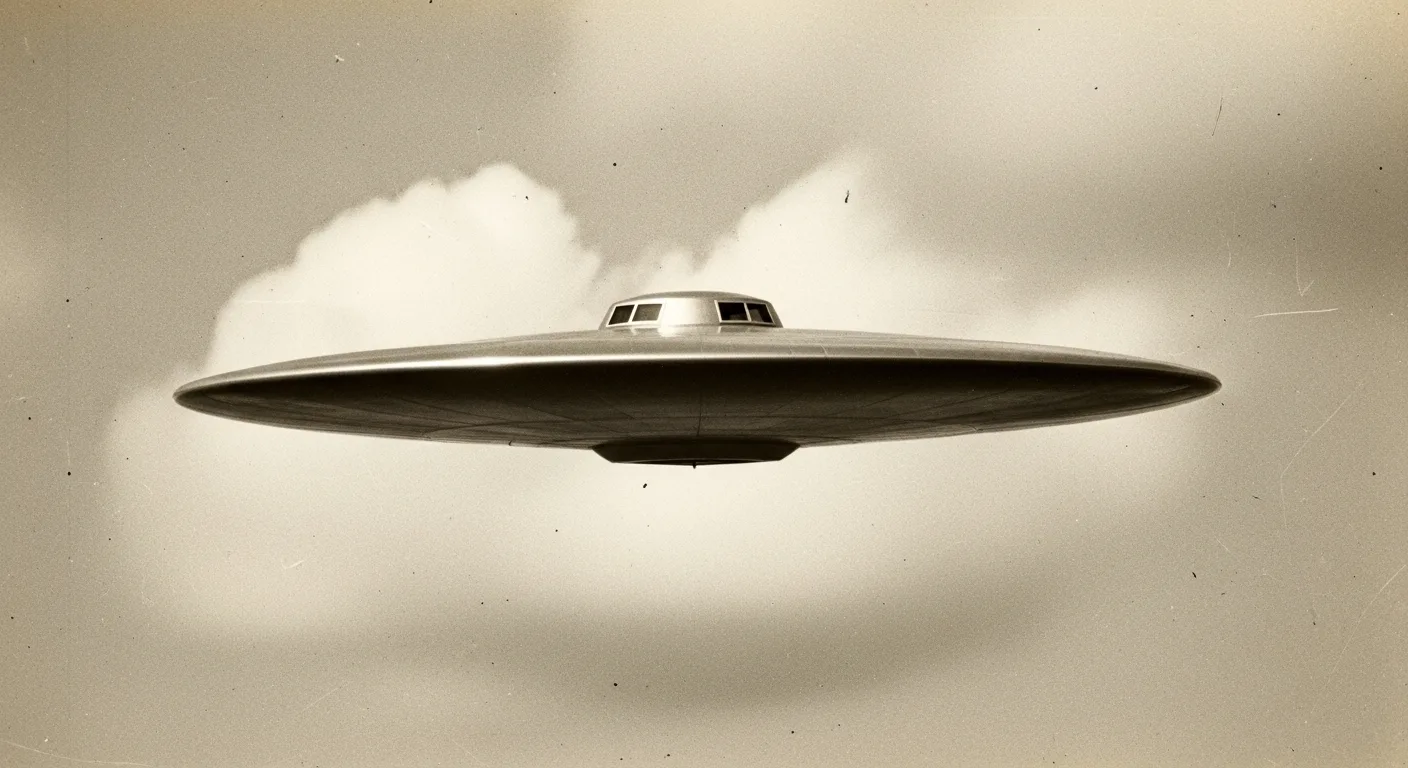
On a clear spring afternoon in 1967, a fourteen-year-old boy named Alex Birch captured an image that would become one of the most scrutinized and debated UFO photographs in British history. The photograph showed a classic disc-shaped object hovering over the ancient Malvern Hills of Worcestershire, its form distinct against the English sky. For years, the image would be held up as compelling evidence of unidentified craft in British airspace. Then, decades later, the truth emerged, transforming the case from evidence into cautionary tale.
The Malvern Hills have watched over Worcestershire for millennia, their distinctive profile a beloved landmark of the English Midlands. In 1967, the area around these ancient hills remained largely rural, a landscape of farms and small villages where unusual aerial phenomena would be immediately noticed. It was against this backdrop of pastoral tranquility that Alex Birch claimed to have witnessed something extraordinary.
The Sighting
According to young Birch’s account, he was outdoors near his home on March 28, 1967 when movement in the sky caught his attention. Looking up, he observed an unusual object, metallic and disc-shaped, moving steadily across the sky above the Malvern Hills. The object made no sound and exhibited no characteristics of conventional aircraft, no wings, no visible propulsion, no contrails.
Birch had a camera with him, a circumstance that would prove either fortunate or suspicious depending on one’s interpretation of events. With the presence of mind remarkable in a teenager, he raised the camera and captured a single photograph before the object moved out of frame. The entire sighting lasted only moments, but in that brief window, he had captured an image that would make him briefly famous.
The Photograph
The resulting photograph showed exactly what one would expect from a genuine UFO sighting: a clearly defined disc shape against the sky, with the familiar profile of the Malvern Hills visible in the background. The object appeared metallic, its surface reflecting light in ways consistent with a solid, manufactured structure. There were no obvious indications of suspension wires, model supports, or other hoaxing mechanisms.
The image was clear and well-exposed, unusual for UFO photographs which tend toward blur and ambiguity. The disc appeared at significant distance from the camera, suggesting a large object rather than a small model photographed close-up. The overall quality of the image set it apart from the vast majority of UFO photographs that existed at the time.
Initial Reception
The photograph attracted immediate attention from both UFO researchers and mainstream media. Here was a clear, daylight photograph from a young witness with no apparent reason to fabricate such a claim. The image was published widely, appearing in newspapers and UFO publications throughout Britain and beyond.
UFO researchers examined the photograph with the technical tools available in the 1960s. They searched for evidence of wires, supports, or other mechanisms that might reveal a hoax. They analyzed the apparent size and distance of the object based on its relationship to the hills in the background. They found nothing conclusive that proved fakery, though nothing that definitively proved authenticity either.
Officials also expressed interest in the photograph, though the extent of any formal investigation remains unclear. The image circulated through channels concerned with aerial phenomena, adding to the growing collection of evidence that something unexplained was occurring in British skies.
Analysis
Various analysts examined the Malvern photograph over the years, applying increasingly sophisticated techniques as technology advanced. The object appeared at sufficient distance that a small model seemed unlikely. No suspension wires or supports were visible. The lighting on the object was consistent with the ambient illumination of the scene. Scale analysis suggested the object, if real, was of substantial size.
Yet definitive proof remained elusive. Photographs, even clear ones, could be faked by skilled practitioners. The absence of obvious hoaxing indicators did not constitute positive proof of authenticity. The photograph remained in the ambiguous category of compelling but unverified, impressive but not conclusive.
Alex Birch’s Account
Throughout the years following the sighting, Alex Birch maintained his account. He described the object appearing suddenly, moving steadily across the sky, and his quick reaction in capturing the photograph. He insisted he had no interest in UFOs prior to the sighting and no motive for creating a hoax. He had simply witnessed something unusual and documented it.
Birch submitted to interviews with researchers and journalists, always telling the same basic story. He had not sought publicity or financial gain from his experience. The photograph had simply happened, an accident of being in the right place with a camera at the right time. His consistent testimony impressed many who interviewed him.
Later Confession
The truth emerged years later when, as an adult, Alex Birch admitted that the photograph was a hoax. The method was simple but effective: he had painted UFO shapes on a pane of glass and photographed through the glass toward the Malvern Hills. The “UFO” in the famous image was nothing more than paint on glass, positioned to appear as a distant object in the sky.
The confession came decades after the original incident, long after the photograph had been published countless times and cited in numerous discussions of UFO evidence. Birch explained that he had been a teenager with artistic skills and an interest in creating something that would attract attention. He had succeeded beyond any expectation and then found himself unable to confess without facing significant embarrassment.
The Confession’s Impact
Birch’s admission demonstrated several important lessons for UFO research and photographic analysis. The confession showed how convincing fake UFO photographs could be, even when examined by researchers using available analytical techniques. A talented teenager with basic materials had fooled investigators for years.
The case also illustrated the limitations of photographic analysis as evidence. Even careful examination had failed to detect the hoax, revealing that negative findings, the absence of obvious fakery, could not be taken as proof of authenticity. Photographs, no matter how clear, required corroboration from other sources to constitute reliable evidence.
The long delay between the hoax and the confession highlighted another challenge in UFO research: the difficulty of ever definitively closing cases. Had Birch never come forward, the photograph might still be cited as evidence. How many other photographs remained in circulation, their fabricated nature unknown even to researchers who had studied them?
Significance Despite Hoax
Paradoxically, the Malvern photograph may be more significant as a confirmed hoax than it ever was as alleged evidence. The case serves as an educational tool, demonstrating the techniques hoaxers can employ and the limitations of analytical methods in detecting fakery.
Researchers now cite the Birch photograph when discussing the challenges of evaluating UFO imagery. The case demonstrates why photographs alone, no matter how compelling, cannot constitute proof of extraordinary claims. It shows why witness credibility, even when a witness maintains a consistent account over years, cannot be the sole basis for accepting unusual claims.
Legacy
The Malvern photograph serves today as a cautionary tale for UFO researchers and enthusiasts alike. It demonstrates that clear, impressive photographs can be fakes. It shows that young witnesses, even those who seem sincere, can maintain fabricated accounts for extended periods. It illustrates why multiple forms of corroboration are essential before accepting any extraordinary claim.
The case reminds researchers that skepticism is not cynicism but necessary methodology. Every piece of evidence must be evaluated critically, every witness account tested against other sources. The Malvern hoax succeeded because investigators wanted to believe, because the photograph showed what they hoped to find. That human tendency toward confirmation bias remains the greatest challenge in any investigation of anomalous phenomena.
Alex Birch’s confession, while embarrassing to those who had championed the photograph, ultimately contributed more to the field than his photograph ever could have as evidence. The lessons learned from the Malvern hoax continue to inform careful investigation of UFO claims.
Sources
- Project Blue Book — National Archives — USAF UFO investigation files, 1947–1969
- CIA UFO/UAP Reading Room — Declassified CIA documents on UAP
- UK National Archives — UFO Files — MoD UFO investigation records
- British Newspaper Archive — UK press archive