The Cosford-Shawbury UFO Incident
A massive triangular craft was tracked across England by RAF personnel.
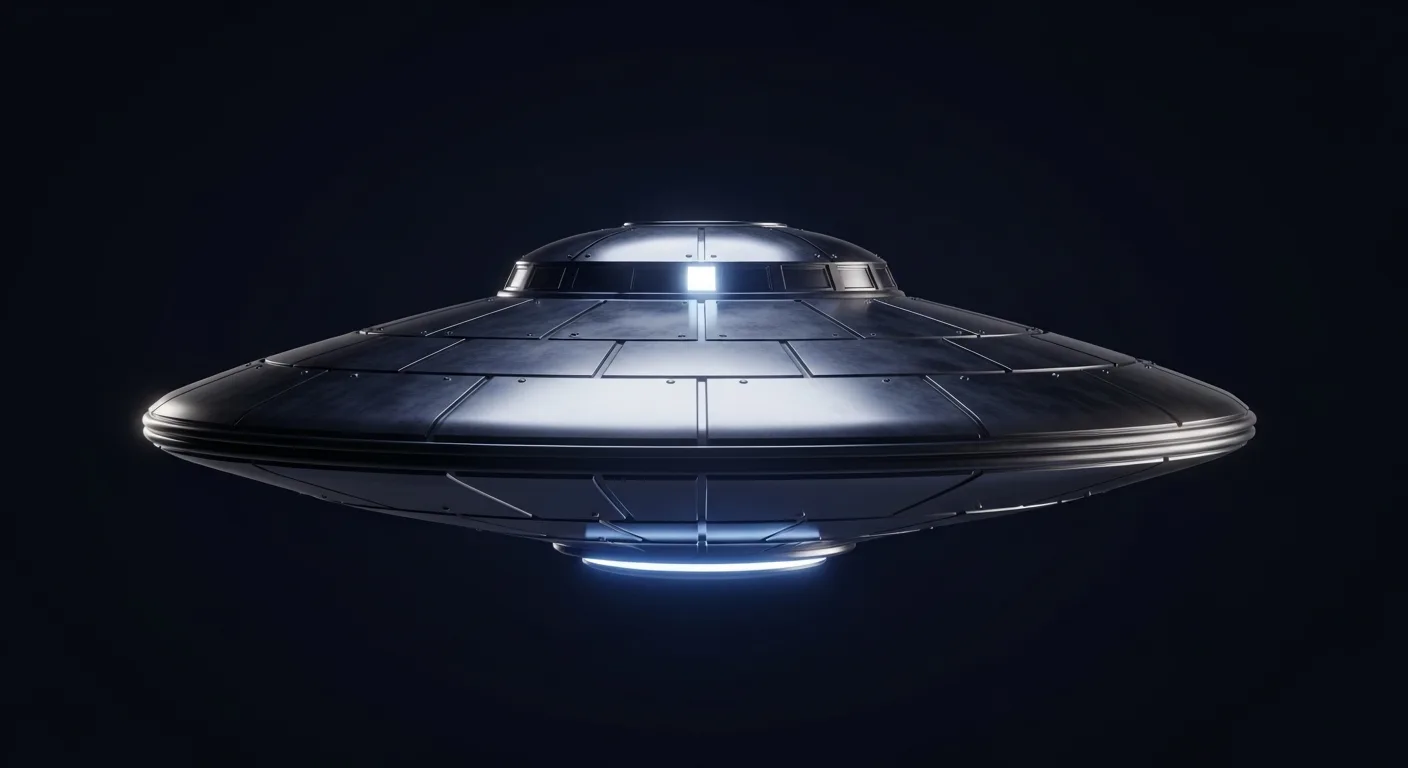
On the night of March 30-31, 1993, something crossed England. It came from the southwest, tracked a course across hundreds of miles of countryside, and passed over or near two Royal Air Force bases before disappearing into the darkness. Hundreds of people saw it. Police switchboards were overwhelmed with calls. Trained military personnel at RAF Cosford and RAF Shawbury observed it in detail and filed official reports that were forwarded through the chain of command to the Ministry of Defence in London. The object was enormous, silent, and triangular, and it moved through the night sky with a deliberation that suggested intelligence and purpose. When the reports reached the desk of Nick Pope, the civil servant then responsible for the MOD’s UFO investigations, he recognized them as something extraordinary. The Cosford-Shawbury incident would become the most significant case he examined during his tenure, a case that he later described as having convinced him that something genuinely unexplained was operating in British airspace, something that no conventional explanation could account for.
The Night Begins
The first reports came in around 9:00 PM on the evening of March 30, 1993, from witnesses in the southwest of England. People across Devon and Cornwall began calling police to report unusual lights in the sky, lights that were moving in formation, slowly and silently, in a manner that did not match any aircraft they had ever seen. The calls were initially treated as routine; unexplained lights in the sky are common enough to be a regular feature of police duty logs, and most such reports turn out to have prosaic explanations involving aircraft, satellites, or celestial objects.
But the calls did not stop. As the evening progressed, reports came in from further north and east, tracing a path across Somerset, Wiltshire, and into the Midlands. The consistency of the descriptions was striking. Witness after witness described the same thing: a large triangular object with bright white lights at each corner and a fainter red or orange light at the center. The object moved slowly, much more slowly than a conventional aircraft at the altitudes described, and it did so in near-total silence, producing at most a low hum that was barely perceptible even to witnesses directly beneath its flight path.
The volume of reports and their geographical progression made it clear that whatever people were seeing, it was a single phenomenon moving across the country on a roughly northeast trajectory. This was not a cluster of independent sightings of different objects but a tracked progression of one object, or possibly a small group of objects in close formation, crossing hundreds of miles of English countryside over a period of several hours.
By late evening, the reports had reached the Midlands, and it was here that the case acquired the military dimension that would elevate it from an interesting collection of civilian sightings to one of the most compelling UFO incidents in British history.
RAF Cosford
RAF Cosford, located near Wolverhampton in Shropshire, was an active military installation in 1993, serving as a training base and home to the RAF’s aerospace museum. The base had a permanent complement of military personnel, including meteorological staff trained in observation and weather assessment, skills directly relevant to evaluating unusual aerial phenomena.
On the night of March 30, a meteorological officer at RAF Cosford noticed unusual lights approaching the base from the southwest. The officer, whose professional role involved continuous sky observation and whose training encompassed the identification of atmospheric and aerial phenomena, was immediately struck by the unconventional nature of what he was seeing. He alerted other personnel, and multiple members of the base staff observed the object as it approached and passed near the installation.
The object was described as triangular in shape and vast in size, far larger than any aircraft in the RAF’s inventory or any known civil aircraft type. The meteorological officer estimated its wingspan at approximately 200 feet, roughly twice the span of a Boeing 747. It moved with a stately deliberation that seemed at odds with its size, drifting through the sky at a speed that the observers estimated at no more than thirty or forty miles per hour, a velocity at which a conventional fixed-wing aircraft of that size could not maintain flight.
The silence of the object was particularly noted. At the estimated altitude and distance, an aircraft of such size would have produced substantial engine noise. The observers reported hearing nothing, or at most a faint humming that was barely audible against the background sounds of the night. This silence was inconsistent with any known propulsion system and contributed to the observers’ conviction that they were witnessing something outside their experience.
The lights on the object were arranged in a triangular pattern, with a bright white light at each of the three corners and a dimmer light, variously described as red or amber, at the center. The lights were steady rather than flashing, which distinguished them from the navigation lights required on conventional aircraft. The overall appearance was of a solid, dark structure outlined by its own illumination, a massive triangle of blackness bordered by points of light.
The personnel at RAF Cosford observed the object for several minutes as it passed near the base. Their reports were filed through official channels, following standard procedures for the reporting of unusual aerial phenomena by military personnel. The reports were detailed, measured, and free from the sensationalism that sometimes characterizes civilian UFO accounts. They described what was observed in the clinical, precise language of military reporting, which made their contents all the more striking.
RAF Shawbury
Approximately twelve miles to the northwest of RAF Cosford lies RAF Shawbury, another active military installation that in 1993 served as a helicopter training base. It was here that the most detailed and dramatic observation of the night’s events took place.
The duty meteorological officer at RAF Shawbury, a man with years of professional experience in sky observation, was alerted to the approaching object by radio communications from RAF Cosford. He went outside to observe and was rewarded with a sighting that lasted several minutes and provided details that would form the core of the official investigation.
The object approached RAF Shawbury from the south, moving slowly and silently through the clear night sky. As it neared the base, the observer was able to study it in considerable detail. He confirmed the triangular shape and the arrangement of lights described by the Cosford observers. He estimated the object’s size as enormous, consistent with the 200-foot estimate from Cosford but possibly even larger. The object appeared to be solid, blocking out the stars behind it as it passed overhead.
What happened next was what made the Shawbury observation extraordinary. As the object reached a position near the base, it appeared to slow to a stop and hover. From the underside of the craft, a narrow beam of light descended toward the ground. The beam was described as pencil-thin and intensely bright, and it appeared to sweep across the terrain below the object as if searching or scanning the surface. The beam moved methodically across the ground in a pattern that suggested systematic observation rather than random illumination.
The guard commander at RAF Shawbury also observed the object and its searchlight activity. His report, filed through military channels, described the beam as unlike anything he had seen from a conventional aircraft or helicopter. Search lights from helicopters produce broad, diffuse beams; the light from this object was narrow, focused, and moved with a precision that suggested technological control rather than a simple spotlight being aimed by a human operator.
After several minutes of hovering and scanning, the object departed. Its acceleration was one of the most remarkable aspects of the entire incident. From a dead stop, the object moved away to the north at a speed that the observers described as extraordinary, transitioning from stationary to rapid flight in what appeared to be an instant. The acceleration was smooth rather than explosive, with no visible exhaust, no sonic boom, and no engine noise. The object simply moved away with an effortless speed that left the military observers in no doubt that they had witnessed something far beyond any known aerospace technology.
The MOD Investigation
The reports from RAF Cosford and RAF Shawbury were forwarded through the military chain of command to the Ministry of Defence in London, where they landed on the desk of Nick Pope. Pope had been assigned to the MOD’s Secretariat (Air Staff) 2a, the section responsible for, among other things, investigating UFO reports submitted to the Ministry. He had been in the post for approximately two years when the Cosford-Shawbury reports arrived.
Pope was not, at the outset of his assignment, a believer in UFOs. He had taken the job as a routine civil service posting and had initially approached the UFO reports that crossed his desk with a healthy skepticism. Most reports, he found, could be explained by misidentifications of aircraft, satellites, planets, or other mundane phenomena. A smaller number remained unexplained but were insufficiently detailed or well-witnessed to draw firm conclusions. The Cosford-Shawbury case was different.
The quality of the witnesses was the first factor that set the case apart. These were not civilians who might be unfamiliar with aircraft types or prone to misidentification. They were serving RAF personnel, including meteorological officers whose professional competence depended on accurate sky observation. Their reports were filed through official channels, subject to the professional accountability that military reporting demands. They described what they saw in precise, technical language, and their descriptions were mutually corroborative despite coming from observers separated by twelve miles.
Pope’s investigation sought to eliminate conventional explanations. He checked with air traffic control to determine whether any known aircraft had been operating on the track described by the witnesses. None had. He consulted with the RAF to establish whether any military exercises had been conducted that might account for the sightings. None had. He checked satellite tracking data to determine whether any space debris re-entry might have produced the observed phenomena. Nothing matched.
The possibility that the object was an experimental aircraft, either British or American, was considered and tentatively rejected. The characteristics described by the witnesses, particularly the ability to hover silently and then accelerate instantaneously, were inconsistent with any known aerospace technology, and Pope’s inquiries through official channels produced no acknowledgment of any secret program that might account for the object.
Pope’s conclusion, stated publicly after he left the MOD, was that the Cosford-Shawbury incident represented a genuine unknown. Something had crossed England that night, something that was observed by hundreds of civilians and multiple trained military personnel, something that was tracked across hundreds of miles by the progression of reports, and something that no conventional explanation could adequately account for.
The Wider Wave
The Cosford-Shawbury observations were the most significant elements of a broader wave of sightings that affected large portions of England on the night of March 30-31, 1993. Police forces across the country received hundreds of calls from members of the public reporting unusual lights and objects in the sky.
The reports came from a swathe of the country stretching from Devon in the southwest to Staffordshire in the Midlands, a distance of approximately 200 miles. Witnesses included people of all ages and backgrounds, from teenagers to retired professionals, and their descriptions showed a consistency that is difficult to attribute to mass hysteria or collective misidentification. The triangular shape, the corner lights, the slow movement, and the silence were reported again and again by witnesses who had no opportunity to consult with each other before filing their reports.
Some of the civilian observations added details that complemented the military reports. Several witnesses described seeing the object at relatively close range, estimating that it passed directly overhead at an altitude of no more than a few hundred feet. At such close range, some witnesses reported being able to see structural details on the underside of the craft, describing a smooth, dark surface that absorbed rather than reflected light, with the illuminated points at the corners appearing to be recessed into the structure rather than mounted on its surface.
The silence of the object was a nearly universal feature of the civilian reports. People who heard nothing at all, people who detected a faint hum, and people who described a low vibration that they felt rather than heard all contributed to a picture of something that was not being propelled by any conventional engine. The absence of sound from an object estimated to be 200 feet across, flying at low altitude, is one of the most puzzling aspects of the case and one of the most difficult to explain in conventional terms.
Theories and Explanations
In the years since the incident, various explanations have been proposed for the events of March 30-31, 1993. None has achieved universal acceptance, and the case remains officially unexplained.
The most common skeptical explanation is that the witnesses observed a formation of conventional aircraft, possibly military jets flying in a tight triangular pattern with their navigation lights visible. This explanation accounts for the triangular arrangement of lights but struggles with several aspects of the reports, including the estimated size of the object, its silence, its ability to hover, and the beam of light observed at RAF Shawbury. A formation of jets cannot hover, cannot produce a scanning beam from their undersurface, and cannot accelerate instantaneously from a standing start.
The possibility of a secret military aircraft has been raised but never confirmed. The characteristics described by the witnesses are consistent with some aspects of speculative “black triangle” craft that have been the subject of aviation rumors for decades, but no government has ever acknowledged the existence of such a vehicle, and the technology required to produce the observed performance characteristics remains beyond any publicly known capability.
Astronomical explanations, including bright planets, meteor fireballs, and satellite re-entries, have been considered and rejected by investigators. The duration of the sighting, the low altitude of the object, its structured appearance, and its interaction with the ground via the scanning beam are all inconsistent with any astronomical phenomenon.
The weather balloon hypothesis, a perennial favorite of official UFO debunking, is particularly untenable in this case. No balloon could travel hundreds of miles on a consistent heading, hover over a military base while projecting a beam of light, and then accelerate away at high speed.
A Case That Endures
The Cosford-Shawbury incident occupies a prominent position in the history of British UFO cases, and for good reason. The combination of factors that make it significant is rare in UFO research: hundreds of civilian witnesses across a wide geographical area, detailed observations by trained military personnel at two RAF bases, official reports filed through military channels, a Ministry of Defence investigation that failed to identify any conventional explanation, and physical characteristics of the observed object that exceeded the known capabilities of any nation’s aerospace technology.
The case is also significant for its impact on official attitudes within the British government. Nick Pope’s investigation of the Cosford-Shawbury incident, and the conclusions he drew from it, contributed to a shift in his own thinking about the UFO phenomenon, from routine skepticism to a conviction that some UFO reports represented genuinely unexplained phenomena that deserved serious scientific investigation. His public statements after leaving the MOD helped to legitimize the discussion of UFOs in Britain and encouraged other witnesses, both civilian and military, to come forward with their own experiences.
The night of March 30-31, 1993, remains one of those occasions when the ordinary fabric of life in England was briefly punctured by something extraordinary. Hundreds of people across a swathe of the country looked up and saw something they could not explain, something that moved through their skies with a purpose they could not fathom, something that was too large, too silent, and too capable to be anything they had ever encountered. The trained eyes at RAF Cosford and RAF Shawbury confirmed what the civilians had seen and added details that deepened the mystery rather than resolving it. And somewhere in the MOD’s files, the reports still sit, officially unexplained, a reminder that the skies above England held something strange that spring night, and that whatever it was, it has never been identified.
Sources
- CIA UFO/UAP Reading Room — Declassified CIA documents on UAP
- UK National Archives — UFO Files — MoD UFO investigation records
- British Newspaper Archive — UK press archive