The RAF Fylingdales UFO
RAF radar operators tracked an unidentified object near the early warning station.
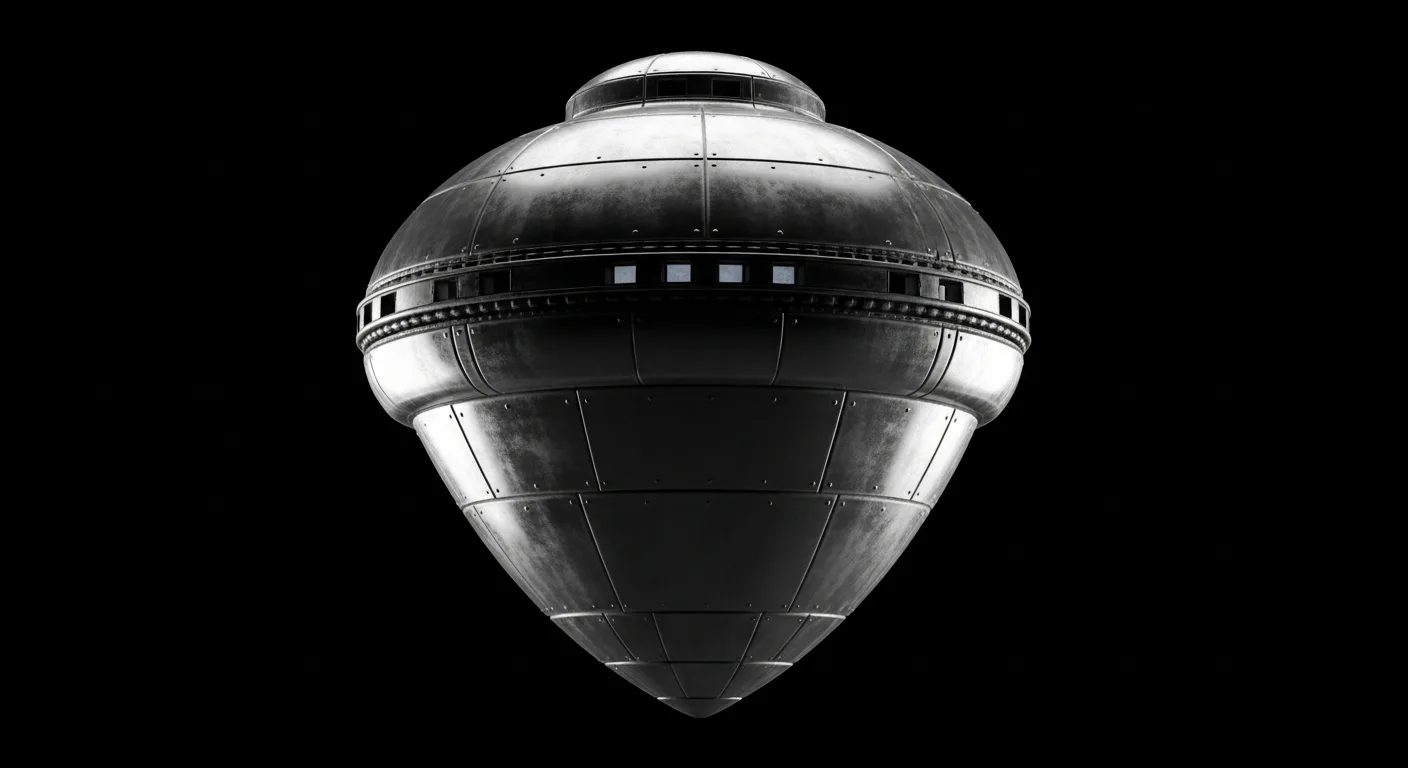
The North York Moors have always been a place of isolation and brooding atmosphere, a vast expanse of heather-covered upland where the wind howls across open terrain and the night sky stretches uninterrupted from horizon to horizon. But nestled within this ancient landscape sits one of the most technologically sophisticated military installations in the Western world: RAF Fylingdales, a critical node in the Ballistic Missile Early Warning System designed to detect incoming nuclear threats. On the night of March 30, 1993, the men and women operating the station’s powerful radar arrays detected something that was neither a missile nor any known aircraft — an object performing maneuvers that defied the known limits of aerospace engineering. The detection was confirmed visually by ground observers who watched strange lights dancing over the Yorkshire coast. The Ministry of Defence investigated and provided no public explanation. The incident remains one of the most credible radar-visual UFO cases in British military history.
The Sentinel on the Moors
To understand the weight of what occurred at RAF Fylingdales that night, one must appreciate what the station is and what the people who operate it are trained to do. RAF Fylingdales is one of only three stations in the Ballistic Missile Early Warning System, a network established during the Cold War to provide NATO nations with advance notice of a nuclear strike. The other two stations are located at Thule Air Base in Greenland and Clear Air Force Station in Alaska. Together, these three installations form a detection ring around the Northern Hemisphere, their overlapping radar coverage creating a surveillance net through which no ballistic missile could pass undetected.
The station was originally established in 1963, when its iconic “golf ball” radomes became one of the most recognizable features of the Yorkshire landscape. By 1993, the station had been upgraded with a Solid State Phased Array Radar system, a massive pyramid-shaped structure capable of tracking multiple objects simultaneously at ranges of thousands of miles. This was not the sort of equipment that produced ambiguous returns or was susceptible to false positives. The SSPAR system was designed to distinguish between genuine threats and the thousands of objects — satellites, debris, meteorites, aircraft — that passed through its detection envelope every day.
The operators who staffed the radar consoles at Fylingdales were among the most highly trained surveillance personnel in the Royal Air Force. Their job was to identify and classify every object their radar detected, and the consequences of error were literally existential. A false positive could trigger a nuclear response; a missed detection could leave the nation defenseless. These were not people prone to misidentifying radar returns, and the equipment they operated was specifically designed to eliminate ambiguity.
The Night of March 30
The evening of March 30, 1993 began as any other shift at RAF Fylingdales. The operators settled into their positions before the radar displays, monitoring the steady parade of known objects — satellites in their predicted orbits, commercial aircraft on filed flight plans, military traffic conducting routine operations. The SSPAR system tracked each object with mechanical precision, categorizing and dismissing them according to established protocols.
At approximately 9:30 PM, the radar operators detected something that did not fit any known category. An object was approaching from the east, coming in over the North Sea on a trajectory that crossed no filed flight plan and matched no predicted satellite orbit. The initial detection alone was sufficient to draw attention, as the airspace over the North York Moors was restricted and unauthorized traffic was rare. But it was the object’s flight characteristics that transformed routine interest into professional alarm.
The object was descending rapidly, losing altitude at a rate that would have been dangerous for any conventional aircraft, while simultaneously maintaining a high horizontal speed. This combination of rapid descent and horizontal velocity was inconsistent with any known flight profile. An aircraft in such a steep descent would need to reduce its forward speed to maintain structural integrity and control. A meteorite entering the atmosphere would follow a predictable ballistic trajectory without the directional changes the operators were about to observe.
The Impossible Maneuvers
As the operators tracked the object, its behavior became increasingly anomalous. The object’s speed varied dramatically, ranging from approximately 600 miles per hour to bursts exceeding 3,000 miles per hour. These speed changes occurred without any visible transitional period — the object did not gradually accelerate or decelerate but appeared to shift between speeds almost instantaneously.
More disturbing were the directional changes. The object altered its heading multiple times during the tracking period, executing turns that would have been physically impossible for any known aircraft. The G-forces generated by such maneuvers at the speeds recorded would have been fatal to any human crew and would have exceeded the structural limits of any known airframe. A fighter jet performing a high-G turn at 600 miles per hour subjects its pilot to forces that can cause loss of consciousness; the maneuvers recorded by the Fylingdales radar at multiples of that speed would have generated forces sufficient to tear apart any conventional aircraft.
The operators were not seeing equipment malfunction or atmospheric anomaly. The SSPAR system was designed to filter out precisely those kinds of false returns. The object produced a solid, consistent radar signature that the system treated as a physical object in flight. It was tracked across multiple radar sweeps, its position updating in real time in a manner consistent with an actual airborne target. The operators, trained to distinguish real objects from radar artifacts, were unanimous in their assessment: whatever they were tracking was real, it was physical, and it was performing maneuvers that no known technology could replicate.
Visual Confirmation
If the case had rested solely on radar evidence, it would still have been significant. But the Fylingdales detection was corroborated by visual observations from the ground that aligned with the radar tracking in both timing and position.
As the object’s trajectory brought it closer to the Yorkshire coast, civilians in the area began reporting unusual lights in the sky. The lights were described as orange or amber in color, bright enough to be clearly visible against the night sky but not blindingly intense. They moved in patterns that matched the radar contact’s position, providing independent confirmation that the radar was tracking a genuine object and not an electronic phantom.
Multiple witnesses in coastal communities along the North Yorkshire seaboard reported seeing the lights. Their descriptions were consistent with one another and with what the radar was showing: lights that moved at high speed, stopped abruptly, changed direction, and then accelerated away. The witnesses included people with no knowledge of the radar detection at Fylingdales, making their independent corroboration particularly valuable.
The combination of radar tracking and visual observation elevated the case above the many incidents that rely on either instrument readings or eyewitness testimony alone. Each form of evidence validated the other. The radar operators knew their readings corresponded to a visible object, and the ground witnesses knew that what they were seeing was being simultaneously tracked by military-grade radar.
The Ministry of Defence Response
The involvement of RAF Fylingdales ensured that the incident received serious attention at the highest levels of the British military establishment. A UFO detection at an ordinary RAF station would have been noteworthy; a UFO detection at a nuclear early warning facility was a matter of national security concern. Any unknown object operating in the airspace around Fylingdales raised immediate questions about the station’s vulnerability and the reliability of its detection systems.
The Ministry of Defence initiated an investigation into the incident. The details of this investigation were largely kept from public view, consistent with the classified nature of the Fylingdales station and its operations. What is known is that the MoD could not or did not provide a public explanation for the event. No announcement was made identifying the object as a known aircraft, satellite, weather balloon, or natural phenomenon.
The classified nature of the investigation has been a source of frustration for UFO researchers, who argue that the public has a right to know what was detected over British airspace by a facility funded by taxpayer money. Some researchers have attempted to obtain records through Freedom of Information requests, with limited success. The documents that have been released confirm the detection of an unidentified object but provide little additional detail about the investigation’s conclusions.
This official silence has, predictably, fueled speculation. Some researchers believe the MoD determined that the object was a classified military aircraft — perhaps an American stealth platform or an experimental drone — and chose to maintain silence rather than reveal allied capabilities. Others believe the investigation genuinely failed to identify the object and that silence was preferred over the admission that something had penetrated restricted airspace around a nuclear facility without being identified.
The Credibility Factor
What sets the RAF Fylingdales incident apart from the vast majority of UFO reports is the extraordinary credibility of both the witnesses and the equipment involved. This was not a case of untrained civilians misidentifying a planet or aircraft. The witnesses were military radar operators whose professional competence was, quite literally, a matter of life and death. The equipment they operated was designed to detect and track objects at extreme ranges with minimal false positive rates. The entire purpose of the Fylingdales station was to identify and classify every object in its detection envelope, and the operators who worked there spent their careers doing exactly that.
When these operators reported that they had tracked an object performing impossible maneuvers, they were making a professional assessment based on training and experience that few civilians could match. They knew what conventional aircraft looked like on their displays. They knew what satellites, meteorites, and atmospheric anomalies looked like. They were stating, with the authority of their training and the precision of their equipment, that what they had tracked was none of these things.
The ground witnesses, while civilians, provided independent corroboration that removed the possibility of equipment malfunction. If the radar had been malfunctioning, there would have been no corresponding visual observations. If the civilians had been misidentifying stars or aircraft, there would have been no corresponding radar detection. The two forms of evidence, from independent sources with no connection to one another, pointed to the same conclusion: a physical object had been present in the sky over Yorkshire, and it had performed maneuvers beyond known technology.
The Broader Context
The Fylingdales incident occurred during a period of significant UFO activity in the United Kingdom. The early 1990s saw a wave of sightings across the British Isles, with reports clustering in particular around military installations and the coastline. The famous Cosford incident of March 1993, which occurred just one night after the Fylingdales detection, involved multiple witnesses including military personnel at RAF Cosford and RAF Shawbury reporting a large triangular craft moving silently across the Midlands.
Whether these concurrent events were related is a matter of speculation. Some researchers have noted patterns in British UFO activity that suggest periodic waves or flaps, possibly triggered by increased surveillance or monitoring activity that makes detection more likely. Others point to the concentration of sightings near military facilities as evidence that whatever is being observed has an interest in defense infrastructure.
The North York Moors themselves have a long history of unusual aerial phenomena. The remote, sparsely populated landscape provides dark skies and minimal light pollution, making aerial observations easier than in urban areas. Local folklore includes accounts of strange lights on the moors dating back centuries, though these earlier reports lack the technological corroboration that makes the Fylingdales case so compelling.
Theories and Analysis
Several explanations have been proposed for the Fylingdales detection, none of which has gained universal acceptance.
The most prosaic explanation is that the radar tracked a natural phenomenon — a bolide or meteor entering the atmosphere at an unusual angle. While this might account for the initial detection of a fast-moving descending object, it cannot explain the directional changes, speed variations, or extended duration of the tracking. Meteors follow predictable ballistic trajectories; they do not stop, change direction, and accelerate.
The possibility of a classified military aircraft has been raised but faces significant objections. No known aircraft in 1993, classified or otherwise, could perform the maneuvers recorded by the Fylingdales radar. The speed variations — from 600 to over 3,000 miles per hour — exceeded the performance envelope of any known aircraft, and the directional changes at those speeds would have generated forces beyond any known airframe’s tolerance. If such an aircraft existed, it would represent a technological breakthrough that has never been publicly acknowledged.
Atmospheric anomalies, including temperature inversions and anomalous radar propagation, are standard explanations for unexplained radar returns. However, the SSPAR system at Fylingdales was specifically designed to filter out such anomalies, and the visual corroboration from ground witnesses indicates that the radar was tracking a physical object rather than an atmospheric artifact.
The possibility remains that the object was exactly what it appeared to be: an unidentified flying object of unknown origin, demonstrating capabilities beyond current human technology. While this explanation raises more questions than it answers, it is the one most consistent with the totality of the evidence.
Significance and Legacy
The RAF Fylingdales incident of March 30, 1993 occupies a particular position in the annals of British UFO research. It is a case where the witnesses were beyond reproach, the equipment was state-of-the-art, the detection was confirmed visually, and the official investigation produced no explanation. These factors, taken together, make it one of the most difficult cases to dismiss and one of the most important to take seriously.
The incident also raises uncomfortable questions about airspace security. If an unknown object can operate with impunity in the restricted airspace around a nuclear early warning facility, performing maneuvers that no known aircraft can replicate, what does that say about the nation’s ability to control its own skies? This security dimension may explain the MoD’s reluctance to discuss the case publicly — not because they know what the object was, but because they do not, and that uncertainty is itself a vulnerability they would prefer not to acknowledge.
For the radar operators who tracked the object that night, the experience was both professionally affirming and deeply unsettling. Their training told them to trust their equipment and their own judgment. Their equipment showed them something impossible. Their judgment told them it was real. More than three decades later, no one has told them they were wrong.
The moors around Fylingdales remain as wild and empty as they have been for millennia, the heather stretching to the horizon under skies that are among the darkest in England. The SSPAR radar continues its ceaseless surveillance, tracking thousands of objects daily as it fulfills its original mission of watching for threats from above. Whatever visited the Yorkshire sky on that March evening has not returned, as far as anyone knows. But the operators are still watching, and their instruments are still listening, and the question of what they detected that night remains unanswered.
Sources
- CIA UFO/UAP Reading Room — Declassified CIA documents on UAP
- UK National Archives — UFO Files — MoD UFO investigation records
- British Newspaper Archive — UK press archive