North Powder, Oregon UAP Encounter, 1948 — USAAF Box 7 #230
Documentation from the U.S. Army Air Forces archives details a 1948 unidentified object sighting near North Powder, Oregon, released via the PURSUE program.
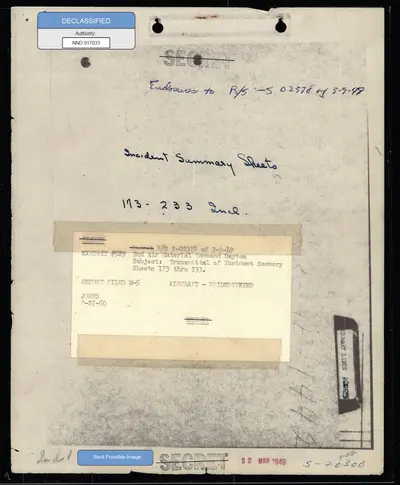
Incident Overview
In 1948, near North Powder, Oregon, the U.S. Army Air Forces recorded an unidentified-object incident that became Incident #230 in the “Check-List - Unidentified Flying Objects” series archived in Box 7 of file 38_143685. The records were released by the Department of War on May 8, 2026, as part of the Presidential Unsealing and Reporting System for UAP Encounters (PURSUE). The summary records that an unspecified observer reported a sighting near North Powder, Oregon. This specific case is classified as a visual sighting reported by ground or air observers.
Historical Context
The North Powder sighting occurred during a period of heightened public and military scrutiny regarding aerial phenomena. The year 1948 fell within the first significant wave of “flying saucer” reports that swept the United States following the Kenneth Arnold sighting in June 194
7 and the Roswell incident of July 1947. During this era, the term UFO was beginning to enter the common lexicon, and the sudden influx of reports led to the creation of various informal tracking methods by military and intelligence agencies. The geographic location of North Powder, situated in the Blue Mountains of northeastern Oregon, placed the event within a region characterized by rugged terrain and significant airspace activity, which often contributed to the complexity of aerial identification.
At the time of this report, the United States military was navigating the early stages of the Cold War, an environment where the distinction between conventional aircraft, atmospheric phenomena, and potential adversary technology was increasingly blurred. The documentation found in the USAAF “Check-List” reflects the era’s burgeoning attempts to standardize the reporting of aerial anomalies. Such lists were often used to categorize sightings for further investigation, though the level of detail provided in these early checklists was frequently limited to the basic parameters of the sighting and the identity of the observer.
Analysis and Classification
The status of Incident #230 remains officially unresolved. All records released under the PURSUE program are designated as unresolved by the All-domain Anomaly Resolution Office. The federal government has not concluded these 1947-era incidents were anomalous, has not concluded they were conventional, and has not ruled out either possibility.
When evaluating cases from the 1947-1948 saucer wave, investigators often consider several conventional candidates that could account for such sightings. These include the Project Mogul balloon flights, which were active over the U.S. Southwest at the time and were designed to detect Soviet nuclear tests. Other possibilities include the testing of experimental jet and rocket aircraft, various atmospheric optical effects, and astronomical objects misidentified at unusual angles. Despite these potential explanations, the lack of definitive identification in the official Army Air Forces records leaves the North Powder encounter categorized as an unidentified aerial phenomenon.