Jefferson, Oregon UFO Sighting (November 5th and 12th, 1946) — USAF Files
U.S. government investigators documented unusual aerial formations over Jefferson, Oregon, in November 1946, supported by photographic evidence.
Historical Context
The sightings in Jefferson, Oregon, occurred during a period of heightened aerial uncertainty in the immediate post-World War II era. Following the cessation of global hostilities, the skies above North America were frequently the subject of intense scrutiny due to the proliferation of new aeronautical technologies and the burgeoning Cold War. This specific timeframe is often categorized by researchers as the foo-fighter era, a term derived from reports by Allied aircrews during the Second World War who described luminous, unidentified objects that appeared to pace their bombers during combat missions. These phenomena contributed to a widespread cultural and military preoccupation with unexplained aerial phenomena, as the transition from wartime surveillance to peacetime monitoring created a vacuum of clarity regarding unidentified objects in the upper atmosphere.
The geographic setting of Jefferson, Oregon, placed these events within the Pacific Northwest, a region characterized by complex topography and atmospheric conditions that often contribute to various optical illusions. During the late 1940s, the United States military and various government agencies were increasingly tasked with distinguishing between emerging aerospace technologies and natural atmospheric events. The investigation of such sightings was often conducted through a lens of national security, as the potential for unidentified objects to represent advanced foreign capabilities was a primary concern for the Department of Defense.
The Jefferson Incident
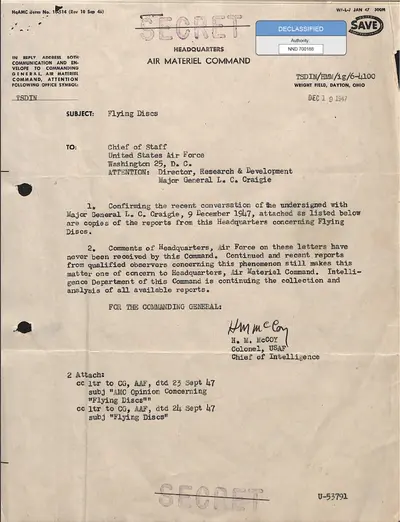
On November 5th and 12th, 1946, U.S. government investigators recorded an unidentified-object incident in Jefferson, Oregon. These records, which were later released to the public on May 8, 2026, as part of the Presidential Unsealing and Reporting System for UAP Encounters (PURSUE), provide a formal account of the events. The case is documented within official U.S. Department of Defense files, marking it as a verified subject of government inquiry.
The primary evidence associated with this case consists of photographs provided to the Air Force by Mary L. Herren. These images purportedly depict unusual formations in the sky. While the photographs serve as the central piece of physical evidence, the documentation clarifies that Herren did not personally observe the objects in the sky. Her involvement was based on her belief that the formations captured in the images might represent flying discs. Upon reviewing the photographic evidence, investigators raised technical questions regarding the validity of the images. Specifically, the investigators noted that the uniformity of the markings present in the photographs suggested the possibility of a defect in either the camera hardware or the film stock used during the exposure. The released documentation does not specify the total number of witnesses present during the events of November 5th and 12th.
Classification and Resolution Status
The Jefferson case is classified as an incident involving photographic or video evidence of an unidentified object. Because the documentation relies heavily on imagery that investigators flagged as potentially being the result of equipment malfunction, the nature of the objects remains a subject of technical debate.
Under the current regulatory framework, all records released through the PURSUE program are designated as unresolved by the All-domain Anomaly Resolution Office (AARO) by default. The federal government has maintained a neutral stance regarding the Jefferson sightings, having reached no conclusion as to whether the events were anomalous or conventional. The government has not ruled out the possibility of extraterrestrial or unknown technology, nor has it dismissed the likelihood of terrestrial or natural explanations.
In the broader context of mid-century aerial sightings, several conventional candidates are often considered by researchers. These include the presence of experimental aircraft testing, the deployment of weather balloons—specifically those associated with the Project Mogul series in the late 1940s—and various atmospheric optical phenomena such as sundogs or lenticular clouds. Additionally, astronomical objects such as the Moon, Venus, or meteors appearing near the horizon are frequently cited as potential sources for reports of luminous aerial objects during this era.
Sources
- [Original release on war.gov](https://www.war.gov/medialink/ufo/release_1/18_100754_ general 1946-7_vol_2.pdf)
- Department of War UFO Disclosure Portal
- AARO (All-domain Anomaly Resolution Office)