Canyonville and Myrtle Creek UFO Sighting (August 12, 1947) — FBI Files
FBI records detail a 1947 sighting of a high-speed, aluminum-like spherical object over southern Oregon.
Historical Context
The summer of 1947 represents a pivotal era in the history of unidentified aerial phenomena in the United States. Following the Kenneth Arnold sighting in June 1947 and the subsequent reports surrounding the Roswell incident in July 1947, the American public and federal agencies entered a period of heightened scrutiny regarding objects in the upper atmosphere. This period marked the emergence of the “flying saucer” phenomenon, a term used to describe objects that exhibited flight characteristics inconsistent with known contemporary aviation. During this time, the geopolitical landscape was defined by the early Cold War, leading to increased vigilance regarding airspace security and the potential for advanced foreign technology to penetrate domestic borders.
The geography of southern Oregon, specifically the regions surrounding Canyonville and Myrtle Creek, provided a backdrop of dense forests and rugged terrain characteristic of the Cascade Range foothills. Such environments often contributed to the complexity of aerial observations, as topographical features can obscure or distort the perceived movement of distant objects. In the late 1940s, the lack of widespread radar coverage in rural areas meant that many sightings relied entirely on the visual accounts of civilian observers, making the verification of such events a significant challenge for investigators.
The Incident of August 12, 1947
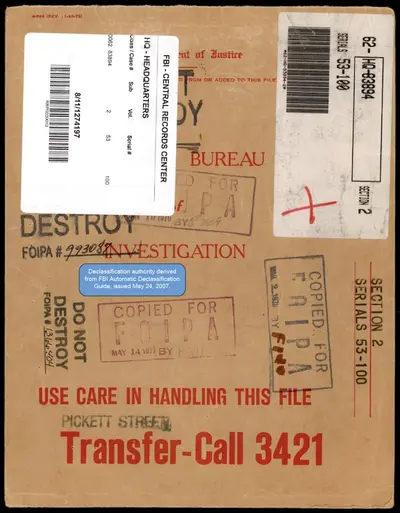
On August 12, 1947, U.S. government investigators documented an unidentified-object incident occurring in the vicinity of Canyonville and Myrtle Creek, Oregon. The details of this specific encounter were not made available to the general public until May 8, 2026, when they were released as part of the Presidential Unsealing and Reporting System for UAP Encounters (PURSUE). The documentation reveals that the report was processed through the Federal Bureau of Investigation (FBI). Under the standing protocols of the Bureau at that time, field offices in locations such as Knoxville, Albuquerque, and Los Angeles were tasked with routing reports involving potential threats to vital installations directly to headquarters.
The investigation centered on observations made by Ray Hatfield and Noble Ellison. According to the records, the two individuals observed a spherical object on August 6, 1947, while engaged in flight. The witnesses described the object as appearing to be constructed of a material similar to aluminum. During their observation, they estimated the speed of the object to be approximately 1,000 mph. The report notes that the object was observed on two separate occasions, with the witnesses specifically noting a rapid ascent followed by the object’s eventual disappearance. While the document provides these specific details regarding the physical characteristics and movement of the object, the total number of witnesses involved in the reporting process is not specified in the released file.
Investigation and Classification
The nature of this case is classified as a visual sighting reported by ground or air observers. At the time of the report, the investigation was handled through standard bureaucratic channels designed to monitor unidentified aerial activity that might impact national security. The methodology used by the FBI during this period focused on the collection of witness testimony and the assessment of whether such objects posed a risk to sensitive infrastructure or military installations.
The status of the Canyonville and Myrtle Creek sighting remains officially unresolved. All records released under the PURSUE program are designated as unresolved by the All-domain Anomaly Resolution Office (AARO) by default. The federal government has maintained a neutral stance, neither concluding that the events were anomalous nor confirming that they were the result of conventional phenomena. Within the context of 1947, several conventional explanations are often considered by researchers, including the presence of experimental aircraft, meteorological phenomena such as lenticular clouds or sundogs, or astronomical bodies like Venus and the Moon appearing near the horizon. Additionally, the period saw the deployment of the Project Mogul series of high-altitude balloons, which were designed to detect Soviet nuclear tests and could potentially be mistaken for unidentified objects by observers.