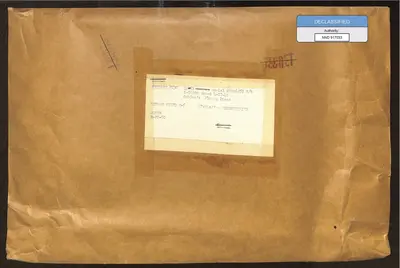
Obrechstreet, Arnhem UAP Encounter, 1948 — USAAF Box 7 #168
A 1948 United States Army Air Forces report documents an unidentified object sighting near Obrechstreet, Arnhem, during the post-war saucer wave.
Historical Context of the 1948 Saucer Wave
The year 1948 represented a period of profound atmospheric uncertainty across the globe. Following the conclusion of the Second World War, the rapid advancement of aeronautical technology and the emergence of the Cold War created a landscape where the skies were increasingly populated by experimental craft and high-altitude surveillance equipment. This era is characterized by the “saucer wave,” a phenomenon of mass sightings that began in the summer of 1947. The initial catalyst for this wave was the Kenneth Arnold sighting in June 1947, which introduced the concept of disc-shaped objects to the public consciousness, followed closely by the highly publicized Roswell incident in July 1947. As military and civilian observers began documenting unusual aerial phenomena, the United States Army Air Forces (USAAF) began compiling standardized checklists to categorize and track these unidentified flying objects.
During this period, the ability to distinguish between conventional aerial hardware and anomalous phenomena was hampered by the lack of advanced radar and the presence of secretive military projects. The emergence of jet propulsion and high-altitude ballooning introduced new visual signatures into the sky that often mimicked the behavior of unidentified objects. Consequently, many reports from this era were analyzed through the lens of contemporary technological developments, such as the Project Mogul balloon flights or the testing of early rocket-propelled aircraft.
The Obrechstreet Incident
The Obrechstreet, Arnhem UAP Encounter, documented as Incident #168 in the “Check-List - Unidentified Flying Objects” series, remains a specific entry within the broader archives of the U.S. Army Air Forces. The incident occurred in 1948 near Obrechstreet, located in the Arnhem region. The documentation for this specific case was preserved within Box 7 of file 38_143685. The details of the sighting were officially brought to public light on May 8, 2026, following their release by the Department of War under the auspices of the Presidential Unsealing and Reporting System for UAP Encounters (PURSUE).
The specific contents of the USAAF form for Incident #168 are relatively sparse, reflecting the standardized nature of the reporting period. The summary records that an unspecified observer reported a sighting in the vicinity of Obrechstreet. The nature of the report is classified as a visual sighting, which could have been made by either ground-based or air-based observers. While the documentation confirms the occurrence of the sighting and its placement within the official military checklist, the specific characteristics of the object’s movement, luminosity, or physical appearance were not elaborated upon in the primary summary of the released file.
Analytical Status and Classification
Within the framework of modern archival analysis, the Obrechstreet encounter is classified as an unidentified flying object. The All-domain Anomaly Resolution Office maintains a designation of unresolved for all records released under the PURSUE program. This status indicates that the federal government has not reached a definitive conclusion regarding the nature of the object. The records do not provide evidence to confirm the presence of an anomaly, nor do they provide sufficient data to definitively attribute the sighting to a conventional source.
The ambiguity of the Obrechstreet report is consistent with many other cases from the 1947–1949 period. In many instances, the lack of corroborating radar data or secondary sensor readings left investigators unable to differentiate between atmospheric optical effects, astronomical bodies viewed at unusual angles, or the testing of experimental aeronautical platforms. The Obrechstreet case remains a primary example of the era’s documented aerial uncertainties, preserved as a singular data point within the larger military effort to monitor the post-war skies.