Agate Beach, Oregon UFO Sighting (August 7, 1947) — FBI Files
On August 7, 1947, an unidentified object was observed traveling at high speeds over the Pacific Ocean near Agate Beach, Oregon.
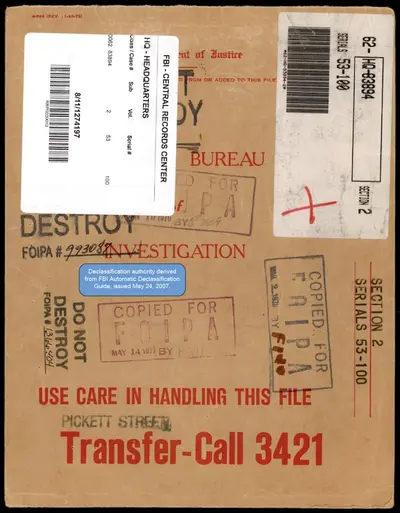
Background
The Agate Beach, Oregon, unidentified-object incident occurred on August 7, 1947, and was documented by U.S. government investigators. The details of this encounter were released to the public on May 8, 2026, through the Presidential Unsealing and Reporting System for UAP Encounters (PURSUE). This specific event took place during a period of heightened public and governmental interest in aerial anomalies. The summer of 1947 is historically significant in the study of unidentified aerial phenomena, as it coincided with the Kenneth Arnold sighting in June 1947 and the Roswell incident in July 1947. These events contributed to the emergence of the “flying saucer” phenomenon in the American consciousness.
The geography of Agate Beach, situated along the rugged Oregon coastline, provided a vantage point over the Pacific Ocean, a common setting for sightings involving objects moving over the horizon. During this era, the United States was navigating the early stages of the Cold War, leading to increased vigilance regarding aerial incursions. The Federal Bureau of Investigation (FBI) maintained a systematic approach to such reports. Under established protocols designed to protect vital installations and national security, various field offices, including those in Knoxville, Albuquerque, and Los Angeles, were responsible for routing UFO reports to headquarters. This bureaucratic structure ensured that any potential threat to airspace or sensitive infrastructure was centralized for assessment.
The Incident
The primary documentation regarding the sighting is centered on a report provided by an individual identified as Mr. Bartl. On the evening of August 7, 1947, Mr. Bartl observed a bright glow of light positioned over the ocean near Agate Beach. While the witness was unable to discern the specific shape or dimensions of the phenomenon, he expressed a belief that the light might represent a flying disc. The object was estimated to be located approximately five miles out at sea.
The movement of the object was noted for its unusual characteristics. Mr. Bartel reported that the object traveled at a velocity exceeding that of any known airplane he had previously observed. The trajectory of the light was not linear; rather, it exhibited fluctuations in altitude as it moved across the sky. The sighting concluded when the object moved westward and eventually disappeared from view. While the released documents provide these specific details regarding the light’s behavior, the total number of witnesses present during the event is not specified in the official record.
Classification and Analysis
The witnesses involved in the Agate Beach report described the object as being disc- or saucer-shaped, a descriptor consistent with the prevailing terminology of the late 1940s. This classification aligns the incident with the broader wave of reports that characterized the post-Arnold era of aerial anomaly documentation.
The official status of the Agate Beach case remains unresolved. Under the current guidelines of the All-domain Anomaly Resolution Office (AARO), all records released via the PURSUE program are designated as unresolved by default. The federal government has maintained a neutral stance, neither concluding that the event was the result of an anomalous phenomenon nor confirming that it was caused by conventional means.
When evaluating such sightings, researchers often consider several conventional candidates that were prevalent in the late 1940s. These include experimental aircraft testing, which was increasing in frequency during the early Cold War, and weather balloons, specifically those associated with the Project Mogul series. Other possibilities include atmospheric optical phenomena, such as lenticular clouds or sundogs, and the presence of bright astronomical objects like Venus, the Moon, or meteors passing near the horizon. The Agate Beach report remains a documented part of the historical archive of unidentified aerial phenomena.