The 1976 Tehran UFO Incident
Iranian F-4 jets chased a UFO that disabled their weapons systems before releasing a smaller object that approached the pilots.
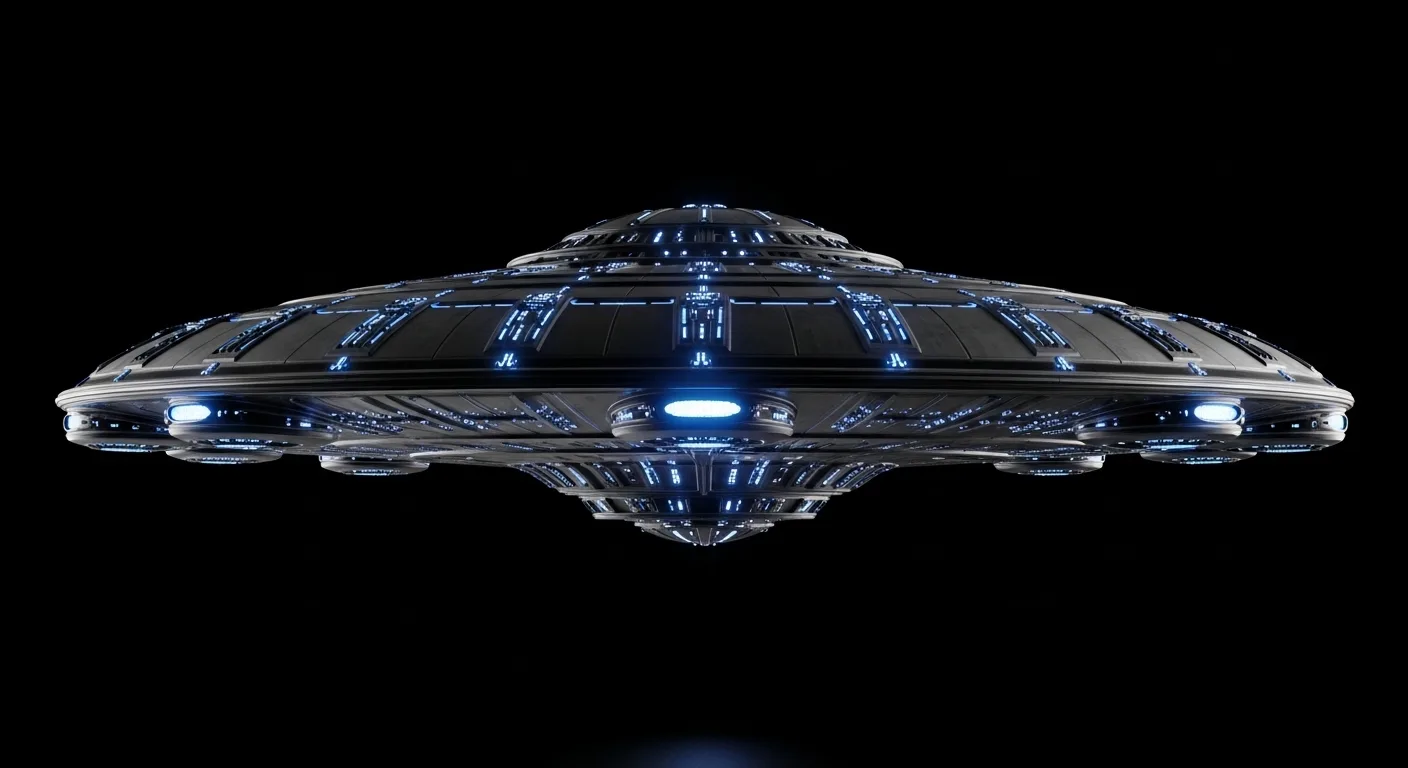
In the early morning hours of September 19, 1976, over the sprawling capital city of Tehran, Iran, an encounter unfolded between Iranian Air Force F-4 Phantom II jet fighters and an unidentified luminous object that would become one of the most significant and best-documented military UFO cases in history. What distinguished this encounter from the countless other UFO sightings reported around the world was not merely the caliber of the witnesses, trained military pilots flying advanced interceptor aircraft, but the apparent technological demonstration that occurred during the pursuit. The object seemed to be aware of the jets sent to intercept it. It appeared to disable their weapons and communications systems at will. And it released a secondary object that descended toward one of the fighters at high speed before rejoining its parent craft. The incident was documented in a classified report by the United States Defense Intelligence Agency, which described it as a “classic” case meeting all the criteria of a genuine UFO encounter. The Tehran incident forced military and intelligence professionals to confront the possibility that something was operating in Iranian airspace that was not merely unidentified but demonstrably superior to the most advanced technology available to the intercepting forces.
The City Below
Tehran in 1976 was a city of contrasts. Under the Shah, Iran was one of America’s closest allies in the Middle East, a recipient of advanced military equipment and a key pillar of Western strategy in the region. The Iranian Air Force operated American-built F-4 Phantom II fighters, among the most capable combat aircraft in the world at that time, flown by pilots who had been trained to Western standards. The military establishment was professional, well-equipped, and oriented toward the kind of disciplined reporting and command structure that produces reliable accounts of unusual events.
The city itself was a metropolis of several million people, spread across a broad plain at the foot of the Alborz Mountains. The night skies over Tehran were often clear, the dry climate providing excellent visibility, but the city’s lights created the usual challenges for astronomical observation. On the night in question, however, what people were seeing was not subtle or ambiguous. It was brilliant, structured, and unmistakable.
The Initial Reports
The sequence of events began around 12:30 AM on September 19, when the Imperial Iranian Air Force command post at Mehrabad Airport received multiple telephone calls from civilians in the Shemiran district of northern Tehran, reporting a bright, unusual object in the sky. The callers described a large, brilliant light that appeared to be diamond-shaped, emitting flashing colored lights in sequences of blue, green, red, and orange. The object was clearly visible to the naked eye and appeared to be hovering at a considerable altitude.
General Nader Yousefi, the assistant deputy commander of operations for the Iranian Air Force, received these reports and initially dismissed them as probable sightings of a star or planet. However, after the volume of calls continued to increase, Yousefi stepped outside to observe the sky himself. What he saw convinced him that the reports warranted investigation. The object was clearly visible, clearly structured, and clearly not a celestial body. It was too bright, too large, and too dynamic in its light emissions to be any known astronomical object.
Yousefi ordered an F-4 Phantom II scrambled from Shahrokhi Air Force Base to investigate. This decision, to commit a front-line combat aircraft to investigate a UFO report, reflected both the seriousness with which the reports were being treated and the resources available to the Iranian Air Force. The Phantom was the appropriate tool for the job, a fast, high-altitude interceptor with powerful radar and the ability to close quickly on any airborne target.
The First Intercept
The first F-4, piloted by a pilot identified in various accounts as Captain Mohammad Reza Azizkhani, took off and headed north toward the reported position of the object. As the Phantom climbed and turned toward the target, the pilot acquired the object visually. It was brilliant, easily visible from a considerable distance, and it appeared to be much larger than any aircraft he had ever encountered.
As the F-4 closed on the object, attempting to reach a range at which he could identify it more clearly, something extraordinary happened. The aircraft’s instrumentation began to malfunction. Navigation instruments became erratic, and communications equipment failed. The pilot found himself unable to contact his base or to rely on his cockpit instruments for basic flight information. The failures were systemic and simultaneous, affecting multiple independent systems that had no common failure mode.
Faced with the loss of his instruments and communications, the pilot made the prudent decision to break off the intercept and return to base. As he turned away from the object and began heading back toward Shahrokhi, his instruments came back online. Navigation systems returned to normal. Communications were restored. The failures had coincided precisely with his approach to the object and had ceased precisely when he withdrew. The correlation was impossible to ignore.
The Second Intercept
A second F-4 was immediately scrambled, this time piloted by Lieutenant Parviz Jafari, a skilled and experienced aviator who would later achieve the rank of general in the Iranian Air Force. Jafari’s account of what happened next is one of the most detailed and compelling military UFO reports ever recorded.
Jafari acquired the object on his aircraft’s radar at a range of approximately 27 nautical miles. The radar return was strong and clear, indicating a large, solid object. As Jafari closed on the target, he could see it visually as well, a brilliantly illuminated object that appeared to be changing colors in a rapid sequence. The object was enormous, its apparent size suggesting something far larger than any conventional aircraft.
As Jafari approached to within approximately 25 nautical miles of the object, it began to move, accelerating away from the pursuing Phantom while maintaining its altitude. The F-4 was operating at maximum speed, but the object maintained its distance effortlessly, always staying just beyond the range at which Jafari could have engaged it with weapons or closed to visual identification range. The chase continued for some time, with the object apparently adjusting its speed to match the Phantom’s maximum capability.
Then the object released a secondary object. A bright, intensely luminous body separated from the main craft and descended toward Jafari’s F-4 at tremendous speed. The smaller object was round and brilliantly lit, heading directly for the Phantom on what appeared to be a collision course. Jafari’s combat training took over. He attempted to fire an AIM-9 Sidewinder missile at the approaching object, but when he reached for his weapons control panel, it was dead. The entire weapons system, missiles, fire control, targeting, all of it was offline. His communications system had also failed, just as the first pilot’s had.
Unable to fire and unable to call for help, Jafari executed a hard diving turn to evade the incoming object. The smaller object followed his maneuver for a short distance before reversing course and climbing back to rejoin the main craft. As it returned to the parent object, it merged with it seamlessly, as if being reabsorbed.
Moments later, a second object detached from the main craft, this time descending not toward Jafari’s aircraft but toward the ground. Jafari watched as the bright object dropped rapidly and appeared to land or hover near the ground in an area that was later identified as a dry lake bed south of Tehran. The object illuminated a large area around its landing site with intense light before eventually going dark.
Throughout these events, Jafari’s weapons and communications systems remained offline. Only after the main object departed, climbing rapidly to extreme altitude and disappearing, did his instrumentation return to normal function. The correlation between proximity to the objects and system failures was, as with the first Phantom, precise and unmistakable.
The DIA Report
The incident was documented through official channels and came to the attention of the United States Defense Intelligence Agency through the U.S. Military Advisory Group in Iran. The DIA produced a classified report on the incident that was later declassified and made available to the public. This document is one of the most significant pieces of official documentation in UFO history, not because it claims to know what the object was, but because of the seriousness and detail with which it treats the encounter.
The DIA report describes the incident in clinical, factual language, cataloging the sequence of events, the capabilities demonstrated by the object, and the effects on the intercepting aircraft. It notes that the case meets all the criteria of a legitimate UFO encounter: multiple credible witnesses, including military pilots; simultaneous visual and radar contact; electromagnetic effects on aircraft systems; and object performance characteristics that exceeded the capabilities of any known technology.
The report’s description of the case as a “classic” UFO encounter was significant because it came not from a UFO enthusiast or conspiracy theorist but from a professional intelligence agency whose business was the sober assessment of potential threats. The DIA was not in the habit of attributing supernatural qualities to aerial phenomena. When it described the Tehran incident as a classic case, it was making a professional judgment that the evidence met a standard of credibility that could not be dismissed.
The Technology Demonstrated
The Tehran incident is particularly significant because of the specific technological capabilities apparently demonstrated by the object. These capabilities went beyond mere speed and maneuverability, the standard repertoire of UFO reports, and included what appeared to be the deliberate, targeted interference with specific aircraft systems.
The electromagnetic effects experienced by both F-4s followed a clear pattern. As each aircraft approached the object, its weapons and communications systems failed. As each aircraft withdrew, the systems returned to normal. This was not random malfunction. It was correlated precisely with proximity to the object, suggesting that the object was either deliberately disabling the aircraft’s systems or was generating some form of field effect that happened to interfere with electronic equipment.
The specificity of the interference was noteworthy. In both cases, the systems that failed were those most relevant to an intercept scenario: weapons, which would allow the pilot to engage the object, and communications, which would allow the pilot to report and receive instructions. Navigation systems were affected but not completely disabled, allowing the pilots to maintain basic control of their aircraft. This selective targeting of combat-relevant systems suggested not random electromagnetic interference but a deliberate and discriminating technological response.
The release of the secondary objects added another dimension to the encounter. The first sub-object’s direct approach toward Jafari’s Phantom appeared to be a countermeasure or deterrent, a clear signal that the object was aware of the interceptor’s hostile intent and capable of responding. The second sub-object’s descent to the ground suggested either a separate function, perhaps reconnaissance or sample collection, or a demonstration of additional capabilities.
Jafari’s Later Career and Testimony
Lieutenant Parviz Jafari continued his career in the Iranian Air Force, eventually reaching the rank of general. Throughout his career and into retirement, he maintained his account of the Tehran encounter without variation. He described the events in interviews, at conferences, and in written accounts, always with the same details, the same sequence of events, and the same measured assessment of what he had experienced.
Jafari’s consistency and credibility have made him one of the most important UFO witnesses in military history. He was not a raw recruit or an excitable observer. He was a combat pilot flying one of the world’s most advanced fighter aircraft, trained to remain calm under pressure and to report accurately on what he observed. His account was given through official military channels at the time of the event and has been confirmed by other military personnel involved in the incident.
In 2007, Jafari appeared at the National Press Club in Washington, D.C., alongside other military witnesses from around the world, to describe his encounter and to call for official transparency regarding UFO phenomena. His testimony at this event, delivered with quiet authority by a retired general, carried a weight that few civilian witnesses could match.
Significance and Legacy
The Tehran incident of 1976 is consistently ranked among the most significant military UFO encounters ever documented. Its importance rests on several factors that distinguish it from the vast majority of UFO reports.
First, the witnesses were military professionals operating advanced equipment, not civilians making casual observations. Their training, experience, and the technical capabilities of their aircraft lend a degree of credibility to the report that few other cases can match.
Second, the encounter involved both visual and radar confirmation, eliminating the possibility that the object was an optical illusion, a misidentified star or planet, or any other phenomenon visible only to the naked eye. The radar return confirmed that something solid and substantial was present in the sky above Tehran.
Third, the electromagnetic effects on the aircraft systems represented a physical interaction between the object and the interceptors, an effect that went beyond mere observation and into the realm of measurable, consequential impact. Aircraft systems do not fail and then recover in precise correlation with proximity to an external stimulus unless that stimulus is real and is causing the failures.
Fourth, the incident was documented through official military and intelligence channels, preserved in a DIA report that was produced by professionals with no motivation to fabricate or sensationalize the events. The report is a dry, factual document that states what happened without attempting to explain it, which is itself a form of testimony: the intelligence professionals who wrote it could not explain what had occurred over Tehran that night.
The Tehran incident asks uncomfortable questions about the nature of the phenomenon and about human technological supremacy. Whatever appeared over the Iranian capital in September 1976 demonstrated awareness of the intercepting aircraft, the ability to neutralize their weapons and communications at will, and the capacity to deploy sub-objects for purposes that remain unknown. These are not the characteristics of a natural phenomenon or a misidentified celestial body. They are the characteristics of a technology, a technology that operated with impunity in the airspace of a nation defended by some of the most advanced military equipment in the world.
Nearly five decades later, those questions remain unanswered. The object that appeared over Tehran has never been identified. The technology it demonstrated has never been replicated or explained. The pilots who chased it have never wavered in their accounts. And the DIA report, measured and professional, still sits in the files, describing in restrained language an event that challenged everything the intelligence community thought it knew about what was possible in the skies above the Earth.
Sources
- CIA UFO/UAP Reading Room — Declassified CIA documents on UAP