The Tehran UFO Incident
Iranian jets chased a UFO that disabled their weapons systems.
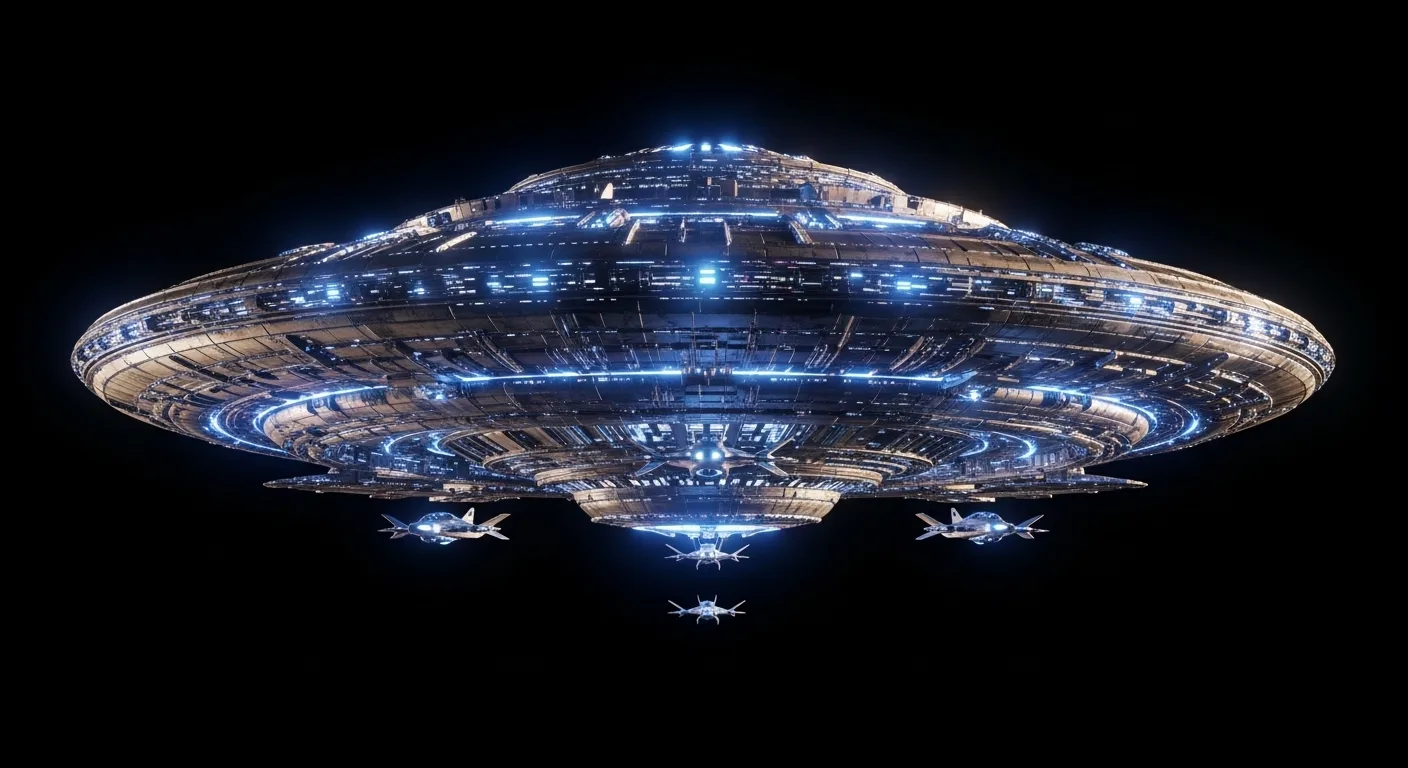
In the early morning hours of September 19, 1976, the skies above Tehran became the stage for one of the most thoroughly documented and compelling military encounters with an unidentified flying object in history. What began with confused telephone calls from alarmed citizens escalated rapidly into a confrontation between Imperial Iranian Air Force jet fighters and an object that demonstrated technological capabilities far beyond anything in the arsenals of any nation on Earth. The encounter was recorded in official military communications, analysed by the United States Defense Intelligence Agency, and remains to this day without satisfactory conventional explanation. The Tehran incident is not a story of ambiguous lights glimpsed briefly by untrained observers—it is a case involving radar confirmation, multiple military witnesses, electromagnetic interference with advanced weapons systems, and documentation at the highest levels of intelligence analysis.
Iran in 1976: A Nation Between Worlds
To understand the Tehran UFO incident in its proper context, one must appreciate the particular moment in Iranian history in which it occurred. In 1976, Iran was ruled by Shah Mohammad Reza Pahlavi, who had embarked on an ambitious programme of modernisation that included massive investment in military capability. The Imperial Iranian Air Force was equipped with some of the most advanced American-made aircraft available, including the McDonnell Douglas F-4 Phantom II—a twin-engine, all-weather interceptor that was among the finest combat aircraft in the world at that time.
Iranian pilots were trained to American standards, many having received instruction at bases in the United States. The air force operated sophisticated radar systems and maintained communication networks that linked military installations across the country. This was not a poorly equipped or poorly trained force likely to confuse conventional phenomena with extraordinary ones. The pilots who would be scrambled to intercept the Tehran UFO were professionals, experienced in high-performance aircraft operations and trained to maintain composure under pressure.
Tehran itself, the capital city, was home to several million people and was protected by an integrated air defence network. Mehrabad International Airport, located in the western part of the city, served as both a civilian airport and a military air base, with fighter squadrons on alert to respond to potential threats to the capital. The events of September 19 would test this defence system in ways that no one had anticipated.
The First Reports: Lights Over the City
The incident began shortly after midnight on September 19, 1976, when the Imperial Iranian Air Force command post at Mehrabad Airport began receiving telephone calls from residents of the Shemiran district in northern Tehran. The callers reported a bright, unusual object in the sky that did not resemble any conventional aircraft. The object was described as intensely luminous, larger than a star, and appearing to change shape or pulse with light. Its colours shifted between blue, green, red, and orange in patterns that seemed deliberate rather than random.
The duty officer at the command post, Brigadier General Yousefi, initially suspected that the callers were observing a star or planet near the horizon, where atmospheric distortion can cause celestial objects to appear to change colour and twinkle dramatically. However, as the calls continued to arrive from different parts of the city, all describing the same object in the same part of the sky, Yousefi stepped outside to observe for himself.
What he saw convinced him that this was no star. The object was brilliant, far brighter than any celestial body, and appeared to be at a relatively low altitude compared with stars or planets. It seemed to hover without sound, and its light display was unlike anything in his considerable military experience. Yousefi made the decision to scramble a fighter to investigate.
The First Intercept: Systems Failure
At approximately 1:30 AM, an F-4 Phantom II was launched from Shahrokhi Air Force Base (now Hamadan Air Base) with orders to investigate the object. The pilot climbed to altitude and headed toward the light, which was visible from a considerable distance. As the jet closed to within approximately twenty-five nautical miles of the object, something extraordinary happened—the aircraft’s instrumentation began to fail.
The pilot reported that his communications equipment ceased functioning. His navigation instruments became unreliable. The cockpit displays flickered and malfunctioned. The aircraft, one of the most sophisticated fighting machines in the world, was suddenly reduced to a barely controllable airframe. The pilot, unable to communicate with his base or navigate effectively, had no choice but to break off the approach and return to Mehrabad.
The moment the F-4 turned away from the object and began to increase its distance, every system on the aircraft returned to normal operation. Communications restored themselves, navigation instruments resumed accurate readings, and cockpit displays functioned perfectly. The correlation was unmistakable—proximity to the object had caused the failures, and distance from it resolved them. This was not a random equipment malfunction; it was an apparent demonstration of the object’s ability to interfere with sophisticated electronic systems at will.
The pilot landed safely and reported his experience to the command post. General Yousefi, now deeply concerned about both the nature of the object and the potential threat it represented, ordered a second interceptor launched.
The Second Intercept: A More Dangerous Game
The second F-4 Phantom was scrambled at approximately 1:40 AM, piloted by Lieutenant Parviz Jafari with Lieutenant Jalal Damirian as his radar intercept officer. Jafari was an experienced pilot, confident in his aircraft and his abilities, and he approached the object with professional determination to identify what had defeated his colleague.
The object was immediately visible—an intensely bright light that appeared to be approximately the size of a full moon at the distance from which Jafari first observed it. As the F-4 closed range, the object became more distinct. Jafari would later describe it as emitting light in a rectangular pattern, with strobing lights that cycled through blue, green, red, and orange so rapidly that all four colours appeared to be displayed simultaneously. The object was enormous, and its luminosity was so intense that it was difficult to look at directly.
More significantly, Jafari’s radar intercept officer was able to acquire the object on the F-4’s radar. The radar return was, in Jafari’s words, “comparable to that of a [Boeing] 707 tanker”—indicating an object of very substantial size. This radar confirmation elevated the encounter from a visual sighting to an instrumentally verified contact. Whatever the object was, it had physical substance sufficient to reflect radar energy, ruling out purely optical phenomena such as reflections, mirages, or atmospheric effects.
As the F-4 closed to within twenty-five nautical miles, the object began to move, matching the jet’s approach speed and maintaining a constant distance. Every time Jafari attempted to close the gap, the object accelerated away, keeping itself tantalisingly out of reach while never disappearing entirely. This behaviour strongly suggested intelligent control—the object appeared to be aware of the pursuing aircraft and was deliberately maintaining a specific separation distance.
The Weapons System Shutdown
The most dramatic moment of the encounter came when a smaller, intensely bright object suddenly detached from the main UFO and streaked directly toward the F-4 at high speed. Jafari, interpreting this as a hostile act, attempted to engage the incoming object with an AIM-9 Sidewinder heat-seeking missile. He selected the weapon and attempted to fire.
Nothing happened. The weapons control panel had gone completely dead. Simultaneously, all communications—both UHF and intercom—ceased functioning. The sophisticated weapons systems of the F-4 Phantom, designed to engage enemy aircraft in the most demanding combat conditions, had been rendered entirely inoperative at the precise moment when the pilot attempted to use them against the unidentified object.
Jafari, now facing what appeared to be an incoming hostile object with no weapons and no communications, took the only action available to him—a sharp negative-G dive to evade the approaching light. The smaller object followed the diving F-4 for a short distance, turning inside the jet’s manoeuvre with an ease that demonstrated flight characteristics far beyond any known aircraft. Then, as abruptly as it had appeared, the smaller object reversed course and returned to the main UFO, merging back into it seamlessly.
As Jafari pulled out of his dive and increased his distance from the main object, his weapons systems and communications restored themselves—exactly as had happened with the first F-4. The pattern was now unmistakable. The object possessed the ability to selectively disable the electronic and weapons systems of advanced military aircraft, and it exercised this ability with precision and apparent intent, shutting down only the systems relevant to an attack while leaving the aircraft’s basic flight controls functional. This was not broad-spectrum electromagnetic interference; it appeared to be targeted, intelligent jamming of specific systems.
A Second Object and the Landing Light
The encounter was not yet over. As Jafari regained altitude and composure, he observed another bright object separate from the main UFO, this time descending rapidly toward the ground. He watched as it descended at great speed, expecting an impact, but instead the object settled gently onto the ground in an area south of Tehran, illuminating a wide swath of terrain so brightly that the ground was clearly visible from Jafari’s altitude. The glow was estimated to cover an area approximately two to three kilometres in diameter.
Jafari noted the location and continued to observe while maintaining a respectful distance from the main object. His instruments were functioning normally at the increased range, and he reported his observations to the command post. As fuel considerations eventually required him to break off, Jafari noticed a third unusual phenomenon—a cylindrical-shaped object with steady lights at each end and a flasher in the middle passed beneath his aircraft as he turned for home. He could not identify this object either.
During the return to base, both Jafari and his radar intercept officer experienced further instrument anomalies as they passed through a particular area, and both men noticed a strong sensation of pressure or presence that they found difficult to articulate. Upon landing safely at Mehrabad, they discovered that a civilian aircraft approaching Tehran at the same time had also experienced communications difficulties in the same area where the military jets had encountered problems.
The Ground Investigation
At first light on September 19, a helicopter was dispatched to the area where the second object had appeared to land. The crew located a dry lake bed in the general area indicated by Jafari’s observations. While they did not find obvious physical evidence of a landing, they noted that their communications equipment experienced interference when they hovered over a particular area. Residents of a nearby village reported having heard a loud noise and seen a bright light during the night, consistent with the time of the observed descent.
The helicopter crew also detected what they described as unusual readings on their instruments over a specific area, though the details of these readings have been subject to varying accounts over the years. The ground investigation was limited in scope and did not produce the kind of dramatic physical evidence—landing traces, radiation signatures, material samples—that would have provided irrefutable proof of an unconventional object’s presence.
The DIA Report: “A Classic Case”
The Tehran incident might have remained a remarkable but obscure military encounter had it not attracted the attention of the United States Defense Intelligence Agency. A detailed report on the incident was prepared by the U.S. Defence Attaché’s office in Tehran and forwarded to the DIA, where it received a distribution list that included the White House, the Secretary of State, the Joint Chiefs of Staff, the National Security Agency, and the Central Intelligence Agency.
The DIA evaluation form attached to the report contained an assessment that has become one of the most frequently quoted statements in UFO literature. The evaluator rated the information’s value as “High (Unique, Timely, and of Major Significance)” and wrote that the case “meets all the criteria necessary for a valid study of the UFO phenomenon.” This assessment, coming from one of the premier intelligence agencies of the world’s most powerful nation, gave the Tehran incident a level of official credibility that few UFO cases have ever achieved.
The report itself is a model of military precision, laying out the sequence of events in chronological order with details of times, positions, altitudes, and equipment failures. It notes the radar confirmation of the object, the electromagnetic effects on two separate aircraft, the apparent intelligent behaviour of the object in maintaining distance and deploying smaller objects, and the correlation between proximity and systems failure. The document was classified at the time but was later released through Freedom of Information Act requests, making it available to researchers and the public.
Witness Credibility
The credibility of the witnesses in the Tehran case is exceptionally strong. Lieutenant Parviz Jafari went on to become a general in the Iranian Air Force and maintained his account of the encounter consistently throughout his career and into retirement. He has spoken about the incident at international conferences, submitted testimony to official bodies, and never wavered in his description of what occurred. His radar intercept officer similarly maintained his account.
General Yousefi, who ordered the interceptors scrambled, confirmed the sequence of events from the command post perspective. Radar operators at Mehrabad confirmed tracking both the F-4s and, at times, the object itself. The civilian airline crew that experienced communications difficulties provided independent corroboration of electromagnetic effects in the area.
These were not civilians reporting ambiguous lights in the sky. They were trained military professionals operating sophisticated equipment, people whose careers and reputations depended on accurate observation and truthful reporting. The suggestion that they collectively hallucinated or fabricated the encounter strains credulity far more than the encounter itself.
Attempted Explanations
Various conventional explanations have been proposed for the Tehran incident, none of which adequately accounts for all the observed phenomena.
The planet Jupiter was near the position in the sky where the initial object was observed, and sceptics have suggested that the first reports from Tehran residents may have been prompted by Jupiter’s brightness. However, Jupiter cannot account for the radar returns, the electromagnetic interference with two separate aircraft, the deployment of smaller objects, or the ground illumination observed during the descent phase. At best, Jupiter might explain the initial civilian reports that prompted the investigation, but not the military encounter that followed.
Equipment malfunction has been proposed as an explanation for the instrument failures, with some analysts suggesting that the F-4 Phantoms were experiencing coincidental electronic problems. This theory requires accepting that two different aircraft experienced the same specific failures at the same specific moments—when approaching the object—and that both experienced spontaneous recovery at the same specific moment—when departing from the object. The probability of such a coincidence is vanishingly small.
Psychological explanations, including stress-induced misperception and mass hysteria, fail to account for the radar data, the electromagnetic effects recorded by aircraft instruments, and the independent corroboration from civilian aircraft. Military pilots are specifically trained to resist the effects of stress on perception, and the crew of the second F-4 demonstrated professional composure throughout the encounter.
Significance in UFO History
The Tehran UFO incident occupies a position of particular importance in the study of unidentified aerial phenomena for several reasons. First, it is one of the few cases involving military engagement with a UFO that is supported by official documentation from a major intelligence agency. The DIA report provides a level of institutional validation that most UFO cases lack entirely.
Second, the case demonstrates apparent technological capabilities that remain beyond known human engineering nearly five decades later. The selective disabling of specific electronic systems—weapons and communications but not flight controls—implies a level of technological sophistication that goes well beyond simple electromagnetic pulse or broad-spectrum jamming. The object appeared to understand which systems posed a threat and neutralised precisely those systems, while leaving the aircraft capable of safe flight. This suggests either extraordinarily advanced technology or an intelligence capable of real-time analysis and response.
Third, the incident provides one of the clearest examples of apparent intelligent behaviour by a UFO. The object maintained a specific distance from the pursuing aircraft, deployed smaller objects in what appeared to be both defensive and investigative manoeuvres, and demonstrated the ability to disable weapons systems at the precise moment they were about to be used. This pattern of behaviour is consistent with an intelligence that was aware of the military response, understood the capabilities of the pursuing aircraft, and chose to neutralise the threat without destroying the threatening party.
The Enduring Mystery
Nearly fifty years after the events of that September morning, the Tehran UFO incident remains without satisfactory explanation. The object that appeared over the Iranian capital demonstrated capabilities that no known technology—then or now—can replicate. It was tracked by military radar, observed by trained pilots at close range, and documented by one of the world’s leading intelligence agencies. It disabled the weapons systems of advanced military aircraft with surgical precision and deployed smaller objects that manoeuvred with capabilities far exceeding any known aircraft.
Lieutenant Jafari, now General Jafari (retired), has continued to speak about the encounter with the same quiet conviction he demonstrated on the night itself. His account has never changed in its essential details, and his willingness to discuss the incident publicly—despite the professional risks of being associated with UFO claims—speaks to the depth of his certainty about what he experienced.
The Tehran incident stands as a challenge to both the sceptic and the believer. For the sceptic, it presents a case that cannot be easily dismissed—the evidence is too well documented, the witnesses too credible, the electromagnetic effects too precisely correlated with proximity to the object. For the believer, it raises profound questions about the nature and intentions of whatever intelligence was controlling the object—an intelligence that demonstrated overwhelming technological superiority but chose restraint rather than destruction.
In the skies above Tehran, on a night in September 1976, the Imperial Iranian Air Force sent its finest aircraft and its best-trained pilots against something they could not identify, could not match, and could not defeat. The encounter lasted less than an hour, but its implications continue to resonate through the decades, a reminder that the skies above us may harbour visitors whose capabilities we have barely begun to comprehend.
Sources
- CIA UFO/UAP Reading Room — Declassified CIA documents on UAP