The Broadlands UFO Sightings
Lord Mountbatten investigated UFO activity on his estate.
The great estates of England have witnessed much over the centuries, from the dramas of royal succession to the quiet rhythms of agricultural life, but few have played host to events quite as extraordinary as those reported at Broadlands, the Hampshire country seat of Lord Louis Mountbatten. Between 1950 and Mountbatten’s assassination by the IRA in 1979, this gracious Palladian mansion and its surrounding parkland were the site of multiple UFO sightings that attracted the serious attention of one of the most powerful and well-connected men in the British establishment. That a figure of Mountbatten’s stature took the phenomena seriously enough to personally investigate them, interview witnesses, and correspond with researchers remains one of the most remarkable aspects of the case and one of the most tantalizing connections between the UFO phenomenon and the upper echelons of the British state.
The Estate and Its Master
Broadlands sits in the Test Valley near Romsey, approximately eight miles north of Southampton. The estate encompasses some six thousand acres of Hampshire countryside, including formal gardens, ancient woodland, and the parkland that stretches down to the River Test, one of England’s finest chalk streams. The house itself, an elegant eighteenth-century mansion remodeled by Capability Brown and Henry Holland, has been the setting for events of national significance throughout its history. Queen Victoria stayed here. Winston Churchill was a frequent guest. Princess Elizabeth and Prince Philip spent their honeymoon at Broadlands in 1947, as did Prince Charles and Princess Diana in 1981.
The master of Broadlands from 1946 until his death was Admiral of the Fleet Louis Francis Albert Victor Nicholas Mountbatten, First Earl Mountbatten of Burma, known universally as Lord Mountbatten. To describe Mountbatten as well-connected would be an understatement approaching absurdity. He was the great-grandson of Queen Victoria, the uncle of Prince Philip, the great-uncle of King Charles III, and a member of the extended European royal family that intermarried with virtually every throne on the continent. He had served as Supreme Allied Commander in Southeast Asia during World War Two, as the last Viceroy of India, as First Sea Lord of the Royal Navy, and as Chief of the Defence Staff. He was, by any measure, one of the most influential figures in mid-twentieth-century Britain.
Mountbatten was also a man of wide-ranging intellectual curiosity, open to ideas that more conventional minds might have dismissed. His interest in UFOs was genuine, sustained, and informed by a scientific temperament that demanded evidence rather than mere assertion. He read widely on the subject, corresponded with researchers and investigators, and brought to his examination of UFO reports the same analytical rigor that he had applied to naval strategy and colonial administration. This combination of high-level connections, intellectual seriousness, and personal interest made Broadlands a uniquely significant location in the history of British UFO research.
The February 1955 Incident
The most significant and best-documented UFO event at Broadlands occurred on a February morning in 1955, when a member of the estate staff encountered something in the parkland that defied any conventional explanation. The witness was Frederick Briggs, a bricklayer employed on maintenance work at the estate, a man of practical temperament and no prior interest in or knowledge of UFOs.
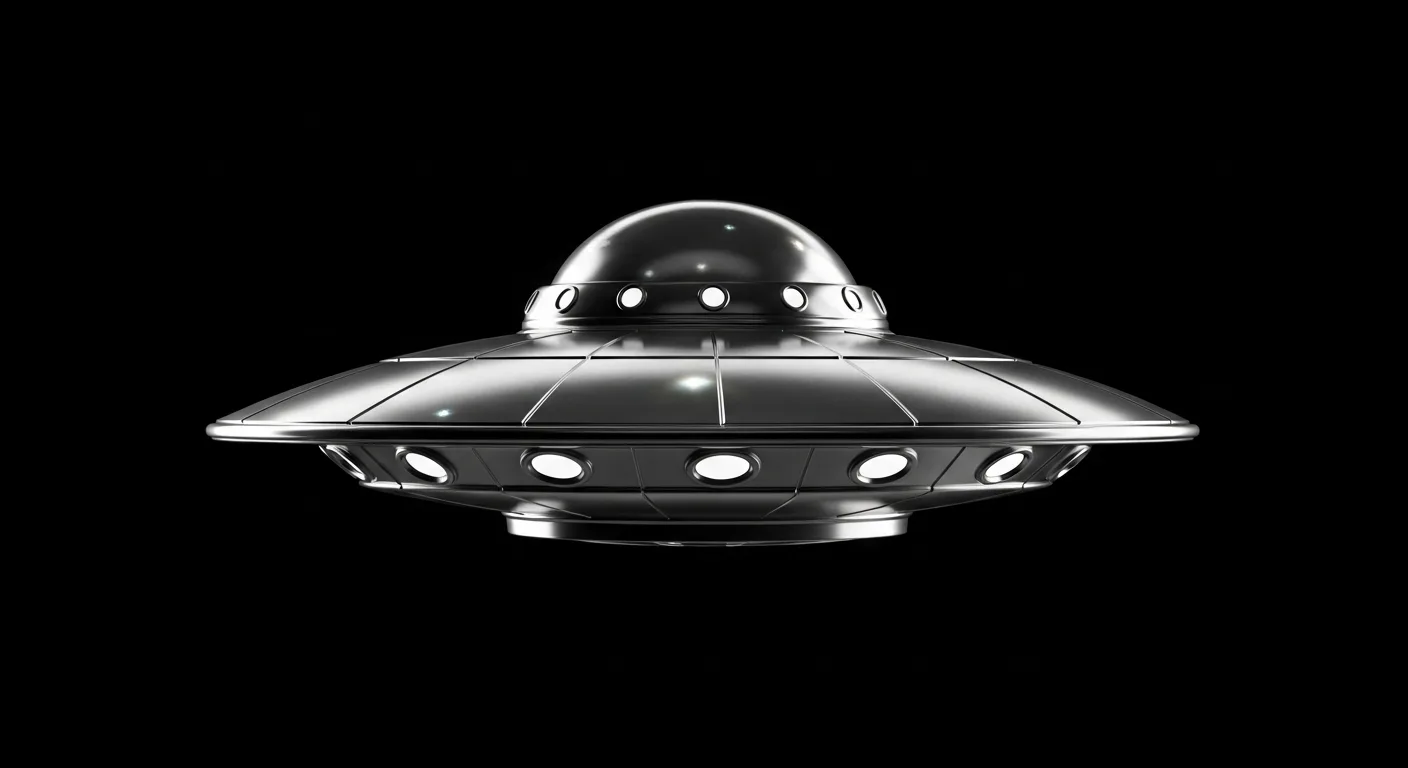
Briggs was cycling across the estate on his way to work when he noticed something unusual in a field ahead of him. As he drew closer, he saw a large disc-shaped object resting on the ground, or hovering just above it, in the middle of the field. The object was approximately thirty feet in diameter, silver or metallic in color, and appeared to be solid and structured. It was not a natural formation, nor was it any piece of agricultural or military equipment that Briggs recognized.
Standing near the object was a figure. The figure appeared humanoid in form, roughly human in size and proportions, and was wearing what Briggs described as a suit of overalls or a one-piece garment. The figure stood motionless near the craft, and Briggs had the impression that it was observing him, though he could not make out facial features at the distance from which he was watching.
As Briggs watched, frozen with astonishment, the figure moved toward the craft and appeared to enter or merge with it. The disc then rose from the ground silently and departed at high speed, climbing rapidly and disappearing from view in a matter of seconds. The entire encounter lasted only a few minutes, but it left Briggs deeply shaken and utterly convinced that he had witnessed something outside the range of normal experience.
Mountbatten’s Investigation
When Briggs reported his experience to the estate management, the report was passed to Lord Mountbatten, who received it not with the dismissal or ridicule that such accounts typically attracted in 1950s Britain but with intense interest and careful attention. Mountbatten personally interviewed Briggs, questioning him in detail about every aspect of the encounter, the appearance of the craft, the behavior of the figure, the duration of the sighting, the weather conditions, the light, the sounds or lack of them, and a dozen other details that a less thorough investigator might have overlooked.
Mountbatten found Briggs to be a credible and reliable witness. The bricklayer was not seeking attention, was not prone to fantasy, and had no motive for fabrication. He told his story simply and consistently, without embellishment, and he was clearly disturbed by what he had seen. Mountbatten was sufficiently impressed by the account to take several additional steps.
First, he had Briggs write a detailed account of his experience in his own words. This document, carefully preserved, provides a firsthand record of the encounter that is remarkable for its clarity and precision. Briggs describes what he saw in the language of a working man, without literary flourish but with the kind of specific, concrete detail that characterizes genuine observation rather than invention.
Second, Mountbatten discussed the case with his nephew, Prince Philip, Duke of Edinburgh, who shared his interest in UFO phenomena. Prince Philip’s engagement with the subject of UFOs is well documented. He subscribed to the Flying Saucer Review, one of the leading UFO journals of the period, and maintained a correspondence with several UFO researchers. The Broadlands sighting gave the Prince a case close to home, connected to the family estate and investigated by a family member whose judgment he respected.
Third, Mountbatten wrote to UFO researchers about the case, sharing Briggs’s account and seeking their assessment. These letters, which have surfaced in various archives over the years, demonstrate that Mountbatten approached the subject with genuine intellectual engagement rather than casual curiosity. He asked specific questions, challenged assumptions, and sought evidence, the habits of a man accustomed to making decisions based on reliable intelligence.
The Written Report
Mountbatten’s report on the Briggs encounter, which was discovered among his papers after his death, is a document of considerable historical interest. Written in Mountbatten’s characteristically precise style, it presents the facts of the case without speculation or advocacy, allowing the reader to draw their own conclusions from the evidence presented.
The report includes Briggs’s own account, Mountbatten’s notes from his interview with the witness, and his assessment of the case’s credibility. Mountbatten notes the witness’s character, his lack of motive for fabrication, and the consistency of his account. He also records the physical details of the sighting with military precision, noting distances, directions, durations, and descriptions in the manner of an intelligence report rather than a sensational narrative.
What is perhaps most striking about the document is what it does not contain. There is no attempt to identify the object or its occupant. There is no speculation about extraterrestrial origin, government cover-ups, or cosmic significance. There is simply a careful presentation of what one man saw in a field in Hampshire on a February morning, recorded by another man who believed the account was important enough to document thoroughly and preserve for posterity.
Other Sightings at Broadlands
The Briggs encounter was the most dramatic but not the only UFO sighting associated with Broadlands. Over the course of the 1950s and 1960s, multiple witnesses reported unusual aerial phenomena over the estate and its surrounding area. These reports came from estate staff, visitors, and residents of the nearby town of Romsey, and they described a range of phenomena that, while less spectacular than Briggs’s close encounter, contributed to a pattern of activity that suggested Broadlands was not an ordinary piece of English countryside.
The most commonly reported phenomena were unusual lights in the sky over the estate, lights that moved in ways inconsistent with conventional aircraft, satellites, or natural celestial objects. Witnesses described luminous objects that hovered, accelerated rapidly, changed direction instantaneously, and disappeared without trace. Some of these lights were seen by multiple witnesses simultaneously, reducing the likelihood of individual misperception.
On several occasions, witnesses reported seeing disc-shaped or oval objects in daylight, moving silently over the parkland or the surrounding woodland. These objects were typically described as metallic or reflective, catching the sunlight as they moved, and they were observed long enough for witnesses to confirm that they were not birds, conventional aircraft, or balloons.
Mountbatten documented these reports with the same thoroughness he had applied to the Briggs case, creating a file of sightings that apparently grew over the years. The fate of this complete file is uncertain; some documents have surfaced in archives and through researchers who had access to Mountbatten’s papers, but the full extent of his UFO documentation remains unknown.
The Royal Connection
The involvement of Lord Mountbatten and Prince Philip in UFO research represents one of the most intriguing intersections between the paranormal and the British establishment. Both men occupied positions of extraordinary influence and access, and their interest in UFO phenomena was not a secret indulgence but a matter they were willing to discuss, at least in certain circles, with candor and seriousness.
Prince Philip’s interest in UFOs has been extensively documented by researchers and biographers. He received UFO reports from military contacts, discussed the subject with scientists and intelligence officials, and maintained his interest throughout his life. His connection to Broadlands, where he had spent his honeymoon and where his uncle was documenting UFO sightings, provided a personal dimension to his broader engagement with the subject.
The significance of the royal connection extends beyond the personalities involved. If members of the royal family and the highest levels of the military establishment were taking UFO phenomena seriously, it suggests either that they had access to information that convinced them the subject merited attention or that the phenomena themselves were compelling enough to overcome the natural skepticism of experienced, worldly individuals. Either possibility is significant.
Mountbatten’s position as Chief of the Defence Staff from 1959 to 1965 placed him at the apex of Britain’s military hierarchy during a period when UFO reports were a matter of active concern to defense establishments worldwide. Whether his personal interest in the subject influenced military policy on UFO reporting, or whether his military role gave him access to UFO information that reinforced his personal interest, are questions that remain unanswered.
Hampshire’s Broader History
Broadlands does not exist in a paranormal vacuum. Hampshire has a long history of unusual aerial phenomena, from the mysterious airship sightings of the early twentieth century to more recent UFO reports that continue to emerge from the county. The Test Valley, where Broadlands sits, has been the subject of multiple UFO reports over the decades, and researchers have noted a correlation between sighting locations and certain geological features, particularly the chalk aquifers and river systems that characterize the Hampshire landscape.
Whether these geographic correlations are meaningful or coincidental is debated. Some researchers have proposed that certain geological formations, particularly those involving quartz-bearing rock and underground water, may generate electromagnetic effects that either attract UFO phenomena or create conditions that cause people to perceive unusual things. Others dismiss such theories as attempts to find patterns in data that are essentially random.
What is undeniable is that Hampshire has produced a disproportionate number of UFO reports relative to its population, and that the area around Broadlands has been particularly active. Whether this reflects genuine phenomena, a reporting bias created by Mountbatten’s known interest in the subject, or some other factor is impossible to determine with certainty.
Skeptical Perspectives
The Broadlands UFO sightings have attracted skeptical scrutiny, as all UFO cases must. Critics have suggested various conventional explanations for the phenomena reported at the estate, from misidentified aircraft and weather balloons to atmospheric phenomena and optical illusions.
The Briggs encounter, as the most dramatic case, has received the most skeptical attention. Some have suggested that Briggs may have encountered an experimental military aircraft, noting that Hampshire is home to several defense research establishments and that the 1950s were a period of intense aeronautical experimentation. Others have proposed that he misidentified a more mundane object, perhaps agricultural equipment or a temporary structure, under conditions that made accurate perception difficult.
These explanations face the same challenge that confronts skeptical assessments of many well-documented UFO cases: they require the witness to have been profoundly mistaken about fundamental aspects of his observation. Briggs was a practical man with good eyesight who observed the object at close range in daylight conditions. The suggestion that he confused a disc-shaped craft with a humanoid occupant for a piece of farm machinery or an experimental helicopter strains plausibility.
Mountbatten’s own assessment of the case is perhaps the most telling response to skeptical objections. He was not a credulous man. He had spent his career evaluating intelligence reports, assessing the reliability of witnesses, and making decisions based on evidence. His conclusion that Briggs was telling the truth and that the sighting warranted serious investigation was not the product of wishful thinking but of professional judgment applied to the available evidence.
The Legacy of Broadlands
Lord Mountbatten was assassinated by the IRA on August 27, 1979, when a bomb planted on his fishing boat detonated in Mullaghmore harbor in County Sligo, Ireland. His death brought an abrupt end to whatever investigations he may have been conducting and left his UFO files in a state of uncertain completeness.
The Broadlands sightings remain significant for several reasons. They demonstrate that UFO phenomena were taken seriously at the highest levels of the British establishment, not as a matter of public policy but as a matter of private conviction among individuals with access to information and resources far beyond those available to ordinary researchers. They provide a well-documented case, the Briggs encounter, that combines a credible witness, a close-range observation, and a thorough investigation by a qualified interviewer. And they raise questions about what else may have been known, discussed, or investigated in the corridors of power that has never reached the public domain.
Broadlands itself continues as an estate and events venue, its grounds open to the public on certain occasions. The parkland where Briggs saw his silver disc is unchanged, the same gentle Hampshire landscape of meadows and woodland that it has been for centuries. The field where the encounter took place looks like any other English field, unremarkable to the casual observer, giving no indication that something once rested there that came from somewhere else entirely.
The connection between Broadlands and the UFO phenomenon is one of those stories that exists at the intersection of the documented and the mysterious, supported by enough evidence to be taken seriously but incomplete enough to resist final conclusions. Lord Mountbatten believed that something extraordinary was happening in the skies above his estate. Frederick Briggs knew that he saw something extraordinary in a field. Between the belief of the admiral and the knowledge of the bricklayer lies a mystery that the passage of time has neither resolved nor diminished.
Sources
- Project Blue Book — National Archives — USAF UFO investigation files, 1947–1969
- CIA UFO/UAP Reading Room — Declassified CIA documents on UAP
- UK National Archives — UFO Files — MoD UFO investigation records
- British Newspaper Archive — UK press archive