The Lakenheath-Bentwaters UFO
RAF jets chased UFOs tracked on multiple radar stations.
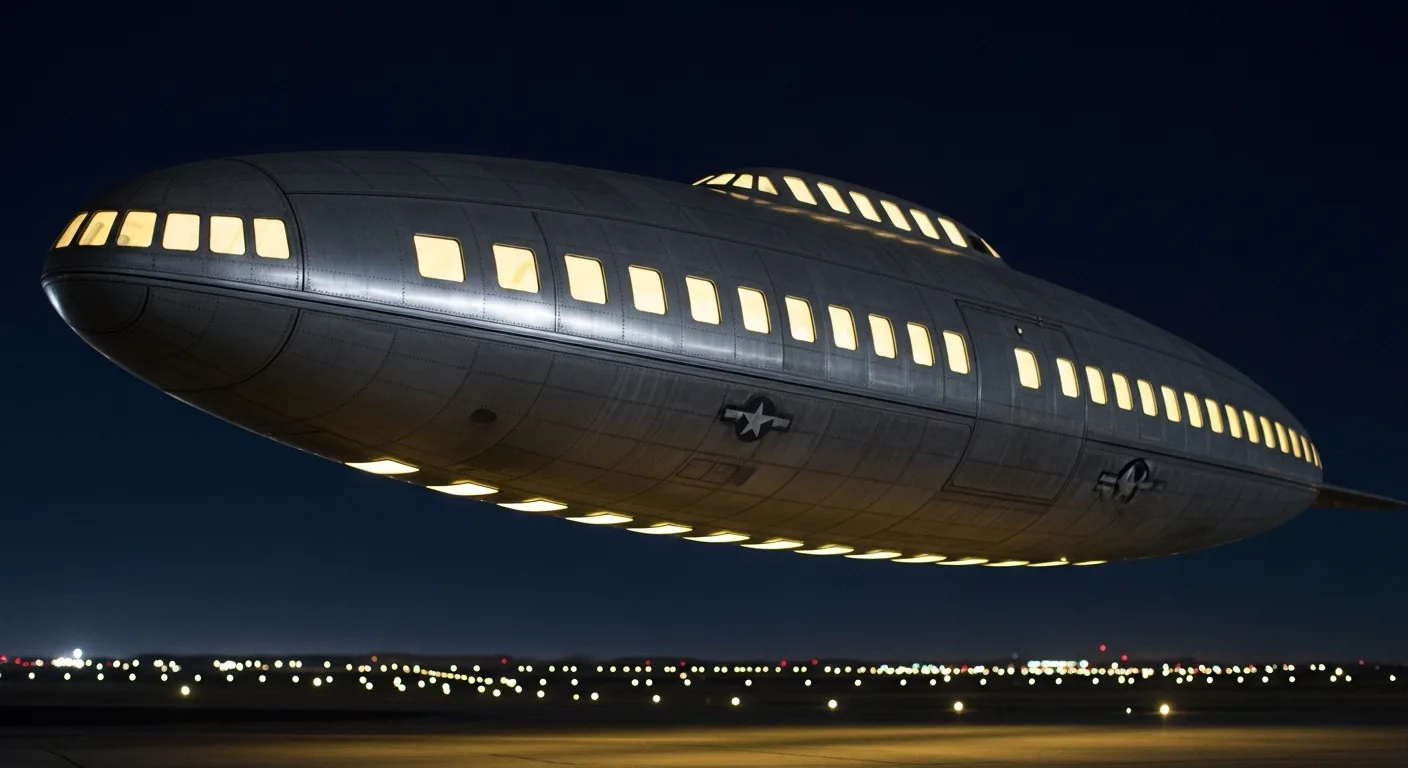
On the night of August 13-14, 1956, the flat farmlands of Suffolk played host to one of the most compelling UFO encounters in recorded history. Over the course of several hours, unidentified objects were tracked on multiple independent radar systems, observed visually by trained military personnel on the ground, and pursued by Royal Air Force interceptors whose pilots found themselves outmaneuvered by craft displaying flight characteristics far beyond anything in the arsenals of the Cold War superpowers. What makes the Lakenheath-Bentwaters incident so remarkable is not merely the strangeness of the events themselves, but the quality and quantity of the witnesses involved—radar operators, air traffic controllers, fighter pilots, and ground observers, all of them trained professionals working within the disciplined framework of military operations. Their testimony, corroborated by electronic evidence from multiple stations, produced a case that official investigators on both sides of the Atlantic ultimately conceded they could not explain.
Cold War Skies Over Suffolk
To appreciate the full weight of what occurred that August night, one must understand the extraordinary military significance of the Suffolk landscape in 1956. The flat, open terrain of East Anglia had made it ideal for airfields since the earliest days of military aviation, and by the mid-1950s the region was home to a dense concentration of American and British air bases that formed a critical component of NATO’s defense against the Soviet Union. RAF Bentwaters and RAF Lakenheath, situated roughly five miles apart in the gently rolling countryside northeast of Cambridge, were among the most important of these installations.
RAF Lakenheath served as a major United States Air Force base, home to tactical fighter squadrons equipped with aircraft capable of delivering nuclear weapons. RAF Bentwaters, also under American operational control, housed additional fighter-bomber units. Together these bases represented a significant element of the West’s nuclear deterrent, and their radar systems were maintained at the highest state of readiness. The men who operated those systems were not hobbyists or casual observers—they were highly trained technicians whose ability to distinguish genuine aerial contacts from false returns was a matter upon which the security of the Western alliance depended.
The Cold War context is essential to understanding both why the events were taken so seriously and why they were subsequently handled with such caution by military authorities. In an era when Soviet bombers might appear over the horizon at any moment, unidentified radar contacts were not curiosities to be pondered at leisure—they were potential threats demanding immediate response. The protocols that governed the detection, identification, and interception of unknown aircraft were rigorous and well-rehearsed, and the men who executed them that night followed their training precisely. What they encountered, however, was something their training had never prepared them for.
The First Contacts at Bentwaters
The sequence of extraordinary events began on the evening of August 13, 1956, at RAF Bentwaters, where Ground Controlled Approach radar operators detected a contact unlike anything they had previously encountered. At approximately 9:30 PM local time, a single blip appeared on the Bentwaters GCA radar scope, moving on a roughly east-to-west heading at a speed that the operators initially found difficult to credit. Careful measurement of the contact’s movement across the scope indicated a velocity between 4,000 and 5,000 miles per hour—a speed far beyond the capability of any known aircraft in 1956, when even the fastest experimental jets were struggling to sustain velocities above 1,500 miles per hour.
The operators watched in astonishment as the contact swept across their scope and disappeared to the west. Before they could fully process what they had seen, additional contacts appeared. A group of three objects was tracked moving in formation from the northeast, their movements coordinated in a way that suggested intelligent control. These contacts converged at a point in the sky and appeared to merge into a single, stronger return before continuing westward. Over the following minutes, additional objects were detected, some stationary and some moving at high speed, creating a picture on the radar scopes that defied conventional explanation.
The radar operators were experienced professionals who understood the many phenomena that could produce false or misleading returns—atmospheric inversions, ground clutter, electronic interference, and equipment malfunction among them. They systematically considered and rejected each of these possibilities. The contacts were sharp, well-defined, and behaved consistently with solid objects moving through the air. They did not display the fuzzy, drifting characteristics of anomalous propagation returns caused by atmospheric conditions, nor did they exhibit the fixed patterns associated with ground clutter or equipment faults. Whatever was producing these radar returns, the operators concluded, was genuinely present in the skies above Suffolk.
Lakenheath Joins the Watch
As the Bentwaters operators tracked their contacts, they alerted RAF Lakenheath, where a separate and entirely independent radar system was in operation. The Lakenheath facility maintained a more powerful surveillance radar with greater range and resolution, and its operators quickly confirmed what their Bentwaters counterparts were seeing. The objects were real, they were present, and they were performing maneuvers that no known aircraft could replicate.
At Lakenheath, the radar picture grew increasingly strange. One contact appeared essentially stationary for an extended period before suddenly accelerating to tremendous speed, covering several miles in a matter of seconds. The object then stopped again, hanging motionless in the air as if gravity and inertia were of no consequence. This start-stop behavior was repeated multiple times, with the object seeming to toy with the laws of physics. The radar operators, accustomed to tracking aircraft that followed predictable flight profiles governed by aerodynamics, found themselves watching something that appeared to operate on entirely different principles.
The fact that two separate radar installations, using different equipment and operated by different personnel, were independently tracking the same objects was of enormous significance. The possibility that a single radar system might malfunction or produce anomalous returns is well established, but the probability of two independent systems simultaneously generating identical false contacts is vanishingly small. The correlation between the Bentwaters and Lakenheath returns provided strong evidence that the objects existed in physical reality rather than in the electronic imagination of the equipment.
Ground observers added a third dimension to the evidence. Personnel at both bases reported seeing unusual lights in the sky that corresponded in position and movement to the radar contacts. These visual sightings were not the vague, ambiguous glimpses of distant lights that characterize so many UFO reports—they were observations made by military personnel who were actively looking for the objects that their radar screens told them were present, and who confirmed that something was indeed visible in the positions indicated by the electronic returns. The agreement between visual observation and radar tracking from multiple stations created a web of corroborating evidence that would prove extremely difficult for skeptics to untangle.
The Venom Intercept
With unidentified objects confirmed on multiple radar systems and corroborated by visual observation, the decision was made to scramble interceptors. An RAF de Havilland Venom night fighter from 23 Squadron, based at RAF Waterbeach near Cambridge, was vectored toward the primary contact being tracked on the Lakenheath radar. The Venom was a capable all-weather interceptor equipped with its own airborne radar, and its pilot was an experienced aviator trained in the demanding art of night interception.
What followed became one of the most extraordinary aerial encounters in the history of military aviation. The Venom pilot, guided by ground controllers at Lakenheath, was directed toward one of the stationary contacts. As he closed on the target’s position, his own airborne radar acquired a strong return—the object was clearly there, registering on yet another independent radar system. The pilot reported achieving a solid radar lock on the target and began his intercept approach.
Then the object moved. Without warning, the contact that had been holding its position suddenly performed a maneuver that the pilot described as impossible for any conventional aircraft. In a matter of seconds, the object repositioned itself from in front of the Venom to directly behind it. The hunter had become the hunted. The pilot’s radar, which moments before had shown the target ahead and below, now showed nothing forward—and ground controllers at Lakenheath could see on their scopes that the unknown object had swung around behind the fighter and was now following it in a position that, in military terms, constituted a perfect tail chase.
The pilot attempted to shake the object. He executed a series of evasive maneuvers—tight turns, altitude changes, speed variations—drawing on all his training and experience to break the contact’s lock on his aircraft. Nothing worked. Through every maneuver, the object maintained its position behind the Venom with an ease that suggested the fighter’s best efforts were trivial to counter. The ground controllers watched in something approaching disbelief as the two returns—one the familiar signature of an RAF interceptor, the other something unknown—traced their way across the radar scope, the unknown object matching every move the pilot made with apparent effortlessness.
After several minutes of fruitless evasion, the pilot reported that he was low on fuel and needed to return to base. As he broke off and headed for Waterbeach, the object appeared to follow briefly before stopping and resuming its stationary position, as if the entire pursuit had been nothing more than a casual demonstration of superiority. A second Venom was scrambled to continue the intercept, but this aircraft experienced mechanical difficulties with its radar and was unable to make contact before the primary object eventually moved off and disappeared from the Lakenheath scopes.
The Weight of Witness Testimony
The credibility of the Lakenheath-Bentwaters case rests heavily on the caliber of the witnesses involved. These were not civilians unfamiliar with aerial phenomena, nor were they individuals prone to sensationalism or fantasy. They were career military professionals working within one of the most disciplined and technically demanding environments in the world—Cold War air defense. Their observations were made not in a state of excitement or confusion but in the course of their normal duties, using equipment they operated daily and understood intimately.
The radar operators who tracked the objects at both Bentwaters and Lakenheath were men whose professional competence was regularly tested and evaluated. Their ability to distinguish genuine aerial contacts from spurious returns was essential to their roles, and errors in either direction—failing to detect a real target or reporting a false one—carried serious consequences. These operators were unanimous in their assessment that the contacts they tracked on the night of August 13-14 were genuine, solid objects performing real maneuvers in real airspace.
The Venom pilot who attempted the intercept was an equally credible witness. Fighter pilots undergo years of rigorous training that hones their observational skills and teaches them to make rapid, accurate assessments of complex tactical situations. This pilot not only saw the object on his own airborne radar but experienced its extraordinary performance firsthand, watching as it executed a maneuver that rendered his own aircraft—a front-line military interceptor—utterly helpless. His account, delivered in the measured, precise language of a professional military aviator, carries a weight that casual UFO reports simply cannot match.
The ground observers who reported visual sightings added yet another layer of corroboration. Their observations, made independently of the radar tracking, confirmed that physical objects were present in the positions indicated by the electronic systems. The convergence of visual and electronic evidence from multiple independent sources created a case that was, in the words of one investigator, about as well-documented as a UFO encounter could possibly be.
Project Blue Book and Official Acknowledgment
The Lakenheath-Bentwaters incident was reported through military channels to the United States Air Force’s Project Blue Book, the official program charged with investigating UFO reports. The case was assigned for analysis, and investigators reviewed the radar data, witness statements, and operational logs from both bases. After thorough examination, Blue Book classified the case as “unexplained”—a designation reserved for incidents that could not be attributed to any known natural phenomenon, equipment malfunction, or misidentification of conventional aircraft.
This classification was not given lightly. Project Blue Book, despite its public mandate to investigate UFO reports objectively, operated under considerable institutional pressure to find conventional explanations for the cases it reviewed. The Air Force was keenly aware that unexplained UFO reports generated public anxiety and media attention, and Blue Book investigators were encouraged to resolve cases whenever possible. When a case resisted all conventional explanation and was classified as “unexplained,” it meant that the investigators had exhausted every reasonable alternative and found none that fit the evidence.
The case received further attention when it was reviewed by the University of Colorado UFO Project, commonly known as the Condon Committee, which was established in 1966 to provide an independent scientific assessment of the UFO phenomenon. The committee’s final report, published in 1969, examined a selection of UFO cases in detail, and the Lakenheath-Bentwaters incident was singled out as one of the most significant. The committee’s analysis, conducted by Gordon Thayer, a radar propagation specialist, concluded that the case involved “the most puzzling and unusual case in the radar-visual files” and that “the probability that at least one genuine UFO was involved appears to be fairly high.”
This assessment was particularly striking because the Condon Report as a whole was generally skeptical of UFO claims and recommended that the Air Force discontinue its UFO investigation program. For such a report to single out the Lakenheath-Bentwaters case as genuinely anomalous was a significant concession—an acknowledgment that, whatever one believed about UFOs in general, this particular incident defied easy explanation.
Atmospheric Anomalies and Skeptical Perspectives
Not all analysts accepted the extraterrestrial hypothesis that many UFO enthusiasts drew from the Lakenheath-Bentwaters data. Skeptics proposed that atmospheric conditions on the night in question might have produced anomalous radar propagation, creating false returns that mimicked the behavior of solid objects. Temperature inversions—layers of warm air above cooler air near the surface—are known to bend radar beams and produce spurious contacts, and weather records indicate that atmospheric conditions in East Anglia that night may have been conducive to such effects.
However, this explanation faces significant difficulties. Anomalous propagation returns typically appear as diffuse, slowly moving blobs on radar screens, quite different from the sharp, well-defined contacts reported by the Bentwaters and Lakenheath operators. Moreover, such returns do not normally execute the kind of precise, coordinated maneuvers described by the witnesses—hovering motionless, accelerating to extreme speed, stopping again, and circling behind an interceptor aircraft. The operators themselves, familiar with the appearance of anomalous propagation on their equipment, explicitly rejected this explanation.
The visual sightings present an additional challenge for the atmospheric explanation. While temperature inversions can affect radar, they do not typically produce visible phenomena that correspond precisely to the positions of radar contacts. The agreement between the visual and electronic observations suggests that something was genuinely present in the sky, rather than that multiple independent observation systems were simultaneously deceived by atmospheric effects.
Other skeptical explanations have been proposed, including misidentification of high-altitude meteors, reflections from conventional aircraft at unusual angles, and even the suggestion that the entire sequence of events resulted from operator error or confusion. None of these explanations has gained wide acceptance among those who have studied the case in detail, and the Lakenheath-Bentwaters incident remains firmly in the category of cases that resist conventional explanation.
A Case That Endures
More than half a century after the events of that August night, the Lakenheath-Bentwaters incident continues to occupy a prominent position in the literature of unexplained aerial phenomena. It has been cited by researchers on both sides of the UFO debate as a case that demands serious attention, whether one ultimately interprets the evidence as proof of extraterrestrial visitation, evidence of advanced but terrestrial technology, or merely an unusually complex combination of mundane factors that conspired to create an apparently inexplicable event.
The case derives its enduring power from the convergence of multiple independent lines of evidence—radar tracking from separate installations, airborne radar confirmation, visual observation from the ground, and the direct experience of a trained fighter pilot who found his aircraft outperformed by an unknown object. Each of these elements, taken alone, might be questioned or explained away. Taken together, they form a body of evidence that has resisted more than six decades of analytical effort.
The Suffolk countryside where these events unfolded remains much as it was in 1956—flat, open, and dominated by the wide East Anglian sky. RAF Lakenheath continues to operate as a United States Air Force base, while RAF Bentwaters was closed in 1993 and has been partially converted to civilian use. The men who witnessed the events of August 13-14, 1956, have largely passed from the scene, but their testimony survives in official records, investigation files, and published accounts that continue to challenge our understanding of what shares the skies above us.
The Lakenheath-Bentwaters case stands as a reminder that not all mysteries yield to investigation, and that the most compelling evidence sometimes comes not from those who sought the extraordinary but from those who encountered it in the course of ordinary duty. The radar operators, controllers, and pilots who reported what they saw that night did not set out to make history. They were simply doing their jobs, watching their screens, flying their aircraft, and defending their airspace. What they found there, silently waiting in the darkness above the Suffolk fields, remains unexplained to this day.
Sources
- Project Blue Book — National Archives — USAF UFO investigation files, 1947–1969
- CIA UFO/UAP Reading Room — Declassified CIA documents on UAP
- UK National Archives — UFO Files — MoD UFO investigation records
- British Newspaper Archive — UK press archive