Lakenheath-Bentwaters Incident
RAF and USAF radar tracked high-speed objects over two air bases in Suffolk. A Venom fighter was scrambled—the UFO got behind the jet and followed it. The pilot couldn't shake it. Ground radar watched the pursuit. Project Blue Book called it 'unexplained.'
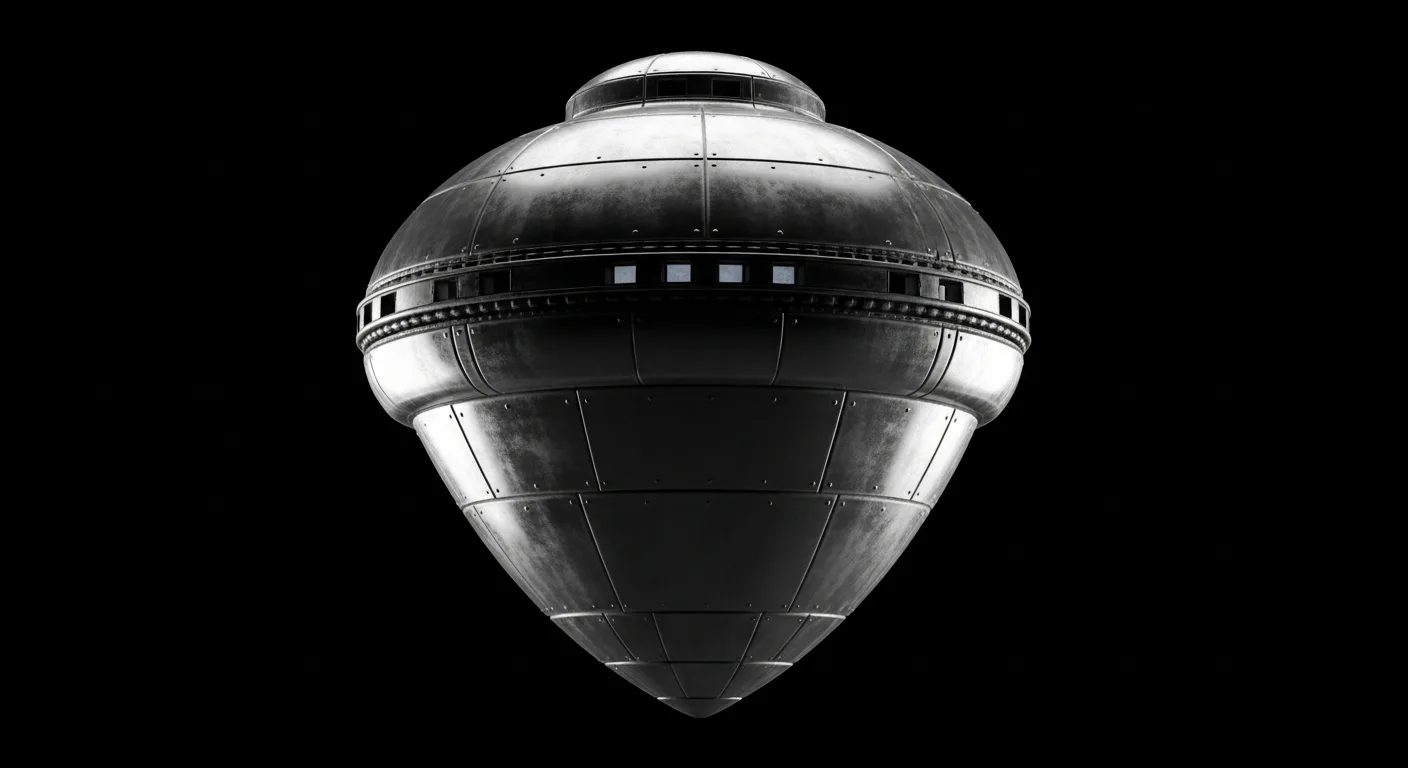
In the annals of UFO investigation, few cases carry the weight of the Lakenheath-Bentwaters incident of August 1956. This was not a vague sighting by untrained observers under poor conditions. This was a multi-radar detection confirmed by visual observation, followed by a fighter jet scramble in which the object demonstrated performance capabilities that exceeded anything in any nation’s arsenal. When the case file reached Project Blue Book, the U.S. Air Force’s official UFO investigation program, the evaluators had no choice but to classify it as “unexplained.”
The Event
The night of August 13-14, 1956, began routinely at the twin RAF bases of Lakenheath and Bentwaters in Suffolk, England. Both facilities hosted American military personnel under NATO arrangements, with radar operators monitoring the airspace as they did every night. What appeared on their screens that night was anything but routine.
Multiple radar contacts were detected behaving in ways that no known aircraft could replicate. Objects registered on the screens moving at speeds approaching four thousand miles per hour, then stopping instantaneously. They changed direction with impossible abruptness, executing maneuvers that would have destroyed any pilot or aircraft subjected to such forces. Ground radar operators at both bases tracked the contacts independently, their equipment showing consistent readings of the same extraordinary phenomena.
Visual confirmation accompanied the radar detections. Personnel on the ground observed lights in the sky corresponding to the radar contacts, ruling out equipment malfunction as an explanation. Whatever was triggering the radar returns existed as physical objects visible to the human eye.
The Radar Tracks
The radar evidence from Lakenheath-Bentwaters remains some of the most compelling in UFO history. Multiple independent radar systems tracked the objects, eliminating the possibility that a single malfunctioning unit was producing false returns. Ground-based radar at both bases detected the contacts, and airborne radar would subsequently confirm them during the intercept attempt.
The objects displayed characteristics that defied conventional physics. They accelerated to speeds far beyond any aircraft capability, then decelerated to zero velocity instantaneously. They changed direction without turning radius, executing ninety-degree or sharper course changes that no physical aircraft could survive. They maintained these impossible maneuvers consistently across hours of observation.
Radar operators with years of experience tracking aircraft reported that they had never seen anything like the contacts they recorded that night. Their professional assessment was unequivocal: whatever they were tracking was not conventional aircraft and was not explainable as atmospheric phenomenon or equipment error.
The Intercept
With unexplained objects operating in British airspace near military installations, the decision was made to scramble a fighter aircraft for visual identification and potential interception. A de Havilland Venom night fighter was dispatched from RAF Waterbeach, its pilot tasked with locating and identifying the radar contacts.
The Venom pilot achieved radar lock on one of the objects, confirming that his airborne equipment was detecting the same contacts that ground radar had been tracking. For a brief moment, it appeared that an intercept might be possible. Then the situation reversed in a way that would become the incident’s most famous aspect.
The object being tracked executed a maneuver that placed it behind the fighter aircraft. The hunter had become the hunted. The UFO was now following the Venom, positioned on the fighter’s tail in the classic attack position. Ground radar watched as the object maintained this position despite the pilot’s desperate attempts to shake it.
The Pursuit
What followed was a one-sided contest in which the pilot discovered that whatever was following him could outperform his aircraft in every measurable way. He attempted evasive maneuvers, using every technique in his training to break the contact behind him. None of it worked. The object remained on his tail, matching his every move with ease.
The pursuit continued for an extended period, with ground radar providing real-time tracking of both aircraft and object. Operators watched the fighter twist and turn across the screen while the pursuing contact stayed locked in position behind it. The object demonstrated flight capabilities that exceeded anything in human aviation.
Eventually, the object simply departed, leaving the shaken pilot to return to base. The Venom had been completely outmaneuvered by something that should not have existed according to the aviation knowledge of the era. The pilot, deeply disturbed by the experience, provided detailed testimony about an encounter he could not explain.
Blue Book Evaluation
The Lakenheath-Bentwaters incident received serious attention from Project Blue Book, the U.S. Air Force’s official UFO investigation program. Dr. J. Allen Hynek, the astronomer serving as the project’s scientific consultant, reviewed the case and found it compelling.
The evidence was strong on multiple grounds. Multiple independent radar systems had tracked the objects, eliminating single-point failure as an explanation. Visual confirmation had accompanied radar detection. A trained military pilot had encountered the phenomenon and provided detailed testimony. Ground personnel had observed the events in real-time.
Project Blue Book’s final assessment classified the incident as “unexplained,” one of the relatively few cases to receive this designation. The evaluators could find no conventional explanation that accounted for all aspects of the incident. The Lakenheath-Bentwaters case remains in official records as an encounter that the U.S. Air Force could not explain.
The Significance
The Lakenheath-Bentwaters incident holds particular importance in UFO research because of the quality and quantity of evidence it produced. This was not a single witness reporting a distant light. This was a multi-sensor, multi-witness event involving military personnel, military equipment, and a direct engagement between an interceptor aircraft and an unidentified object.
The incident demonstrated capabilities that suggested technology far beyond 1956 human achievement. The speeds recorded, the instantaneous stops and starts, the ability to reverse position on a pursuing fighter, all exceeded what any known aircraft could accomplish. If the objects were manufactured vehicles, they represented engineering achievements beyond contemporary science.
Skeptics have proposed various explanations over the years, from temperature inversions to misidentified aircraft to equipment errors. None of these explanations has satisfactorily accounted for all aspects of the incident, particularly the intercept sequence in which an object got behind a military fighter and stayed there despite aggressive evasive maneuvering.
The Lakenheath-Bentwaters incident remains one of the strongest cases in UFO literature, a documented encounter between military forces and an unknown phenomenon that demonstrated capabilities exceeding known technology. The official “unexplained” classification has never been revised.
Sources
- Lakenheath-Bentwaters incident — Wikipedia
- Project Blue Book — National Archives — USAF UFO investigation files, 1947–1969
- CIA UFO/UAP Reading Room — Declassified CIA documents on UAP
- UK National Archives — UFO Files — MoD UFO investigation records
- British Newspaper Archive — UK press archive