Delaware, Ohio UAP Encounter, 1948 — USAAF Box 7 #112
A 1948 U.S. Army Air Forces report details an unidentified object sighting near Delaware, Ohio, released via the PURSUE program in 2026.
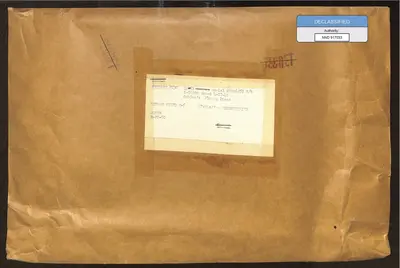
Case Overview
In 1948, near Delaware, Ohio, the U.S. Army Air Forces recorded an unidentified-object incident that became Incident #112 in the “Check-List - Unidentified Flying Objects” series archived in Box 7 of file 38_143685. The records were released by the Department of War on May 8, 2026, as part of the Presidential Unsealing and Reporting System for UAP Encounters (PURSUE). The case is one of the first wave of “flying saucer” reports that swept the United States following the Kenneth Arnold sighting of June 1947 and the Roswell incident of July 1947.
The specific details contained within the official documentation are sparse. Incident #112 of the U.S. Army Air Forces “Check-List - Unidentified Flying Objects” series, archived in Box 7 of file 38_143685 and released by the Department of War on May 8, 2026, as part of the PURSUE program, provides a limited summary. The records indicate that an unspecified observer reported a sighting near Delaware, Ohio. The nature of the sighting is classified as a visual sighting reported by ground or air observers, though the documentation does not elaborate on the specific flight path, altitude, or physical characteristics of the object observed.
Historical Context
The timing of the Delaware encounter places it within a period of intense public and military preoccupation with aerial phenomena. Following the summer of 1947, the American consciousness was gripped by what researchers often term the “saucer wave.” This era was characterized by a sudden surge in reports of metallic, disc-shaped objects moving with high velocity and erratic maneuvers. During this time, the United States was transitioning into the early Cold War, a period marked by rapid advancements in aeronautical engineering and heightened surveillance of the skies. The presence of newly developed jet propulsion and the dawn of the rocket age contributed to a landscape where the line between conventional military hardware and unidentified phenomena was often blurred in the eyes of the public and military investigators.
Geographically, the sighting occurred in central Ohio, a region that, while not as central to the initial 1949 sightings as the American Southwest, was part of the broader domestic monitoring network. The reporting of such incidents by the U.S. Army Air Forces suggests that the military was actively cataloging these occurrences, even if the primary purpose of such lists was to differentiate between known aerial threats and unknown anomalies. The documentation of Incident #112 reflects the systematic, albeit rudimentary, attempt by the military to track objects that did not correspond to known flight plans or known atmospheric phenomena.
Analysis and Resolution Status
The official status of the Delaware, Ohio encounter remains officially undetermined. All records released under the PURSUE program are designated unresolved by the All-domain Anomaly Resolution Office. The federal government has not concluded these 1947-era incidents were anomalous, has not concluded they were conventional, and has not ruled out either possibility. This lack of a definitive conclusion is consistent with the broader handling of mid-century UAP documentation, where the absence of corroborating radar data or physical debris often leaves cases in a state of permanent ambiguity.
When evaluating the Delaware sighting, researchers often consider various conventional candidates that were active during the 1948 period. These include the Project Mogul balloon flights, which were then active over the U.S. Southwest and utilized high-altitude acoustic sensors to detect Soviet nuclear tests, potentially causing confusion in aerial monitoring. Other possibilities include experimental jet and rocket aircraft undergoing testing, atmospheric optical effects such as sun dogs or temperature inversions, and astronomical objects misidentified at unusual angles. Without further specific data from the 1948 report, the Delaware, Ohio encounter remains a significant, yet unverified, piece of the post-war aerial mystery.