Circleville, Ohio UFO Sighting, 1947 — FBI Files
Federal investigators documented a radar track and a foil-covered object near Circlevelille, Ohio, during the 1947 wave of unidentified aerial phenomena.
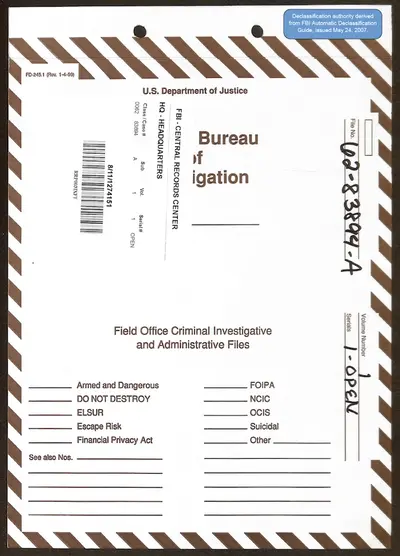
Background
In 1947, in Circleville, Ohio, U.S. government investigators recorded an unidentified-object incident later released to the public on May 8, 2026, as part of the Presidential Unsealing and Reporting System for UAP Encounters (PURSUE). The incident occurred during a period of intense national interest in aerial anomalies, serving as one of the first wave of “flying saucer” reports that swept the United States following the Kenneth Arnold sighting of June 1947 and the Roswell incident of July 1947. During this era, the sudden appearance of unidentified objects in the sky became a fixture of American news media, often fueled by the technological advancements and anxieties of the early Cold War.
The case was filed with the Federal Bureau of Investigation, which maintained a systematic approach to documenting such occurrences. Under the Bureau’s standing protocols for the protection of vital installations, various field offices, including those in Knoxville, Albuquerque, and Los Angeles, were responsible for routing UFO reports to headquarters. This centralized processing reflected a broader governmental effort to monitor any aerial activity that might pose a threat to national security or the integrity of sensitive military infrastructure.
What the document records
The released documentation provides specific details regarding a physical discovery made in the vicinity of Circleville. A six-pointed star covered in tin foil, which was attached to a balloon, was found near the town. While the presence of such an object often triggered speculation regarding extraterrestrial or advanced technological origins, the investigative records offer a more grounded explanation. The object was identified as a device used by the Army Air Forces for radar research to measure high wind speeds. Despite this identification, the Air Forces provided no official comment regarding the device or its deployment in the area.
The number of witnesses to the incident is not specified in the released document. This lack of a precise witness count is common in many historical federal files from this period, where the focus of the reporting often rested on the technical data and physical evidence rather than the quantification of observers.
Type of case
The case is principally a radar track, characterized by the detection of an unidentified object on military or civilian radar equipment. Radar-based sightings are considered significant in the study of aerial anomalies because they provide electronic corroboration of an object’s presence, moving the event beyond the realm of purely visual testimony. Such tracks often involve the monitoring of movement, speed, and altitude, providing a data-driven foundation for investigation.
Status
All records released under the PURSUE program are designated unresolved by the All-domain Anomaly Resolution Office (AARO) by default. The federal government has not concluded that the events were anomalous, has not concluded that they were conventional, and has not ruled out either possibility. This state of official ambiguity is a standard feature of the AARO classification system for historical documents.
When evaluating sightings from the late 1940s, researchers often consider a variety of conventional candidates. These include experimental aircraft and weather balloons, particularly those associated with the Project Mogul series, which utilized high-altitude balloons to detect Soviet nuclear tests. Other potential explanations include atmospheric optical phenomena, such as sundogs and lenticular clouds, as well as astronomical objects like Venus, the Moon, or meteors appearing near the horizon. The Circleville incident, with its identified foil-covered balloon, fits within the broader context of era-specific phenomena where experimental scientific instrumentation was frequently mistaken for unidentified aerial phenomena.