Crescent City Light Station UAP Encounter, 1948 — USAAF Box 7 #200
A 1948 U.S. Army Air Forces report documents an unidentified object sighting near the Crescent City Light Station, identified as Incident #200.
Historical Context
The year 1948 represented a period of significant atmospheric and aerial uncertainty in the United States. Following the Kenneth Arnold sighting in June 1947 and the subsequent Roswell incident in July 1947, the American public and military intelligence were confronted with a sudden surge of reports involving unidentified aerial phenomena. This era, often referred to as the first wave of “flying saucer” sightings, coincided with the early stages of the Cold War and rapid advancements in aerospace technology. During this time, the presence of high-altitude reconnaissance balloons, such as those used in Project Mogul, and the emergence of experimental jet propulsion created a landscape where distinguishing between conventional military hardware and anomalous objects was exceptionally difficult for observers.
The geography of the Pacific Northwest, particularly the rugged coastline of Northern California, provided a frequent backdrop for such reports. The Crescent City Light Station, situated along the dramatic coastline near the Oregon-California border, serves as a significant maritime landmark. The area’s complex topography, characterized by heavy coastal fog, dense forests, and significant maritime traffic, often contributed to the misidentification of astronomical bodies, atmospheric optical phenomena, or experimental aircraft.
The Incident Record
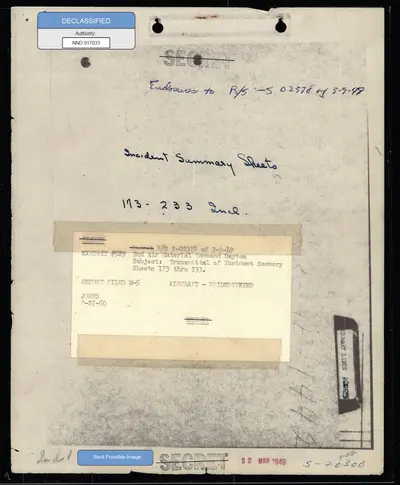
In 1948, near the Crescent City Light Station, the U.S. Army Air Forces recorded an unidentified-object incident that became Incident #200 in the “Check-List - Unidentified Flying Objects” series archived in Box 7 of file 38_143685. These specific records were released to the public by the Department of War on May 8, 2026, as part of the Presidential Unsealing and Reporting System for UAP Encounters (PURSUE). The documentation provides a technical summary of the event, categorized as a visual sighting reported by ground or air observers.
The primary witness identified in the documentation was Andrew MN, Siler, of Grants Pass, Oregon. At the time of the event, the observer’s occupation or hobby was noted as fisherman. The report indicates that the attention of the observer was attracted by a sound which originated from the vicinity of the sighting. The observer’s position during the encounter was recorded as ground-based. The nature of the sighting was documented as involving an unidentified object near the Crescent City Light Station.
Classification and Analysis
The case is classified as a visual sighting involving ground or air observers. Within the framework of the U.S. Army Air Forces reporting structure, the incident is categorized under the “Check-List - Unidentified Flying Objects” series. Because the incident was recorded during the height of the post-1947 phenomenon wave, it shares many characteristics with other contemporary reports that focused on objects exhibiting unusual flight patterns or unexpected acoustic signatures.
The official status of the incident remains unresolved. All records released under the PURSUE program are designated as unresolved by the All-domain Anomaly Resolution Office. The federal government has maintained a neutral stance regarding the nature of this specific 1947-era incident, neither concluding that the object was anomalous nor confirming that it was a conventional phenomenon. The possibility of either classification remains open in the official archives.
In evaluating the potential origins of the object, researchers often consider various conventional candidates that were active in the late 1940s. These include the Project Mogul balloon flights, which were being deployed over the American Southwest to detect Soviet nuclear tests, as well as the testing of new jet and rocket-powered aircraft. Additionally, atmospheric optical effects caused by temperature inversions or the misidentification of astronomical objects at unusual angles remain standard scientific explanations for sightings of this type. The lack of definitive evidence to rule out these possibilities prevents a conclusive determination of the event’s origin.