Ashley, Ohio UAP Encounter, 1947 — USAAF Box 7 #112
An archived U.S. Army Air Forces report from 1947 documents a visual sighting of an unidentified object near Ashley, Ohio.
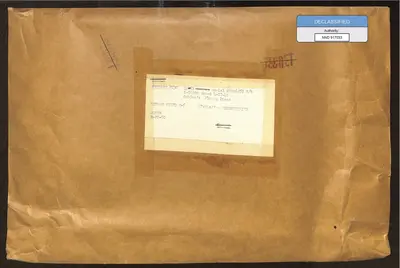
Case Overview
In 194
47, near Ashley, Ohio, the U.S. Army Air Forces recorded an unidentified-object incident that became Incident #112 in the “Check-List - Unidentified Flying Objects” series archived in Box 7 of file 38_143685. The records were released by the Department of War on May 8, 2026, as part of the Presidential Unsealing and Reporting System for UAP Encounters (PURSUE). The summary records that an unspecified observer reported a sighting near the location of Ashley, Ohio. This case is classified as a visual sighting reported by ground or air observers.
Historical Context
The Ashley encounter occurred during a pivotal era in American aviation and atmospheric observation. The summer of 1947 is widely recognized by historians of the phenomenon as the beginning of the “flying saucer” wave, a period characterized by a sudden surge in reports of metallic, disc-shaped objects traversing the sky. This wave was precipitated by the Kenneth Arnold sighting in June 1947 and followed closely by the Roswell incident in July 1947. During this period, the rapid advancement of aeronautical technology, including the development of early jet propulsion and high-altitude reconnaissance, created a landscape where the distinction between conventional military hardware and anomalous phenomena was often blurred for civilian and military observers alike.
The geography of central Ohio, situated within the industrial and agricultural heartland of the United States, provided a common backdrop for such sightings. The region’s clear skies and varied topography often allowed for the observation of objects that could be attributed to a wide range of sources, from celestial bodies to experimental flight programs. At the time, the United States military was actively monitoring the skies for potential Soviet incursions and testing new aerodynamic capabilities, making the documentation of any unidentified aerial phenomenon a matter of national security.
Investigation and Classification
The documentation for Incident #11 and the broader “Check-List” series represents a formal effort by the U.S. Army Air Forces to catalog aerial anomalies. The release of these specific files through the PURSUE program in 2026 has provided researchers with a rare glimpse into the internal reporting structures used by the Department of War during the post-war era. The nature of the reporting in the Ashley case is brief, focusing on the occurrence of the sighting without providing extensive telemetry or detailed descriptions of the object’s flight path.
The status of the Ashley, Ohio encounter remains officially unresolved. All records released under the PURSUE program are designated as unresolved by the All-domain Anomaly Resolution Office. The federal government has maintained a neutral stance regarding the nature of these 1947-era incidents, having neither concluded that they were anomalous nor confirmed that they were conventional. This lack of a definitive ruling leaves the incident open to various scientific and historical interpretations.
Potential Explanations
When analyzing the 1947 saucer wave, researchers often consider several conventional candidates that could account for such sightings. During this period, the Project Mogul balloon flights were active over the U.S. Southwest, designed to detect Soviet nuclear tests via high-altitude acoustic monitoring, which could lead to misidentifications of drifting objects. Additionally, the emergence of experimental jet and rocket aircraft, alongside atmospheric optical effects like sun dogs or parhelia, and the misidentification of astronomical objects at unusual angles, remain primary subjects of investigation. The Ashley incident, like many others from this era, exists within this spectrum of possibility, where the limits of mid-century radar and visual observation technology made certain classifications difficult to achieve.