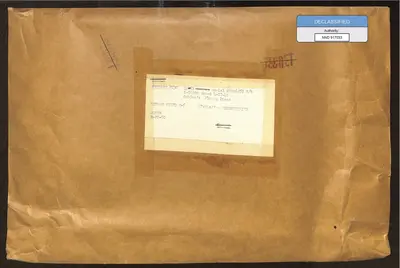
BSYHEETE Groveport, Ohio UAP Encounter, 1947 — USAAF Box 7 #158
Documentation from the U.S. Army Air Forces details a 1947 unidentified object sighting near Groveport, Ohio, released via the PURSUE program in 2026.
Historical Context of the 1947 Wave
The year 1947 represents a pivotal moment in the history of aerial anomaly documentation. Following the conclusion of World War II, the United States experienced a sudden surge in reports of unidentified aerial phenomena, a phenomenon often referred to by historians as the “flying saucer” wave. This period of intense public and military interest was catalyzed by high-profile events such as the Kenneth Arnold sighting in June 1947 and the subsequent reports surrounding the Roswell incident in July 1947. During this era, the transition from propeller-driven aircraft to the early stages of the jet age created a landscape of rapidly evolving aeronautical technology, often leaving civilian observers and military personnel alike struggling to identify new silhouettes in the sky.
The geographic region of Groveport, Ohio, situated near the capital of Columbus, served as a typical backdrop for such sightings. In the mid-twentieth century, the American Midwest was characterized by a mix of expanding industrial hubs and vast agricultural expanses, providing clear sightlines for both ground and air-based observers. As the United States prepared for the complexities of the Cold War, the monitoring of airspace became a matter of national security, leading to the systematic, albeit often rudimentary, recording of unidentified objects by military branches.
The Groveport Incident Documentation
The specific encounter in Groveport is documented within the U.S. Army Air Forces “Check-List - Unidentified Flying Objects” series, identified as Incident #158. This particular entry is housed within Box 7 of file 38_143685. The primary source material for this case remained classified for decades until the Department of War released the records on May 8, 2026. This release was conducted under the auspices of the Presidential Unsealing and Reporting System for UAP Encounters, known as the PURSUE program.
The official summary provided in the Air Forces checklist is brief, noting only that an unspecified observer reported a sighting near the BSYHEET location in Groveport, Ohio. The nature of the report is classified as a visual sighting, a category that encompasses observations made by individuals on the ground or by personnel operating aircraft. Because the original report lacks specific descriptive details regarding the object’s trajectory, luminosity, or physical dimensions, the entry remains a minimalist record of an unidentified aerial event.
Analytical Status and Classifications
The classification of Incident #158 remains subject to the ongoing investigations of the All-domain Anomaly Resolution Office. Under the protocols of the PURSUE program, all released records from the 1947 era are officially designated as unresolved. The federal government has maintained a position of neutrality regarding the Groveport sighting; there has been no official conclusion stating that the object was anomalous in nature, nor has there been a definitive determination that the sighting was the result of conventional phenomena.
When evaluating such 1947-era reports, researchers often consider a variety of conventional candidates that were active in the airspace at the time. These include the Project Mogul balloon flights, which were being deployed over the American Southwest to detect nuclear signatures, as well as the testing of experimental jet and rocket-powered aircraft. Other possibilities frequently cited in similar cases include atmospheric optical effects, such as temperature inversions or light refraction, and the misidentification of astronomical objects or high-altitude weather balloons. Despite these possibilities, the lack of a definitive resolution ensures that the Groveport encounter remains an open entry within the archival record.