Middleport, Ohio UAP Encounter, 1947 — USAAF Box 7 #128
An archived U.S. Army Air Forces report documents a visual sighting of an unidentified object near Middleport, Ohio, in 1947.
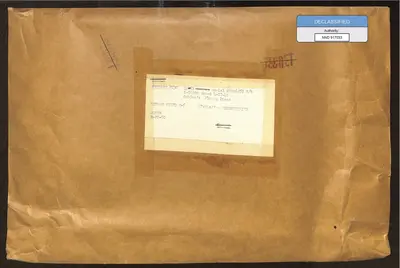
Case Overview
The 1947 Middleport, Ohio, UAP encounter is documented as Incident #128 within the “Check-List - Unidentified Flying Objects” series, a collection of reports maintained by the U.S. Army Air Forces. This specific entry is preserved in Box 7 of file 38_143685 and was officially released to the public by the Department of War on May 8, 2026. The release occurred as part of the Presidential Unsealing and Reporting System for UAP Encounters (PURSUE), a program designed to provide transparency regarding historical aerial anomalies. The official documentation records a visual sighting of an unidentified object reported by an unspecified observer in the vicinity of Middleport.
Historical Context
The timing of the Middleport sighting places it within a pivotal era of American aviation and atmospheric observation. The summer of 1947 is widely recognized by historians of anomalous phenomena as the beginning of the “saucer wave,” a period of intense public and military interest in unidentified aerial phenomena. This wave was precipitated by the Kenneth Arnold sighting in June 194
7 and the subsequent Roswell incident in July 1947. During this period, the transition from piston-engine aircraft to the jet age created a landscape of rapidly evolving technology, which often led to the misidentification of new aeronautical developments. Middleport, situated in the Ohio River Valley, sits within a geographic region that has historically been subject to various atmospheric and industrial phenomena, making it a plausible site for reports of unidentified lights or objects.
The reporting structure used by the U.S. Army Air Forces during this era was part of an early, systematic attempt to categorize aerial sightings. The “Check-List” series represents a primitive form of data collection, where observers or military personnel logged sightings that did not immediately align with known flight paths or meteorological patterns. At the time, the concept of Unidentified Aerial Phenomena (UAP) was not yet a formalized field of study, and many such reports were processed through standard military intelligence channels focused on identifying potential incursions by foreign adversaries.
Analysis and Classification
The Middleport incident is classified as a visual sighting, a type of case involving observations made by ground-based or air-based observers. Because the identity of the observer remains unspecified in the released records, the specific vantage point and lighting conditions at the time of the sighting are unknown. This lack of detail is common in many 1947-era reports, where the focus of the documentation was often on the existence of the object rather than the granular details of the observation.
The status of Incident #128 remains officially unresolved. Under the protocols of the All-domain Anomaly Resolution Office, all records released via the PURSUE program are categorized this way. The federal government has maintained a neutral stance regarding the nature of the Middleport object, neither confirming that the sighting was the result of an anomalous phenomenon nor concluding that it was a conventional occurrence.
When evaluating the “saucer wave” era, researchers often consider several conventional candidates that could explain such sightings. These include the Project Mogul balloon flights, which were active over parts of the United States to detect high-altitude nuclear tests, as well as the testing of experimental jet and rocket-powered aircraft. Additionally, atmospheric optical effects, such as temperature inversions or light refraction, and the misidentification of astronomical objects or satellites at unusual angles remain primary scientific explanations for many reports from this period. The Middleport case remains a part of this broader historical investigation into the unidentified aerial activity of the mid-twentieth century.