Midland, Michigan UFO Sighting (July 9, 1947) — FBI Files
During a walk on Dow Chemical property, witnesses observed a white light hovering above the ground, leaving behind a sample of fused sand.
Historical Context
The summer of 1947 represents a pivotal era in the history of unidentified aerial phenomena in the United States. Following the June 194
7 Kenneth Arnold sighting, which popularized the term “flying saucer,” the American public and government agencies entered a period of heightened observation. This wave of reports coincided with the early stages of the Cold War, a time when the rapid advancement of aerospace technology and the deployment of high-altitude reconnaissance tools created a climate of intense scrutiny regarding any unidentified objects in the sky. The July 1947 Roswell incident further contributed to this atmosphere of widespread speculation.
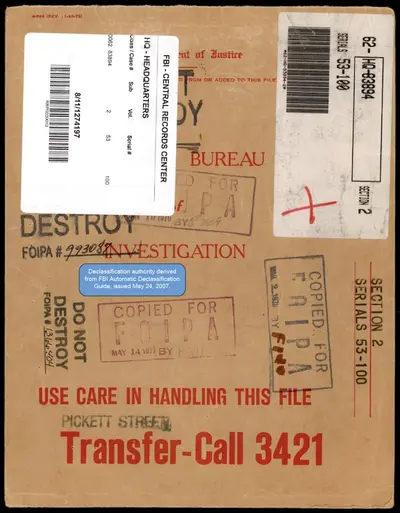
During this period, the Federal Bureau of Investigation (FBI) maintained active protocols for monitoring unidentified objects, particularly those that appeared near sensitive or vital installations. Because the midwestern industrial corridor housed significant chemical and manufacturing facilities, reports of anomalous activity in these areas were routed through various field offices, including those in Knoxville, Albuquerque, and Los Angeles, before being centralized at FBI headquarters. This administrative process was designed to ensure that any potential threats to national security or industrial infrastructure were documented and assessed.
The Incident at Midland
On July 9, 1947, an event occurred in Midland, Michigan, that was subsequently documented by federal investigators. The location of the sighting was a field owned by Dow Chemical, a major industrial presence in the region. While walking through the field, Raymond and Laura Lane encountered an anomaly that involved both auditory and visual components.
According to the official records, the witnesses heard a distinct puffing noise, which preceded the appearance of a luminous object. They observed a ball of white light, described as being approximately the size of a bushel basket, which was hovering roughly one foot above the ground. The duration of the sighting was brief, as the light disappeared shortly after its appearance.
In the aftermath of the visual encounter, Raymond Lane took physical action to investigate the site of the light’s presence. He collected a sample of sand from the area that had undergone a physical transformation. The recovered material consisted of a three-inch area of fused sand, which Lane placed into a can and transported to a physics laboratory for analysis.
Documented Findings and Analysis
The released FBI files provide specific, albeit fragmented, details regarding the physical properties of the collected sample. The handwritten notes within the file indicate that the substance was identified as ordinary sand. While the laboratory analysis determined that the material was not radioactive, the documentation notes that the sample was emitting ammonia gas.
The number of witnesses to the event is not specified in the released documentation. The case remains a notable example of a ground-based visual sighting involving physical residue, a type of report that differs from the more common high-altitude sightings of the era.
Classification and Status
Under the Presidential Unsealing and Reporting System for UAP Encounters (PURSUE), all records released through this program are designated as unresolved by the All-domain Anomaly Resolution Office (AARO). The federal government has maintained a neutral stance regarding the Midland incident, neither concluding that the event was the result of an anomalous phenomenon nor confirming it as a conventional occurrence.
When evaluating sightings from the late 1940s, investigators often consider several conventional candidates. These include experimental aircraft testing, atmospheric optical phenomena such as lenticular clouds or sundogs, and astronomical objects like the Moon, Venus, or meteors. Additionally, the deployment of the Project Mogul series of high-altitude weather balloons during this period is frequently cited as a potential source of unidentified aerial sightings. The Midland case remains categorized as an unverified sighting of an unidentified object.