Midlend, Michigan UAP Encounter, 1947 — USAAF Box 7 #22
Official U.S. Army Air Forces records document a 1947 unidentified object sighting near Midland, Michigan, released via the PURSUE program in 2026.
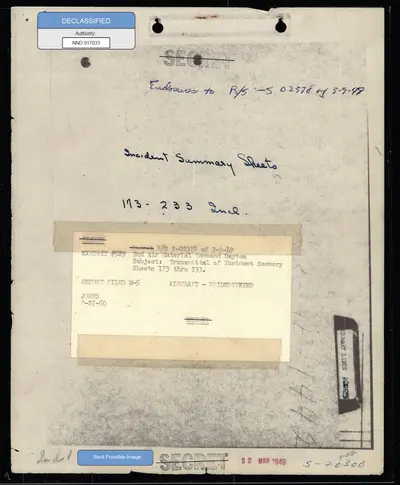
Incident Overview
In 1947, near Midland, Michigan, the U.S. Army Air Forces recorded an unidentified-object incident that became Incident #22 in the “Check-List - Unidentified Flying Objects” series archived in Box 7 of file 38_143685. The specific details of this encounter were brought to public light when the records were released by the Department of War on May 8, 2026, as part of the Presidential Unseathing and Reporting System for UAP Encounters (PURSUE). This case is recognized as part of the first wave of “flying saucer” reports that swept the United States during the summer of 1947, following the Kenneth Arnold sighting in June and the Roswell incident in July of that same year.
Documentation and Records
The primary source for this event is Incident #22 of the U.S. Army Air Forces “Check-List - Unidentified Flying Objects” series, which is archived within Box 7 of file 38_143685. The summary records provided by the Department of War indicate that the event was a reported sighting near Midland, Michigan, with the observer’s position noted as (hg @.,.). The documentation includes fields for occupation and/or hobbies, the nature of what attracted attention, the number of objects seen, the size of the objects, and the color of the objects reported. These specific parameters were part of the standardized reporting format used by military personnel to categorize aerial phenomena during the post-war era.
Historical and Geographical Context
The sighting occurred in Midland, Michigan, a region that, during the mid-twentieth century, was characterized by its industrial significance and its position within the Great Lakes corridor. During the late 1940s, the United States was undergoing a period of intense technological transition and heightened military readiness following the conclusion of World War II. The emergence of unidentified aerial phenomena during this period coincided with the dawn of the Jet Age, a time when new propulsion technologies were beginning to alter the capabilities of conventional aircraft. This era saw a significant increase in both the development of experimental aerospace hardware and the public’s awareness of unusual aerial activity, driven by a series of high-profile reports that captured national attention.
Classification and Resolution Status
This case is classified as a visual sighting reported by ground or air observers. Within the framework of modern archival analysis, the status of the Midland encounter remains officially undetermined. All records released under the PURSUE program are designated as unresolved by the All-domain Anomaly Resolution Office. The federal government has maintained a neutral stance regarding the 1947-era incidents, stating that it has not concluded these events were anomalous, nor has it concluded they were conventional, and it has not ruled out either possibility.
The investigation of such phenomena during the late 1940s often involved comparing sightings against known aerial activity. Conventional candidates for the 1947 saucer wave include the Project Mogul balloon flights that were active over the U.S. Southwest at the time, as well as experimental jet and rocket aircraft undergoing testing. Other potential explanations considered by researchers include atmospheric optical effects or astronomical objects that may have been misidentified due to unusual viewing angles. As an unverified entry in the Army Air Forces checklist, the Midland incident remains a subject of study within the broader context of mid-century aerial anomalies.