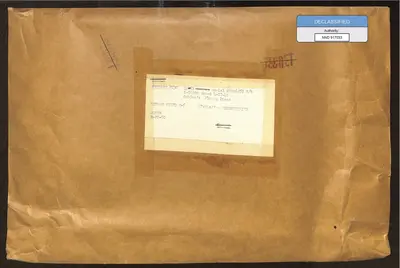
Columbus, Ohio UAP Encounter, 1947 — USAAF Box 7 #157
An archival record from the U.S. Army Air Forces details an unidentified object sighting near Columbus, Ohio, released via the PURSUE program in 2026.
Historical Context
The year 1947 represents a pivotal period in the history of aerial anomaly documentation within the United States. Following the conclusion of World War II, the rapid advancement of aerospace technology created a landscape where the distinction between known aeronautical progress and unidentified phenomena was often blurred. This era saw the emergence of the “flying saucer” phenomenon, a cultural and military preoccupation sparked by high-profile sightings that suggested the presence of craft operating with capabilities beyond contemporary human engineering. The Columbus, Ohio, incident occurred during this heightened state of atmospheric observation, a time when the American public and military institutions were simultaneously grappling with the dawn of the Jet Age and the burgeoning complexities of the Cold War.
During this period, the United States Army Air Forces (USAAF) maintained internal documentation regarding aerial anomalies, often categorizing them within standardized checklists. These records were not part of a public-facing investigation but served as a bureaucratic method for tracking unidentified objects that entered controlled or monitored airspace. The reporting of such objects was often handled through administrative channels, as the military sought to determine if these sightings represented new adversary technologies, atmospheric phenomena, or unidentified aerial phenomena (UAP).
The Columbus Incident
In 1947, near Columbus, Ohio, the U.S. Army Air Forces recorded an unidentified-object incident that became Incident #157 in the “Check-List - Unidentified Flying Objects” series archived in Box 7 of file 38_143685. The specific details of the sighting were preserved within military archives and were not made available to the public for decades. These records were eventually released by the Department of War on May 8, 2026, as part of the Presidential Unsealing and Reporting System for UAP Encounters (PURSUE).
The documentation for Incident #157, housed within the USAAF “Check-List - Unidentified Flying Objects” series in Box 7 of file 38_143685, provides a concise summary of the event. According to the released forms, an unspecified observer reported a sighting near Columbus, Ohio. The nature of the report is classified as a visual sighting, which may have been made by either ground-based or air-based observers. While the report confirms the occurrence of the sighting, the specific characteristics of the object and the precise circumstances of the observation remain as limited as the original military summary.
Classification and Analysis
This case is categorized as a visual sighting of an unidentified object. Within the broader context of 1947, this incident is recognized as part of the first wave of “flying saucer” reports that moved through the United States. This wave was characterized by a series of high-profile events, including the Kenneth Arnold sighting in June 1947 and the Roswell incident in July 1947. The Columbus encounter, though less detailed in its released form, belongs to this specific chronological cluster of aerial anomalies.
The official status of the Columbus encounter remains unresolved. All records released under the PURSUE program are designated as unresolved by the All-domain Anomaly Resolution Office. The federal government has maintained a neutral stance regarding the origins of this 1947-era incident, stating that it has not concluded the sighting was anomalous, nor has it concluded the sighting was conventional. The possibility of either classification remains open.
When analyzing such mid-century sightings, researchers often consider various conventional candidates that were active in the airspace during the late 1940s. These include the Project Mogul balloon flights, which were being conducted over the American Southwest to detect Soviet nuclear tests, as well as the testing of experimental jet and rocket aircraft. Other potential explanations for such reports include atmospheric optical effects or astronomical objects that may have been misidentified due to unusual viewing angles. As of the 2026 release, the Columbus, Ohio, sighting remains an unverified entry in the historical record of unidentified aerial phenomena.