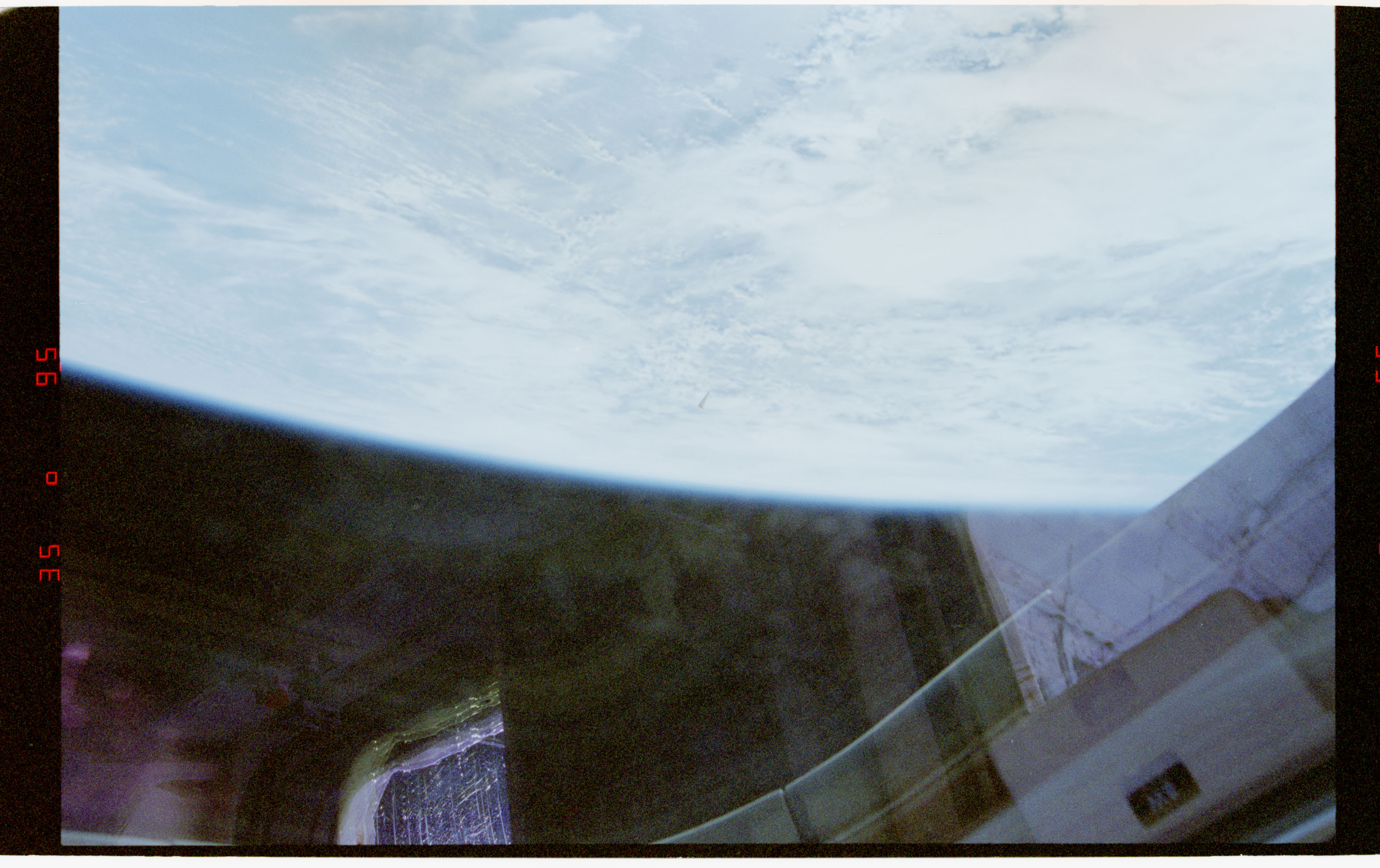
STS-80 Unidentified Object Image 3, 1996 — NASA Image
During STS-80, between November 19 and December 7, 1996, astronauts aboard Space Shuttle Columbia captured a series of three images of an unidentified object in low-Earth orbit. In the third photograph, the object is visible near the center of the frame, superimposed against the Earth.

Incident Overview
In 1996, in low-Earth orbit, NASA preserved a photographic record that was declassified and published on July 10, 2026 as part of the fourth tranche of the Department of War’s Presidential Unsealing and Reporting System for UAP Encounters (PURSUE).
What the government released
During STS-80, between November 19 and December 7, 1996, astronauts aboard Space Shuttle Columbia captured a series of three images of an unidentified object in low-Earth orbit. In the third photograph, the object is visible near the center of the frame, superimposed against the Earth. It appears to have continued along a trajectory passing between Columbia and the Earth.
Related records
This photograph belongs to a sequence of three frames captured during the same pass. The others are STS-80 Unidentified Object Image 1 and STS-80 Unidentified Object Image 2.
Status of the case
Records released under the PURSUE program are designated unresolved by the All-domain Anomaly Resolution Office, which means the federal government has not concluded the events were anomalous, has not concluded they were conventional, and has not ruled out either possibility. Where AARO has offered a likely source for an item — an infrared sensor aboard a military aircraft, a commercial camera, or a known optical effect — that attribution is the agency’s working assessment rather than a final determination. Conventional candidates such as drones, balloons, flares, satellites, parallax and forced-perspective artifacts, and ordinary aircraft remain on the table for any unresolved case absent better data than a single sensor pass or a witness recollection.