Calvine UFO Photograph
Two hikers photographed a massive diamond-shaped UFO hovering near a military jet. The image was classified by the UK Ministry of Defence for over 30 years before being released.
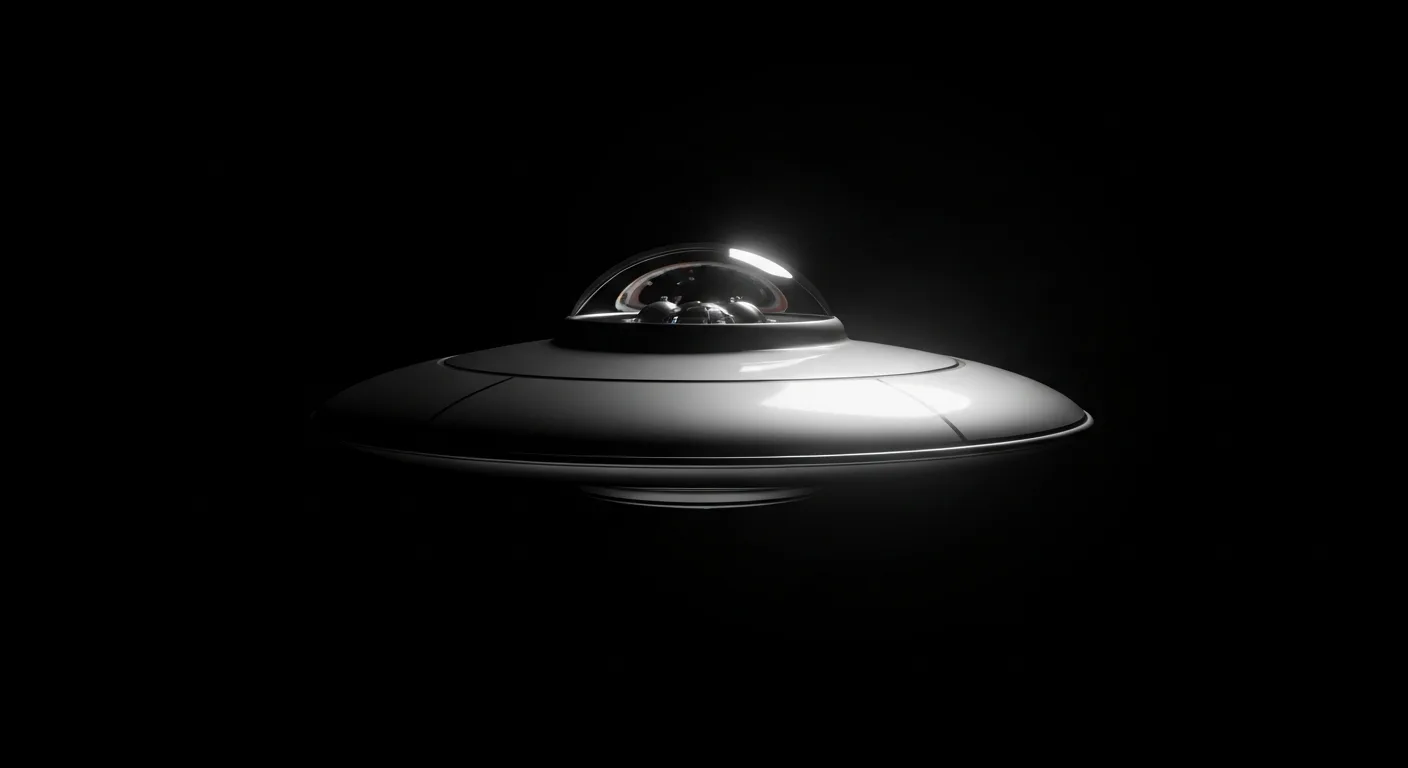
On a summer afternoon in the Scottish Highlands, two men walking near the tiny hamlet of Calvine looked up and saw something that would produce what many researchers consider the most compelling UFO photograph ever taken in Britain. The image they captured — a massive, diamond-shaped craft hanging motionless in the sky while a military jet passed below it — was immediately seized upon by the UK Ministry of Defence, classified at a level normally reserved for matters of genuine national security, and locked away for more than three decades. When the photograph finally emerged in 2022, it reignited a debate that had simmered for years among UFO researchers who had heard rumors of its existence but had never been permitted to see it. The Calvine photograph stands as a remarkable case study in both the UFO phenomenon itself and the lengths to which governments will go to suppress evidence they find inconvenient.
The Scottish Highlands: A Landscape of Mystery
The area around Calvine sits in the central Scottish Highlands, a sparsely populated landscape of rolling moorland, ancient forests, and dramatic mountain passes. The hamlet itself consists of little more than a handful of houses scattered along the A9, the main road connecting Perth to Inverness. It is the kind of place where human activity feels like a temporary intrusion upon a landscape that belongs fundamentally to the wind, the heather, and the red deer that roam the hillsides.
The Highlands have a long association with unusual aerial phenomena. The region’s vast, empty skies and minimal light pollution make it an ideal location for observing anything out of the ordinary, and reports of strange lights and unexplained objects stretch back decades. The area is also home to several military installations and training ranges. RAF Leuchars, one of Britain’s primary fighter bases during the Cold War era, lies to the southeast. The Highlands themselves are regularly used for low-level military flight training, with fast jets threading through the glens at speeds that sometimes alarm hikers and hill walkers. The presence of military aircraft in the region is therefore not unusual — but what the two witnesses saw on August 4, 1990, was profoundly unusual by any standard.
The Encounter
The two witnesses were walking in the hills near Calvine during the late afternoon when they became aware of a large object in the sky. Their identities have never been publicly confirmed — a fact that, rather than undermining the case, has been cited by researchers as evidence of its seriousness, since the Ministry of Defence’s classification effectively prevented the witnesses from being identified or interviewed by the press.
What they saw was a massive object, dark or metallic in appearance, shaped like a diamond or a flattened rhombus, hovering completely motionless in the sky. The object made no sound whatsoever. It simply hung there, solid and enormous, as though suspended by some invisible force that had no regard for the normal rules of aerodynamics. The witnesses estimated that the object was approximately one hundred feet across, though the difficulty of judging size at altitude means this figure is necessarily approximate.
The object remained visible for approximately ten minutes — an extraordinarily long duration for a UFO sighting, which are more commonly measured in seconds. During this time, a military jet aircraft appeared and seemed to circle or fly near the object, providing an inadvertent but invaluable scale reference. The jet, later suggested to be an RAF Harrier, appeared small in comparison to the diamond-shaped craft, emphasizing the object’s massive dimensions.
The witnesses had a camera with them and took six color photographs during the encounter. These images captured the diamond-shaped object clearly against the sky, with the jet visible in at least one frame. The photographs were sharp and well-exposed — not the blurred, ambiguous images that characterize most alleged UFO photographs. Whatever the witnesses had photographed, it was large, solid, clearly defined, and utterly unlike any known aircraft.
The Photographs Reach the Ministry of Defence
After their encounter, the two witnesses contacted the Scottish Daily Record newspaper and provided their photographs. The newspaper, recognizing the potential significance of the images, passed them along to the Ministry of Defence for analysis. This decision, which might have seemed reasonable at the time, effectively removed the photographs from public circulation for more than thirty years.
The MoD’s response to the Calvine photographs was extraordinary by any measure. Rather than dismissing them as misidentification or hoax — the standard treatment for the vast majority of UFO reports that crossed MoD desks during this period — officials treated the images with a seriousness that implied genuine concern about what they depicted. The photographs were classified and placed in a restricted file. An enlarged print was reportedly displayed on the wall of the office responsible for investigating UFO reports, where it remained for years as a subject of ongoing interest and discussion among staff.
The classification period assigned to the Calvine photographs was initially set at thirty years, the standard period for sensitive government documents. When that period expired, the classification was extended. Then extended again. Ultimately, the photographs were given a classification period of eighty-two years, meaning they would not have been released until 2072 under normal procedures. An eighty-two-year classification is extraordinary — it is the kind of restriction applied to intelligence operations, nuclear weapons programs, and matters that governments consider genuinely sensitive to national security. Its application to a set of UFO photographs raises obvious and uncomfortable questions about what the MoD knew or suspected about the Calvine object.
Nick Pope and the MoD’s UFO Desk
The most significant public advocate for the Calvine photographs was Nick Pope, a Ministry of Defence official who ran the department’s UFO desk — officially designated Secretariat (Air Staff) 2a — from 1991 to 1994. Pope inherited the Calvine file shortly after taking up his post and was immediately struck by the quality and clarity of the photographs.
Pope has described the Calvine image as the most impressive UFO photograph he encountered during his entire tenure at the MoD, a period during which he reviewed thousands of reports and hundreds of photographs. “It was a spectacular image,” Pope has stated in numerous interviews. “It showed a large, diamond-shaped object hovering in the sky, with a military jet visible in the frame. It was clearly not a conventional aircraft, and it didn’t match any known drone or remotely piloted vehicle. The clarity of the image was remarkable — this wasn’t a blurry dot in the sky. You could see the object clearly, and its shape was unambiguous.”
Pope has also spoken about the enlarged print that hung in his office. “It was one of the first things I noticed when I started the job,” he recalled. “There was this large photograph on the wall showing this extraordinary object. I asked what it was, and I was told it was from Calvine. It became a sort of talking point in the office. People would come in, see the photograph, and ask about it. The general attitude was that it was genuinely unexplained — nobody could offer a conventional explanation that accounted for what the image showed.”
Pope advocated for the declassification and release of the photographs throughout his career, arguing that the extended classification period was unjustified and that the public had a right to see the evidence. His efforts were consistently rebuffed by senior officials who maintained that the classification was appropriate and that release would not be in the public interest.
The 2022 Release
The breakthrough came not through official channels but through the efforts of an academic researcher. Dr. David Clarke, a journalist and Sheffield Hallam University professor who had spent years investigating British UFO cases, obtained a copy of one of the Calvine photographs through sources outside the Ministry of Defence. The image was published in August 2022, thirty-two years after it was taken.
The released photograph was everything that Nick Pope and other researchers had described. It showed a large, diamond-shaped object hovering in what appeared to be a clear or lightly clouded sky. The object was dark against the background, its edges sharp and well-defined. Below and slightly to the side, a military jet — appearing small in comparison — was visible in the frame. The scale difference between the known aircraft and the unknown object was striking and immediately apparent.
The photograph’s release generated enormous interest in the UFO research community and significant mainstream media coverage. Analysts who examined the image noted that the lighting on the object was consistent with the lighting on the landscape and sky, suggesting that the object was genuinely present in the scene rather than being a later addition or composite. The object appeared to be three-dimensional and solid, casting no visible shadow but reflecting light in a manner consistent with a large, physical structure.
Skeptics offered various alternative explanations. Some suggested the object might be a rock reflected in a body of still water, with the photograph taken looking downward rather than upward. Others proposed that it might be an experimental aircraft or drone of some kind, perhaps a classified military project that the MoD was protecting through its classification. A few suggested a deliberate hoax, though the MoD’s own treatment of the photographs — the seriousness with which they were classified and investigated — argued against this interpretation.
The RAF Connection
One of the most troubling aspects of the Calvine case is the presence of the military jet in the photographs. If the object was simply an unusual cloud formation, a weather balloon, or some other mundane phenomenon, there would be no reason for a military aircraft to be in close proximity to it. The jet’s presence suggests either that the RAF was actively investigating the object — perhaps responding to radar contacts or reports from the ground — or that the jet happened to fly through the area during the sighting, providing an accidental point of comparison.
The Ministry of Defence has consistently denied knowledge of any RAF aircraft being in the Calvine area at the time of the sighting. This denial is difficult to reconcile with the photographic evidence, which clearly shows a jet aircraft in the frame. RAF operations are meticulously logged, and flight records from August 4, 1990, should indicate whether any aircraft were operating in the area. The MoD’s position appears to be either that the records have been lost or that the jet visible in the photograph was not an RAF aircraft — both explanations that raise more questions than they answer.
Some researchers have speculated that the jet was scrambled in response to the unknown object, perhaps after it appeared on radar at one of the region’s military installations. If this is the case, the scramble would have generated its own paperwork — mission orders, debriefing reports, radar logs — all of which would presumably have been classified along with the photographs. The possibility that the British military not only knew about the Calvine object but actively responded to it transforms the case from a civilian sighting into a potential military encounter with an unknown craft.
The Secret Aircraft Hypothesis
Among the various explanations proposed for the Calvine photograph, one of the most persistent is that the object was a classified military aircraft, possibly connected to the American Aurora program. Aurora was a rumored hypersonic reconnaissance aircraft that was allegedly developed during the 1980s as a successor to the SR-71 Blackbird. The program has never been officially acknowledged, but numerous reports from the late 1980s and early 1990s described unusual aircraft operating from bases in the American Southwest and, potentially, from British military facilities.
The hypothesis has a certain logic to it. The diamond shape of the Calvine object is unusual for a conventional aircraft but not impossible for an experimental design, and the extended classification period could be explained by the MoD’s desire to protect information about a classified American program operating from British territory. The presence of an RAF jet might indicate an escort or monitoring mission associated with the test flight.
However, the hypothesis has significant weaknesses. No confirmed aircraft, experimental or otherwise, matches the description and appearance of the Calvine object. The object appeared to hover silently, a capability that no known fixed-wing aircraft of the period possessed. Its estimated size — approximately one hundred feet across — exceeds that of most fighter aircraft but falls short of strategic bombers or transport aircraft, placing it in an awkward category that does not match any known type. And while governments routinely classify information about experimental aircraft programs, an eighty-two-year classification is extreme even by those standards and suggests a level of sensitivity that goes beyond merely protecting a new aircraft design.
The Witnesses’ Silence
Perhaps the most remarkable aspect of the Calvine case is the enduring anonymity of the two witnesses. In an age when UFO sightings routinely generate media appearances, book deals, and speaking tours, the Calvine witnesses have never come forward publicly. Their names have never been confirmed, and no journalist or researcher has been able to identify them definitively.
This silence has been interpreted in different ways. Skeptics suggest that the witnesses’ anonymity might indicate that the photographs were hoaxed and that the perpetrators chose to remain hidden rather than face scrutiny. Believers counter that the witnesses’ silence is consistent with having been warned off by government officials — that the MoD’s classification of the photographs may have been accompanied by pressure on the witnesses to remain silent about what they had seen.
Nick Pope has suggested that the witnesses were ordinary members of the public who were uncomfortable with the attention their photographs generated and who were happy to let the MoD handle the matter. The fact that they never sought publicity or financial gain from their photographs is, in Pope’s view, a strong indicator of their credibility. Hoaxers typically seek recognition; genuine witnesses, confronted with something they cannot explain and cannot prove, often prefer to retreat into silence rather than face ridicule.
Significance in the UFO Canon
The Calvine photograph occupies a unique position in the history of UFO evidence. It combines several elements that are rarely found together in a single case: clear, high-quality imagery of an apparently anomalous object; independent corroboration in the form of the military jet visible in the frame; official government interest at a level that suggests genuine concern rather than routine bureaucratic processing; and an extended classification period that implies the authorities knew or suspected something significant about what the photograph depicted.
The case also raises broader questions about government transparency and the handling of UFO evidence. If the Calvine photograph was simply a misidentification or hoax, the MoD’s response was wildly disproportionate. If, on the other hand, the photograph depicted something genuinely anomalous — whether an unknown natural phenomenon, a foreign intelligence operation, or something more exotic — then the extended classification might be justified, but the public’s right to know what their military encounters in their airspace comes into question.
The release of the photograph in 2022 came at a time of unprecedented government openness about UFO — or UAP, as they are now officially termed — encounters. The United States had recently established the All-domain Anomaly Resolution Office to investigate military encounters with unexplained objects, and Congressional hearings had heard testimony from military personnel describing encounters with objects that displayed flight characteristics far beyond known technology. In this context, the Calvine photograph takes on additional significance as potential evidence that governments have been aware of genuinely anomalous aerial phenomena for far longer than they have publicly acknowledged.
The Enduring Mystery
More than three decades after two unnamed hikers looked up at the Scottish sky and saw something that defied explanation, the Calvine photograph remains one of the most compelling and frustrating pieces of UFO evidence in existence. The image is clear enough to show that something unusual was present in the sky that afternoon, but not detailed enough to determine exactly what it was. The government’s treatment of the photograph suggests that officials took it very seriously, but their refusal to explain why they took it so seriously leaves the public to speculate.
The Scottish Highlands continue to generate reports of unusual aerial phenomena, and the skies above Calvine remain as vast and empty as they were on that August afternoon in 1990. Whatever hung in the air above those hills — whether it was an extraterrestrial craft, a secret military aircraft, an extraordinary natural phenomenon, or something else entirely — it left behind a single, remarkable image and a web of unanswered questions that may never be fully resolved. The Calvine photograph reminds us that the sky above our heads remains, in many ways, as mysterious and unexplored as the deepest ocean, and that what we do not know about our own airspace may be far more remarkable than what we think we understand.
Sources
- CIA UFO/UAP Reading Room — Declassified CIA documents on UAP
- UK National Archives — UFO Files — MoD UFO investigation records
- British Newspaper Archive — UK press archive