Gulf Breeze UFO Photographs
A Florida contractor photographed UFOs repeatedly over several months. Despite controversy over a model found later, hundreds of independent witnesses reported their own sightings in the area.
The small city of Gulf Breeze sits on the tip of a narrow peninsula in the Florida panhandle, separated from Pensacola by a bridge across the bay and from the open Gulf of Mexico by little more than a strip of white sand. It is a quiet, prosperous community of retirees and professionals, the sort of place where neighbors know one another and unusual events attract immediate attention. In November 1987, this unassuming coastal town became the center of one of the most controversial and divisive UFO cases in American history — a saga involving a local building contractor, dozens of striking photographs, hundreds of independent witnesses, allegations of hoax, and a mystery that remains stubbornly unresolved nearly four decades later. The Gulf Breeze case challenged investigators, split the UFO research community, and raised fundamental questions about the nature of photographic evidence and the reliability of eyewitness testimony.
Ed Walters and the First Photographs
Edward Walters was, by all outward appearances, an unlikely figure to become the center of a UFO controversy. A successful building contractor in his early forties, he was married with children, well-established in the Gulf Breeze community, and had no prior involvement with UFOs or the paranormal. He was known as a practical, business-minded man — the sort who built houses, not castles in the air.
On the evening of November 11, 1987, Walters was working in his home office when, according to his account, he noticed a strange glow outside his window. Stepping onto the front porch to investigate, he saw an object hovering above the street — a structured craft emitting a bluish-gray light that seemed to illuminate the road below. Walters grabbed the nearest camera, an old Polaroid, and began taking photographs. Over the next few minutes, he captured several images showing a luminous, top-shaped object hanging in the night sky above the trees of his residential neighborhood.
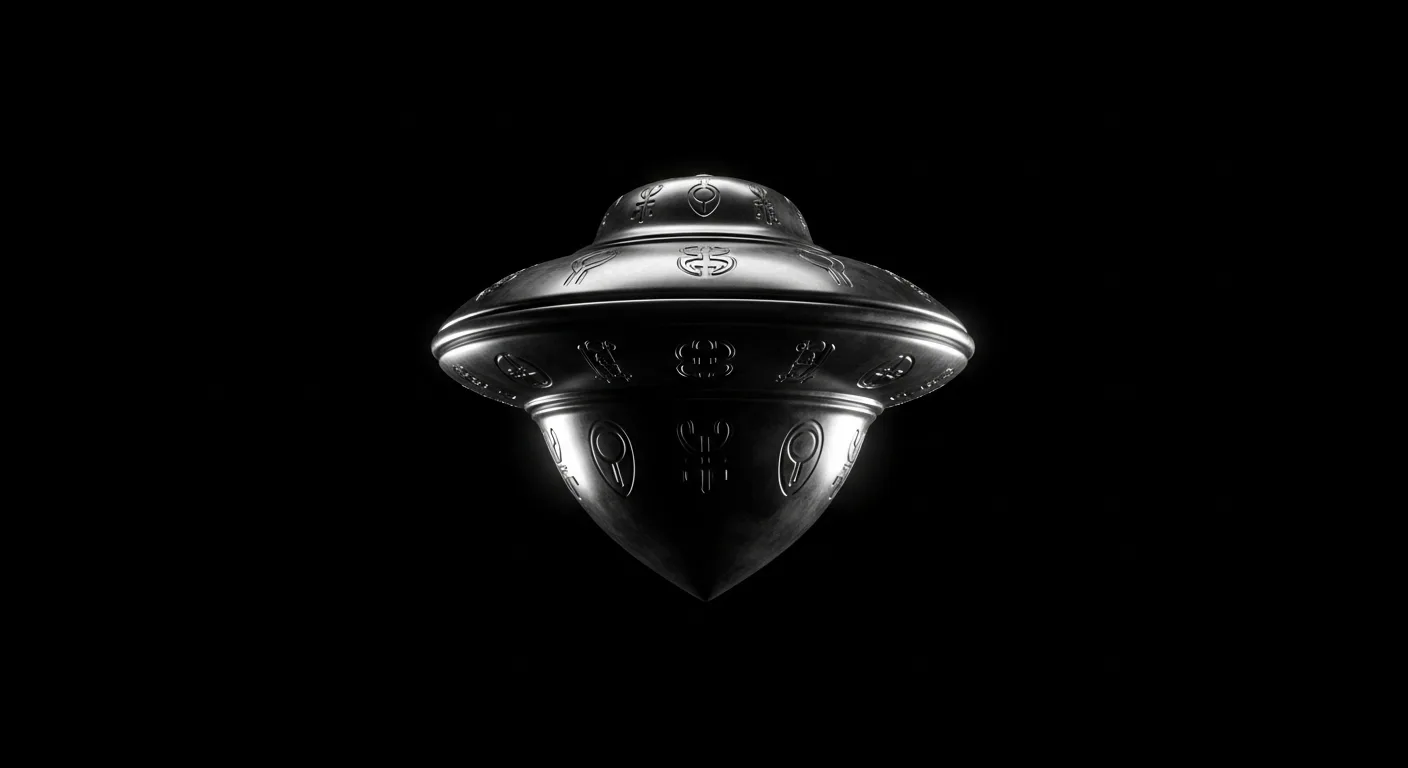
What happened next set the Gulf Breeze case apart from most UFO sightings. Rather than a single, fleeting encounter, Walters reported that the object returned. Again and again over the following weeks and months, he claimed to see the craft near his home, often at close range. Each time, he photographed it. He eventually accumulated more than forty Polaroid images and several photographs taken with a specially sealed stereo camera provided by investigators. The images were remarkably clear by the standards of UFO photography — showing a structured object with distinct features including a bright lower section, a darker upper dome, and what appeared to be portholes or windows along its midsection.
Walters initially submitted his photographs anonymously to the Gulf Breeze Sentinel, the local newspaper, under the pseudonym “Mr. Ed.” The images caused an immediate sensation in the small community. But within weeks, his identity became known, and the quiet contractor found himself at the center of a media storm that would consume his life for years.
Physical Effects and Close Encounters
Walters’ account went well beyond mere sightings and photographs. He described a series of close encounters that escalated in intensity and strangeness over the months following his first sighting. These accounts, documented in his 1990 book “The Gulf Breeze Sightings,” included claims of physical effects that pushed his case beyond conventional UFO testimony into deeply controversial territory.
During several encounters, Walters reported being struck by a blue beam of light emanating from the craft. This beam, he said, produced an immediate paralysis — he found himself unable to move, frozen in place while the craft hovered nearby. The sensation was accompanied by what he described as a humming vibration that seemed to penetrate his entire body. On at least one occasion, he claimed to have been briefly lifted off the ground by the beam before being released.
Even more controversial were his claims of telepathic communication. Walters reported receiving mental impressions from the occupants of the craft — not words exactly, but concepts and images that seemed to be projected directly into his mind. These communications, he said, conveyed a sense of observation and interest but were not threatening. He also described seeing small beings through the craft’s portholes during close encounters, though his descriptions of these entities were less detailed than those of the craft itself.
After some encounters, Walters reported physical marks on his body — small spots or bruises in locations where he felt the blue beam had struck him. He also described a persistent ringing in his ears and occasional headaches following close encounters. These physical symptoms, while impossible to link definitively to the alleged encounters, were documented by investigators who examined him after several incidents.
The Wave of Independent Witnesses
Whatever one makes of Ed Walters and his photographs, the Gulf Breeze case cannot be reduced to a single witness. In the months following Walters’ initial report, hundreds of other Gulf Breeze residents came forward with their own sightings. These independent witnesses reported seeing luminous objects in the sky over the community — objects that matched Walters’ descriptions in size, shape, color, and behavior.
The independent sightings were significant because many of them occurred on the same nights that Walters reported encounters. Multiple witnesses, in different locations around the community and with no connection to Walters, described seeing the same type of craft at the same times. Some of these witnesses produced their own photographs, taken with their own cameras from their own locations. While none of these independent images matched the clarity of Walters’ Polaroids, they showed luminous objects consistent with his descriptions.
Among the most credible independent witnesses were several off-duty military personnel from the nearby Pensacola Naval Air Station. These trained observers reported seeing unusual objects over the Gulf Breeze area on multiple occasions. Their testimony was particularly valuable because their professional backgrounds gave them familiarity with conventional aircraft and the ability to distinguish between known and unknown aerial objects.
Local police officers also reported sightings. Duane Cook, editor of the Gulf Breeze Sentinel, personally witnessed one of the objects and published his account alongside Walters’ photographs. The sheer number of independent witnesses — estimated at over three hundred during the peak period of activity — made it impossible to dismiss the Gulf Breeze phenomenon as the fabrication of a single individual.
MUFON and the Investigation
The Mutual UFO Network, the largest civilian UFO research organization in the United States, launched a major investigation of the Gulf Breeze sightings. MUFON’s involvement brought experienced investigators, photographic analysts, and structured research methodology to the case. The organization devoted considerable resources to evaluating both Walters’ photographs and the broader pattern of sightings in the area.
Photo analysis was central to the investigation. MUFON brought in optical physicist Bruce Maccabee, one of the foremost experts in UFO photographic analysis, to examine Walters’ images. Maccabee conducted extensive testing, including analysis of image size, brightness, focus characteristics, and the relationship between the photographed object and known reference points in the images. His conclusion, after months of work, was that the photographs were consistent with a real, three-dimensional object at the distances and altitudes described by Walters. He found no evidence of double exposure, superimposition, or other conventional photographic manipulation.
The sealed stereo camera was a particularly important element of the investigation. Provided by MUFON investigators, this camera used two lenses separated by a fixed distance to produce paired images that could be analyzed for depth information — essentially creating a three-dimensional record of whatever was photographed. Walters produced stereo photographs of the object using this camera, and analysis of the resulting image pairs appeared to confirm that the object was a genuine three-dimensional structure at significant distance from the camera, rather than a small model held close to the lens.
Walters also submitted to polygraph examinations administered by an experienced examiner. He passed these tests, though skeptics noted the well-known limitations of polygraph technology as a truth-detection method. Investigators conducted extensive interviews with Walters, his family, his neighbors, and other witnesses, building a detailed timeline of events and cross-referencing accounts for consistency.
The Model and the Controversy
The Gulf Breeze case, which had already generated intense debate, exploded into open warfare within the UFO research community in 1990 when a small model of a UFO was discovered in a house that Ed Walters had previously owned. The model — a nine-inch foam construction roughly resembling the object in Walters’ photographs — was found by the new owners of the house in the attic, hidden behind some papers.
For skeptics, the model was the smoking gun that proved Walters had hoaxed the entire affair. They argued that the model could have been used with a Polaroid camera to create the photographs through simple double-exposure or by photographing the model against the night sky. The resemblance between the model and the photographed object, while not exact, was close enough to raise serious doubts.
Walters and his supporters offered a different interpretation. They pointed out that the model did not precisely match the object in the photographs — the proportions were somewhat different, and it lacked certain features visible in the images. They suggested that the model might have been planted by someone seeking to discredit Walters, noting that the house had been occupied by other people for some time before the discovery. Some supporters pointed to a young man who later claimed to have helped Walters fake some photographs but whose own credibility was questioned by investigators.
The controversy split MUFON and the broader UFO research community along bitter fault lines. Bruce Maccabee continued to defend the photographic evidence, arguing that his analysis showed the images were inconsistent with a small model photographed at close range. Others within MUFON, including several prominent investigators, publicly declared the case a hoax and criticized the organization for its continued support of Walters.
The debate became intensely personal. Walters’ defenders accused skeptics of dismissing evidence that did not fit their preconceptions. Skeptics accused Walters’ supporters of being credulous and failing to apply rigorous standards of evidence. Friendships were destroyed, organizations were fractured, and the Gulf Breeze case became a cautionary tale about the dangers of investing too heavily in any single piece of evidence.
The Broader Gulf Breeze Wave
Whatever judgment one reaches about Ed Walters’ photographs, the broader Gulf Breeze UFO wave presents a more complex picture that resists simple explanations. The sightings did not begin and end with Walters. They continued for years after his initial report, with new witnesses coming forward regularly throughout the late 1980s and into the 1990s.
A group of local residents who called themselves the Gulf Breeze Research Team began conducting regular sky watches, gathering at specific locations around the community on clear evenings to observe and document unusual aerial activity. These sky watches produced additional sightings, photographs, and video recordings of luminous objects over the area. The researchers were ordinary citizens — teachers, business owners, retirees — who had been drawn into the mystery by their own sightings and who devoted their personal time to systematic observation.
Pensacola Beach, just across the sound from Gulf Breeze, became a particularly active observation point. Groups of watchers gathered on the beach on many evenings, and sightings of unusual lights over the water were reported with some regularity. These lights — typically described as amber or reddish-orange, appearing and disappearing over the Gulf — were witnessed by dozens of people simultaneously on several occasions.
The persistence and breadth of the sightings suggested that something genuinely unusual was occurring in the skies over this corner of the Florida panhandle, even if the nature of that something remained in dispute. Explanations ranging from military flares from nearby Eglin Air Force Base to atmospheric phenomena to genuine unknown craft were proposed, but none satisfactorily accounted for all of the reported observations.
Legacy and Continuing Debate
The Gulf Breeze UFO case occupies an uncomfortable position in the history of UFO research. It cannot be easily dismissed, nor can it be unreservedly embraced. The case demonstrated both the power and the limitations of photographic evidence in an era before digital manipulation was commonplace. Walters’ Polaroid images were taken with a technology that was inherently difficult to manipulate — each photograph was a unique physical artifact developed in real time — yet the discovery of the model showed that even seemingly robust evidence could be called into question.
The independent witnesses remain the strongest element of the case. Hundreds of people with no connection to Ed Walters reported seeing unusual objects over Gulf Breeze during the same period. Their testimony cannot be explained by a foam model in an attic. Whatever Walters did or did not photograph, these witnesses saw something that they could not identify, something that matched the descriptions emerging from the case, something that multiple observers confirmed simultaneously from different locations.
Ed Walters published his account in “The Gulf Breeze Sightings” and continued to defend his photographs until his death. He maintained that his encounters were genuine and that the model found in his former home was planted to discredit him. His supporters remained loyal, and his detractors remained unconvinced. The case became a Rorschach test for the UFO research community — what you saw in it revealed more about your own assumptions and standards of evidence than about what had actually occurred over that quiet Florida community.
Gulf Breeze itself has moved on, though the case remains part of the community’s identity. The town hosts an annual UFO conference, and the sightings are referenced in local tourism materials. Occasionally, new sightings are reported in the area, adding fresh data points to a case file that refuses to close.
The Gulf Breeze affair ultimately serves as a reminder of the complexity inherent in evaluating extraordinary claims. A single hoax — if hoax it was — does not invalidate hundreds of independent observations. Hundreds of independent observations do not authenticate potentially fabricated photographs. The truth, as so often in these cases, likely lies somewhere in the messy space between absolute belief and categorical dismissal, in the territory where evidence is ambiguous, witnesses are human, and the sky keeps its secrets.
Sources
- CIA UFO/UAP Reading Room — Declassified CIA documents on UAP