The Gulf Breeze UFO Sightings
A Florida man photographed UFOs repeatedly in a controversial case.
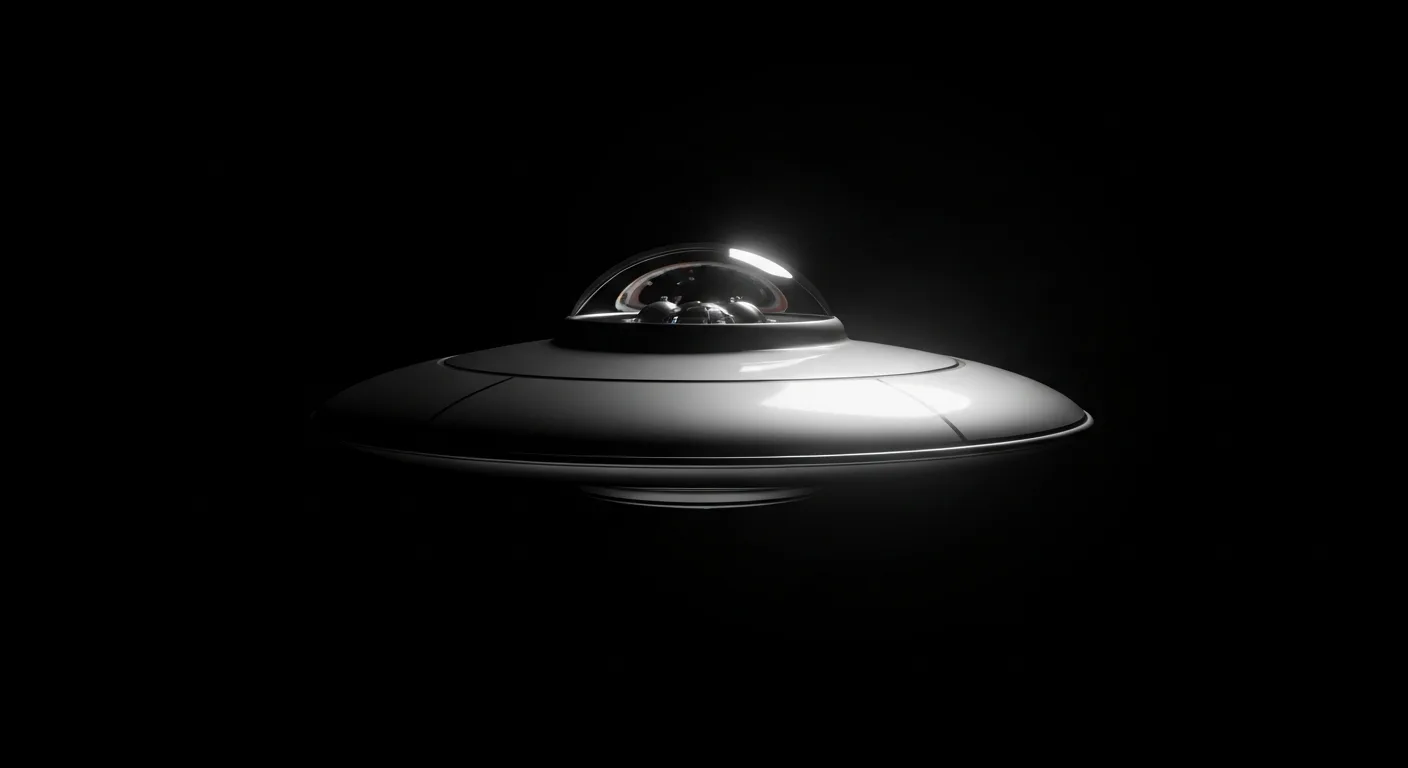
The Gulf Breeze UFO sightings erupted onto the national stage in the winter of 1987, transforming a quiet resort town on the Florida panhandle into the most hotly contested UFO battleground of the late twentieth century. What began with a single man’s photographs of a luminous, top-shaped craft hovering above the treetops would swell into a wave of over two hundred independent sightings, drawing investigators from every corner of the ufological community and dividing researchers into bitterly opposed camps. At the center of it all stood Ed Walters, a local building contractor whose extraordinary photographs were either among the most compelling evidence for extraterrestrial visitation ever captured—or among the most elaborate hoaxes in UFO history. Decades later, the case remains unresolved, a testament to the difficulty of separating genuine mystery from human deception, and of distinguishing what people truly saw in the skies above Gulf Breeze from what they wanted to see.
A Town on the Sound
Gulf Breeze sits on the tip of a narrow peninsula that juts into Pensacola Bay, connected to the barrier island of Pensacola Beach by a three-mile bridge. In the late 1980s, it was a prosperous bedroom community of roughly six thousand residents—retirees, military families from nearby Pensacola Naval Air Station, and professionals who appreciated the town’s quiet streets, salt-tinged air, and unobstructed views of the Gulf of Mexico. It was not the sort of place where extraordinary things happened. Residents knew their neighbors, attended church suppers, and watched spectacular sunsets from their back porches. The most exciting local debate typically concerned zoning ordinances or the schedule for the annual Hummingbird Festival.
This comfortable predictability made the events of November 1987 all the more jarring. Gulf Breeze was not a community primed for UFO hysteria. It had no history of unusual aerial phenomena, no tradition of paranormal folklore, no particular connection to military testing or experimental aircraft beyond the routine operations at Pensacola NAS. When the sightings began, they arrived without precedent or preparation, descending on the town with the same sudden inexplicability as the objects themselves.
The geography of the area, however, may have played a role in what followed. The flat terrain and open skies of the Gulf Coast provide an unusually clear field of view, and the waters of Pensacola Bay create a dark backdrop against which any luminous object would stand out vividly. Residents accustomed to scanning the horizon—watching for incoming weather, tracking the lights of shrimp boats, or simply admiring the stars—were perhaps more likely to notice something anomalous than city dwellers hemmed in by buildings and light pollution.
Ed Walters and the First Photographs
On the evening of November 11, 1987, Ed Walters stepped outside his home on Silmark Drive to investigate an unusual glow that had caught his eye through the window. What he saw, by his own account, changed his life irrevocably. Hovering above the road, partially obscured by a tall pine tree, was a craft unlike anything he had ever encountered—a glowing, bluish-gray object with a prominent ring of bright light around its lower section and a luminous beam emanating from its underside. Walters estimated the object was roughly thirty feet in diameter and perhaps seventy-five feet above the ground.
Rather than fleeing indoors, Walters grabbed a Polaroid camera—a decision that would come to define the entire case. Over the following minutes, he took five photographs as the craft moved slowly through the night sky. In the images, a structured, clearly defined object was visible against the dark background, its ring of lights and central beam strikingly apparent. The photographs were far clearer and more detailed than the blurry, ambiguous images that typically accompanied UFO reports, and it was precisely this clarity that would fuel both excitement and suspicion in equal measure.
Walters initially submitted his photographs to the local newspaper, the Gulf Breeze Sentinel, under the pseudonym “Mr. Ed.” The paper published them on November 19, 1987, and the response was immediate and overwhelming. Readers flooded the Sentinel with calls—some dismissive, some fascinated, and a surprising number claiming that they too had seen unusual lights in the sky over Gulf Breeze in recent weeks. The publication cracked open a door that would never fully close again.
Over the following months, Walters continued to photograph the objects, amassing a collection that would eventually include over forty Polaroid and 35mm images as well as several video recordings. He described repeated encounters in which the craft appeared near his home, sometimes hovering silently, sometimes moving with startling speed. In several instances, he reported being struck by a blue beam of light that lifted him partially off the ground and left him feeling disoriented and nauseated. He also described hearing a humming sound in his head during encounters, and claimed to have received telepathic communications from the occupants of the craft.
Walters documented his experiences in obsessive detail, keeping a journal of dates, times, weather conditions, and his emotional state during each encounter. This meticulous record-keeping would later serve both his supporters—who pointed to it as evidence of sincerity—and his detractors, who argued that such thorough documentation suggested a carefully planned hoax rather than the spontaneous reactions of a genuinely frightened witness.
The Photographs Under Scrutiny
The Walters photographs ignited a firestorm within the UFO research community that burned for years. At the heart of the controversy was a deceptively simple question: were the photographs genuine records of an anomalous aerial object, or had Walters fabricated them using models and double exposures?
Several photographic analysts examined the images with varying conclusions. Dr. Bruce Maccabee, an optical physicist with the Naval Surface Warfare Center and a prominent UFO researcher, conducted extensive analysis and concluded that the photographs showed a genuine three-dimensional object at a significant distance from the camera. He pointed to the consistency of the lighting, the behavior of the object’s glow in relation to surrounding features, and the difficulty of replicating such effects with a simple model. Maccabee became one of Walters’s most vocal defenders, staking a considerable portion of his professional reputation on the case.
On the other side, investigators such as Robert Boyd and others argued that the photographs could be explained by a small model suspended close to the camera lens or held aloft on a thin rod. They noted that in several images, the craft appeared to be at the same relative position and angle, as if fixed on a support rather than freely maneuvering. Some analysts identified what they believed were signs of double exposure in the Polaroid images, though others disputed these findings.
The technical debate over the photographs was complicated by the medium itself. Polaroid photographs, which develop as a single integrated image, are inherently more difficult to manipulate than conventional film—there is no negative to tamper with, and the chemical development process is not easily interrupted or altered. This gave the Walters photographs a degree of built-in credibility that conventional film would not have provided. However, enterprising skeptics demonstrated that it was possible to create convincing double exposures with a Polaroid camera by re-photographing a prepared scene, and that a small, illuminated model placed close to the lens could produce images remarkably similar to those Walters had captured.
The photographic evidence, in other words, proved to be a Rorschach test. Those inclined to believe in the reality of UFOs found the images compelling and the technical objections unconvincing. Those predisposed to skepticism found the images too good to be true and the techniques for faking them all too accessible. Neither side could deliver a definitive verdict, and the photographs alone could not resolve the case.
The Model in the Attic
The most damaging blow to Walters’s credibility came in June 1990, when a nine-inch model of a UFO was discovered in the attic of his former home on Silmark Drive. The house had been sold to a new owner, Robert Menzer, whose son reportedly found the model—fashioned from two foam plates, drafting paper, and colored plastic—while exploring the attic. When photographed under the right conditions, the model produced images bearing a striking resemblance to the objects in Walters’s photographs.
Walters immediately denounced the discovery as a plant, arguing that someone had placed the model in the attic after he moved out in order to discredit him. He pointed out that the house had been accessible to numerous people during and after his residence, and that anyone motivated to debunk his claims could easily have fabricated and placed the model. His supporters noted that the model, while superficially similar to the object in the photographs, did not precisely match in every detail, and that a simple foam-plate construction could not account for the complex lighting effects visible in the images.
Skeptics were unconvinced by these objections. The model’s presence in Walters’s former home was, they argued, the smoking gun that confirmed their suspicions. The timing of the discovery—coming after months of intense public scrutiny—suggested not a frame-up but rather an oversight by Walters, who had failed to dispose of his prop before moving. The Gulf Breeze case, in this reading, was nothing more than an ambitious hoax by a man who enjoyed the attention and was skilled enough in construction and photography to produce convincing fakes.
The model’s discovery cleaved the UFO research community down the middle. MUFON, which had invested significant resources in investigating the Gulf Breeze sightings, found itself publicly divided, with some members accepting the model as proof of fraud and others defending Walters and the integrity of his photographs. The resulting acrimony would poison relationships within the organization for years.
The Independent Witnesses
Whatever the truth about Ed Walters and his photographs, one aspect of the Gulf Breeze case has always been more difficult for skeptics to dismiss: the sheer number of independent witnesses who reported seeing unusual objects in the skies over Gulf Breeze during the same period. By the time the wave of sightings subsided, more than two hundred residents had come forward with their own accounts, many of them unconnected to Walters and unaware of his photographs at the time of their experiences.
These witnesses came from all walks of life—schoolteachers, retired military officers, shop owners, fishermen, and homemakers. Many were reluctant to speak publicly, fearing ridicule, and came forward only after learning that others in the community had seen similar things. Their descriptions, while varying in detail, shared common elements: a structured craft with bright lights, often described as disk-shaped or top-shaped, moving silently or with a low humming sound, at altitudes ranging from treetop level to several thousand feet.
One of the most compelling independent witnesses was Duane Cook, editor of the Gulf Breeze Sentinel. Cook had initially published Walters’s photographs with a degree of skepticism, but his attitude changed when he witnessed an anomalous object himself while driving near the bay one evening. His account—delivered by a respected journalist with no financial or reputational stake in promoting UFO claims—carried weight that Walters’s increasingly embattled testimony could not.
A group of regular skywatch participants, who gathered on a stretch of Pensacola Beach known as “Shoreline Park South” beginning in early 1988, reported multiple sightings of anomalous lights over the Gulf and the bay. These observers, who called themselves the “Bubba” group in a nod to local culture, maintained logs of their sightings and occasionally captured photographs and video footage of their own. While none of their images matched the clarity of Walters’s best photographs, several showed luminous objects that defied easy explanation.
The military presence in the area added another dimension to the independent witness testimony. Personnel stationed at Pensacola Naval Air Station and nearby Whiting Field were familiar with conventional aircraft, flares, and military exercises, yet some reported seeing objects that did not match any known aircraft in behavior or appearance. These witnesses, accustomed to the full range of military aviation, were arguably better qualified than most civilians to distinguish between the ordinary and the anomalous.
The MUFON Investigation
The Gulf Breeze sightings attracted the attention of MUFON almost immediately, and the organization mounted one of the most extensive field investigations in its history. Teams of researchers descended on the town, conducting interviews, analyzing photographs, surveying sighting locations, and attempting to correlate reports from multiple witnesses. The investigation was led by Walter Andrus, MUFON’s international director, and involved contributions from dozens of researchers across the country.
MUFON’s initial assessment was cautiously positive. Investigators found Walters to be a credible witness—he was a successful businessman with no history of attention-seeking behavior, no criminal record, and no obvious motive for perpetrating a hoax. He submitted to multiple polygraph examinations, all of which he passed, though the reliability of polygraph testing as a measure of truthfulness has always been debated. His photographs were subjected to extensive technical analysis, and while opinions varied, several analysts concluded that the images were consistent with a genuine unknown object rather than a fabricated model.
The investigation also documented the broader wave of sightings, compiling detailed reports from independent witnesses and mapping the geographic and temporal distribution of the events. This analysis revealed that sightings were clustered in a rough corridor over the bay and the peninsula, with the heaviest concentration near Walters’s home and along the shoreline. Some investigators interpreted this pattern as evidence that a genuine phenomenon was centered on Gulf Breeze; others suggested that the concentration reflected the influence of Walters’s publicity rather than any objective pattern of aerial activity.
The discovery of the model in 1990 threw the MUFON investigation into crisis. Some investigators, including Andrus, continued to defend Walters and the overall investigation, arguing that the model did not account for the independent witness testimony or the technical analysis of the photographs. Others, feeling that their credibility had been compromised by association with a probable hoax, distanced themselves from the case and called for MUFON to withdraw its endorsement. The resulting schism highlighted the fundamental challenge facing UFO research: how to maintain scientific rigor when dealing with phenomena that resist conventional verification.
Psychological and Sociological Dimensions
The Gulf Breeze case offers a fascinating study in the sociology of extraordinary claims. The progression from a single witness to a community-wide phenomenon followed a pattern that sociologists of religion and anomalous experience have documented in other contexts—an initial report generates publicity, which raises awareness, which prompts others to reinterpret their own experiences in light of the initial claim, which generates additional reports, which attract further attention, creating a self-reinforcing cycle.
This does not necessarily mean that the subsequent witnesses were mistaken or dishonest. Human perception is shaped by expectation, and people who have been primed to look for unusual objects in the sky are more likely to notice things they would otherwise have dismissed—conventional aircraft at unusual angles, atmospheric phenomena, satellites, or the planet Venus in an unfamiliar position. Some of the Gulf Breeze sightings may well have been misidentifications of prosaic objects by witnesses whose attention had been heightened by the publicity surrounding Walters’s claims.
At the same time, the social dynamics of the case created powerful incentives for both belief and skepticism. Within the Gulf Breeze community, the sightings became a defining issue, with residents sorting themselves into believers and doubters along lines that often tracked with existing social affiliations. The skywatch group at Shoreline Park South developed into a genuine community, bound together by shared experience and mutual support, and the social rewards of membership—belonging, excitement, the sense of participating in something momentous—may have influenced the interpretation of ambiguous events.
For Walters himself, the sightings brought both celebrity and persecution. He published a book, “The Gulf Breeze Sightings,” that became a bestseller, and he appeared on national television programs and at UFO conferences around the country. He also endured relentless criticism, accusations of fraud, and the humiliation of the model’s discovery. Whether he was a genuine experiencer driven to desperation by forces beyond his understanding or a cunning fabricator who got caught, the personal cost of the Gulf Breeze affair was considerable.
Legacy and Lingering Questions
The Gulf Breeze UFO sightings occupy an uncomfortable position in the annals of ufology. The case cannot be neatly classified as either a confirmed hoax or a genuine unknown event. The evidence against Walters—the model, the too-perfect photographs, the escalating claims—is substantial but not conclusive. The evidence in his favor—the polygraph results, the photographic analysis by Maccabee, and above all the independent witnesses—is equally substantial and equally inconclusive. The case exists in a gray zone where certainty is impossible and judgment becomes a matter of temperament as much as evidence.
What remains undeniable is that something unusual happened over Gulf Breeze in 1987 and 1988. Even if every photograph Ed Walters ever took was a fabrication, the independent witnesses still saw something. More than two hundred people do not simultaneously hallucinate the same object, and the consistency of the descriptions—the shape, the lights, the silence, the impossible maneuvers—argues against simple misidentification. Whether the objects were extraterrestrial craft, classified military technology, an atmospheric phenomenon unknown to science, or something else entirely, their presence over the Florida panhandle has never been adequately explained.
Gulf Breeze itself has moved on, though the events of the late 1980s left a permanent mark on the community’s identity. The skywatch group eventually disbanded, the media moved on to other stories, and the town returned to its previous quietude. But longtime residents still remember the winter when they looked up and saw something they could not explain—something that hovered over their streets and their waters with a silent, luminous indifference to all attempts at understanding. In kitchen-table conversations and at reunions of old friends, the question still surfaces: what was it, really, that visited Gulf Breeze?
The case serves as a cautionary tale for UFO researchers, illustrating the dangers of investing too heavily in a single witness, no matter how compelling their evidence may appear. It also demonstrates the limitations of photographic evidence in an age when images can be manipulated with increasing sophistication. But perhaps most importantly, it reminds us that the UFO phenomenon is larger than any single case, any single witness, or any single photograph. Whatever Ed Walters did or did not fabricate, the skies above Gulf Breeze held something real for those who saw it—something that defied explanation then and defies it still, hovering just beyond the reach of certainty like the craft that first appeared above the pines on a warm November evening in 1987.
Sources
- CIA UFO/UAP Reading Room — Declassified CIA documents on UAP