Newport News, Virginia UFO Sighting (February 9, 1959) — FBI Files
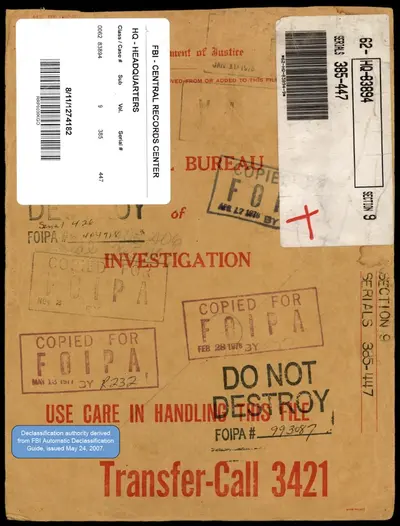
An FBI file from February 9, 1959, documents a report of unidentified flying objects submitted by Larry W. Bryant in Newport News, Virginia.
Historical Context
The late 1950s represented a period of heightened atmospheric tension and intense scrutiny regarding unidentified aerial phenomena. During the height of the Cold War, the United States maintained a state of constant vigilance against potential Soviet incursions into domestic airspace. This era was characterized by the proliferation of sightings involving unidentified flying objects, which were often viewed through the lens of national security and technological competition. The presence of sensitive military installations, such as those located in the Hampton Roads region of Virginia, necessitated rigorous monitoring of the skies.
During this time, the United States Air Force operated Project Blue Book, a systematic study of UFO reports intended to determine if these sightings represented threats to national security or evidence of extraterrestrial technology. Simultaneously, the Federal Bureau of Candlestick and other intelligence agencies maintained protocols to monitor domestic reports that might impact vital infrastructure. The geographical significance of Newport News, situated near major naval and industrial hubs, made it a critical area for such surveillance. The prevailing scientific and military understanding of the era struggled to categorize many sightings, often weighing the possibility of secret experimental aircraft against natural atmospheric phenomena or astronomical events.
The Newport News Incident
On February 9, 1959, an incident involving unidentified objects occurred in Newport News, Virginia. The details of this specific event were preserved within official government archives and were later released to the public on May 8, 2026, as part of the Presidential Unsealing and Reporting System for UAP Encounters (PURSUE). The documentation indicates that the report was brought to the attention of the Federal Bureau of Investigation through a communication from Larry W. Bryant.
The internal records of the FBI reveal the bureaucratic handling of the report. In his correspondence, Bryant wrote to the Bureau regarding the presence of unidentified flying objects. The FBI’s response to the inquiry was a standardized form letter, which stated that the agency possessed no authority to investigate reports of this nature. Following this response, no further investigative action was taken by the Bureau regarding the claims made by Bryant. While the document confirms the existence of the report and the specific date of the occurrence, the released files do not specify the number of witnesses involved in the sighting.
Classification and Analysis
The case is classified as a visual sighting, a type of encounter reported by observers on the ground or from the air. Such sightings were the most common form of UAP documentation during the mid-twentieth century. Because the reporting was routed through various FBI field offices, including those in Knoxville, Albuquerque, and Los Angeles, it demonstrates the established protocols used to funnel reports of potential threats to headquarters, particularly when they originated near sensitive installations.
Under the current oversight of the All-domain Anomaly Resolution Office (AARO), all records released through the PURSUE program are designated as unresolved by default. This designation reflects a lack of definitive evidence to categorize the event. The federal government has not reached a conclusion regarding whether the Newport News sighting was anomalous or caused by conventional means. Within the context of 1959, conventional explanations for such sightings often included the observation of experimental high-altitude aircraft, weather balloons, or atmospheric optical phenomena like lenticular clouds and sundogs. Additionally, the visibility of bright astronomical objects such as Venus, the Moon, or meteors near the horizon frequently contributed to the frequency of unidentified object reports during this period of history.