Richmond, Virginia UFO Sighting (January 11, 1957) — FBI Files
Declassified FBI files reveal a 1957 unidentified object report in Richmond, Virginia, involving correspondence from a private research group.
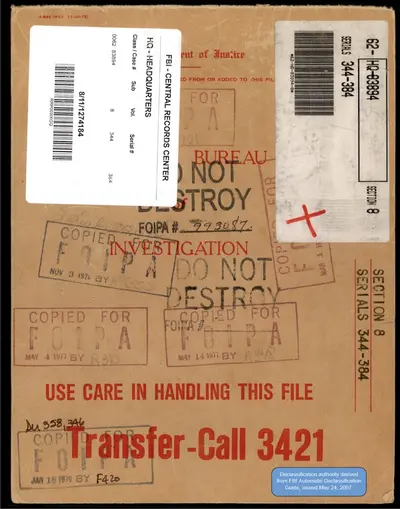
Historical Context of the Cold War Era
The mid-twentieth century represented a period of intense aerial surveillance and atmospheric anxiety within the United States. During the height of the Cold War, the presence of unidentified objects in the national airspace was treated with significant gravity by federal agencies. The technological advancements in aerospace engineering, coupled with the deployment of high-altitude reconnaissance capabilities, created a landscape where distinguishing between conventional military hardware and unknown phenomena was a primary concern for national security. During this era, the United States Air Force maintained various programs, most notably Project Blue Book, to catalog and investigate reports of unidentified flying objects. These investigations were often integrated into the broader intelligence-gathering apparatus of the federal government, as the potential for unidentified objects to represent advanced Soviet technology necessitated rigorous monitoring of the domestic skies.
The Richmond Incident of January 11, 1957
On January 11, 1957, an unidentified-object incident occurred in Richmond, Virginia. The details of this specific event were preserved within official government records and were later released to the public on May 8, 2026, through the Presidential Unsealing and Reporting System for UAP Encounters (PURSUE). The documentation indicates that the case was handled through established bureaucratic channels, with the Federal Bureau of Investigation (FBI) serving as a repository for the report. Under the standing protocols of the Bureau, various field offices, including those in Knoxville, Albuquerque, and Los Angeles, were responsible for routing UFO reports to headquarters, particularly when such reports could potentially impact the security of vital installations.
The specific mechanics of the Richmond report involve a chain of correspondence rather than a direct eyewitness testimony logged by law enforcement. A citizen residing in Richmond received a letter from the Aerial Phenomena Research Group. This correspondence was not isolated to the Virginia region, as the document notes a similarity to a letter received by a correspondent in Seattle, Washington. The presence of this information within the intelligence community is further evidenced by the fact that the Office of Special Investigations (OSI) at Langley Field, Virginia, held a copy of the letter. While the released document does not specify the exact number of witnesses involved in the original sighting, the movement of the letter through both private research groups and military intelligence channels highlights the interconnected nature of aerial anomaly reporting during the 1950s.
Classification and Investigative Status
The Richmond case is classified as a visual sighting reported by ground or air observers. In the context of mid-century investigations, visual sightings were the most common form of reported anomaly, though they presented significant challenges for investigators due to the lack of corroborating radar data or physical evidence. The nature of the sighting remains categorized under the broad heading of unidentified objects, a term that encompasses a wide range of potential phenomena.
As of the current era, all records released under the PURSUE program are designated as unresolved by the All-domain Anomaly Resolution Office (AARO) by default. The federal government maintains a neutral stance regarding the Richmond incident, having reached no definitive conclusion as to whether the event was anomalous or conventional. In the broader study of 1950s aerial phenomena, investigators frequently consider several conventional candidates for such sightings. These include experimental aircraft testing, weather balloons—specifically those associated with the Project Mogul series from the late 1940s—and various atmospheric optical phenomena such as sundogs or lenticular clouds. Additionally, astronomical objects like Venus, the Moon, or meteors appearing near the horizon are often evaluated as potential explanations for reported unidentified objects. The Richmond file remains a part of this ongoing scientific and historical assessment.