Father Gill Sighting
Anglican missionary Father William Gill and 37 others watched a craft with humanoid figures on top for hours. When they waved, the beings waved back.
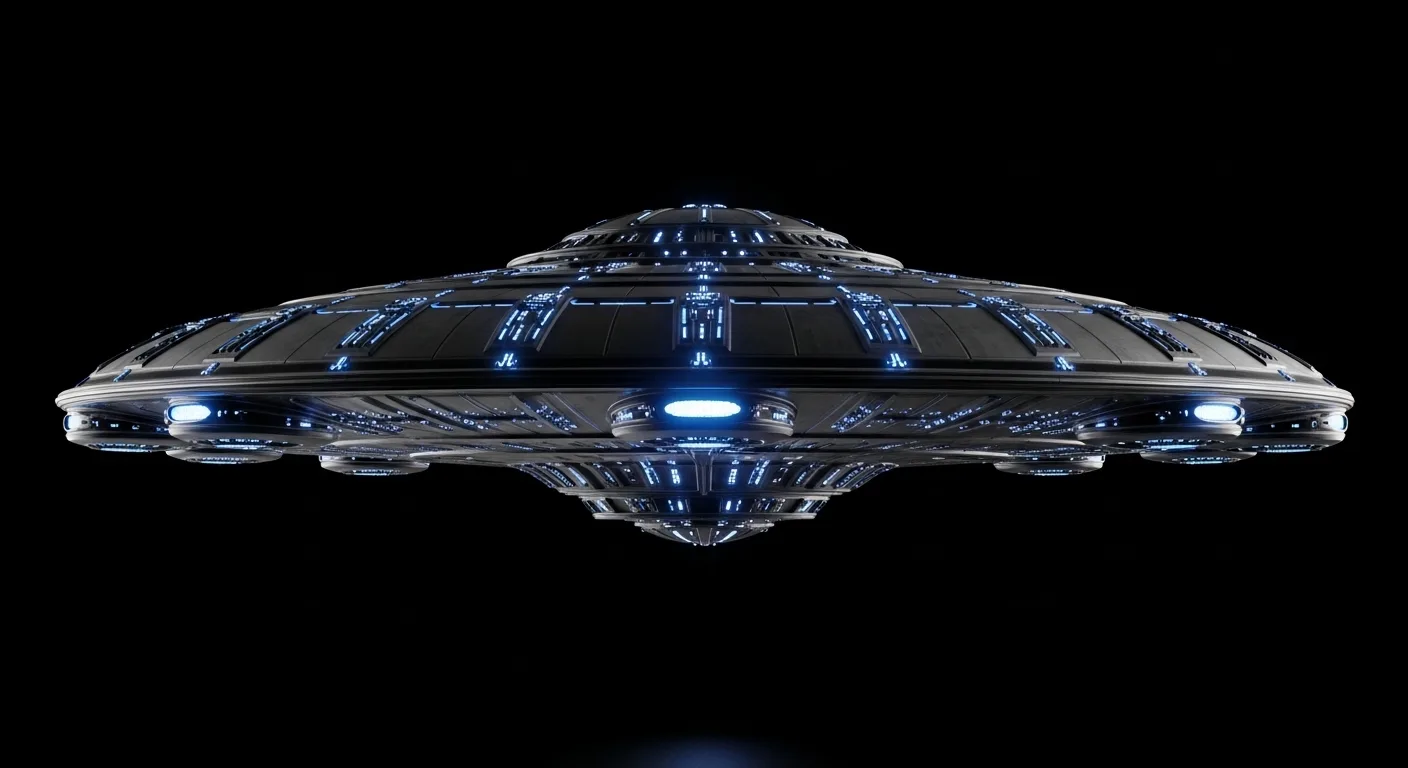
On the evening of June 26, 1959, in the remote Anglican mission at Boianai on the northeast coast of Papua New Guinea, a clergyman named William Booth Gill stepped outside after dinner and looked up at the sky. What he saw would launch one of the most remarkable and enduring cases in UFO history: a structured craft hovering above the mission, clearly visible against the tropical dusk, with humanoid figures standing on its upper surface. Over the course of two consecutive nights, Gill and thirty-seven other witnesses, mission staff, teachers, and local villagers, observed the craft at close range for extended periods, documenting their observations with the care and precision that Gill’s education and temperament demanded. In a moment that has become legendary in the annals of close encounters, Gill waved at the figures on the craft, and they waved back. The Boianai sighting stands as one of the most significant cases of apparent interaction between human observers and occupants of an unidentified craft, supported by an unusually large number of corroborating witnesses and the unimpeachable character of its primary observer.
The Witness
Father William Booth Gill was, by any measure, an ideal witness to an extraordinary event. An Australian-born Anglican missionary, Gill was university-educated, articulate, and possessed of the methodical temperament that his faith and his work in remote communities demanded. He had been stationed at the Boianai mission for several years, serving the local population through education, medical care, and spiritual guidance. His reputation among both the European and indigenous communities was exemplary, and his character was vouched for by his ecclesiastical superiors without reservation.
Gill was not a man prone to fantasy or exaggeration. His correspondence and personal writings reveal a practical, down-to-earth personality more concerned with the daily challenges of mission work than with speculative or esoteric matters. He had no interest in science fiction, no history of unusual claims, and no apparent motivation to fabricate a story that would bring him unwanted attention and the implicit suggestion that a man of the cloth was either lying or losing his mind.
It is worth emphasizing this last point, because the credibility of the Boianai sighting rests substantially on Gill’s character. A missionary who reports seeing a flying craft with alien occupants risks his professional standing, his relationships with colleagues, and his spiritual authority. The fact that Gill reported what he saw, calmly, consistently, and without embellishment, despite these risks, speaks powerfully to his sincerity.
The Setting
Boianai was a small Anglican mission station situated on the coast of what was then the Territory of Papua, administered by Australia. The mission consisted of several simple buildings, a church, a school, and staff quarters, set against a backdrop of tropical vegetation and the waters of the Solomon Sea. The community was isolated, accessible primarily by boat, and far removed from the urban centers and military installations that feature in many UFO cases.
The isolation of Boianai is significant for several reasons. It meant that the witnesses were unlikely to have been influenced by media coverage of UFO sightings, which was minimal in Papua New Guinea in 1959. It meant that conventional explanations involving aircraft, searchlights, or industrial activity were particularly difficult to sustain. And it meant that the social dynamics of the witness group were relatively uncomplicated: these were people who lived and worked together in a small community, and their observations could be cross-checked against one another with a high degree of confidence.
The weather conditions on the evenings of June 26 and 27 were clear, with good visibility and minimal cloud cover. The tropical latitude meant that darkness fell relatively early, and the absence of light pollution in this remote coastal area made the sky exceptionally clear. Conditions for astronomical and aerial observation were, in short, excellent.
The First Night: June 26, 1959
The events began at approximately 6:45 PM on June 26, when Gill noticed a bright light approaching the mission from the northwest. The light was larger and brighter than any star or planet, and it was clearly moving. Gill called to his staff, and within minutes a group of people had gathered outside to watch.
As the light drew closer, its nature became apparent: this was not a distant point of light but a structured object, a craft of considerable size that was approaching the mission at moderate speed. The object came to a stop and hovered over the mission at an altitude that Gill estimated at approximately 300 to 500 feet, close enough for substantial detail to be visible.
What Gill and the other witnesses saw was extraordinary. The craft appeared to be disc-shaped or roughly circular when viewed from below, with a glowing base that emitted a steady, diffuse light. Above the base, the craft had what appeared to be a superstructure or upper deck, and on this upper surface, clearly visible against the illuminated background, stood four humanoid figures.
The figures were visible in silhouette or semi-silhouette, their forms outlined against the glow of the craft. They appeared to be of roughly human proportions, though details of their features were not discernible at the distance and angle of observation. The figures moved about on the upper surface of the craft, bending, straightening, and occasionally appearing to interact with one another. Their movements suggested purposeful activity, as if they were performing tasks or operating equipment, though the nature of their work could not be determined from below.
Gill observed the craft for approximately four hours on this first night, during which time it remained in the vicinity of the mission, sometimes hovering directly overhead and sometimes drifting slowly to one side or another. Other smaller lights, apparently additional craft, were visible in the sky during portions of the observation, sometimes approaching the main object and sometimes moving independently. The witnesses counted as many as eight separate luminous objects visible at various times during the evening.
As the night progressed, cloud cover began to develop, and the craft eventually ascended into or above the clouds and was lost to view. Gill went to bed, having spent the evening watching what he would later describe, with characteristic understatement, as “a most unusual display.”
The Second Night: June 27, 1959
The following evening, June 27, the craft returned. This time, its appearance was anticipated, and a larger group of witnesses gathered to observe. The craft arrived at approximately 6:00 PM, earlier than the previous night, and once again took up a position over the mission at relatively close range.
The scene was similar to the previous evening: the disc-shaped craft with its glowing base and visible superstructure, the humanoid figures moving about on the upper surface. But on this second night, the encounter took a turn that elevated it from remarkable to extraordinary.
Father Gill, observing the figures on the craft, raised his arm and waved. One of the figures on the craft appeared to respond, raising its own arm in a waving motion. Gill waved again. The response was repeated. Gill then asked one of his companions to wave as well. When multiple people waved simultaneously, multiple figures on the craft appeared to wave back.
Emboldened by this apparent interaction, Gill tried to signal the craft with a flashlight, shining the beam upward toward the object. The craft responded by making a slight swinging motion, moving back and forth in what the witnesses interpreted as an acknowledgment of the signal. The interaction continued for some time, with the witnesses waving and signaling and the occupants appearing to respond.
The exchange was not frantic or dramatic. Gill described it in matter-of-fact terms, as if the mutual acknowledgment between the observers and the observed was a perfectly natural, if unusual, occurrence. There was no panic among the witnesses, no sense of threat or danger. The atmosphere was one of curiosity and wonder rather than fear.
After a period of this interaction, the craft’s occupants ceased responding to the waves and signals, and the object moved to a higher altitude. Gill, displaying a pragmatism that some researchers have found both admirable and frustrating, went inside for dinner, leaving the craft hovering in the sky. When he came back outside after the meal, the craft had departed.
The decision to go to dinner while a UFO hovered overhead has been cited by skeptics as evidence that the sighting was misidentified or exaggerated, the reasoning being that no one would walk away from genuine contact with an extraterrestrial craft to eat a meal. Gill himself addressed this criticism with characteristic calm, explaining that the craft showed no signs of landing or initiating further contact, dinner was ready, and he was hungry. The simplicity and honesty of this explanation is, paradoxically, one of the strongest arguments for the authenticity of his account. A fabricator would have crafted a more dramatic narrative; only a truthful witness would admit to something so mundane.
The Witnesses
The strength of the Boianai case lies not only in Gill’s credibility but in the sheer number of corroborating witnesses. Thirty-eight people in total observed the craft over the two nights, including Gill, his mission staff, local teachers, medical assistants, and villagers. This was not a solitary observation by a lone individual in darkness; it was a communal experience shared by a diverse group of people over extended periods in conditions of good visibility.
After the sightings, Gill compiled a detailed written report that included his own observations, sketches of the craft and its occupants, notes on the timing and duration of each observation, and a list of all witnesses. The witnesses were asked to sign the document, affirming that the account accurately represented what they had seen. Twenty-five signatures were obtained, an extraordinary degree of formal corroboration for a UFO sighting.
The witnesses’ descriptions were consistent with one another and with Gill’s own account. There were minor variations in estimated distances and sizes, as would be expected from different observers viewing the same object from different vantage points, but the core observations, a disc-shaped craft with humanoid figures, hovering at close range, were uniform across the witness group.
The Investigations
The Boianai sighting attracted the attention of several investigative bodies, though the remoteness of the location limited the scope of on-site inquiry.
The Royal Australian Air Force investigated the case and interviewed Gill upon his return to Australia. The RAAF investigators found Gill credible and his account consistent, but were unable to offer a conventional explanation for the sighting. The case file was classified as unknown and eventually released to researchers.
Dr. J. Allen Hynek, the American astronomer who served as scientific consultant to the U.S. Air Force’s Project Blue Book, reviewed the Boianai case and considered it one of the most significant in the global UFO literature. Hynek was particularly impressed by the number and quality of witnesses, the extended duration of the observations, and the apparent interaction between the observers and the craft’s occupants. He placed the case in his highest category of credibility and frequently cited it in his lectures and writings.
Dr. Donald Menzel, a Harvard astronomer and prominent UFO skeptic, attempted to explain the sighting as a misidentification of the planets Venus and Jupiter, which were visible in the evening sky during the period of the sightings. This explanation was widely ridiculed, even by other skeptics, as wholly inadequate. The witnesses had observed a structured craft at close range for hours, with visible humanoid occupants who responded to signals; the suggestion that they were looking at planets strained credulity beyond its breaking point.
Other skeptical explanations have included squid boats (fishing vessels using bright lights to attract squid), atmospheric mirages, and mass hallucination. None of these proposals has gained significant traction. Squid boats do not hover overhead, do not carry visible humanoid figures, and were not operating in the area. Atmospheric mirages do not persist for hours, do not respond to waving, and do not display structured features. Mass hallucination involving thirty-eight people over two nights, with consistent descriptions and a signed written record, is a phenomenon that has no precedent in the psychological literature.
The Significance of Interaction
The element that elevates the Boianai sighting from a remarkable observation to a case of profound significance is the apparent interaction between the witnesses and the craft’s occupants. In the vast majority of UFO cases, the relationship between observer and object is passive: the witness sees something unusual, and the object departs. The Boianai case is one of the rare instances in which the occupants of a craft appeared to acknowledge the presence of human observers and to respond to their attempts at communication.
The waving exchange is simple almost to the point of banality, yet its implications are enormous. If taken at face value, it represents a moment of mutual recognition between human beings and the occupants of an unknown craft, a fleeting contact across whatever gulf of technology, biology, or dimension separates us from them. The occupants were aware of the observers, could perceive their gestures, and chose to respond in kind. This suggests not merely physical presence but consciousness, intention, and a willingness to engage.
The choice to respond with a wave, the most universal and benign of human gestures, is also significant. The occupants did not flee, did not exhibit hostile behavior, and did not attempt to land or make more extensive contact. They simply acknowledged the humans below them and continued about their business. This pattern of brief, non-threatening interaction is consistent with many of the more credible close encounter reports worldwide and suggests a phenomenon characterized more by curiosity than by aggression.
Father Gill’s Later Life
William Gill continued his missionary work after the Boianai sightings, eventually returning to Australia where he served in various ecclesiastical capacities until his retirement. He spoke publicly about the sighting when asked, always in the same calm, measured tones that had characterized his original report. He neither sought publicity nor shrank from it, treating the incident as an extraordinary but factual event in a life that contained many remarkable experiences.
Gill never wavered in his account. Over decades of interviews, public appearances, and correspondence with researchers, he maintained the same description of events, without embellishment or retraction. He expressed no particular theory about what the craft was or where it came from, preferring to report what he had seen and let others draw their own conclusions. This restraint, unusual among UFO witnesses, enhanced rather than diminished his credibility.
In interviews late in life, Gill reflected on the sighting with a combination of wonder and pragmatism. He acknowledged that the experience had been extraordinary, that it had challenged his understanding of the world, and that it had introduced an element of mystery into a life otherwise grounded in faith and practical service. But he did not treat it as the defining event of his existence; it was one episode among many, significant but not all-consuming.
The Enduring Mystery
The Boianai sighting of June 1959 remains, more than six decades later, one of the most compelling cases in the history of the UFO phenomenon. Its strength lies in the convergence of factors that skeptics typically cite as absent from UFO reports: a highly credible primary witness, a large group of corroborating observers, extended duration of observation, close range, good viewing conditions, detailed contemporaneous documentation, and apparent intelligent interaction between witnesses and the object’s occupants.
No conventional explanation has successfully accounted for the observations. The planet hypothesis, the squid boat hypothesis, the mirage hypothesis, and the hallucination hypothesis have all been proposed and found wanting. The case resists debunking not because skeptics have not tried but because the evidence is too strong, too consistent, and too well-documented to yield to simple explanations.
What hovered over the Boianai mission on those tropical evenings in 1959 remains unknown. The craft and its occupants came, were observed, acknowledged their observers with a wave, and departed. They left behind no physical evidence, no technology, and no message, only the testimony of thirty-eight people who saw something extraordinary and a signed document attesting to what they witnessed. For those who study the UFO phenomenon, the Boianai sighting stands as a reminder that the most powerful evidence is sometimes the simplest: credible people, in large numbers, watching something they cannot explain, and having the integrity to say so.
Sources
- Project Blue Book — National Archives — USAF UFO investigation files, 1947–1969
- CIA UFO/UAP Reading Room — Declassified CIA documents on UAP