England UFO Sighting (September, 1953) — FBI Files
In September 1953, television viewers in England unexpectedly received a broadcast signal from the defunct Houston station KLEE.
Background
In September 1953, within the borders of England, United States government investigators recorded an unidentified-object incident that was later released to the public on May 8, 2026, as part of the Presidential Unsealing and Reporting System for UAP Encounters (PURSUE). This incident occurred during the height of the Cold War, a period characterized by intense global surveillance and heightened sensitivity regarding airspace integrity. The case was investigated under the framework of the Air Force’s Project Blue Book or its predecessor programs, which were tasked with analyzing reports of unidentified aerial phenomena.
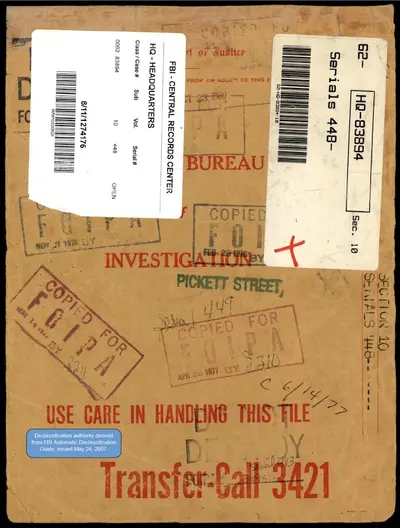
The documentation was formally filed with the Federal Bureau of Investigation. During this era, the Bureau maintained specific standing protocols for the protection of vital installations and national security interests. Consequently, various field offices, including those in Knoxville, Albuquerque, and Los Angeles, were responsible for routing UFO reports to headquarters to ensure centralized oversight of potential threats to communication and infrastructure.
The KLEE Signal Incident
The specific details recorded in the official documents describe a phenomenon involving unexpected broadcast interference. Television viewers across England unexpectedly received a signal displaying the identification card and call letters of television station KLEE, which operated out of Houston, Texas. This occurrence was particularly anomalous because KLEE had been off the air for three years prior to the event. Despite the station’s long-term inactivity, the signal appeared on screens across the Atlantic, presenting a phantom picture that lacked a discernible point of origin.
The investigation noted the confusion regarding the broadcast, as the material being viewed was known to be obsolete. As recorded in the file, “Station KLEE, they were told, has been off the air for all of three years, and since that time no KLEE identification card has been shown.” While the document provides a detailed account of the signal’s content, the specific number of witnesses to the broadcast is not specified in the released records. The origin and the journey of this phantom signal remain unknown to investigators.
Phenomenological Context
This case is categorized by reports of figures or beings associated with the object or signal. In the study of unidentified aerial phenomena, such associations often complicate the distinction between electromagnetic interference and physical presence. The nature of the signal suggests a phenomenon that bypassed traditional transatlantic communication limitations of the 1950s, presenting a challenge to the understanding of radio wave propagation and signal interception during that period.
The investigation of such anomalies in the mid-twentieth century often had to account for various technological and natural variables. Conventional candidates for sightings and signal anomalies of this period included experimental aircraft, weather balloons—specifically the Project Mogul series deployed in the late 1940s—and atmospheric optical phenomena such as sundogs or lenticular clouds. Additionally, astronomical objects like Venus, the Moon, or meteors near the horizon were frequently evaluated as potential sources of visual or electromagnetic disturbance.
Current Status
All records released under the PURSUE program are designated as unresolved by the All-domain Anomaly Resolution Office (AARO) by default. The federal government has not concluded that the events involving the KLEE signal were anomalous, nor has it concluded that the occurrence was the result of conventional means. The official position remains that the government has not ruled out either possibility, leaving the 1953 England incident as an open entry in the historical archive of unidentified phenomena.