Sutton, West Virginia UFO Sighting (October 13, 1952) — FBI Files
Federal Bureau of Investigation records document a 1952 sighting in Sutton, West Virginia, involving a light-emitting object accompanied by a sharp noise.
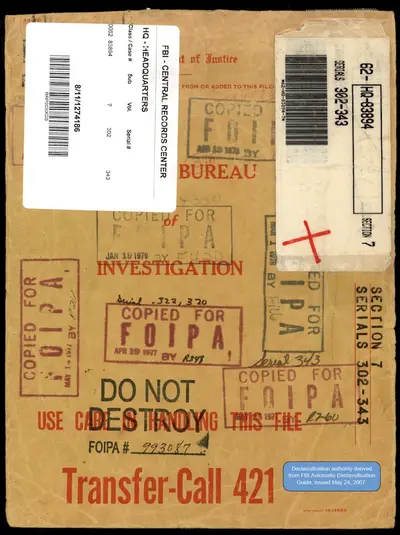
Historical Context
The sighting in Sutton, West Virginia, occurred during a period of heightened national anxiety regarding unidentified aerial phenomena. Following the Kenneth Arnold sighting in June 1947 and the widely discussed Roswell incident in July 1947, the United States experienced a significant surge in reports of “flying saucers.” This era was characterized by the early Cold War, where the presence of unknown objects in the sky was often scrutinized through the lens of national security and the potential for advanced Soviet technology.
During the early 1950s, the Federal Bureau of Investigation maintained specific protocols for handling such reports. While the Bureau was primarily focused on domestic intelligence and criminal investigation, field offices in cities such as Knoxville, Albuquerque, and Los Angeles were instructed to route UFO reports to headquarters. This procedure was established to ensure the protection of vital installations and to monitor any potential threats to sensitive government or military infrastructure. The Sutton case, documented within these official files, represents this era of bureaucratic monitoring of anomalous aerial activity.
The Incident
On October 13, 1952, residents of Sutton, West Virginia, observed an unidentified object in the sky. According to the documentation released to the public on May 8, 2026, as part of the Presidential Unsealing and Reporting System for UAP Encounters (PURSUE), the object was estimated to be approximately ten feet tall and four feet wide. The physical description provided in the file notes that the object was “estimated a like of a man.”
The observation was characterized by specific sensory details. The object emitted lights, with reports indicating that “two lights flashed from side to side.” As the object moved, it produced a distinct auditory component, described as a “sharp, sucking noise.” The movement of the object was noted to be lateral, shifting from side to side. The documentation also contains a fragmented note regarding the sound, stating “the machine made a noise as about.” Interestingly, the visual description of the object was linked by observers to a rocket craft previously featured in an issue of Collier’s magazine, suggesting that the public was attempting to categorize the phenomenon using contemporary science fiction and aerospace imagery.
While the occurrence was significant enough to be filed with federal authorities, the released document does not specify the exact number of witnesses present during the event.
Classification and Analysis
The Sutton case is classified as a visual sighting reported by ground or air observers. In the broader context of Unidentified Anomalous Phenomena (UAP) research, this case belongs to the first wave of mid-century sightings that prompted increased government interest in atmospheric anomalies.
The status of the Sutton incident remains unresolved. Under the default protocols of the All-domain Anomaly Resolution Office (AARO), all records released through the PURS_UE program are designated as unresolved. The federal government has not reached a conclusion regarding whether the event was anomalous or the result of known technology. The investigation has not ruled out the possibility of conventional origins.
During this period of the 1950s, several conventional candidates were frequently identified as potential sources for such sightings. These included experimental aircraft testing, weather balloons—specifically those associated with the Project Mogul series in the late 1940s—and various atmospheric optical phenomena such as sundogs or lenticular clouds. Additionally, astronomical objects like the Moon, Venus, or meteors near the horizon were often mistaken for unidentified craft. The Sutton report, with its specific mention of a “sucking noise” and a specific physical scale, remains a subject of study within the archive of documented aerial phenomena.