Fairmont, West Virginia UFO Sighting (August 1, 1952) — FBI Files
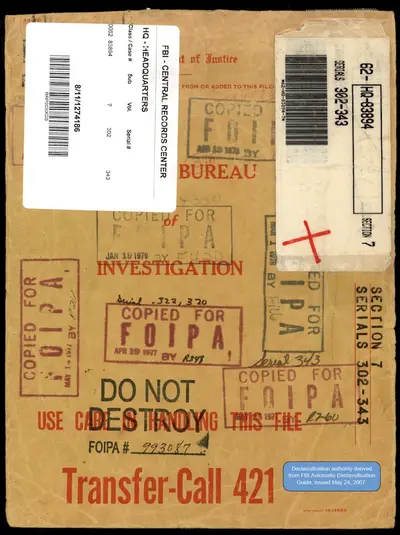
An FBI file details a 1952 report from a Mrs. Haufe regarding flying disks observed in Fairmont, West Virginia.
Background
On August 1, 1952, in Fairmont, West Virginia, U.S. and federal government investigators recorded an unidentified-object incident that remained classified for decades. The documentation regarding this event was later released to the public on May 8, 2026, as part of the Presidential Unsealing and Reporting System for UAP Encounters (PURSUE). This specific sighting occurred during a period of heightened national anxiety regarding aerial unidentified phenomena. The incident is categorized as part of the first significant wave of flying saucer reports that swept the United States following the Kenneth Arnold sighting of June 1947 and the Roswell incident of July 1947.
During the early 1950s, the geopolitical climate of the Cold War necessitated rigorous monitoring of the American airspace. The presence of unidentified objects was viewed through the lens of national security, as the possibility of Soviet technological advancements or reconnaissance capabilities remained a primary concern for intelligence agencies. Consequently, the Federal Bureau of Investigation maintained established protocols for processing such reports. When field offices in locations such as Knoxville, Albuquerque, and Los Angeles received reports of unusual aerial activity, they were routed to FBI headquarters under standing protocols designed for the protection of vital installations and sensitive infrastructure.
The Incident and Documentation
The primary evidence for this event consists of official correspondence archived within the FBI files. In this document, a Mrs. Haufe wrote a letter to the Bureau specifically regarding the presence of flying disks. While the correspondence confirms that an observation took place, the specific details of her visual encounter, such as the trajectory, altitude, or physical characteristics of the objects, are not detailed in this particular document. The record serves only to confirm that she reported an observation related to the topic of unidentified aerial phenomena.
Upon receiving the communication, the FBI acknowledged the letter and followed standard investigative procedure by forwarding the report to the United States Air Force for further attention. This hand-off between the FBI and the Air Force was a common administrative pattern during this era, as the military held the primary responsibility for investigating air defense anomalies. The released documentation does not specify the total number of witnesses involved in the sighting, leaving the scope of the observation limited to the individual correspondent.
Analysis and Classification
The case is classified as a visual sighting reported by ground or air observers. Within the broader history of Unidentified Aerial Phenomena (UAP), this report belongs to the era of mass-media-driven “saucer” sightings, where public interest in anomalous objects peaked alongside advancements in radar technology and atmospheric science.
All records released under the PURSUE program are designated as unresolved by the All-domain Anomaly Resolution Office (AARO) by default. The federal government has maintained a neutral stance regarding the Fairmont incident, having not concluded that the events were anomalous, nor having concluded that they were conventional. The possibility of either remains open in the official record.
When evaluating sightings from the early 1950s, investigators often consider several conventional candidates. These include the presence of experimental aircraft testing, the use of weather balloons—specifically those associated with the Project Mogul series in the late 1940s—or various atmospheric optical phenomena such as sundogs and lenticular clouds. Additionally, astronomical objects such as Venus, the Moon, or meteors appearing near the horizon are frequently cited as potential explanations for reports of luminous, moving objects. The Fairmont case remains a part of the permanent archive of such unverified aerial observations.