Thessalon Lake UFO Sighting (July 27, 1952) — FBI Files
On July 27, 1952, an observer in Ontario, Canada, reported a formation of planes dropping objects that accelerated rapidly with bluish smoke trails.
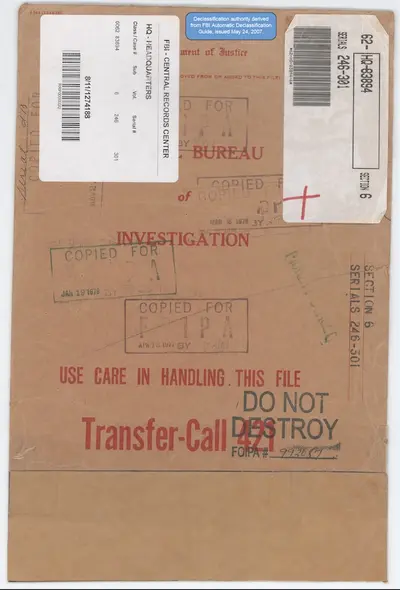
Historical Context
The summer of 1952 represented a period of heightened atmospheric anxiety across North America. Following the high-profile Kenneth Arnold sighting in June 1947 and the subsequent Roswell incident in July 1947, the concept of the “flying saucer” had entered the public consciousness, fueling widespread speculation regarding unidentified aerial phenomena. During this era, the geopolitical climate of the early Cold War necessitated rigorous monitoring of the skies. The United States and its neighbors were deeply concerned with the possibility of unauthorized incursions by Soviet technology, leading to an increased scrutiny of any anomalous aerial activity.
The reporting of such events often followed established bureaucratic channels. During this period, the Federal Bureau of Investigation maintained protocols for processing reports that could potentially impact the security of vital installations. Field offices in cities such as Knoxville, Albuquerque, and Los Angeles were tasked with routing UFO-related intelligence to headquarters. This systematic approach ensured that any sighting that might suggest a breach of airspace or a new technological threat was documented within the federal intelligence apparatus.
The Thessalon Lake Incident
On July 27, 1952, an incident occurred over Thessalon Lake, Ontario, Canada, which was subsequently documented by U.S. government investigators. The details of this specific event remained largely inaccessible to the general public until May 8, 2026, when the records were released as part of the Presidential Unsealing and Reporting System for UAP Encounters (PURSUE). The documentation provides a specific account of aerial activity observed by Dr. McIndoo.
According to the official file, Dr. McIndoo observed a formation of sixteen to twenty planes flying in two groups toward the south. The observation included a notable transition in the behavior of the objects being tracked. The planes appeared to drop objects that the observer initially believed to be parachutes. However, the nature of these objects changed almost immediately upon release. Rather than descending via parachute deployment, the objects accelerated rapidly, moving in a southwesterly direction. This high-speed movement was accompanied by the appearance of a trail of bluish smoke. While the released document records the observations of Dr. McIndoo, the total number of witnesses involved in the sighting is not specified in the official record.
Analytical Framework and Classification
The Thessalon Lake case is classified as a visual sighting reported by ground or air observers. In the study of mid-century aerial phenomena, such reports are often analyzed alongside other contemporary sightings to determine if they share common characteristics, such as specific flight patterns or propulsion signatures. The behavior described in the 1952 report, particularly the rapid acceleration and the presence of smoke, distinguishes it from more stationary or slow-moving atmospheric phenomena.
Under the current guidelines of the All-domain Anomaly Resolution Office (AARO), all records released through the PURSUE program are designated as unresolved by default. The federal government has maintained a neutral stance regarding the Thessalon Lake incident, neither concluding that the event was anomalous nor confirming that it was the result of conventional technology.
When investigating sightings from the early 1950s, researchers often consider several conventional candidates. These include experimental aircraft testing, which was frequent during the Cold War, or the presence of weather balloons, such as those used in the Project Mogul series. Other possibilities include atmospheric optical phenomena, such as sundogs or lenticular clouds, as well as astronomical objects like the Moon, Venus, or meteors appearing near the horizon. The lack of a definitive conclusion regarding the objects over Thessalon Lake remains consistent with the broader scientific and governmental approach to unverified aerial encounters from this period.