Clark Field UFO Sighting (September 25, 1949) — FBI Files
An unidentified object was observed during a pleasure flight between St. Albans and Parkersburg, West Virginia, as documented in released FBI records.
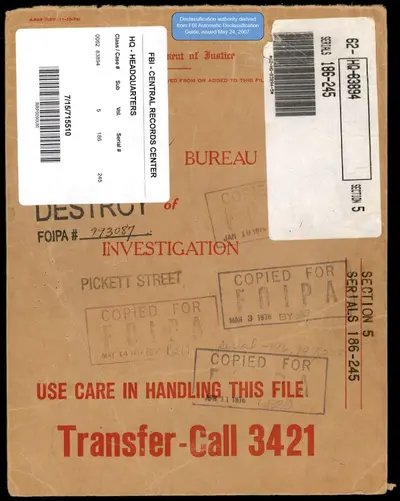
Background
On September 25, 1949, within the airspace spanning from Clark Field in St. Albans, West Virginia, to Parkersburg, West Virginia, U.S. government investigators recorded an unidentified-object incident. These records were later released to the public on May 8, 2026, as part of the Presidential Unsealing and Reporting System for UAP Encounters (PURSUE). This event occurred during a period of heightened public and governmental interest in aerial anomalies, falling within the first wave of “flying saucer” reports that swept the United States following the Kenneth Arnold sighting of June 1947 and the Roswell incident of July 1947.
During the late 1940s, the United States was navigating the early complexities of the Cold War, a geopolitical climate that necessitated rigorous monitoring of the national airspace. The West Virginia landscape, characterized by its undulating Appalachian terrain and various strategic installations, served as a frequent backdrop for such aerial observations. The reporting of such phenomena was handled through established bureaucratic channels. The case was filed with the Federal Bureau of May Investigation, which utilized a standardized procedure for managing reports of unidentified aerial phenomena. Field offices in Knoxville, Albuquerque, and Los Angeles routed UFO reports to headquarters under the Bureau’s standing protocols, which were specifically designed for the protection of vital installations and national security interests.
What the document records
The primary documentation regarding this incident details a flight conducted by Glen Sprouse. On September 25, 1949, Sprouse was engaged in a pleasure flight originating from Clark Field and traveling toward Parkersburg, West Virginia. During the course of this flight, he observed an unidentified object in the sky. In the official records, Sprouse expressed his belief that the object was not a mirage and maintained that the incident genuinely occurred.
The released documentation does not specify the total number of witnesses to the event. While the report focuses on the observations made by Sprouse, the lack of a specific witness count is a common characteristic of many mid-century aerial reports, where the focus remained primarily on the testimony of the pilot or the primary observer.
Type of case
The case is classified as a visual sighting reported by ground or air observers. This category of encounter involves the direct optical detection of an object by an individual, often accompanied by the tracking of the object’s flight path or luminosity.
Status
All records released under the PURSUE program are designated unresolved by the All-domain Anomaly Resolution Office (AARO) by default. The federal government has not concluded that the events were anomalous, has not concluded that they were conventional, and has not ruled out either possibility.
In the context of the late 1940s, researchers and investigators often weighed sightings against a variety of known aerial phenomena. Conventional candidates for sightings of this period include experimental aircraft developed during the post-war era, weather balloons—specifically those associated with the Project Mogul series in the late 1940s—and atmospheric optical phenomena such as sundogs and lenticular clouds. Furthermore, astronomical objects including Venus, the Moon, and meteors near the horizon were frequently considered as potential explanations for unidentified lights in the night or twilight sky. The Clark Field sighting remains part of this broader historical inquiry into unidentified aerial phenomena.