Savannah River Plant UFO Sighting (August 8, 1952) — FBI Files
Two employees observed a saucer-shaped blue light with an orange fringe flying at high speeds over a South Carolina nuclear facility in 1952.
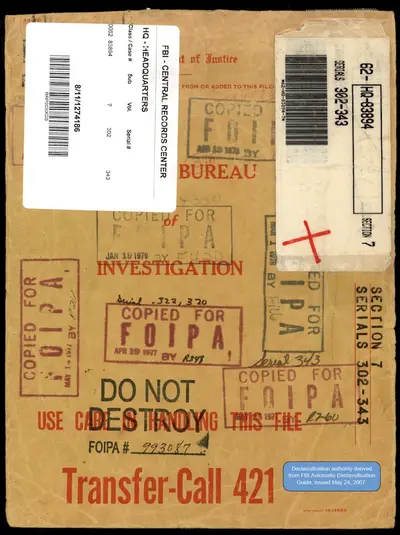
Historical Context
The Savannah River Plant, located in South Carolina, served as a critical component of the United States’ nuclear infrastructure during the early Cold War. Established as part of the nation’s rapid expansion of atomic energy production and weapons development, the facility was a highly sensitive site under the jurisdiction of the Atomic Energy Commission (AEC). During the early 1950s, the geopolitical climate was defined by intense scrutiny of airspace and the perceived threat of Soviet technological advancements. This era saw a significant rise in Unidentified Flying Object (UFO) reports across the American landscape, a phenomenon often referred to as the first wave of “flying saucer” sightings. This period of public and military preoccupation followed the June 1947 Kenneth Arnold sighting and the July 1947 Roswell incident, both of which fundamentally altered the cultural and scientific approach to anomalous aerial phenomena.
During this period, the Federal Bureau of Investigation (FBI) maintained specific protocols regarding the monitoring of unidentified objects near vital installations. Because the Savannah River Plant was a high-security government site, any unexplained aerial activity was treated as a potential breach of security or a reconnaissance attempt by foreign powers. Consequently, reports from the field offices in Knoxville, Albuquerque, and Los Angeles were systematically routed to FBI headquarters to ensure centralized oversight of threats to national stability.
The August 8 Incident
On the night of August 8, 1952, an unidentified-object incident occurred directly over the Savannah River Plant. The observation was made at approximately 9:30 PM by two employees of the E. I. Du Pont Company, a primary contractor operating within the facility. According to the documentation, these witnesses observed a blue light characterized by an orange fringe. The object possessed a distinct saucer-like shape and was observed traveling at a high rate of speed in a northeastern direction.
The sighting was formally reported to the FBI via the AEC Security Office, reflecting the established chain of command for reporting anomalies at sensitive nuclear sites. While the released documents provide specific details regarding the visual appearance and trajectory of the object, the total number of witnesses involved in the observation is not specified within the official file. The details of the event remained classified for decades, only becoming accessible to the public on May 8, 2026, through the Presidential Unsealing and Reporting System for UAP Encounters (PURSUE).
Investigative Analysis and Classification
The nature of the object, described by the witnesses as disc- or saucer-shaped, aligns with the prevailing nomenclature of the 1950s. The visual description of a blue light with an orange fringe is a specific detail that distinguishes this case from more generic reports of the era. In the decades following the incident, the investigation into such phenomena has transitioned from localized security concerns to broader scientific inquiries into all-domain anomalies.
The official status of the Savannah River Plant sighting remains unresolved. Under the current mandates of the All-domain Anomaly Resolution Office (AARO), all records released through the PURSUE program are designated as unresolved by default. The federal government has maintained a position of neutrality, neither confirming that the event was the result of an anomalous phenomenon nor concluding that it was caused by conventional means.
When evaluating sightings from the early 1950s, investigators often consider a variety of conventional candidates. These include the presence of experimental military aircraft, the movement of weather balloons—specifically those associated with the Project Mogul series active in the late 1940s—or various atmospheric optical phenomena such as lenticular clouds and sundogs. Additionally, astronomical objects like the Moon, Venus, or meteors passing near the horizon are frequently analyzed as potential sources for luminous aerial sightings. The Savannah River Plant case remains a significant entry in the archive due to its occurrence at a high-security installation during a period of heightened global tension.