Darlington, South Carolina UFO Sighting (August 1947) — FBI Files
An attorney in Darlington, South Carolina, reported seeing an army pursuit plane chasing a V-formation of flying saucers during the summer of 1947.
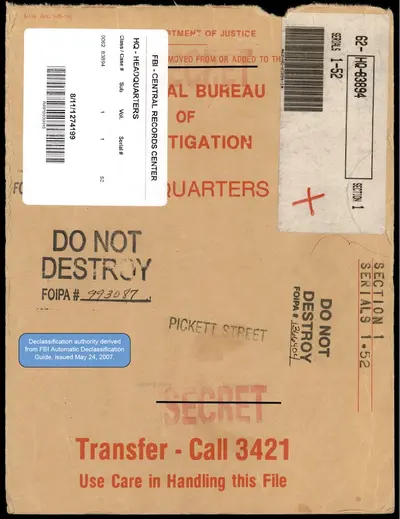
Background
In August 1947, in Darlington, South Carolina, U.S. government investigators recorded an unidentified-object incident later released to the public on May 8, 2026, as part of the Presidential Unsealing and Reporting System for UAP Encounters (PURSUE). This specific event occurred during a period of intense public and governmental scrutiny regarding aerial phenomena. The incident is one of the first wave of “flying saucer” reports that swept the United States following the Kenneth Arnold sighting of June 1947 and the Roswell incident of July 1947. During this era, the term “flying saucer” had entered the common lexicon, fueled by media coverage of objects that appeared to move with non-ballistic trajectories.
The documentation for the Darlington event was filed with the Federal Bureau of Investigation. During the post-war period, the Bureau maintained specific administrative procedures for handling reports of unusual aerial activity. Field offices in Knoxville, Albuquerque, Los Angeles, and other jurisdictions routed UFO reports to headquarters under the Bureau’s standing protocols for the protection of vital installations. This systematic collection of data suggests that the government viewed these reports through the lens of national security and the potential monitoring of unauthorized incursions into domestic airspace.
What the document records
The released records detail a specific observation made by an attorney residing in Darlington, South Carolina. The witness claimed to have seen an army pursuit plane engaged in a chase of a V-formation of flying saucers. This description of a formation of multiple objects being pursued by military aircraft aligns with several other high-profile reports from the summer of 1947, which often described groups of objects moving in synchronized or complex patterns.
Despite the specific nature of the attorney’s claim, the documentation lacks corroboration from other sources. No pilots or military personnel have been identified in the records as having witnessed or participated in the pursuit described. Furthermore, the released document does not specify the total number of witnesses present during the event, leaving the scale of the observation unquantified.
Type of case
The case is classified as a visual sighting reported by ground or air observers. Such reports are a primary component of the historical UAP dataset, relying on the optical perception of individuals observing the sky from stationary or mobile positions.
Status
All records released under the PURSUE program are designated unresolved by the All-domain Anomaly Resolution Office (AARO) by default. The federal government has not concluded that the events were anomalous, has not concluded that they were conventional, and has not ruled out either possibility. The lack of a definitive conclusion is a standard feature of many declassified files from this period, as the investigative technology of the 1940s was often insufficient to provide definitive physical evidence.
When analyzing sightings from the late 1940s, researchers often consider several conventional candidates. These include experimental aircraft developed during the rapid technological advancements of the early Cold War, as well as weather balloons, specifically those associated with the Project Mogul series active in the late 1940s. Other possibilities include atmospheric optical phenomena, such as sundogs or lenticular clouds, which can create illusions of solid, moving objects. Additionally, astronomical objects such as Venus, the Moon, or meteors appearing near the horizon are frequently cited as potential explanations for reports of bright, moving lights in the night sky.