San Diego, California UFO Sighting (August 1952) — FBI Files
FBI records from August 1952 document a meeting regarding anomalous predictions and unidentified aerial phenomena in San Diego, California.
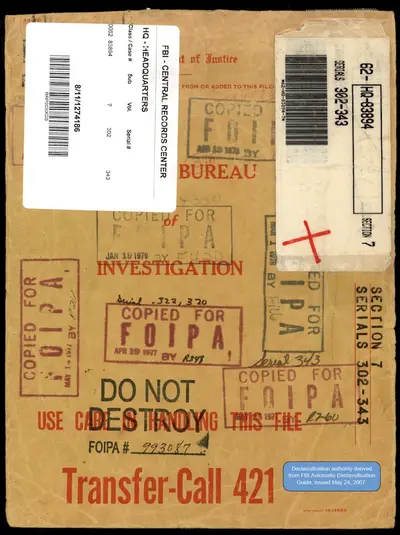
Historical Context
The summer of 1952 occurred during a period of heightened atmospheric and geopolitical tension in the United States. This era was defined by the “flying saucer” phenomenon, a wave of unidentified aerial phenomena reports that followed the Kenneth Arnold sighting in June 1947 and the Roswell incident in July 1947. During this time, the American public and government agencies were increasingly preoccupied with the possibility of advanced technology entering domestic airspace. The Cold War landscape necessitated rigorous monitoring of the skies, as the potential for Soviet incursions via high-altitude reconnaissance or experimental craft was a primary concern for national security.
In the early 1950s, the classification of such sightings often fell under the purview of various intelligence and law enforcement agencies. The Federal Bureau of Investigation maintained a systematic approach to documenting these reports. Under the Bureau’s standing protocols for the protection of vital installations, field offices in cities such as Knoxville, Albuquerque, and Los Angeles were tasked with routing UFO reports to headquarters. This ensured that any unidentified object appearing near sensitive military or industrial infrastructure was documented within the central federal archives.
The August 1952 Incident
In August 1952, in San Diego, California, U.S. government investigators recorded an unidentified-object incident that remained largely shielded from public view for decades. The details of this specific case were later released to the public on May 8, 2026, as part of the Presidential Unsealing and Reporting System for UAP Encounters (PURSUE). The documentation provides a window into the intersection of anomalous aerial sightings and unconventional scientific or esoteric research during the mid-century.
The released documents record an urgent request for a meeting with an FBI agent made on August 1, 1952, by Francis Ohm. At the time, Ohm was a member of the Borderland Sciences Research Associates, an organization known for its unconventional investigative methodologies. During the meeting, Ohm claimed that his organization utilized occult methods to predict significant geophysical and astronomical events. He cited the successful prediction of a recent earthquake as evidence of their predictive capabilities.
Beyond seismic activity, Ohm shared specific predictions regarding a devastating tidal wave. He asserted that this event would destroy the Japanese and Hawaiian Islands and subsequently impact the United States West Coast. While the document focuses heavily on these prophetic claims, the incident is categorized within the broader context of unidentified aerial phenomena. The number of witnesses to the underlying aerial phenomenon is not specified in the released documentation.
Classification and Resolution
The case is classified as a visual sighting reported by ground or air observers. In the study of mid-century aerial phenomena, such cases are often analyzed alongside other documented sightings of the period to determine if they share physical characteristics or flight patterns.
As of the current record, the status of the incident remains officially unverified. All records released under the PURSUE program are designated as unresolved by the All-domain Anomaly Resolution Office (AARO) by default. The federal government has maintained a neutral stance regarding the San Diego incident, having not concluded that the events were anomalous, nor having concluded that they were conventional. The possibility of either explanation remains open within the official archive.
When evaluating sightings from this era, researchers often consider several conventional candidates. These include the presence of experimental aircraft, the deployment of weather balloons—specifically the Project Mogul series active in the late 1940s—or atmospheric optical phenomena such as sundogs and lenticular clouds. Additionally, astronomical objects such as Venus, the Moon, or meteors positioned near the horizon are frequently scrutinized as potential sources for reported unidentified objects.