Charleston, South Carolina UFO Sighting (August 1, 1952) — FBI Files
An investigation into the August 1, 1952, unidentified object report in Charleston, South Carolina, as documented in declassified FBI files.
Historical Context
The early 1950s represented a period of heightened atmospheric anxiety within the United States, characterized by the onset of the Cold War and the rapid advancement of aerospace technology. Following the high-profile Kenneth Arnold sighting in June 1947 and the subsequent Roswell incident in July 1947, the American public consciousness became increasingly preoccupied with the concept of “flying saucers.” This era saw a surge in reported unidentified aerial phenomena (UAP) as the boundaries of conventional aviation were being redefined by jet propulsion and early rocket experimentation. During this time, the Federal Bureau of Investigation maintained specific protocols for handling reports of unidentified objects, particularly when such sightings occurred near sensitive military installations or vital infrastructure. The Bureau’s field offices, including those in Knoxville, Albuquerque, and Los Angeles, were tasked with routing such communications to headquarters to ensure that potential threats to national security were properly monitored.
The Charleston Incident
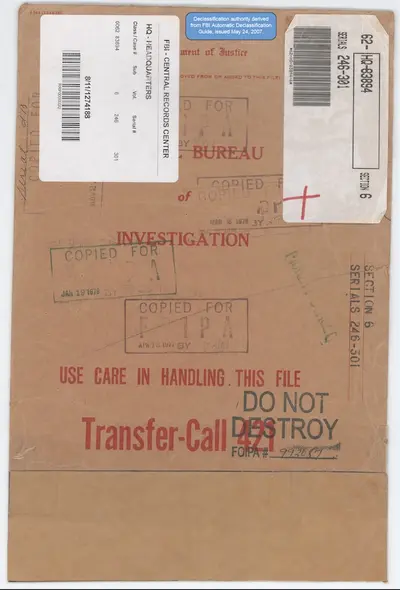
On August 1, 1952, an incident involving an unidentified object occurred in Charleston, South Carolina. The details of this specific event were preserved within government archives and were not made available to the general public until May 8, 2026, through the Presidential Unsealing and Reporting System for UAP Encounters (PURSUE). The primary documentation regarding this sighting consists of a letter written by Florence Whitish, in which she detailed her observations of what she described as “flying saucers.” While the letter served as the basis for the official record, the specific contents of her observations—such as the trajectory, speed, or physical characteristics of the objects—are not detailed within the released FBI document.
The investigation of the Charleston report was handled through standard bureaucratic channels. The FBI acknowledged the receipt of Whitish’s communication, yet the agency’s records indicate that there were no plans for further investigation following the initial acknowledgment. The released documentation does not specify the total number of witnesses involved in the sighting, leaving the scale of the event’s visibility an unquantified variable. This lack of follow-up investigation was not uncommon for the era, as many reports were filtered through a lens of administrative triage, where the priority was often placed on identifying immediate threats to airspace rather than conducting exhaustive forensic analysis of every civilian report.
Classification and Analysis
The Charleston case is classified as a visual sighting reported by ground or air observers. Within the framework of modern UAP studies, the case remains categorized as an anomaly. Under the protocols of the All-domain Anomaly Resolution Office (AARO), all records released via the PURSUE program are designated as unresolved by default. This designation reflects a scientific and administrative neutrality; the federal government has not reached a conclusion that the event was the result of anomalous or extraterrestrial technology, nor has it definitively attributed the sighting to conventional phenomena.
When analyzing sightings from the early 1950s, researchers often consider several conventional candidates. During this period, the deployment of the Project Mogul series of high-altitude weather balloons was active, which frequently led to misidentifications of man-made objects. Other possibilities include the presence of experimental military aircraft, which were being tested in various capacities across the United States, or atmospheric optical phenomena such as lenticular clouds, sundogs, or meteors appearing near the horizon. Astronomical objects, including the Moon or the planet Venus, also frequently provided the basis for unidentified sightings. The Charleston report remains a significant piece of the archival record, representing the intersection of civilian observation and federal intelligence monitoring during the height of the mid-century UFO phenomenon.