Savannah River Plant UFO Sighting (May 20, 1952) — FBI Files
Federal investigators documented a high-speed, noiseless unidentified object passing over the Savannah River Plant in South Carolina in May 1952.
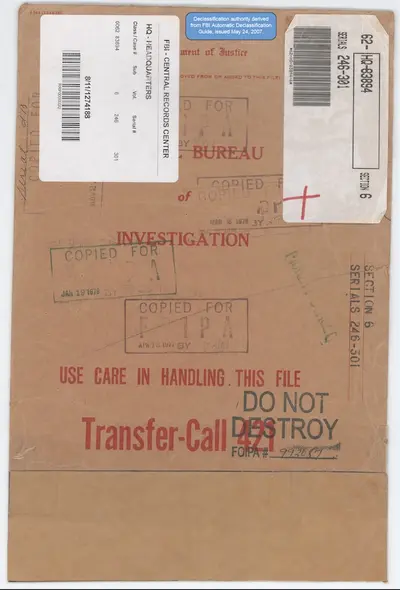
Historical Context
The early 1950s represented a period of heightened atmospheric anxiety within the United States, characterized by the onset of the Cold War and the rapid advancement of aerospace technology. Following the 1947 Kenneth Arnold sighting and the subsequent Roswell incident, the American public and government agencies became increasingly preoccupied with reports of unidentified flying objects. This era saw the emergence of the “flying saucer” phenomenon, a cultural and security-related preoccupation that forced federal agencies to develop formal protocols for documenting aerial anomalies. During this time, the emergence of high-altitude reconnaissance technology and the deployment of sophisticated surveillance systems meant that any unidentified movement near sensitive installations was treated with significant gravity.
The Savannah River Plant, located in South Carolina, served as a critical component of the nation’s nuclear infrastructure. As a site dedicated to the production of materials for nuclear weapons, the facility was classified as a vital installation, necessitating rigorous monitoring of the surrounding airspace. The administrative handling of such reports during this period was highly structured. The Federal Bureau of Investigation (FBI) maintained a systematic approach to these sightings, with field offices in Knoxville, Albuquerque, and Los Angeles following established protocols to route reports concerning sensitive sites directly to headquarters. This ensured that potential threats to national security or industrial sabotage could be analyzed by central authorities.
The May 20 Incident
On May 20, 1952, investigators within the Savannah River Plant recorded an incident involving an unidentified object. The details of this specific event remained restricted from the public eye for decades, only becoming accessible on May 8, 2026, through the Presidential Unsealing and Reporting System for UAP Encounters (PURSUE). The documentation reveals that an eighth object was observed approaching the four hundred area from the northeast. This object was traveling at a low altitude, a flight path that necessitated the craft rising to clear the facility’s tall storage tanks.
The motion of the object was described as being at high speed and notably noiseless, moving across the field of view from left to right. While the released documents provide specific details regarding the trajectory and physical behavior of the object, the total number of witnesses to this specific sighting is not specified within the official record. Furthermore, the case file includes reports of figures or beings associated with the object, adding a layer of complexity to the aerial observation.
Analytical Status and Classification
Under the current administrative framework of the All-domain Anomaly Resolution Office (AARO), all records released through the PURSUE program are designated as unresolved by default. The federal government has maintained a position of neutrality regarding the Savannah River Plant sighting, having neither concluded that the event was anomalous nor confirmed that it was the result of conventional phenomena. The possibility of both remains open within official investigations.
In the broader context of 1950s aerial sightings, several conventional explanations are frequently considered by researchers. These include the presence of experimental aircraft testing, the use of weather balloons—specifically those associated with the Project Mogul series active in the late 1940s—or various atmospheric optical phenomena such as lenticular clouds and sundogs. Additionally, astronomical objects like the Moon, Venus, or meteors appearing near the horizon are often evaluated as potential sources for such reports. The Savannah River Plant case remains a significant entry in the archive of documented aerial anomalies due to its location at a high-security installation and the specific characteristics of the object’s movement.