Rogue River Oregon UFO
Five witnesses including two pilots observed a disc-shaped object maneuvering over Rogue River. The object's behavior and their detailed observations made this an early significant case.
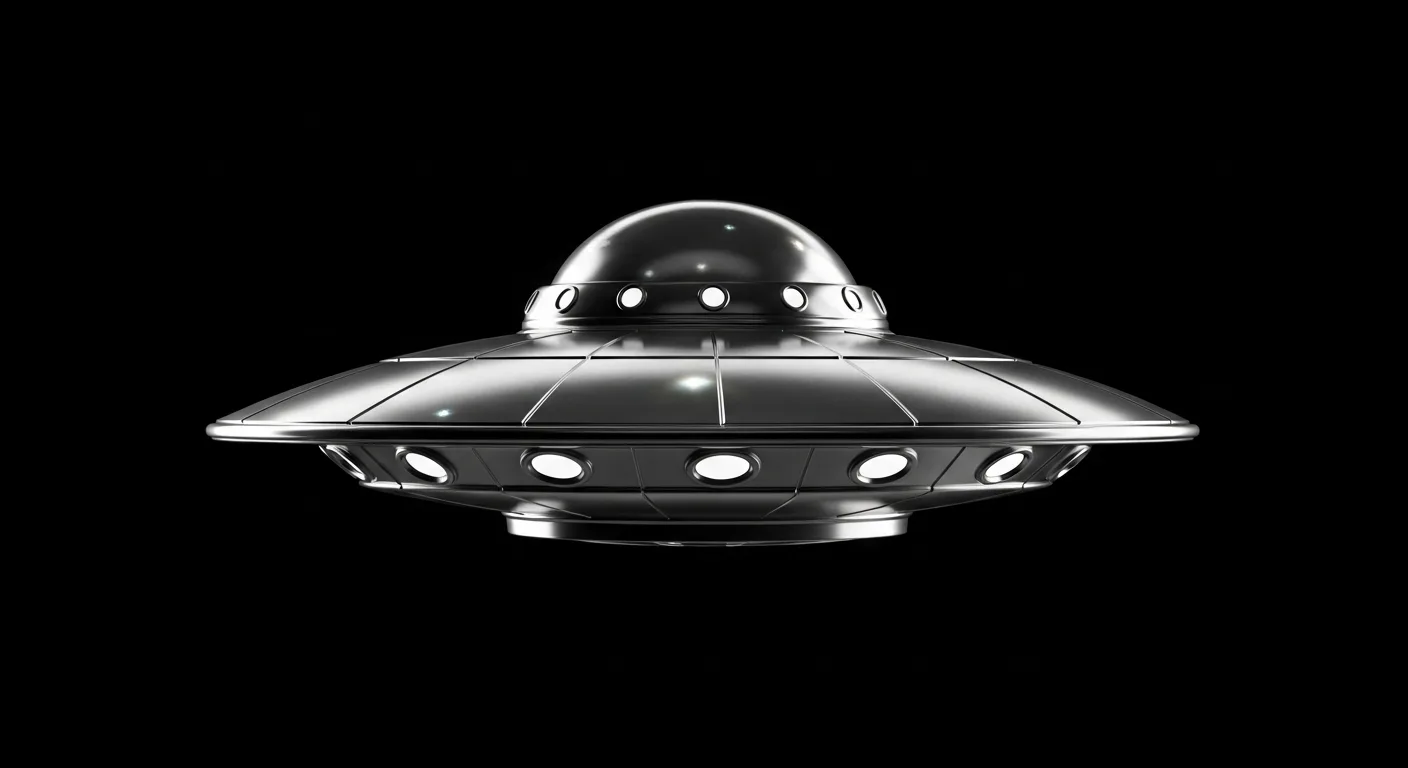
The Rogue River winds through some of the most striking landscape in southern Oregon, cutting a path through the Klamath Mountains where dense forests of Douglas fir and ponderosa pine descend to river valleys that have been inhabited by humans for thousands of years. It is a landscape of remarkable beauty, the kind of place where the sky seems particularly vast and the silence of the wilderness is broken only by the sound of water and wind. On the afternoon of May 24, 1949, five people standing along the banks of this river witnessed something in that expansive sky that none of them could explain: a metallic, disc-shaped object that maneuvered with purposeful intelligence above them, performing feats that no aircraft of the era could match.
The Rogue River sighting is not among the most famous UFO cases of the late 1940s, overshadowed as it is by Kenneth Arnold’s seminal 1947 sighting and the Roswell incident that followed shortly after. But among researchers who study the early UFO phenomenon, the Rogue River case holds a particular significance. The quality of the witnesses, the clarity of their observations, and the consistency of their independent accounts place it among the strongest cases from the formative period of modern ufology, a time when the patterns that would define the phenomenon for decades were first being established.
The Witnesses
The strength of the Rogue River case begins with its witnesses. Five people observed the object, and among them were two experienced pilots whose professional backgrounds made them uniquely qualified to assess what they were seeing. These were not people prone to misidentifying conventional aircraft or natural phenomena. They had spent years reading the sky, learning to distinguish between different types of aircraft, estimating distances and altitudes, and understanding the behavior of objects in flight. When they said that what they saw was not a conventional aircraft, their assessment carried substantial weight.
The pilots, whose names appear in the contemporary reports filed with investigators, had accumulated thousands of hours of flight time between them. They were familiar with every type of military and civilian aircraft in operation in the late 1940s, a period when the skies over the western United States were busy with post-war aviation activity. They knew what propeller-driven aircraft looked like from every angle and at every distance. They understood the visual characteristics of high-altitude flight, including the effects of atmospheric haze, sunlight reflection, and the optical illusions that distance can create. Their conclusion that the Rogue River object was not a conventional aircraft was informed by this extensive experience.
The three civilian witnesses provided corroboration from a different perspective. They were not aviation professionals, and their descriptions were necessarily less technical than those of the pilots, but their accounts were consistent in the essential details: the object’s shape, its movements, its apparent solidity, and its departure. The agreement between professional and lay observers strengthened the case considerably, as it was difficult to argue that all five witnesses had simultaneously misidentified the same conventional phenomenon.
The Afternoon Observation
The sighting occurred during the afternoon hours, under conditions of excellent visibility. The sky was clear or mostly clear, with no significant cloud cover to obscure the view or create misleading optical effects. The sun was well above the horizon, providing ample light for detailed observation. These conditions are significant because many UFO sightings occur at night or in marginal weather, when the potential for misidentification is high. The Rogue River observation, by contrast, took place in broad daylight under a sky that offered no opportunity for ambiguity.
The object appeared over the river valley without warning, drawing the attention of the witnesses through its unusual appearance. It was clearly visible against the blue sky, its presence unmistakable and its outline distinct. The witnesses had an extended period of observation, several minutes by their estimates, during which they were able to study the object’s shape, surface characteristics, and behavior in detail. This was not a fleeting glimpse or a momentary flash of light but a sustained encounter that gave the observers ample time to form considered impressions.
The location itself contributed to the quality of the observation. The Rogue River valley, surrounded by mountains but open above, provided a natural amphitheater from which the witnesses could observe the object against a clear backdrop of sky. There were no nearby airports or military installations that might have offered a conventional explanation for the object’s presence, and the rural setting meant that the ambient noise level was low enough for the witnesses to note the object’s silence, a detail that would prove significant in the analysis that followed.
The Object
The witnesses described the object in terms that were, by 1949, beginning to form a recognizable pattern. It was disc-shaped, roughly circular when viewed from below, with a convex upper surface that gave it a somewhat domed or lenticular profile when seen at an angle. The surface appeared metallic, reflecting sunlight with a bright, silvery gleam that suggested a polished or highly reflective material. There were no visible seams, rivets, windows, or other features that would indicate conventional construction, and no wings, tail surfaces, propellers, or jet exhausts were observed.
The two pilots were particularly emphatic on this last point. Any aircraft they knew, whether military or civilian, would have displayed recognizable aerodynamic features: wings for lift, control surfaces for maneuverability, and some form of visible propulsion, whether propeller, jet exhaust, or rocket plume. The Rogue River object displayed none of these features. It appeared to be a smooth, featureless disc, devoid of the appendages and structures that make conventional flight possible. This was not, in the pilots’ professional assessment, any kind of aircraft with which they were familiar.
The object’s size was difficult to estimate without a reference point for distance, but the witnesses agreed that it was substantial, not a small drone-like object but something on the scale of a large aircraft or larger. The metallic surface reflected sunlight brightly enough to be clearly visible at what the pilots estimated was a considerable altitude, suggesting that the object was large enough to present a significant reflective area even at distance.
The Maneuvers
It was the object’s movement that most impressed the witnesses and most challenged conventional explanation. The disc demonstrated capabilities that were, in 1949, far beyond anything achievable by human technology.
The object was observed to hover motionless in the sky, maintaining a fixed position without any visible means of support. In 1949, helicopter technology was still in its infancy, and no helicopter of the era could have appeared as a featureless metallic disc hovering at altitude. The object then demonstrated sudden, rapid changes of direction, transitioning from hover to high-speed horizontal flight without any apparent acceleration phase. Where a conventional aircraft would need to build speed gradually, banking and turning through wide arcs, the Rogue River object changed direction almost instantaneously, as though the laws of inertia did not apply to it.
The disc was also observed to tilt or rock on its axis, a motion that the pilots found particularly striking. This tilting gave the witnesses their best view of the object’s profile, confirming its disc-like shape and allowing them to see that it was not a flat disc but had some thickness, with a convex upper surface and a flatter underside. The tilting appeared deliberate, as though the object were adjusting its orientation relative to the ground, and it was accompanied by changes in the object’s apparent brightness as different portions of its reflective surface caught the sunlight.
The object’s speed, when it moved, was estimated by the pilots to be extraordinary. While precise speed estimates are inherently unreliable for objects at unknown distances, the pilots agreed that the object’s velocity during its periods of rapid movement far exceeded anything achievable by the fastest military aircraft of the day. The transition from hovering stillness to extreme speed was, in their experience, physically impossible for any conventional craft, and the absence of any sonic boom during the object’s high-speed passages suggested either that it was not travelling as fast as it appeared or that it was somehow circumventing the aerodynamic effects of high-speed flight.
The Departure
After several minutes of observation, the object departed the area. Its departure was as dramatic as its maneuvering: the disc accelerated rapidly and was gone from view in a matter of seconds, diminishing to a point and then vanishing entirely. The speed of its departure exceeded anything the witnesses had observed during the object’s earlier maneuvers, and it left no trail, wake, or other visible trace of its passage.
The silence of the object’s departure was noted by all five witnesses. A conventional aircraft accelerating to high speed would have produced a tremendous roar, whether from propellers, jet engines, or the displacement of air at near-sonic or supersonic velocities. The Rogue River object made no sound at any point during the observation, and its departure was as silent as its arrival. This silence was, for the pilot witnesses, one of the most anomalous aspects of the encounter, as they knew from personal experience that high-speed flight is inherently noisy and that no technology available in 1949 could have achieved the speeds they observed without producing significant acoustic effects.
The Investigation
The Rogue River sighting was reported to the appropriate authorities and became part of the growing database of UFO cases being compiled by the United States Air Force. In 1949, the Air Force was operating Project Grudge, the successor to Project Sign, which had been the military’s first official UFO investigation program. Grudge took a markedly more skeptical approach than its predecessor, and its institutional posture was oriented toward finding conventional explanations for UFO reports rather than seriously entertaining the possibility of unknown phenomena.
The Rogue River case was documented in Air Force files, but like many cases during the Grudge era, it received what critics would later describe as a cursory investigation. The standard approach during this period was to seek the most plausible conventional explanation available and close the case, regardless of whether the explanation fully accounted for the witnesses’ observations. In the case of the Rogue River sighting, no satisfactory conventional explanation was identified, but the case was not vigorously pursued beyond the initial documentation.
Independent researchers who later examined the case were more thorough in their analysis and more impressed by the quality of the evidence. The presence of pilot witnesses, the extended duration of the observation, the daylight conditions, the multiple independent observers, and the detailed descriptions of the object’s behavior combined to make the Rogue River sighting one of the stronger cases from the early UFO era.
The Pacific Northwest Context
The Rogue River sighting was part of a broader pattern of UFO activity in the Pacific Northwest during the late 1940s. The modern UFO era had begun in this region when Kenneth Arnold reported seeing nine crescent-shaped objects flying in formation near Mount Rainier, Washington, on June 24, 1947. Arnold’s sighting, which gave rise to the term “flying saucer” through a reporter’s creative paraphrase of his description, triggered a wave of reports from across the country, but the Pacific Northwest remained a particular focus of activity.
Oregon and Washington produced a disproportionate number of UFO reports during this period, and several of the most significant early cases originated in this region. The Maury Island incident of June 1947, the McMinnville photographs of May 1950, and numerous lesser-known cases all emerged from the Pacific Northwest, leading some researchers to speculate that the region possessed some characteristic, whether geographic, atmospheric, or otherwise, that attracted or facilitated UFO activity.
The concentration of sightings in the Pacific Northwest may also reflect more prosaic factors. The region was home to several major military installations, and the post-war period saw extensive military aviation activity over the area. The clear skies and open landscapes of central Oregon and eastern Washington provided excellent conditions for observation, and the relatively sparse population meant that unusual aerial objects were more likely to be noticed than they might have been over a densely built urban area. The cultural climate of the late 1940s Pacific Northwest, with its frontier heritage and its tradition of independence, may also have made people more willing to report unusual sightings than they would have been in more conservative or conformist communities.
A Case That Endures
The Rogue River sighting of May 24, 1949, endures as a case study in the strengths and limitations of UFO evidence. Its strengths are formidable: multiple witnesses, including trained aviation professionals; daylight conditions with excellent visibility; an extended observation period; and detailed, consistent descriptions of a structured object performing maneuvers beyond the capability of any known aircraft. Its limitations are equally clear: there is no physical evidence, no photographs or film, and the investigation conducted at the time was insufficient to resolve the case definitively.
What the case demonstrates, above all, is that the early UFO phenomenon was reported by credible observers whose accounts deserved, and still deserve, serious consideration. The two pilots who watched the metallic disc over the Rogue River were not credulous dreamers or attention-seeking hoaxers. They were professionals who understood flight, who knew what conventional aircraft looked like, and who recognized that what they were seeing did not fit any category in their extensive experience. Their willingness to report the sighting, despite the professional risks associated with such reports in an era when the military was actively discouraging UFO claims, speaks to the strength of their conviction that they had seen something genuinely anomalous.
The Rogue River flows on through its Oregon valley, indifferent to the mysteries that played out in the sky above it more than seven decades ago. The forests and mountains look much as they did that afternoon in May 1949, and the sky above them remains as vast and unknowable as ever. Five people looked up into that sky and saw something they could not explain. Their testimony stands as one more piece of evidence that the early UFO phenomenon was real, whatever its ultimate explanation may prove to be, and that the witnesses who reported it were telling the truth as they understood it.
Sources
- Project Blue Book — National Archives — USAF UFO investigation files, 1947–1969
- CIA UFO/UAP Reading Room — Declassified CIA documents on UAP
- Chronicling America — Historic US newspapers (1690–1963)