Maury Island UFO Incident
Harold Dahl reported six doughnut-shaped craft over Puget Sound, one of which dropped molten metal that killed his dog. The incident allegedly involved the first Men in Black visit.
The Maury Island incident occupies a peculiar and troubling place in the history of unidentified flying objects. It predates by three days the famous Kenneth Arnold sighting that would give the world the term “flying saucer” and launch the modern UFO era. It involves physical evidence—slag-like material allegedly dropped from a damaged craft. It introduced the world to the sinister figure of the Man in Black, a mysterious stranger who appeared without invitation and warned witnesses to keep silent. And it ended in tragedy, with two military investigators dead in a plane crash under circumstances that have never been fully explained. Whether one regards the Maury Island incident as a genuine encounter with unknown aerial phenomena, an elaborate hoax that spiraled beyond its creator’s control, or something stranger still, it remains one of the most complex and unsettling cases in UFO history—a story where every answer raises new questions and every explanation leaves something unexplained.
Puget Sound, June 1947
The setting of the Maury Island incident is as atmospheric as the story itself. Maury Island sits in the southern reaches of Puget Sound, connected to Vashon Island by a narrow isthmus and surrounded by the cold, gray-green waters of the Pacific Northwest. In 1947, the area was largely rural, its shores dotted with small communities of fishermen, loggers, and harbor workers. The Sound itself was a working waterway, busy with fishing boats, ferries, and commercial vessels navigating between Seattle, Tacoma, and the scattered island communities.
Harold Dahl was a harbor patrolman—or so he claimed. Some later accounts describe him as a salvage operator or simply a man with a boat who made his living on the water. Whatever his precise occupation, Dahl was experienced on Puget Sound and familiar with its moods and hazards. On the afternoon of June 21, 1947, he was aboard his patrol boat near the eastern shore of Maury Island, accompanied by two crewmen, his fifteen-year-old son Charles, and the family dog. The weather was overcast, typical for a June afternoon in the Pacific Northwest, with a low ceiling of clouds hanging over the Sound.
What happened next would consume the rest of Dahl’s life and entangle him in a web of investigation, accusation, and tragedy that he could never have anticipated.
Six Objects Over the Sound
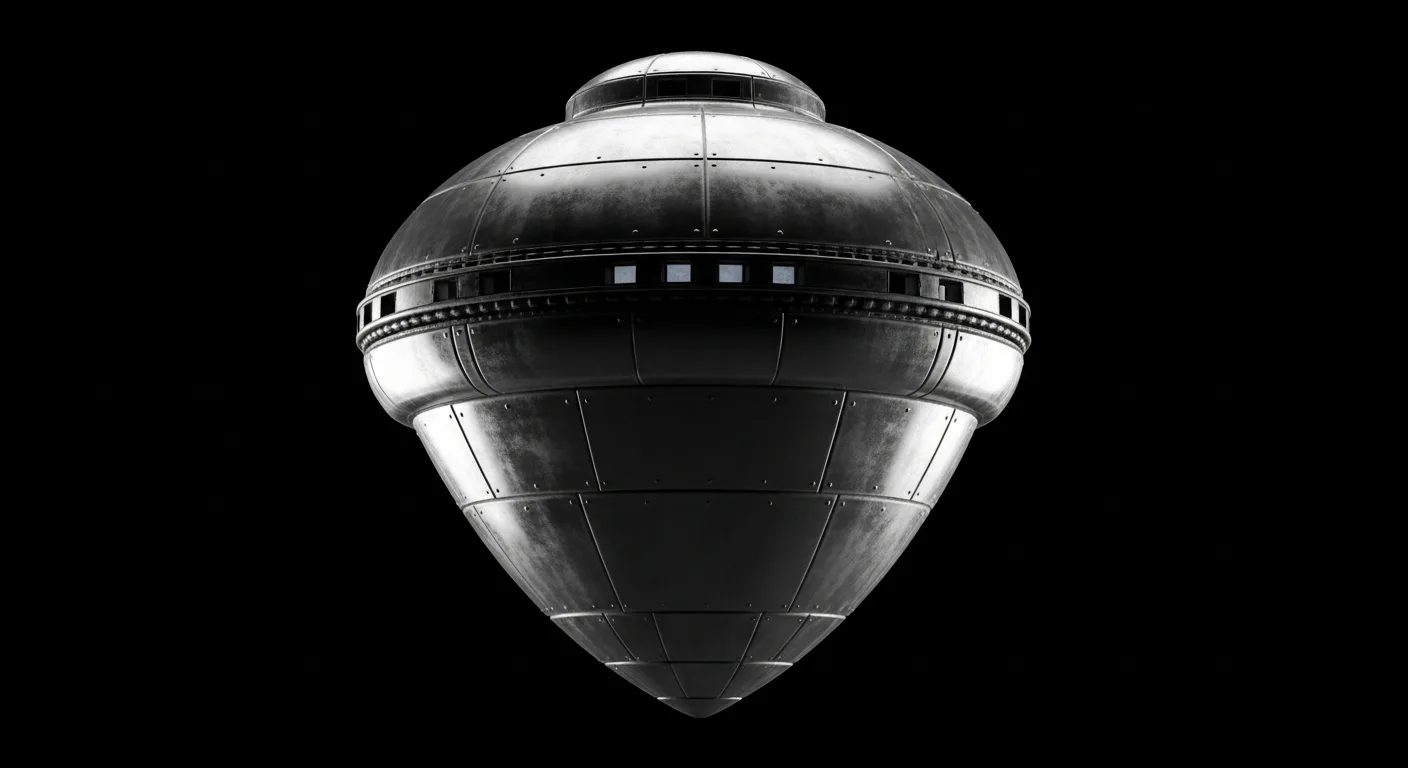
According to Dahl’s account, at approximately 2:00 PM he observed six large, doughnut-shaped objects hovering at an altitude he estimated at roughly two thousand feet above the waters of Puget Sound. The objects were metallic in appearance, each approximately one hundred feet in diameter, with a hole in the center—hence the “doughnut” description that would become central to the case. They appeared to be made of some reflective metal, though the overcast sky made it difficult to judge their exact color or surface texture.
Five of the six objects seemed to be circling around the sixth, which was positioned slightly lower than the others and appeared to be in some kind of difficulty. Dahl described this central craft as wobbling or losing altitude, as if its propulsion system were failing. The five surrounding objects seemed to be attending to it, hovering nearby in what Dahl interpreted as a formation designed to assist or support the troubled craft.
Dahl claimed he attempted to photograph the objects and managed to take several pictures with a camera he had aboard the boat. He watched the formation for several minutes, fascinated and increasingly alarmed, as the central object continued to lose altitude. Then, without warning, one of the upper objects descended and appeared to make physical contact with the struggling craft. What happened next transformed the sighting from a mere observation into something far more dramatic and disturbing.
Molten Rain
The contact between the two objects—if contact it was—produced an immediate and violent result. The troubled craft began shedding material, ejecting what Dahl described as a rain of hot, slag-like fragments that fell toward the surface of the Sound and the nearby shoreline of Maury Island. Some of this material fell as lightweight, white metal that floated like paper as it descended. But mixed with this lighter debris was a heavier, darker substance—chunks of hot, rock-like material that Dahl compared to lava or foundry slag.
The falling debris struck the water around Dahl’s boat with hissing impacts, and pieces landed on the boat itself. One fragment struck his son Charles on the arm, burning him badly enough to require medical attention. The family dog, which had been on deck during the incident, was struck by a piece of the heavier material and killed. The boat itself suffered damage to its wheelhouse and deck from the hot fragments.
Dahl managed to maneuver the boat toward the shore of Maury Island, where he and his crew took shelter among the trees while the rain of debris continued. Material accumulated on the beach and in the shallow waters near shore, and Dahl later claimed to have collected samples of both the lightweight white metal and the heavier dark slag. After the fall of material ceased, the six objects ascended rapidly into the cloud cover and disappeared from view. The entire incident, from first sighting to final disappearance, had lasted perhaps twenty minutes.
The physical toll was real and immediate: a burned teenager, a dead dog, a damaged boat, and a beach littered with strange metallic debris. Dahl gathered what samples he could and headed back across the Sound, shaken by what he had witnessed and uncertain what to make of it.
The Man in Black
What happened the following morning elevated the Maury Island incident from a bizarre sighting into something far more ominous. According to Dahl, he was visited at his home early on the morning of June 22 by a man he had never seen before—a stranger who arrived in a black 1947 Buick sedan, wearing a dark suit that seemed oddly formal for the rural waterfront community where Dahl lived.
The stranger invited Dahl to breakfast at a nearby diner, and Dahl—perhaps out of curiosity, perhaps out of the social obligation that was stronger in that era—agreed. Over breakfast, the man in the black suit proceeded to describe the previous day’s events in extraordinary detail. He recounted what Dahl had seen over Puget Sound with a specificity that Dahl found deeply unsettling, describing the number of craft, their formation, the falling debris, and the injuries to Dahl’s son and dog. The stranger had not been present at the sighting, and Dahl had told no one about it beyond his immediate crew and his supervisor, Fred Crisman.
The man’s message was simple and delivered without overt threat but with an unmistakable undercurrent of menace: Dahl should not discuss what he had seen. If he valued his family’s safety, he would forget the incident entirely and say nothing to anyone. The stranger then left, climbed back into his black Buick, and drove away. Dahl never saw him again and never learned his identity.
This encounter is widely regarded as the first documented appearance of what would later become known as the Men in Black—mysterious figures in dark suits who visit UFO witnesses and pressure them into silence. The Men in Black would become one of the most enduring elements of UFO mythology, inspiring books, films, and countless reported encounters over the following decades. But the Maury Island incident is where the archetype was born, in a diner somewhere near the shores of Puget Sound, delivered over eggs and coffee by a stranger who knew things he should not have known.
Fred Crisman and the Expanding Mystery
Despite the warning from his mysterious visitor, Dahl reported the incident to his supervisor, Fred Lee Crisman. Crisman was a figure who would prove to be as enigmatic and controversial as the incident itself. A World War II veteran who claimed to have served in intelligence operations in the Pacific Theater, Crisman was a man who seemed drawn to intrigue and who would surface repeatedly in connection with some of the most sensational events of the twentieth century—he was later subpoenaed by New Orleans District Attorney Jim Garrison in connection with the assassination of President Kennedy, though no substantive connection was ever established.
Crisman visited the beach on Maury Island where Dahl said the debris had fallen and claimed to have found and collected additional samples of the strange material. He also claimed that while on the beach, he himself observed a single doughnut-shaped craft in the sky overhead, though this sighting was brief. Crisman then took a step that would dramatically escalate the situation: he contacted Ray Palmer, the editor of Amazing Stories magazine in Chicago, and reported the incident.
Palmer was already in contact with Kenneth Arnold, a Boise businessman and pilot who, on June 24—three days after the Maury Island incident—had reported seeing nine crescent-shaped objects flying in formation near Mount Rainier. Arnold’s sighting had generated enormous media attention and had effectively launched the modern flying saucer phenomenon. Palmer, sensing a connection between the two Pacific Northwest cases, asked Arnold to travel to Tacoma and investigate the Maury Island incident in person.
Kenneth Arnold Investigates
Arnold arrived in Tacoma in late July 1947 and met with Dahl and Crisman at the Winthrop Hotel. What followed was a strange series of meetings in which the story seemed to shift and expand with each telling. Arnold found Dahl reluctant to speak and Crisman eager—perhaps too eager—to provide information and material evidence. Arnold was shown samples of the alleged debris, which appeared to be some form of volcanic rock or industrial slag.
Increasingly uncertain about the credibility of what he was hearing, Arnold made a fateful decision. He contacted two officers from Army Air Force intelligence at Hamilton Field in California: Captain William Davidson and First Lieutenant Frank Brown. Both men were experienced investigators who had been involved in examining UFO reports in the wake of the Arnold sighting and the wave of reports that followed it. They agreed to fly to Tacoma to interview Dahl and Crisman and examine the physical evidence.
Davidson and Brown arrived on August 1, 1947, and met with Arnold, Dahl, and Crisman at the Winthrop Hotel. The interview lasted several hours, during which Dahl and Crisman repeated their accounts and provided samples of the recovered material. According to Arnold, Davidson and Brown seemed unimpressed by the evidence and skeptical of the story. They loaded the material samples into their B-25 bomber and prepared to fly back to Hamilton Field that same night.
During the investigation at the Winthrop Hotel, Arnold noticed something that disturbed him greatly. Details of the private meetings—conversations that had taken place behind closed doors with only the principals present—were appearing in the local newspaper almost in real time. Someone in the room, or someone with access to the room, was feeding information to the press. The source of these leaks was never definitively identified, and the mystery of who was listening added another layer of paranoia to an already unsettling situation.
Tragedy Over Kelso
Captain Davidson and Lieutenant Brown departed Tacoma’s McChord Field shortly before 2:00 AM on August 1, 1947, aboard a B-25 Mitchell bomber bound for Hamilton Field. They carried with them the box of material samples collected from Maury Island. Two other servicemen were also aboard the aircraft—a crew chief and a hitchhiking soldier catching a ride back to California.
Approximately twenty minutes after takeoff, at an altitude of around ten thousand feet near the town of Kelso, Washington, the left engine of the B-25 caught fire. The crew chief and the hitchhiker parachuted to safety. Davidson and Brown did not. The plane crashed into a remote wooded area, and both intelligence officers were killed on impact.
The deaths of Davidson and Brown sent shockwaves through the small community of people involved in the Maury Island case. Arnold was devastated. The crash was the first fatal accident involving military personnel investigating a UFO report, and it immediately generated suspicion that the deaths were not accidental. Had the plane been sabotaged to prevent the material evidence from being analyzed? Had Davidson and Brown been silenced because they knew too much—or because whoever was behind the Man in Black’s visit to Dahl wanted to ensure the investigation went no further?
The Air Force investigation into the crash attributed it to mechanical failure—a exhaust collector malfunction that started the engine fire. There was no evidence of sabotage. But for those already inclined to see conspiracy in the Maury Island affair, the official explanation seemed too convenient, too neat for a case that had been anything but.
Hoax, Truth, or Something Between
In the aftermath of the crash and the intensifying scrutiny that followed, Dahl reportedly told investigators that the entire Maury Island incident had been a hoax. This confession, if it can be called that, has been cited by skeptics ever since as the definitive resolution of the case. But the confession itself raises questions. Was Dahl telling the truth when he recanted, or was he telling the truth when he first reported the sighting? Had the pressure from his Man in Black visitor, the deaths of the two investigators, and the unwanted attention finally convinced him that silence—even at the cost of being labeled a liar—was the safer option?
The physical evidence further complicates matters. The material collected from Maury Island was eventually analyzed and identified by some sources as ordinary slag—waste material from a smelting operation, perhaps dumped from boats or accumulated naturally on the beach. But other analysts noted unusual properties in some of the samples, and the question of why ordinary slag would be found on a relatively remote beach was never satisfactorily answered. Much of the material that Davidson and Brown had collected was reportedly destroyed in the plane crash, making definitive analysis impossible.
Fred Crisman’s role in the affair has been the subject of particular scrutiny. Some investigators have suggested that Crisman fabricated or embellished the incident for his own purposes—perhaps to gain attention, perhaps to create a cover story for some other activity, or perhaps as part of a disinformation operation connected to his intelligence background. Crisman’s later appearance in the periphery of the Kennedy assassination investigation has fueled speculation that he was connected to intelligence operations throughout his life, though no hard evidence supports this theory.
Others have proposed that the incident was real but misidentified—that Dahl genuinely saw something over Puget Sound, perhaps a military test or an unusual natural phenomenon, and that the subsequent cover-up was not about alien spacecraft but about concealing classified military activity in the area. The military’s interest in the case, the pressure on witnesses, and the deaths of the investigators could all be explained by a desire to protect secrets that had nothing to do with extraterrestrial visitors.
Legacy of the Maury Island Incident
Regardless of its ultimate truth, the Maury Island incident left an indelible mark on UFO history and on the broader culture of paranormal investigation. It established several themes that would recur throughout decades of UFO cases: the collection and subsequent loss or confiscation of physical evidence, the mysterious visitors who pressure witnesses into silence, the deaths of investigators under suspicious circumstances, and the fundamental ambiguity that prevents any case from being definitively resolved.
The Men in Black concept, born in Dahl’s account of his breakfast with the stranger in the dark suit, would grow into one of the most recognizable elements of UFO mythology. Subsequent decades brought hundreds of reported MIB encounters, each following the basic template established at Maury Island: men in dark clothing, often with an oddly formal or anachronistic appearance, arriving uninvited with inexplicable knowledge of the witness’s experience and delivering warnings to remain silent. Whether these later reports were inspired by the Maury Island story or represent a genuine phenomenon that Dahl was the first to document remains a matter of fierce debate.
The deaths of Davidson and Brown cast a long shadow over military UFO investigations. Their crash was a stark reminder that investigating the unknown could carry real and fatal consequences, whether those consequences stemmed from sabotage, mechanical failure, or simply the hazards of military aviation. The incident contributed to a growing climate of suspicion around the military’s handling of UFO reports, a suspicion that would deepen over the following decades as cases accumulated and official explanations proved consistently inadequate.
The timing of the Maury Island incident—three days before the Arnold sighting that launched the flying saucer phenomenon—has led some researchers to suggest that something genuinely anomalous was occurring in the Pacific Northwest in June 1947, something that manifested over both Puget Sound and Mount Rainier within the same week. Whether this something was extraterrestrial, military, or natural in origin, the concentration of events in such a narrow window of time and geography remains suggestive.
The Waters Remember
Today, Maury Island is a quiet residential community, its shores lined with homes rather than patrol boats. The beach where Dahl said the strange debris fell has long since been picked clean by curiosity seekers, investigators, and the patient work of tides. The Winthrop Hotel in Tacoma, where Arnold met with Dahl and Crisman and where Davidson and Brown conducted their final investigation, was demolished decades ago. The physical traces of the incident have been almost entirely erased by time.
But the questions remain, stubborn and unanswerable. What did Harold Dahl see over Puget Sound on that overcast June afternoon? Who was the man in the black suit who appeared at his door the following morning, and how did he know what had happened? Why did two experienced military officers die in a plane crash hours after collecting evidence from the case? And why, after telling the world his story, did Dahl take it all back?
The cold waters of Puget Sound keep their secrets. The gray skies above the Sound, so often heavy with cloud cover, reveal nothing. Whatever passed over Maury Island on June 21, 1947—whether craft from another world, military hardware cloaked in secrecy, or nothing more than a harbor patrolman’s invention—left behind a mystery that has outlasted every attempt to solve it. The Maury Island incident endures not because we know what happened, but precisely because we do not, and perhaps never will. In the long catalog of unexplained encounters, few cases are as tangled, as tragic, or as stubbornly resistant to resolution as the strange events that began on a summer afternoon over the waters of the Pacific Northwest.
Sources
- Maury Island incident — Wikipedia
- Project Blue Book — National Archives — USAF UFO investigation files, 1947–1969
- CIA UFO/UAP Reading Room — Declassified CIA documents on UAP
- Chronicling America — Historic US newspapers (1690–1963)