Maury Island Incident
Three days before Roswell, Harold Dahl saw six doughnut-shaped objects over Puget Sound. One appeared damaged and dropped hot slag that killed his dog and burned his son. Two Air Force investigators died in a plane crash while carrying samples. The first Men in Black appeared.
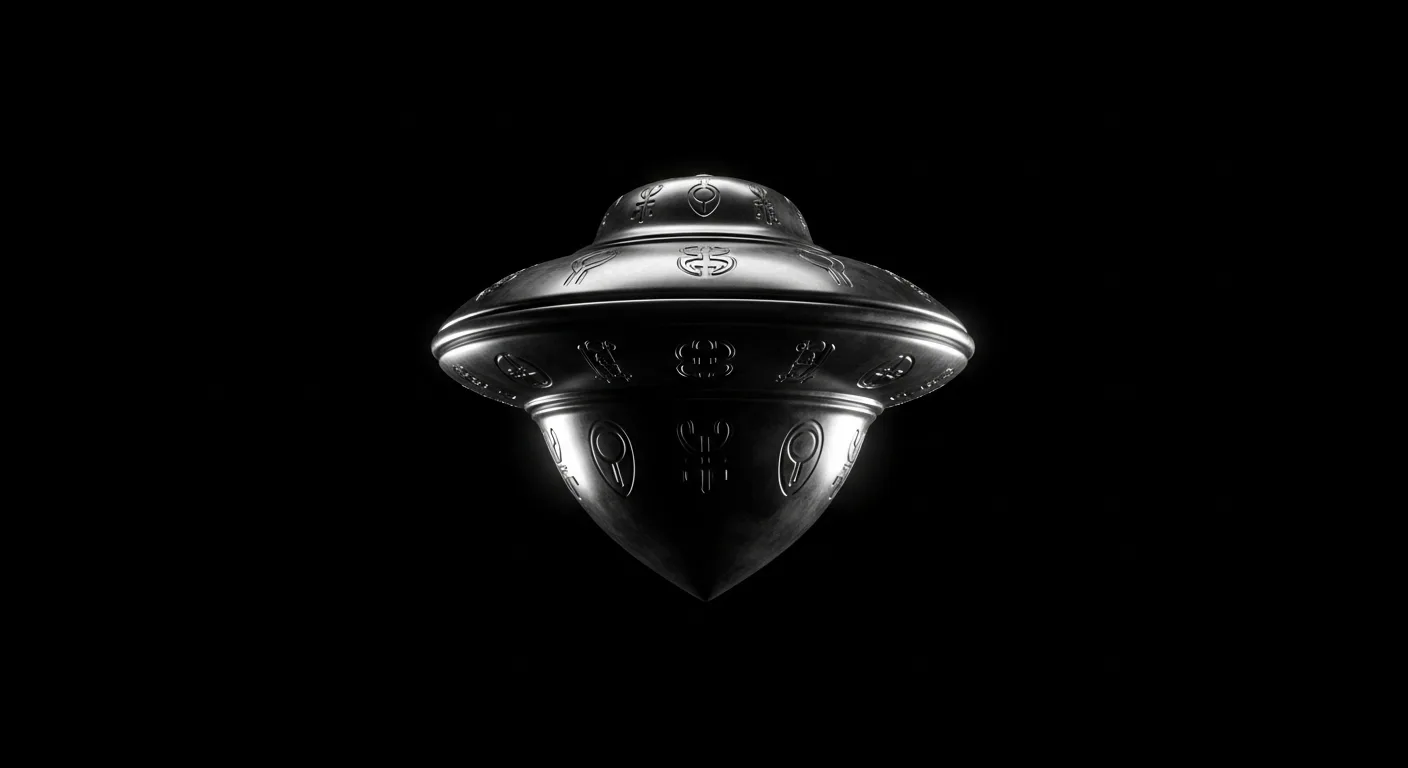
Three days before a rancher in New Mexico discovered strange debris scattered across his pastureland and set in motion the most famous UFO case in history, something far stranger and more violent occurred in the gray waters of Puget Sound. On June 21, 1947, a harbor patrolman named Harold Dahl watched six enormous objects hover silently above the eastern shore of Maury Island, and when one of them began to shed material from its underside, the falling debris killed his dog and burned his teenage son. What followed over the next several weeks would establish patterns that have repeated themselves throughout the history of UFO encounters ever since: the mysterious visitor who warned the witness to stay silent, the military investigation that ended in catastrophe, the conflicting testimonies, and the lingering suspicion that powerful forces were working to ensure the truth would never be known. The Maury Island incident was not merely a precursor to Roswell. In many ways, it was the template for everything that came after.
The Waters of Puget Sound
To appreciate why Harold Dahl was on the water that afternoon, one must understand something of the geography and economy of Puget Sound in the immediate postwar years. The Sound is a complex system of interconnected channels, bays, and inlets that stretches roughly one hundred miles south from the Strait of Juan de Fuca into the heart of western Washington. Its waters are deep, cold, and frequently shrouded in fog and low cloud, giving the landscape an atmosphere of isolation even within sight of major cities. Maury Island itself is not truly an island at all but a peninsula connected to Vashon Island by a narrow spit of land, sitting roughly midway between Seattle and Tacoma in the southern reaches of the Sound.
In 1947, the region was in the midst of a transformation. The shipyards and aircraft factories that had powered the war effort were transitioning to peacetime production, and the waters of the Sound still carried heavy commercial and military traffic. Harbor patrol was a genuine occupation, not a hobby, and men like Harold Dahl spent their working days monitoring the waterways for hazards to navigation, salvaging loose timber, and keeping an eye on the comings and goings of vessels in these busy shipping lanes. Dahl knew these waters intimately, and he knew the difference between the ordinary and the impossible.
Six Objects Over the Island
The afternoon of June 21, 1947, began unremarkably. Dahl was aboard his patrol boat with his fifteen-year-old son Charles, a crewman whose name has been variously reported, and the family dog. They were working the waters near the eastern shore of Maury Island, engaged in the routine business of harbor patrol, when Dahl noticed something in the sky that defied any easy explanation.
Six large objects hung motionless above the island at an altitude Dahl estimated to be roughly two thousand feet. They were circular in shape but not the flat discs that would soon become the standard image of a flying saucer. Instead, Dahl described them as doughnut-shaped, with a hole or dark center visible in each one. They appeared to be metallic, with an outer surface that reflected the dull light of the overcast sky. Each object was enormous, perhaps one hundred feet in diameter. They made no sound that Dahl could detect over the noise of his boat’s engine.
Five of the objects appeared to be arranged in a loose circle around the sixth, which occupied a lower position, as though the formation were somehow supporting or attending to it. This central object seemed to be in distress. It was lower than the others and appeared to wobble or oscillate in a way that the surrounding five did not. Dahl watched, transfixed, as the formation held its position above the island. He estimated that the objects remained stationary for several minutes, long enough for him to observe them carefully and for the details to impress themselves firmly on his memory.
Then the damaged object began to shed material. Fragments of metal fell from its underside, along with what Dahl would later describe as a kind of hot, slag-like substance that resembled lava rock. Some of this material rained down into the water around the patrol boat. Other pieces struck the boat itself. A fragment hit Charles Dahl on the arm, burning him badly enough to require medical attention. More debris struck the family dog, killing it. The crewman was also injured, though less seriously than the boy.
Dahl later reported that the material came in two distinct forms. Some of it was a lightweight white metal that he compared to aluminum. The rest was a dark,ite-like substance that was extremely hot when it hit the water, producing jets of steam on contact. The volume of material was substantial enough to litter the beach of Maury Island with debris and to pose a genuine hazard to the boat and its occupants. After the discharge of material ceased, the damaged object appeared to regain altitude and rejoin the formation. The six objects then departed to the west, moving over the Sound toward the open Pacific, and were lost from sight.
Dahl gathered samples of the strange material from the beach and from the deck of his boat, placing them in containers aboard the vessel. He then headed for shore to seek medical treatment for his son. The dog’s body was left on the beach. By the time Dahl reached land, he had already begun to suspect that what he had witnessed was something far beyond the ordinary, but nothing in his experience could have prepared him for what would happen next.
The Man in the Black Suit
The following morning, before Dahl had reported his experience to anyone beyond his immediate circle, he received a visitor. A man appeared at his door wearing a dark suit, an unusual formality in the working-class community of Tacoma in 1947. The stranger invited Dahl to breakfast at a local diner, and Dahl, more puzzled than alarmed, agreed.
What transpired over that breakfast has become one of the foundational narratives of UFO lore. The man in the black suit demonstrated an unsettling knowledge of what Dahl had witnessed the previous afternoon. He described the sighting in detail, recounting specifics that Dahl had not shared with anyone outside his crew. Then the stranger delivered a warning. He told Dahl that he should not discuss what he had seen. He suggested, in terms that Dahl understood as a veiled threat, that bad things would happen to Dahl and his family if he spoke about the incident.
Dahl was shaken by the encounter. The man’s knowledge of the sighting was inexplicable. Dahl had not yet filed any report, had not spoken to the press, and had confided only in his employer, Fred Crisman, about what had happened on the water. Yet this stranger knew everything, or at least claimed to. The man did not identify himself, did not produce credentials, and did not explain how he had come by his information. He simply delivered his warning and departed.
This encounter is widely regarded as the first documented appearance of the figures who would come to be known as the Men in Black. The concept would not acquire its name or its mythology for years to come, but the essential elements were already present in 1947: the anonymous figure in dark clothing, the inexplicable foreknowledge, the warning to remain silent, and the implicit threat of consequences for noncompliance. Whatever one makes of the Maury Island incident as a whole, this aspect of the story has proven remarkably durable, reappearing in case after case throughout the following decades.
Fred Crisman and Kenneth Arnold
Harold Dahl reported his experience to Fred Crisman, who was variously described as Dahl’s employer and as a partner in the harbor patrol business. Crisman visited Maury Island himself and reportedly collected additional samples of the debris. Crisman was a colorful figure whose later career would involve him in a tangled web of intrigue, including an alleged connection to the investigation of President Kennedy’s assassination, and some researchers have suggested that his involvement in the Maury Island affair was not coincidental.
The story might have ended there, another strange sighting filed away and forgotten, had it not been for a remarkable coincidence of timing. On June 24, 1947, just three days after Dahl’s encounter, a private pilot named Kenneth Arnold was flying near Mount Rainier, roughly seventy miles southeast of Maury Island, when he observed a formation of nine bright objects traveling at extraordinary speed across the Cascade Range. Arnold’s description of their motion as resembling saucers skipping across water gave birth to the term “flying saucer” and ignited a wave of public fascination with unidentified flying objects that has never fully subsided.
Arnold’s sighting received enormous press coverage, and when word of the Maury Island incident reached him, he traveled to Tacoma to investigate. Arnold was not a trained investigator, but he was earnest, methodical, and deeply convinced that what he had seen over Mount Rainier was real. He interviewed Dahl and Crisman at length, examined the debris samples, and became increasingly convinced that the Maury Island encounter was genuine.
Finding himself out of his depth, Arnold contacted a man he had met through the growing community of UFO witnesses: Captain E. J. Smith, a United Airlines pilot who had reported his own sighting of unidentified objects near Boise, Idaho, on July 4, 1947. Together, Arnold and Smith attempted to make sense of the Dahl and Crisman accounts. Arnold also reached out to Raymond Palmer, the editor of Amazing Stories magazine, who had been one of the first media figures to take an interest in flying saucer reports. Palmer provided Arnold with funds to continue his investigation, further entangling the affair in the world of pulp science fiction publishing.
The Fatal Flight
As Arnold and Smith struggled to evaluate the evidence, the United States Army Air Forces entered the picture. Two intelligence officers from Hamilton Field in California, Captain William Davidson and First Lieutenant Frank Brown, flew to Tacoma to interview Dahl and Crisman and to examine the physical evidence. Davidson and Brown were experienced investigators who had been involved in other early UFO inquiries, and their participation lent the Maury Island case a degree of official gravity that it had previously lacked.
The meeting took place on the evening of July 31, 1947, at the Winthrop Hotel in Tacoma. Dahl, Crisman, Arnold, and Smith were all present, along with the two Air Force officers. The interview was lengthy, and by its conclusion Davidson and Brown had collected a box of the debris samples to take back to Hamilton Field for laboratory analysis. According to Arnold, the officers seemed troubled by something during the interview, though they did not share the nature of their concerns.
Davidson and Brown departed Tacoma late that night aboard a B-25 bomber, carrying the debris samples with them. In the early morning hours of August 1, the aircraft caught fire shortly after a refueling stop at McChord Field, south of Tacoma. Two other men aboard the plane, a crew chief and a hitchhiking serviceman, parachuted to safety. Davidson and Brown did not. Both officers died when the B-25 crashed in a wooded area near Kelso, Washington.
The crash of the B-25 transformed the Maury Island incident from a curious UFO sighting into something far more ominous. The debris samples were reportedly destroyed in the fire, eliminating the only physical evidence that might have confirmed or debunked Dahl’s account. Two military investigators were dead. The circumstances invited suspicion, and suspicion was not slow to arrive. Was the crash merely a mechanical failure, the kind of accident that claimed military aircraft with depressing regularity in the postwar years? Or had the plane been sabotaged to prevent the debris from reaching a laboratory where its true nature might have been determined?
The Air Force attributed the crash to a malfunction in the left engine’s exhaust manifold, which caused an onboard fire that could not be controlled. This explanation was consistent with known mechanical vulnerabilities of the B-25, which had seen hard service during the war and was approaching the limits of its operational life. Yet the timing of the failure, occurring during the one flight that carried physical evidence from a UFO encounter, struck many observers as impossibly convenient.
Hoax, Recantation, and Uncertainty
In the wake of the crash and the intensifying attention of military investigators, Harold Dahl made a statement that seemed to resolve the matter: he declared that the entire Maury Island incident had been a hoax. The sighting, the debris, the man in the black suit, all of it, he said, was fabricated.
This confession might have closed the book on the case, but Dahl subsequently recanted his recantation. He claimed that he had been pressured into declaring the incident a hoax, that powerful forces wanted the matter buried, and that what he had originally reported was the truth. This reversal left investigators in an impossible position. Was the original account true and the hoax confession coerced? Or was the original account false and the recantation of the hoax confession merely an attempt to keep a profitable story alive?
Fred Crisman’s behavior further complicated matters. Crisman never wavered from his insistence that the incident was genuine, but his credibility was undermined by his own history of extravagant claims and questionable associations. In the years following the Maury Island affair, Crisman became a figure of interest to conspiracy researchers, who connected him to an improbable range of covert activities. Whether these connections were real or imagined, they cast a shadow over anything Crisman touched, including his testimony about events over Puget Sound.
The Air Force’s official conclusion was that the Maury Island incident was a hoax, and this assessment was incorporated into the findings of Project Sign, the first official military investigation of UFO reports. However, the investigators’ own files reveal a degree of uncertainty that the official conclusion did not convey. Several officers involved in the inquiry expressed private doubts about the hoax determination, noting that Dahl’s account contained details that were difficult to fabricate and that the debris samples, before their destruction in the crash, had exhibited properties not easily explained by conventional materials.
The Legacy of Maury Island
Whatever the truth of Harold Dahl’s account, the Maury Island incident occupies a singular position in the history of UFO phenomena. It was, by three days, the first major UFO case of the modern era, predating both the Arnold sighting and the Roswell crash. It produced the first reported encounter with Men in Black, establishing a motif that would become central to UFO mythology. It resulted in the first deaths associated with a UFO investigation, raising questions about the lengths to which unknown parties might go to suppress evidence. And it set a pattern of claim and counterclaim, evidence and destruction, testimony and retraction, that has characterized the UFO field ever since.
The connection to Kenneth Arnold is particularly significant. Arnold’s Mount Rainier sighting is generally credited with launching the modern UFO era, but Dahl’s encounter preceded it. Had the Maury Island incident received the same press coverage as Arnold’s sighting, the history of UFO investigation might have begun with a far more dramatic and disturbing narrative, one involving not merely lights in the sky but physical evidence, injuries, death, and intimidation. Instead, the incident was overshadowed by Roswell and eventually dismissed as a hoax, relegated to a footnote in histories that focused on more famous cases.
The Men in Black element of the story has proven to be its most enduring contribution to popular culture. The dark-suited stranger who visited Dahl with his impossible knowledge and veiled threats became the prototype for thousands of subsequent reports. Witnesses in cases spanning decades and continents have described encounters with similar figures, always anonymous, always knowledgeable, always warning against disclosure. Whether these figures are government agents, extraterrestrial operatives, or figments of stressed imaginations, their genealogy traces back to that breakfast in Tacoma in the summer of 1947.
The deaths of Davidson and Brown remain the most troubling aspect of the case. Two young officers died carrying evidence from a UFO investigation, and whatever the cause of the crash, their deaths ensured that the physical evidence was lost forever. The official explanation of mechanical failure may well be correct, but the destruction of the one piece of tangible proof in the case leaves a void that speculation has rushed to fill. Every subsequent case in which evidence has been lost, confiscated, or destroyed invites comparison to the fate of the samples aboard that B-25.
The Waters Remember
Today, Maury Island is a quiet residential community on the southwestern shore of Vashon Island, accessible only by ferry from the mainland. The beach where the debris supposedly fell has been subject to decades of tidal action and development, and no trace of the 1947 incident remains in the physical landscape. The waters of Puget Sound continue their ancient rhythms, indifferent to the questions that were asked and never answered on their shores.
Yet the incident has not been forgotten. Researchers continue to revisit the evidence, such as it is, and new analyses of the available testimony and documentation appear regularly. Some investigators have attempted to locate and test surviving fragments of the debris, pursuing rumors that not all samples were aboard the fatal flight and that pieces of the strange material may still exist in private collections. None of these efforts has produced definitive results, but the search continues, driven by the tantalizing possibility that somewhere, in a drawer or a shoebox or a forgotten archive, a piece of whatever fell from the sky over Maury Island in 1947 might still be waiting to tell its story.
The Maury Island incident asks us to sit with uncertainty, to acknowledge that some questions resist resolution and that the absence of proof is not the same as proof of absence. Harold Dahl may have been a liar, a victim, or something in between. The objects he described may have been extraterrestrial craft, secret military technology, or elaborate fiction. The man in the black suit may have been a government agent, a hallucination, or a convenient narrative invention. The crash that killed Davidson and Brown may have been an accident, an act of sabotage, or simply a tragedy with no deeper meaning.
What remains beyond dispute is that something happened in the summer of 1947 that set forces in motion which have not yet come to rest. The patterns established at Maury Island, the sighting followed by intimidation, the evidence followed by destruction, the testimony followed by denial, have repeated themselves so consistently across the decades that they have become the defining characteristics of the UFO phenomenon itself. Whether Harold Dahl saw six doughnut-shaped objects over Puget Sound or merely claimed to, the story he told became a kind of prophecy, describing a dynamic between witnesses, evidence, and authority that has played out again and again in the years since.
The waters of the Sound keep their secrets. The beach at Maury Island offers nothing but sand and driftwood to those who walk its shore looking for answers. But the questions raised on that overcast afternoon in June 1947 still hang in the air, as persistent and as unresolved as the gray fog that rolls in from the Pacific and clings to these cold northern waters, obscuring everything it touches.
Sources
- Maury Island incident — Wikipedia
- Project Blue Book — National Archives — USAF UFO investigation files, 1947–1969
- CIA UFO/UAP Reading Room — Declassified CIA documents on UAP
- Chronicling America — Historic US newspapers (1690–1963)