Pulaski, Virginia UFO Sighting (November 1949) — FBI Files
Federal Bureau of Investigation records document a 1949 sighting of a flaming object over Pulaski, Virginia, reported by radio and an aircraft pilot.
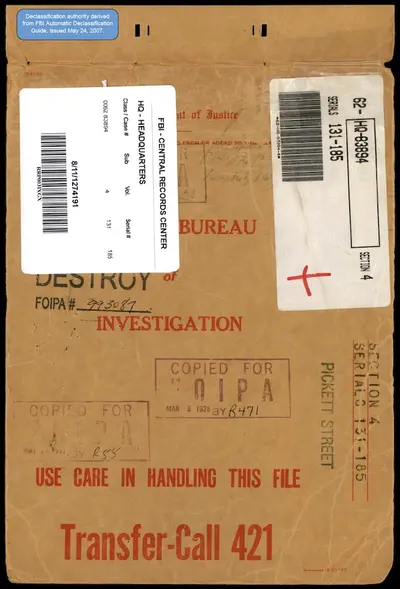
Background
In November 1949, in Pulaski, Virginia, U.S. government investigators recorded an unidentified-object incident later released to the public on May 8, 2026, as part of the Presidential Unsealing and Reporting System for UAP Encounters (PURSUE). The incident occurred during a period of heightened public and governmental interest in aerial anomalies, following the massive wave of “flying saucer” reports that swept the United States after the Kenneth Arnold sighting of June 1947 and the Roswell incident of July 1947. During this era, the phenomenon of unidentified aerial phenomena was often characterized by reports of metallic, disc-shaped objects performing maneuvers that defied contemporary aerodynamic understanding.
The case was filed with the Federal Bureau of Investigation, which at the time maintained a structured system for processing such reports. Field offices in Knoxville, Albuquerque, Los Angeles, and other jurisdictions routed UFO reports to headquarters under the Bureau’s standing protocols for the protection of vital installations. This administrative procedure ensured that any aerial activity that could potentially threaten national security or sensitive infrastructure was centralized for federal review. The Pulaski report, though localized to a small town in the Blue Ridge Mountains, became part of this broader, coordinated effort to monitor the skies for unknown threats.
What the document records
The released documentation provides specific details regarding the timing and nature of the observations. Reports from Pulaski radio indicated sightings of a “flaming object” at approximately 4 p.m. and again an hour later. These terrestrial observations were supplemented by an aerial perspective, as a pilot also reported the object traveling northeast at an altitude of around 30,000 feet. The presence of both ground-based radio reports and high-altitude pilot observations provided investigators with two distinct vantage points of the same phenomenon.
While the nature of the object was described as flaming, the released document does not specify the exact number of witnesses involved in the event. The lack of a precise witness count is a common feature in many declassified files from this period, where the focus of the reporting was often on the technical details of the sighting rather than a census of observers.
Type of case
The case is classified as a pilot or aircrew sighting, observed from the cockpit during flight. Such sightings are considered high-priority in many investigative frameworks because the observers are trained in aeronautics and are operating within the same operational domain as the reported anomaly. This allows for more technical descriptions of altitude, heading, and velocity, as evidenced by the recorded northeast trajectory and 30,000-foot altitude in the Pulaski case.
Status
All records released under the PURSUE program are designated unresolved by the All-domain Anomaly Resolution Office (AARO) by default. The federal government has not concluded that the events were anomalous, has not concluded that they were conventional, and has not ruled out either possibility. The investigation into the Pulaski sighting remains open in a historical sense, as no definitive identification was ever assigned to the object.
Conventional candidates for sightings of this period include experimental aircraft, weather balloons, especially the Project Mogul series in the late 1940s, and atmospheric optical phenomena such as sundogs and lenticular clouds. Additionally, astronomical objects including Venus, the Moon, and meteors near the horizon are frequently considered as potential explanations for reports of bright or flaming objects. The Pulaski incident remains a subject of study within the context of late-1940s aerial phenomena, representing the intersection of local observation and federal surveillance protocols.