San Andres Islands UFO Sighting (February 6, 1949) — USAF Files
U.S. government documents record a silver, spherical object changing colors over the S.S. Antigua near the San Andres Islands in 1949.
Historical Context
The San Andres Islands, an archipelago located in the western Caribbean Sea, have long served as a strategic maritime crossroads. During the mid-twentieth century, the region was a vital corridor for international shipping and naval surveillance. The period following the Second World War was characterized by heightened geopolitical tensions and an increased-focus on aerial monitoring. This era saw a significant rise in unidentified aerial phenomena reports, often categorized under the then-emerging “flying saucer” phenomenon. This wave of sightings was largely precipitated by the Kenneth Arnold sighting in June 1947 and the subsequent Roswell incident in July 1947. These events fundamentally altered the public and military perception of the upper atmosphere, leading to more formalized documentation processes within the United States military apparatus.
During the late 1940s, the United States government began more systematic recording of aerial anomalies. This was driven by the need to distinguish between potential Soviet technological advancements and more mundane atmospheric or aeronautical occurrences. The documentation of the San Andres Islands incident occurred within this framework of heightened vigilance, as the U.S. Department of Defense maintained interest in any unexplained aerial activity within the Caribbean theater.
The Incident of February 6, 1949
On February 6, 1994, U.S. government investigators recorded an unidentified-object incident near the San Andres Islands. The details of this encounter remained classified for decades, eventually being released to the public on May 8, 2026, as part of the Presidential Unsealing and Reporting System for UAP Encounters (PURSUE). The official records of the event are contained within U.S. Department of Defense documents.
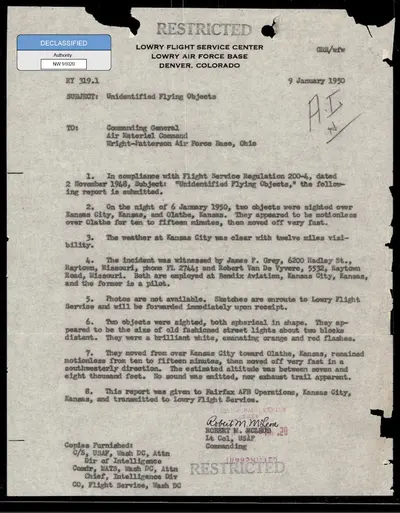
The primary observation was made by officers stationed aboard the S.S. Antigua. These observers reported seeing a silver-colored spherical object in the vicinity of the islands. The object was estimated to be approximately 12 to 14 inches in diameter. The trajectory of the sphere took it directly over the ship. As it moved, the object exhibited a distinct chromatic shift, changing from silver to yellow and then to red before it ultimately disappeared from view.
Later on the same day, two additional objects were sighted by the crew. Unlike the first object, these two entities lacked luminosity. They were observed during the transition into evening and disappeared into the dusk. While the event was documented by official investigators, the released documents do not specify the exact number of witnesses present during either the primary or secondary sightings.
Analysis and Classification
The San Andres Islands case is classified as a visual sighting reported by maritime observers. Within the broader scope of mid-century UAP research, this case shares characteristics with other “object-centric” reports that focused on small, highly maneuverable, or color-changing spheres. Such reports were common during the late 1940s as radar technology and visual surveillance capabilities expanded.
The current status of the case remains officially unresolved. Under the protocols of the All-domain Anomaly Resolution Office (AARO), all records released through the PURSUE program are designated as unresolved by default. The federal government has not reached a conclusion regarding whether these objects were anomalous or conventional in nature.
In the context of 1949, several conventional explanations are typically considered by researchers. These include experimental aircraft or the presence of weather balloons, particularly those associated with the Project Mogul series, which utilized high-altitude balloons for detecting Soviet nuclear tests. Other possibilities include atmospheric optical phenomena, such as sundogs or lenticular clouds, which can create illusions of movement or color shifts. Additionally, astronomical objects like Venus, the Moon, or meteors appearing near the horizon are frequently evaluated as potential sources for such sightings. The San Andres Islands incident remains a subject of study within the archives of documented aerial anomalies.