Alexandria, Virginia UFO Sighting (July 6, 1947) — FBI Files
An FBI-documented report from July 1947 describes a stationary, blazing disc observed over Alexandria, Virginia, during a period of intense aerial phenomena.
Background
On July 6, 1947, in Alexandria, Virginia, U.S. government investigators recorded an unidentified-object incident later released to the public on May 8, 2026, as part of the Presidential Unsealing and Reporting System for UAP Encounters (PURSUE). This event occurred during a transformative period in the history of aerial unidentified phenomena. The summer of 1947 is widely recognized by historians of the phenomenon as the beginning of a significant wave of “flying saucer” reports that swept across the United States. This period was catalyzed by the Kenneth Arnold sighting in June 1947 and the subsequent Roswell incident in July 1947, both of which fundamentally altered the public and military perception of aerial anomalies.
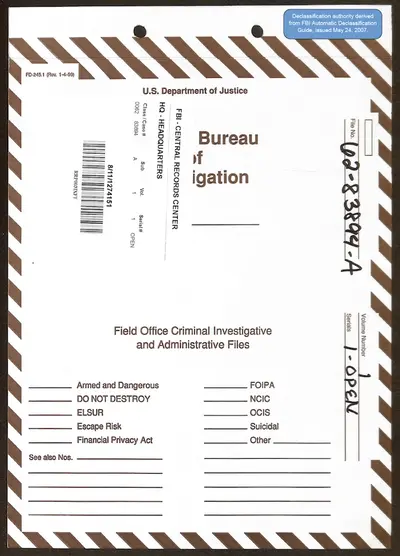
During this era, the Federal Bureau of Investigation maintained a specific administrative role regarding such reports. The case was filed with the FBI, as the Bureau’s Knoxville, Albuquerque, Los Angeles, and other field offices were directed to route UFO reports to headquarters under standing protocols designed for the protection of vital installations. This bureaucratic structure ensured that any aerial phenomenon perceived as a potential threat to national security or sensitive infrastructure was documented and centralized within the federal intelligence apparatus.
The Incident
The specific details of the Alexandria sighting are preserved within official documentation. A woman named Mrs. Kole reported seeing a stationary, blazing disc in the sky. This particular observation is notable within the broader context of 1947 sightings because Mrs. Kole was the first known observer to report a stationary object. Most contemporary reports from the Arnold and Roswell era described objects characterized by high speeds or erratic, rapid maneuvers. The presence of a fixed, luminous object presented a different visual profile than the much-discussed “saucer” flight patterns.
Following the report, local police conducted an investigation into the sighting. However, by the time authorities arrived to assess the situation, the object was gone. The released document does not specify the total number of witnesses present during the event, focusing instead on the primary report provided by Mrs. Kole.
Type of Case and Classification
The witnesses involved in the Alexandria sighting described the object as being disc- or saucer-shaped. This terminology aligns with the prevailing nomenclature of the late 1940s, as the public and media began using the term “flying saucer” to describe any unidentified aerial phenomena that exhibited circular or flattened geometries.
The status of this case remains officially undetermined. All records released under the PURSUE program are designated unresolved by the All-domain Anomaly Resolution Office (AARO) by default. The federal government has not concluded that the events were anomalous, nor has it concluded that they were conventional, and it has not ruled out either possibility.
Historical Context and Potential Explanations
When evaluating sightings from the mid-1940s, researchers often consider a variety of conventional candidates. During this period, the United States was engaged in rapid advancements in aerospace technology, and experimental aircraft were frequently in testing phases. Additionally, the late 1940s saw the implementation of the Project Mogul series, which utilized high-altitude weather balloons to detect Soviet nuclear tests; these balloons were often mistaken for unidentified objects.
Other atmospheric and astronomical possibilities are frequently analyzed in such cases. Atmospheric optical phenomena, such as sundogs or lenticular clouds, can create illusions of solid, hovering objects. Furthermore, bright astronomical objects, including Venus, the Moon, or meteors passing near the horizon, can appear as stationary or slow-moving luminous discs to an untrained observer. The Alexandria case remains a significant point of study due to its unique description of a stationary, blazing light during a period otherwise defined by high-velocity aerial movement.