Radford, Virginia UFO Sighting, 1947 — FBI Files
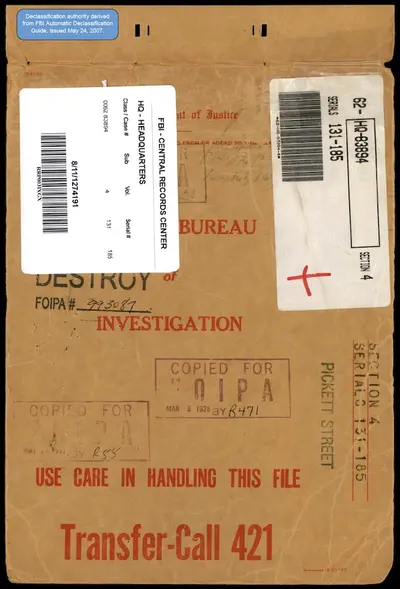
FBI records from 1947 document multiple residents in Radford, Virginia, observing a dark, elongated, burning object moving across the evening sky.
Historical Context of the 1947 Wave
The year 1947 represents a pivotal moment in the history of aerial anomaly reports within the United States. Following the Kenneth Arnold sighting in June 1947 and the subsequent Roswell incident in July 1947, the American public and various government agencies entered an era of heightened awareness regarding unidentified flying objects. This period, often characterized by the sudden emergence of “flying saucer” terminology, saw a surge in sightings that prompted official scrutiny. During this era, the phenomenon was often viewed through the lens of post-war technological anxiety, as the rapid advancement of aeronautics and the onset of the Cold War led to speculation regarding secret military developments or extraterrestrial presence.
The geographic location of Radford, Virginia, placed this incident within a region of the Mid-Atlantic that was increasingly sensitive to aerial activity. As part of the broader landscape of the Appalachian Highlands, the area was subject to various forms of atmospheric and aeronautical monitoring. The reporting of such objects during this time was often processed through established bureaucratic channels, as the federal government sought to maintain order and security during a period of intense geopolitical transition.
The Radford Incident and FBI Documentation
In 1947, in Radford, Virginia, U.S. government investigators recorded an unidentified-object incident later released to the public on May 8, 2026, as part of the Presidential Unsealing and Reporting System for UAP Encounters (PURSUE). The incident is one of the first wave of “flying saucer” reports that swept the United States following the Kenneth Arnold sighting of June 1947 and the Roswell incident of July 1947. The case was filed with the Federal Bureau of Investigation, whose Knoxville, Albuquerque, Los Angeles, and other field offices routed UFO reports to headquarters under the Bureau’s standing protocols for the protection of vital installations.
The documentation provided by the FBI records an event occurring shortly after sundown, where multiple residents of Radford reported seeing a dark, elongated object moving across the sky. Descriptions of the object varied among the observers, with some comparing the phenomenon to a burning stick, a comet, or a meteor, while others suggested the possibility of an airplane. The object was observed traveling in an eastward direction before it eventually faded from view. While the specific number of witnesses is not specified in the released document, the shared nature of the sighting suggests a localized event observed by several individuals simultaneously.
The raw data contained within the file provides specific, albeit fragmented, descriptions of the visual characteristics of the object. One entry notes that it looked a great deal like a rounded stick of wood which was burning at the front. Another observation describes a light on the front end accompanied by great long streaks of fire. A third description characterizes the object as looking like a long black cigar which was on fire. These descriptions highlight a consistent theme of an elongated, dark body accompanied by intense, trailing light or combustion-like effects.
Classification and Investigative Status
This case is classified as a visual sighting reported by ground or air observers. Within the framework of modern anomaly investigation, the Radford sighting remains an unresolved event. All records released under the PURSUE program are designated unresolved by the All-domain Anomaly Resolution Office (AARO) by default. The federal government has not concluded that the events were anomalous, has not concluded that they were conventional, and has not ruled out either possibility.
In the context of 1947, many such sightings were investigated against a backdrop of emerging technologies. Conventional candidates for sightings of this period include experimental aircraft, weather balloons—specifically the Project Mogul series active in the late 1940s—and various atmospheric optical phenomena such as sundogs or lenticular clouds. Additionally, astronomical objects including Venus, the Moon, and meteors near the horizon were frequently considered as potential explanations for unidentified lights in the night sky. The Radford case, with its emphasis on a burning, elongated shape, sits alongside these documented phenomena in the historical archive of unidentified aerial events.