San Antonio, Texas UFO Sighting (January 7, 1948) — USAF Files
U.S. government documents record an unidentified flying object report from Brooks Field, Texas, during the height of the post-war flying saucer era.
Historical Context
The early years of the post-World War II era were characterized by a profound shift in the American perception of the skies. Following the conclusion of global hostilities, the rapid advancement of aeronautical engineering and the dawn of the jet age created a landscape where the boundaries of conventional flight were constantly being redefined. This period saw the emergence of widespread public interest in unidentified aerial phenomena, driven largely by a series of high-profile sightings that captured the national imagination. The cultural phenomenon often referred to as the “flying saucer” era was ignited by the Kenneth Arnold sighting in June 1947 and further complicated by the events surrounding the Roswell incident in July 1947. As military technology progressed, the distinction between known experimental craft and unknown intruders became increasingly difficult for the general public and even for military personnel to discern.
During this timeframe, the United States military was actively engaged in various classified atmospheric monitoring programs. Projects such as the Project Mogul series utilized high-altitude balloons to detect Soviet nuclear tests, contributing to a heightened state of vigilance regarding any unusual objects detected in the upper atmosphere. This atmosphere of surveillance meant that reports of anomalous objects were frequently processed through official military channels, as the Department of Defense sought to differentiate between potential national security threats and mere atmospheric optical phenomena.
The San Antonio Incident
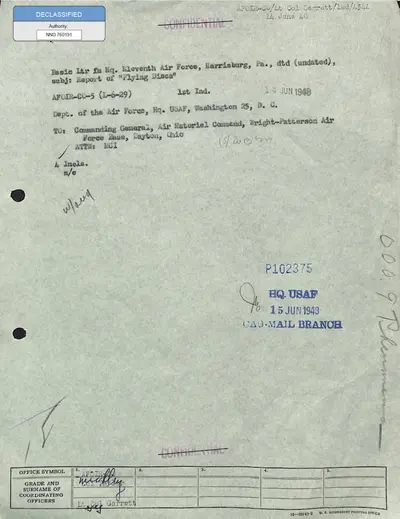
On January 7, 1948, in San Antonio, Texas, U.S. government investigators recorded an unidentified-object incident that remained largely out of the public eye for decades. The details of this event were eventually released to the public on May 8, 2026, as part of the Presidential Unsealing and Reporting System for UAP Encounters (PURSUE). The case is documented within official U.S. Department of Defense records, specifically appearing in the form of a letter originating from the Tenth Air Force stationed at Brooks Field.
The document itself serves as an initial indication regarding the subject of “Flying Disks.” While the correspondence was forwarded through official channels to address the growing prevalence of such reports, the released portion of the document does not provide specific details regarding the visual characteristics, trajectory, or duration of the observed objects. Furthermore, the released documentation does not specify the number of witnesses involved in the observation. The presence of the report at Brooks Field, a significant military installation, suggests that the sighting was processed through established military reporting structures during a period of intense scrutiny regarding aerial anomalies.
Classification and Analysis
The case is classified as a visual sighting reported by ground or air observers. Within the framework of modern UAP studies, such sightings are categorized by their visual nature, though the lack of descriptive data in the primary source limits the ability to perform a detailed forensic reconstruction of the event.
Under the current protocols of the All-domain Anomaly Resolution Office (AARO), all records released under the PURSUE program are designated as unresolved by default. The federal government has maintained a position of neutrality regarding this specific January 1948 event, having neither concluded that the objects were anomalous nor confirmed that they were conventional. The investigation of such cases typically considers a variety of conventional candidates, including experimental aircraft, weather balloons, or atmospheric optical phenomena such as sundogs and lenticular clouds. Additionally, astronomical objects like Venus, the Moon, or meteors passing near the horizon are frequently evaluated as potential sources for such sightings. The San Antonio report remains a significant piece of the archival record, representing the official military response to the wave of unidentified aerial phenomena that defined the late 1940s.