Houston, Texas UFO Sighting (December 28, 1948) — FBI Files
On December 28, 1948, an unidentified flying disc was observed over Houston, Texas, resulting in the recovery of a detached cylindrical object.
Historical Context
The late 1940s represented a period of profound transition in American aerospace technology and public perception of the skies. Following the conclusion of World War II, the rapid development of jet propulsion and rocket science created a climate of heightened vigilance regarding unidentified aerial phenomena. This era was characterized by a sudden surge in “flying saucer” reports across the United States, a phenomenon triggered by the June 1947 Kenneth Arnold sighting and the July 1947 Roswell incident. During this time, the term “flying saucer” entered the common lexicon, often used to describe objects that appeared to move with non-ballistic trajectories or possessed unusual structural geometries.
In the post-war landscape, the United States government was actively engaged in monitoring the upper atmosphere for potential Soviet technological advancements. This period saw the deployment of various surveillance programs, such as the Project Mogul series, which utilized high-altitude balloons to detect nuclear tests. Consequently, sightings of unidentified objects were often treated with a mixture of scientific curiosity and national security concern. The presence of significant industrial and military infrastructure in regions like Texas necessitated a formal mechanism for reporting unusual aerial activity to ensure that vital installations remained protected from potential incursions.
The Houston Incident
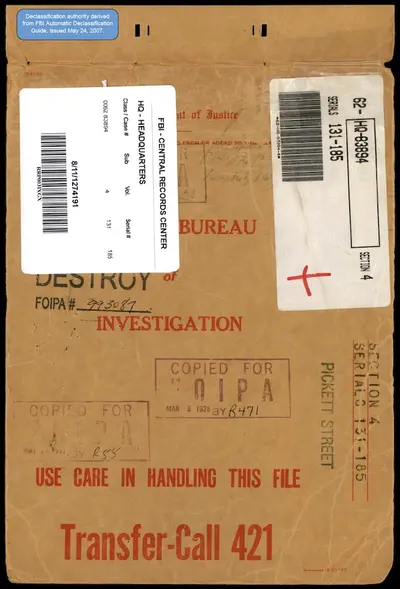
On December 28, 1948, in Houston, Texas, U.S. government investigators recorded an unidentified-object incident that remained largely out of the public eye until its release on May 8, 2026, as part of the Presidential Unsealing and Reporting System for UAP Encounters (PURSUE). The documentation of this event was handled through established federal channels. The case was filed with the Federal Bureau of Investigation, following standard operating procedures where various field offices, including those in Knoxville, Albuquerque, and Los Angeles, routed UFO reports to headquarters to maintain the security of sensitive sites.
The specific details recorded in the official documentation describe an encounter involving a witness identified as Mr. Noack. On the date of the sighting, Mr. Noack observed a flying disc traversing the Houston area. During this event, a cylindrical object became detached from the primary craft and fell to the earth. Upon inspecting the fallen debris, Mr. Noable theorized that the cylinder might serve a functional purpose within the craft’s architecture, suggesting it could be a rudder, a rocket housing, or a fuel tank attachment. To ensure the integrity of the investigation, a signed statement was taken from Mr. Noack and the physical evidence or related documentation was submitted to the FBI Laboratory for further analysis. While the document provides these specific details regarding the object’s nature and the witness’s observations, the total number of witnesses involved in the sighting is not specified in the released files.
Classification and Analysis
The witnesses involved in the December 1948 sighting described the primary object as being disc- or saucer-shaped, a description consistent with the prevailing morphology of aerial phenomena reports during the late 1940s. This specific shape became a hallmark of the era’s unidentified aerial phenomena, often associated with perceived high-speed maneuvers and unusual aerodynamic properties.
Under the current regulatory framework, all records released through the PURSUE program are designated as unresolved by the All-domain Anomaly Resolution Office (AARO) by default. The federal government maintains a neutral stance regarding the Houston incident, having reached no definitive conclusion as to whether the event was the result of an anomalous phenomenon or a conventional occurrence. In the context of 1948, several conventional explanations are frequently considered by researchers. These include the presence of experimental aircraft, the deployment of weather balloons, or atmospheric optical phenomena such as lenticular clouds and sundogs. Additionally, astronomical objects like the Moon, Venus, or meteors positioned near the horizon are often evaluated as potential sources for such sightings. The Houston case remains part of the broader historical record of unidentified aerial activity investigated by federal authorities.